




A Lore thread with its own music track (courtesy: the Blackened Folk Metal band, Celtachor).
OOC: this is where the OP sets out rules! Given that Lore is a place where tempers may fray, the basic rule is the usual: CC-BH (civility & courtesy required, butter and honey welcome). Also, this is absolutely not me having an argument with @Priya about Bombadil and Lugh. Both Lugh and Nuada were of the Tuatha Dé Danann, and Nuada is most certainly not Bombadil. But Nuada of the Silver Arm, aka Nodens the Catcher, may relate to Bombadil's title of the one who nobody has ever caught - one glimpses the sliver of a story, an opening into which imagination may step. In any case, while maintaining an open mind about Lugh, directives came through from the new administration that other minor godlings of Irish mythology also warrant their own thread if the nuplaza is to keep clean on the D of its DEI. So basically, anything that comes to mind on the Irish Nuada who in Wales became known as Nodens is welcome here.
Nuada of the Silver Arm
- Points: 4 777

Tree
Posts: 3136
Joined: Sun May 17, 2020 7:54 pm
Eat earth. Dig deep. Drink water.
- Points: 4 777
Tree
Posts: 3136
Joined: Sun May 17, 2020 7:54 pm
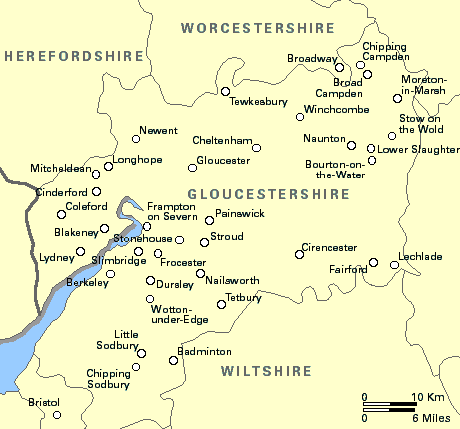
A map. The blue is the Severn Estuary, with Wales to the north-west and England to the south and east. A little further east and we hit the Berkshire Downs and Oxford. Just a little south of Bristol is Bath, which is very ancient and home of the goddess Sul, whose name (said Tolkien) may mean 'the Eye' - she is the Celtic goddess of the springs, whose cult was continued into Roman days when Bath became a center of civilization. The Romans identified Sul with Minerva and built a temple for her soon after arriving in Britain.
On the Welsh side of the estuary is Lydney. A prehistoric hilltop fort and the home of Nuada, whose cult presumably travelled from Ireland. Nodens the Catcher of Lydney had to wait until the very late days of Julian the Apostate before he had a temple built for him. And it was in ruins within a few centuries.
Bombadil and Goldberry do not belong in these realms of Nodens and Sul. They are neighbours, dwelling to the east, around the Berkshire Downs.
Eat earth. Dig deep. Drink water.
- Points: 4 777
Tree
Posts: 3136
Joined: Sun May 17, 2020 7:54 pm
The Name Nodens
Mordor denizens aside, I believe that a plaza read along of Tolkien's 1932 etymological note has as much chance the proverbial snowball in hell. You'all are too busy with professional life crises to give the close reading to this text that it demands. So I am going to do the hard work myself and bullet point the note below. But for now, context: this is the book at the back of which (pp. 132-137), just before the photographic plates, we find an appendix written by Tolkien.

This is the report on the excavation of Lydney by the archeologists. Tolkien's Pembroke colleague R. Collingwood was another British archeologist, and we may presume that it was he who had hooked the Wheelers up with Tolkien, who provided an etymological appendix to the archeological report. So while we are about to look at etymology, we should not forget that this was a philologist talking to people who dug up material things and drew pictures of them.

Mordor denizens aside, I believe that a plaza read along of Tolkien's 1932 etymological note has as much chance the proverbial snowball in hell. You'all are too busy with professional life crises to give the close reading to this text that it demands. So I am going to do the hard work myself and bullet point the note below. But for now, context: this is the book at the back of which (pp. 132-137), just before the photographic plates, we find an appendix written by Tolkien.
This is the report on the excavation of Lydney by the archeologists. Tolkien's Pembroke colleague R. Collingwood was another British archeologist, and we may presume that it was he who had hooked the Wheelers up with Tolkien, who provided an etymological appendix to the archeological report. So while we are about to look at etymology, we should not forget that this was a philologist talking to people who dug up material things and drew pictures of them.
Eat earth. Dig deep. Drink water.
- Points: 4 777
Tree
Posts: 3136
Joined: Sun May 17, 2020 7:54 pm
This is how it begins. So it is ferocious. But straightforward enough when one takes the trouble to follow. First, the empirical evidence - from where do we know the name Nodens? Answer: three inscriptions, possibly also a mosaic, all local to Lydney Park.APPENDIX 1
The Name ‘Nodens’
BY PROFESSOR J. R. R. TOLKIEN
This name occurs in three inscriptions: C.J.L. vii, 138 d(eo) M(artz *) Nodonti, C.I.L. vii, 139 deo Nudente, C.I.L. vii, 140 devo Nodenti. donavit Nodenti.. .templum [No]dentis. It may also have occurred in the mosaic C.I.L. vii, 137. Apart from these inscriptions, from the same place and presumably roughly contemporary, there is in early Keltic material no trace of any such name or stem.
And already so much is actually before our eyes. These inscriptions are Latin. Before the Romans the name was spoken. Those who learned the Roman letters used them to spell the name that before was only spoken. The godling, the name of the godling, whatever stories then were known of the godling, all predate the Romans. But when the Romans come and slivers of what was said were inscribed a window into the past was gifted to the philologist who appeared many centuries later. This is how fusion of cultures works, one shines a light on the other, but cannot but distort that light as it does so.
Eat earth. Dig deep. Drink water.
- Points: 4 777
Tree
Posts: 3136
Joined: Sun May 17, 2020 7:54 pm
Tolkien says that Nuada (Argat-lam ‘of the Silver Hand’) was the king of the Tuatha Dé Danann. Of the Tuatha Dé Danann he says:
[they] may with some probability, amid the wild welter of medieval Irish legend, be regarded as in great measure the reduced form of ancient gods and goddesses. Although it is perhaps vain to try and disentangle from the things told of Nuada any of the features of Nodens of the Silures in Gloucestershire, it is at least highly probable that the two were originally the same.
Eat earth. Dig deep. Drink water.
- Points: 4 777
Tree
Posts: 3136
Joined: Sun May 17, 2020 7:54 pm
While it is possible that Nodens travelled from Wales to Ireland, Tolkien considers as the 'more likely conjecture that Nodens is a Goidelic god, probably introduced eastward into Britain. He adds:
It is possible to see a memory of this figure in the medieval Welsh Lludd Llaw Ereint (‘of the Silver Hand’)—the ultimate original of King Lear—whose daughter Creiddylad (Cordelia) was carried off, after her betrothal to Gwythyr vab Greiddawl, by Gwynn vab Nudd, a figure having connexions with the underworld.
Eat earth. Dig deep. Drink water.
- Points: 4 777
Tree
Posts: 3136
Joined: Sun May 17, 2020 7:54 pm
These Fomorians appear a bad lot! The Goose was right to smell trouble.Of Nuada Argat-lam it is told that he was at war with both Firbolg and Fomorians. He lost his hand in the first battle, and the royalty passed with it for seven years to Bress, chief of the Fomorians. The Tuatha de Danann made a new hand ‘with full motions of a hand’ for him. Hence his surname. For twenty years he regained his royalty, but finally perished in battle against the Fomorians.
Eat earth. Dig deep. Drink water.
- Points: 4 777
Tree
Posts: 3136
Joined: Sun May 17, 2020 7:54 pm
And so Tolkien sketches a first preliminary conclusion.
If not an established certainty, it is, then, at least a probable theory that there was a divine personage of whom the chief later representative is the Nuada of the Silver Hand in Irish tradition, and that this Nuada, whose name ¢. A.D. 100 to A.D. 300 probably had both in Goidelic and British forms of Keltic (irrespective of borrowings) the form Noudus... and its variations of the inscriptions, which occur in curious and suggestive isolation in Britain.
Eat earth. Dig deep. Drink water.
- Points: 4 777
Tree
Posts: 3136
Joined: Sun May 17, 2020 7:54 pm
And now a new turn:
To be continued...Linguistic considerations unaided by other data can do little, usually, to recall forgotten gods from their twilight. The form of this name, however, is favourable.
Eat earth. Dig deep. Drink water.
- Points: 4 777
Tree
Posts: 3136
Joined: Sun May 17, 2020 7:54 pm
Tolkien gives reasons why such a form "as *noudont-, *neudont-, is most likely to contain a once intelligible verbal stem." This stem was Indo-European: "the name is not pre-Keltic, whatever may be true of the god". The name is not aboriginal, whatever may be the case of the named. Given the circling of proper names on Speak Egg! I wish especially to circle this:
And this is but the converse side of the movement that Tolkien is in the midst of making, which discovers the meaning of a Celtic word already obsolete in the days when Nodens was the proper name of the godling (when the inscriptions were made) by looking to Germanic languages. The transition from adjectival title to proper name is but the other side of why the lost meaning of this name is to be found outside the Celtic languages.
Here we glimpse the mind and imagination of this Professor. 'Nodens' was once the title of a godling with another proper name. 'Nodens' had a meaning. But this word became obsolete, and so the title lost its meaning. Because words without meaning are natural proper names, so what was a title passed into a proper name - Nodens.... the name was probably in origin adjectival, a title of a god whose remoter proper name is lost. Certainly adjectives formed with this suffix often become nouns.
And this is but the converse side of the movement that Tolkien is in the midst of making, which discovers the meaning of a Celtic word already obsolete in the days when Nodens was the proper name of the godling (when the inscriptions were made) by looking to Germanic languages. The transition from adjectival title to proper name is but the other side of why the lost meaning of this name is to be found outside the Celtic languages.
Eat earth. Dig deep. Drink water.
- Points: 4 777
Tree
Posts: 3136
Joined: Sun May 17, 2020 7:54 pm
And so we turn to the last page (136) and all at once find we have slipped into an ocean of more northerly history - an etymology pointing us to a comparitive reflection on how acquisition and ownership and property were spoken of in very distant pasts.
Mark xii, 13 is well worth dwelling on when it comes to meanings of Nodens the Catcher.
Take note of that first quoted paragraph. The earliest preserved records of the Germanic languages are no older than the temple of Nodens and the inscriptions found at Lydney. The inscriptions found at Lydney originate because people in the area had learned letters from the Romans and so recorded the spoken Celtic name of the local godling. And now Tolkien finds the meaning of the name - a meaning forgotten by those who scratched 'Nodens' and meant the proper name of the godling - in Gothic. But the Gothic word has meaning for us today because it is used in a careful translation out of biblical Greek. Fusion is a given here, for the barbarian past has otherwise vanished except when recorded with cultural borrowings from neighbouring civilization. We cannot really see the ancient heathen world, the only records we have are made by those who were civilized.In Gothic, the earliest recorded of the Germanic group and preserved in a form spoken at a time when Nodens’ temple possibly still had votaries, clear traces remain of an older sense. There ga-niutan means ‘to catch, entrap (as a hunter)’; it is the word used in the extremely careful version of the Scriptures to translate [Greek], Mark xii, 13. In Gothic, too, the derived noun... means ‘fisherman’; it is used of St. Peter.
Of this hunting, catching sense a trace is conceivably preserved in Germanic *naut- (OE. néat * neat’, OHG. naz, ON. naut) a head of cattle. But in ON. naut-r means any piece of valuable personal property, a sword, a ring, and we must probably compare the sense-development of ‘cattle' and ‘chattel’, both derived from late Latin capita/e, principal property. For the development ‘acquire, take possession of, have usufruct of’ from ‘ catch, bring home from the hunt or field’ many parallels may be cited.
Mark xii, 13 is well worth dwelling on when it comes to meanings of Nodens the Catcher.
Eat earth. Dig deep. Drink water.
- Points: 4 777
Tree
Posts: 3136
Joined: Sun May 17, 2020 7:54 pm
And so we conclude on what is actually the last page, 137. Surveying the development of meanings of caught fish and game, Tolkien rejects the later associations of property.
Far more probably the older sense of Gothic ga-niutan, ‘to catch, ensnare’, was the one shared by Keltic with old Germanic. Whether the god was called the ‘snarer’ or the ‘catcher’ or the ‘hunter’ in some sinister sense, or merely as being a lord of venery, mere etymology can hardly say.
It is suggestive, however, in this connexion that the most remarkable thing about Nuada was his hand, and that without his hand his power was lost. Even in the dimmed memories of Welsh legend in llaw ereint we hear still an echo of the ancient fame of the magic hand of Nodens the Catcher.
___________________________
Fin - on 'The Name Nodens' (1932) collective plaza read through. Do I need to say that I would welcome any engagement, however pondlike?Eat earth. Dig deep. Drink water.
- Points: 4 777
Tree
Posts: 3136
Joined: Sun May 17, 2020 7:54 pm
My own comment on all that from the 1932 etymological note is that Nodens, as a plaza member, would belong in Mordor, but would roam abroad, stalking the threads of named kingdoms and legendary regions, a time travellor hunting, and very hungry. Fishing, peering down into the dim and dark waters, another dimension from out of which equally hungry but curiously blind fish might with patience and chance be induced to accept an invitation to a bite for lunch.
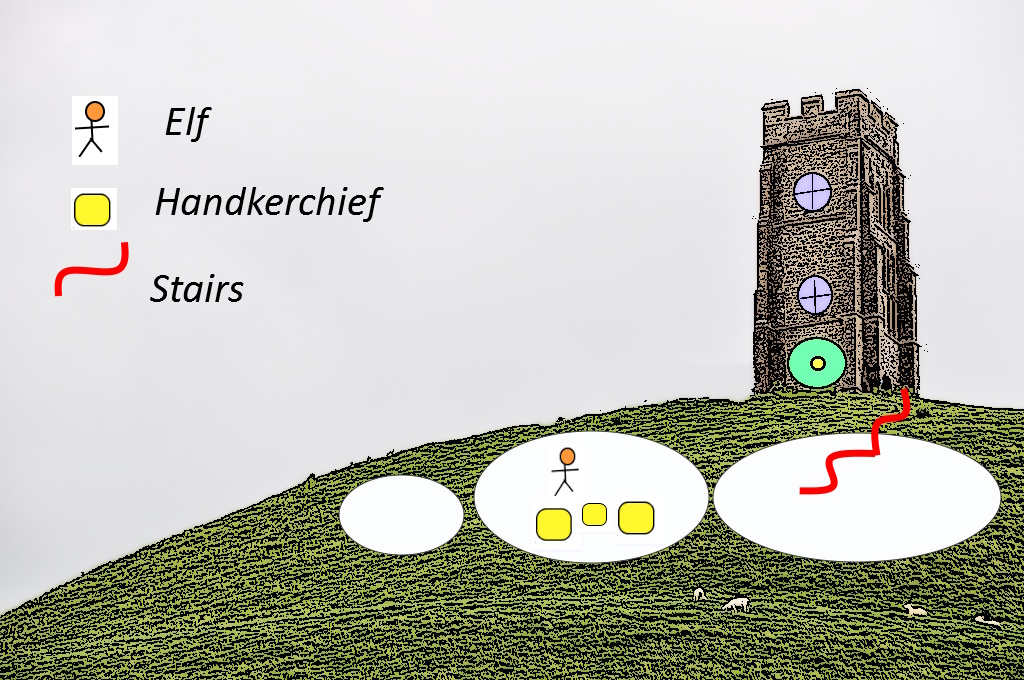
Since encountering Nodens and Sul, whose name Tolkien says may also mean the Sun, I always pictured them either side of the Severn Estuary as Dol Guldor in Mirkwood and Lorien face each other over the Anduin, the Great River. Glastonbury is down near Bath. Glastonbury Tor, in my own head, gives the view from Cerin Amroth. Here is something like the picture that I have in my head - not of the view, but Glastonbury Tor as it might appear in Middle-earth.
In hindsight, this may be a picture of @Saranna, Librarian of Undertowers, as she checks over an inventory of pocket handkerchiefs in the holes within the hill.
Since encountering Nodens and Sul, whose name Tolkien says may also mean the Sun, I always pictured them either side of the Severn Estuary as Dol Guldor in Mirkwood and Lorien face each other over the Anduin, the Great River. Glastonbury is down near Bath. Glastonbury Tor, in my own head, gives the view from Cerin Amroth. Here is something like the picture that I have in my head - not of the view, but Glastonbury Tor as it might appear in Middle-earth.
In hindsight, this may be a picture of @Saranna, Librarian of Undertowers, as she checks over an inventory of pocket handkerchiefs in the holes within the hill.
Eat earth. Dig deep. Drink water.
- Points: 4 777
Tree
Posts: 3136
Joined: Sun May 17, 2020 7:54 pm
@The Good Hunter, I apologize for once again bringing up 'The Myth of Callisto' when you have expressed a desire to move on from it. But as you have supplied the music for this thread I hope you do not mind if I attempt to tie the knot, so to speak?
I have tried to set out above a sort of rational reconstruction of how Tolkien's pondering of the meaning of the name 'Nodens' first took shape by way of a contrast with another local god, this one on the other side of the river and seemingly far more wholesome, and then by way of an imagination of their counterparts further east. This second step is to take seriously Tolkien's statement in a letter of 1937 that Bombadil embodies the spirit of the Oxford and Berkshire countryside, and to observe on a map how this countryside sits due east of the great River border between Nodens and Sul (and Glastonbury).
So what I discovered from 'The Myth of Callisto' is the Classical underbelly of the way that Tolkien seems to imagine all of these ancient Celtic (pre-Roman) tales. What I think your tale spelled out is something like what I speculate to be his original vision, with Nodens the divine Greek rapist hunting water-nymphs. 'The Adventures of Tom Bombadil', which relates the courtship of Goldberry and Tom (and is really the tale of how Tom found his voice), was published in 1934, two years after 'The Name 'Nodens''. So I guess that 'The Adventures of Tom Bombadil' is a second transposition, so to speak. A taking of the Nodens 'Myth of Callisto' and reworking it around some notion of northern courtesy and fairy-tale courtship. Something like that. OK. Thank you for your patience on your old story. I put it down again now.
I have tried to set out above a sort of rational reconstruction of how Tolkien's pondering of the meaning of the name 'Nodens' first took shape by way of a contrast with another local god, this one on the other side of the river and seemingly far more wholesome, and then by way of an imagination of their counterparts further east. This second step is to take seriously Tolkien's statement in a letter of 1937 that Bombadil embodies the spirit of the Oxford and Berkshire countryside, and to observe on a map how this countryside sits due east of the great River border between Nodens and Sul (and Glastonbury).
So what I discovered from 'The Myth of Callisto' is the Classical underbelly of the way that Tolkien seems to imagine all of these ancient Celtic (pre-Roman) tales. What I think your tale spelled out is something like what I speculate to be his original vision, with Nodens the divine Greek rapist hunting water-nymphs. 'The Adventures of Tom Bombadil', which relates the courtship of Goldberry and Tom (and is really the tale of how Tom found his voice), was published in 1934, two years after 'The Name 'Nodens''. So I guess that 'The Adventures of Tom Bombadil' is a second transposition, so to speak. A taking of the Nodens 'Myth of Callisto' and reworking it around some notion of northern courtesy and fairy-tale courtship. Something like that. OK. Thank you for your patience on your old story. I put it down again now.
Eat earth. Dig deep. Drink water.
- Points: 4 777
Tree
Posts: 3136
Joined: Sun May 17, 2020 7:54 pm
I have mispelled the name of the goddess of Bath. This book was published by R. Collingwood in 1922.

In a footnote to his later (co-authored) Roman Britain And The English Supplements (1936), Collingwood states:

In a footnote to his later (co-authored) Roman Britain And The English Supplements (1936), Collingwood states:
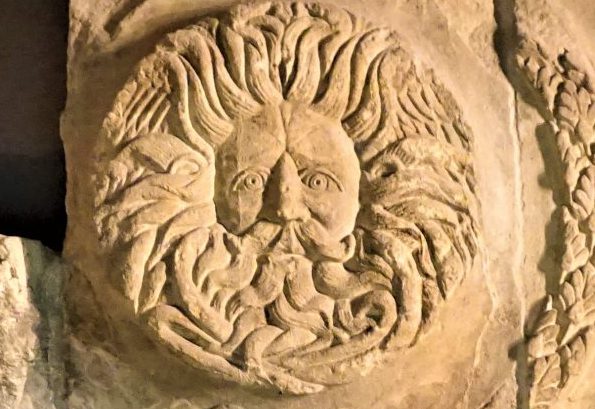
Sulis enters into the picture because Tolkien entered the picture through the archeological enthusiasm of his friend Collingwood, and Collingwood had a thing about the Gorgon-head Sulis of her temple in Bath. Collingwood was the son of full-on arts and crafts types, who chose to live in rural but creative poverty in the Lake District where they could play the piano and write stories about the local archeology (which they dutifully explored). As an archeologist of Roman Britain, Collingwood was contemptuous of just about everything that was dug up. He believed that Celtic art was quite vibrant before the Romans came and introduced mass-production, whereupon British native taste vanished. But the Gorgon-head Sulis he praised as a lonely instance of cultural fusion - in this singular work a British artit had become impregnated by and yet domesticated the best of the alien Roman spirit.My colleague Professor J. R. R. Tolkien has helped me untiringly with problems of Celtic philology. She[the goddess of the hot springs at Bath] is traditionally called Sul; but Professor Tolkien points out to me that the Celtic nominative can only be Sulis.
Eat earth. Dig deep. Drink water.
- Points: 6 125

Balrog
Posts: 3682
Joined: Mon May 18, 2020 11:02 am
By all means, if you find it to be a useful tool you are welcomed to it as such. In context of all this, I think my overall displeasure is that the story itself skips over all the good parts, the research. Similar to what we are doing here with regard to comparative folklore and mythology. My character in the story skipped over the art of speculation, debate, and theorizing and jumped straight to "this is what it is" which is where the story should have ended rather than started. I think the structure does a disservice to the story and to the mythology of Callisto, for whom I have a very special affinity.Chrysophylax Dives wrote: ↑Tue May 28, 2024 11:30 am I apologize for once again bringing up 'The Myth of Callisto' when you have expressed a desire to move on from it. But as you have supplied the music for this thread I hope you do not mind if I attempt to tie the knot, so to speak?
All that being said, I am very happy to see that restructuring of classical stories and folktales to understand their similarities is a fascinating endeavor. I fear I am too much a layman on the topic to contribute meaningfully, other than summarizing and structuralizing things into stories so I shall continue to read along closely. Perhaps I can use my talents later, when a sort of historiographic and psychogeographic consensus has been reached.
"We are born of the blood, made men by the blood, undone by the blood. Our eyes have yet to open... Fear the Old Blood..."
- Points: 920

New Soul
Posts: 362
Joined: Wed Jun 22, 2022 1:00 am
Hello Chrysophylax Dives
Excellent! A very impressive amount of output. And an interesting and informative dissection of Tolkien’s mini thesis. Forgive me - for I am a slow reader and need time to digest it all. In fact I’ve read over it three times thus far.
You’ve brought into focus the important elements from Tolkien’s report - but have you any knowledge on whether Tolkien read Collingwood’s book?
We know in 1945 per Letter #95 that he showed interest in the :
“… intriguing story of the origins of our peculiar people.”
And in another thread I pointed out that I believe the little book around the age of 8 from which he plucked ‘ond’ was Bertrand Windell’s Life in Early Britain, 1897. Coincidentally, I seem to remember Windell’s nephew was a good friend of Tolkien’s as an undergraduate at Exeter College.
It would seem to me that Tolkien would have had more than enough interest to read in its entirety Collingwood’s book. I get the feeling that some sort of rivalry was afoot between Collingwood and Windell Sr., because in 1923 Bertram Windell published The Romans in Britain.

Excellent! A very impressive amount of output. And an interesting and informative dissection of Tolkien’s mini thesis. Forgive me - for I am a slow reader and need time to digest it all. In fact I’ve read over it three times thus far.
You’ve brought into focus the important elements from Tolkien’s report - but have you any knowledge on whether Tolkien read Collingwood’s book?
We know in 1945 per Letter #95 that he showed interest in the :
“… intriguing story of the origins of our peculiar people.”
And in another thread I pointed out that I believe the little book around the age of 8 from which he plucked ‘ond’ was Bertrand Windell’s Life in Early Britain, 1897. Coincidentally, I seem to remember Windell’s nephew was a good friend of Tolkien’s as an undergraduate at Exeter College.
It would seem to me that Tolkien would have had more than enough interest to read in its entirety Collingwood’s book. I get the feeling that some sort of rivalry was afoot between Collingwood and Windell Sr., because in 1923 Bertram Windell published The Romans in Britain.
- Points: 4 777
Tree
Posts: 3136
Joined: Sun May 17, 2020 7:54 pm
That other book above appears of very peculiar proportions. Your question reminds me of a plaza conversation I had last Christmas, on which I decided to step out of Lore. The discussion was whether Tolkien had read Bede. To my mind, the Oxford Professor of Anglo-Saxon cannot be imagined as not having read Bede. But the Tolkien scholar with whom I was talking insisted on concrete evidence. At this point I saw there was no point in talking with the mass ranks of Tolkien scholars out there who know everything that there is to know about Tolkien, except what it means that he was an Oxford Professor. (I could really rant here...)
There was a way of life at an Oxford College in the 1920s and 1930s. I guess much of it endures still today, because it is a social life built around routines of teaching and research but above all of communal living. From the time of Queen Elizabeth I down to around 1900, the fellows of Oxbridge colleges were celibate - if they wished to marry they must resign their fellowship. Each college was an endowment intended by the founder to support a certain number of permanent fellows, who were basically Protestant monks charged with teaching Greek and Latin and correct Anglican theology. The way of life was communal, only a good deal wealthier than your usual monastery. The fellows lived in rooms in the same building and ate their meals together and attended the same chapel. What they did was not write books but talk to one another. The history of Oxbridge can only be accessed through the written word, but in reality it is a history of conversations.
Collingwood and Tolkien were members of Pembroke College and very clearly talked a fair bit with one another. They were friends who shared deep interests. Both were religious and both adherents in their ways of the arts and craft tradition of Ruskin and William Morris. But fundamentally, they shared an historical interest in Dark Age Britain. I would imagine that Tolkien did look at Collingwood's book, but do not know and have little interest in the question because they clearly talked.
Their interests really did overlap. Collingwood's greatest book on Roman Britain concludes with King Arthur, a tale in which the British are said to have embodied their sense of Time, their knowledge that their world had ended with the Anglo-Saxon settlements, and their hope that the once and future king would return. Tolkien's 'Fall of Arthur' is the tale of Arthur told by one of the early Anglo-Saxon settlers and embodies what Tolkien took to be the English sense of Time - a succession of catastrophic falls, from which there is no way back. Behind these two texts we may guess - and begin to imagine - some extraordinary conversations between these two extraordinarily brilliant scholars.
Eat earth. Dig deep. Drink water.
- Points: 4 777
Tree
Posts: 3136
Joined: Sun May 17, 2020 7:54 pm
Priya, I really am sorry if I sound grumpy. I do not wish to take my frustrations with everyone out on you. I have come to respect all aspects of your Tolkien scholarship, but do feel frustrated that you seem to disqualify yourself from Tolkien's own scholarship. I think you thereby miss the historical framework by which Tolkien thought about the world, especially the origin of myth and the fortunes of fairy-stories. 'The Name 'Nodens'' is not easy to read - but it is by Tolkien, and reveals to us another side of his astonishing mind, engaged not with the imagination of new fantasy but in seeking to catch some ancient fantasies. Once we start to glimpse how Tolkien chased these lost ancient stories of Nodens and Sulis we obtain unexpected vistas on what he might have been trying to do in his own story-telling.
Eat earth. Dig deep. Drink water.
- Points: 920
New Soul
Posts: 362
Joined: Wed Jun 22, 2022 1:00 am
Hello Chrysophylax Dives
No offence taken.
My interest was firstly just personal. Because I try to read from front to cover anything which can be ‘confirmed’ that Tolkien read. I prioritize such books over what he ‘probably’ read, and sequentially again over what he ‘possibly’ read.
Secondly, my question was meant to be a lead-in to another; for I wanted to know from a later edition of Roman Britain or similarly authored publications by Collingwood (such as The Archaeology of Roman Britain & Roman Britain and the English Settlements) whether there was any extra information on the Vyne Ring or Curse Tablet.
Perhaps Mortimer Wheeler’s discussion is the best/most we have from that timeframe. But from his paper how, with those articles, do we fit them in to better tie-in Bombadil to Nodens?
Thoughts?
No offence taken.
A simple yes or no would have sufficed.… have you any knowledge on whether Tolkien read Collingwood’s book?
My interest was firstly just personal. Because I try to read from front to cover anything which can be ‘confirmed’ that Tolkien read. I prioritize such books over what he ‘probably’ read, and sequentially again over what he ‘possibly’ read.
Secondly, my question was meant to be a lead-in to another; for I wanted to know from a later edition of Roman Britain or similarly authored publications by Collingwood (such as The Archaeology of Roman Britain & Roman Britain and the English Settlements) whether there was any extra information on the Vyne Ring or Curse Tablet.
Perhaps Mortimer Wheeler’s discussion is the best/most we have from that timeframe. But from his paper how, with those articles, do we fit them in to better tie-in Bombadil to Nodens?
Thoughts?
- Points: 4 777
Tree
Posts: 3136
Joined: Sun May 17, 2020 7:54 pm
Sorry.
 I feel suitably chastened.
You are asking about the inscription with the stolen ring? I don't think (and very much doubt) anything new turned up in later editions. Honestly, I think that inscription is a bit of a red herring. Or at least, the more important thing is to take in the broad picture of what Nodens was for Tolkien. I don't see in the first instance there is any need to read Wheeler or even Collingwood - just Tolkien's etymological note. But Collingwood's various books give a good sense of how he was attempting to reconstruct the local British landscape in the period leading up to and including the Anglo-Saxon settlements, when Tolkien's professional interest begins and so they are worth looking at because they give a sense of the conversations between Collingwood and Tolkien and how their respective research related.
Btw, Collingwood was a philosopher as well as archeologist. After around 1938 he switched his full time research to philosophy, where his great contributions concerned the philosophy of history. Just before he made the switch he wrote an unfinished manuscript on fairy-stories, which has now been published as 'The Philosophy of Enchantment'. Reading this carefully my conclusion was that much of Tolkien's OFS arises as direct engagement with Collingwood's idea of magic (Collingwood believed that magic was real, only modern western magic had become withered and ineffectual.)
Eat earth. Dig deep. Drink water.
- Points: 4 777
Tree
Posts: 3136
Joined: Sun May 17, 2020 7:54 pm
Summary of 'The Name Nodens', J.R.R. Tolkien, 1932
'The Name Nodens' was published as an etymological appendix to the Wheeler's archeological report on the excavations of the late Roman temple in Lydney in the Forest of Dean in Wales.
The name 'Nodens' is known from three Latin inscriptions found (in the previous century) at Lydney. Tolkien proposes that Nodens was an ancient Irish god whose cult (somehow) was adopted in south-east Wales. He suggests that this god originally had a proper name that is lost to us, and that 'Nodens' was an adjectival title. The word 'Nodens' fell into disuse and became obsolete in Celtic, and drained of any meaning the sound 'Nodens' became the proper name of the god - the state of affairs when the inscriptions were made.
Chasing the meaning of 'Nodens' as a title, Tolkien looks in two directions. He looks to the Germanic languages, discovers a common meaning, and suggests that it was once common also to Celtic. Tolkien says that Nodens means 'the Catcher' or 'the Hunter' and points to the suggestive uses of the Gothic variant in the translation of the Bible by which Gothic is known to us (and contemporary with the late days of the temple of Nodens in Wales). And he looks also into the future, into the various medieval records of the folklore and mythology of both Wales and Ireland and underlines the new title that Nodens acquired, 'the Silver-handed one'. Tolkien's conclusion is worth pondering in its own words.
'The Name Nodens' was published as an etymological appendix to the Wheeler's archeological report on the excavations of the late Roman temple in Lydney in the Forest of Dean in Wales.
The name 'Nodens' is known from three Latin inscriptions found (in the previous century) at Lydney. Tolkien proposes that Nodens was an ancient Irish god whose cult (somehow) was adopted in south-east Wales. He suggests that this god originally had a proper name that is lost to us, and that 'Nodens' was an adjectival title. The word 'Nodens' fell into disuse and became obsolete in Celtic, and drained of any meaning the sound 'Nodens' became the proper name of the god - the state of affairs when the inscriptions were made.
Chasing the meaning of 'Nodens' as a title, Tolkien looks in two directions. He looks to the Germanic languages, discovers a common meaning, and suggests that it was once common also to Celtic. Tolkien says that Nodens means 'the Catcher' or 'the Hunter' and points to the suggestive uses of the Gothic variant in the translation of the Bible by which Gothic is known to us (and contemporary with the late days of the temple of Nodens in Wales). And he looks also into the future, into the various medieval records of the folklore and mythology of both Wales and Ireland and underlines the new title that Nodens acquired, 'the Silver-handed one'. Tolkien's conclusion is worth pondering in its own words.
Far more probably the older sense of Gothic ga-niutan, ‘to catch, ensnare’, was the one shared by Keltic with old Germanic. Whether the god was called the ‘snarer’ or the ‘catcher’ or the ‘hunter’ in some sinister sense, or merely as being a lord of venery, mere etymology can hardly say.
It is suggestive, however, in this connexion that the most remarkable thing about Nuada was his hand, and that without his hand his power was lost. Even in the dimmed memories of Welsh legend in llaw ereint we hear still an echo of the ancient fame of the magic hand of Nodens the Catcher.
Eat earth. Dig deep. Drink water.
- Points: 920
New Soul
Posts: 362
Joined: Wed Jun 22, 2022 1:00 am
Hello Chrysophylax Dives
“To the god Nodens: Silvianus has lost his ring and given half (its value) to Nodens. Among those who are called Senicianus do not allow health until he brings it to the temple of Nodens.”
bears a resemblance/echo to the offer made to Dain by a horseman from Mordor with a fell voice (a Ringwraith perhaps?)
“… Then about a year ago a messenger came to Dáin, but not from Moria – from Mordor: a horseman in the night, who called Dáin to his gate. The Lord Sauron the Great, so he said, wished for our friendship. Rings he would give for it, such as he gave of old. And he asked urgently concerning hobbits, of what kind they were, and where they dwelt. "For Sauron knows," said he, "that one of these was known to you on a time."
'At this we were greatly troubled, and we gave no answer. And then his fell voice was lowered, and he would have sweetened it if he could. "As a small token only of your friendship Sauron asks this," he said: "that you should find this thief," such was his word, "and get from him, willing or no, a little ring, the least of rings, that once he stole. …”.
In the Lydney Park tablet translation, replace and reformulate minimally as follows:
‘For my master Lord Sauron the Great, he has lost his Ring, and I his servant in allegiance have given half my soul to my Lord Sauron. Among those who are called Baggins do not allow health until he brings it to the house of my master Sauron.’ (my adaptation)
Hmm … that seems a little odd from a scholastic viewpoint. In any case, to me the inscription:I don't see in the first instance there is any need to read Wheeler or even Collingwood - just Tolkien's etymological note.
“To the god Nodens: Silvianus has lost his ring and given half (its value) to Nodens. Among those who are called Senicianus do not allow health until he brings it to the temple of Nodens.”
bears a resemblance/echo to the offer made to Dain by a horseman from Mordor with a fell voice (a Ringwraith perhaps?)
“… Then about a year ago a messenger came to Dáin, but not from Moria – from Mordor: a horseman in the night, who called Dáin to his gate. The Lord Sauron the Great, so he said, wished for our friendship. Rings he would give for it, such as he gave of old. And he asked urgently concerning hobbits, of what kind they were, and where they dwelt. "For Sauron knows," said he, "that one of these was known to you on a time."
'At this we were greatly troubled, and we gave no answer. And then his fell voice was lowered, and he would have sweetened it if he could. "As a small token only of your friendship Sauron asks this," he said: "that you should find this thief," such was his word, "and get from him, willing or no, a little ring, the least of rings, that once he stole. …”.
In the Lydney Park tablet translation, replace and reformulate minimally as follows:
‘For my master Lord Sauron the Great, he has lost his Ring, and I his servant in allegiance have given half my soul to my Lord Sauron. Among those who are called Baggins do not allow health until he brings it to the house of my master Sauron.’ (my adaptation)
- Points: 4 777
Tree
Posts: 3136
Joined: Sun May 17, 2020 7:54 pm
@Priya, we maybe need to talk about methods and aims? Both you and Ephtariat have a thing about folktales as the key. I don't at all mean to lump you together: Ephtariat also has a thing about 'archetypes' and classifying fairy-tales into types (which I don't think helps at all). For my part, I'm actually astonished quite how far you manage to go with this method. But it is not my method, which is rather to attempt to reconstruct the context of any text - positioning it in relation to other of Tolkien's texts in terms of time and theme, as well as in the context of real world events, and to do this with the scholarly as well as the non-scholarly writings. The result is that we seem to walk past each other somewhat.
I must apologize for splurging all the Nodens stuff. For what seems an age I have been talking to Ephtariat and trying to understand what he was saying. And in the process I got increasingly frustrated that he did not see that my method was different to his. So the Nuada/Catch stuff was me letting loose my own voice after what felt like it had been stifled. But now that it is out it is maybe useful to see how it reveals our different approaches.
I agree with you that we may hear an echo of the inscription in the report from the Lonely Mountain. But so what? When I write fiction I find myself pulling phrases from all over the place, for no more obvious reason than that these words spring to mind as fitting. Obviously Tolkien read these inscriptions, and maybe we have an echo. But I don't feel I learn very much from that.
All the 'Tolkien scholars' talking about the inscription, none of them carefully reading 'The Name 'Nodens''! It is absurd. Preposterous. But then precisely the same can be said of 'Beowulf: the Monsters and the Critics.' Honestly, Priya, I am aware that yours not mine is the way of old plaza Lore. You are the true representative of old plaza Lore on the nuplaza. While I have great respect for that tradition (sufficient to dedicate many hours to editing 'Peeling the Onion' for the nuplaza halfir archive), I also bear the scars of deep frustration with what I deem the limitations of Old Plaza Lore.
I am aware that I have not convinced you, indeed nothing like it, but to my mind the etymological note opens up all sorts of clues and pointers to the stories of the 1930s, and these are what are needed to understand what Tolkien might have thought he was doing with the fairy-stories that you explore. At the very least, it seems to me that you walk past an important seam of evidence that may have a bearing on Tolkien's literary intentions.
I must apologize for splurging all the Nodens stuff. For what seems an age I have been talking to Ephtariat and trying to understand what he was saying. And in the process I got increasingly frustrated that he did not see that my method was different to his. So the Nuada/Catch stuff was me letting loose my own voice after what felt like it had been stifled. But now that it is out it is maybe useful to see how it reveals our different approaches.
I agree with you that we may hear an echo of the inscription in the report from the Lonely Mountain. But so what? When I write fiction I find myself pulling phrases from all over the place, for no more obvious reason than that these words spring to mind as fitting. Obviously Tolkien read these inscriptions, and maybe we have an echo. But I don't feel I learn very much from that.
All the 'Tolkien scholars' talking about the inscription, none of them carefully reading 'The Name 'Nodens''! It is absurd. Preposterous. But then precisely the same can be said of 'Beowulf: the Monsters and the Critics.' Honestly, Priya, I am aware that yours not mine is the way of old plaza Lore. You are the true representative of old plaza Lore on the nuplaza. While I have great respect for that tradition (sufficient to dedicate many hours to editing 'Peeling the Onion' for the nuplaza halfir archive), I also bear the scars of deep frustration with what I deem the limitations of Old Plaza Lore.
I am aware that I have not convinced you, indeed nothing like it, but to my mind the etymological note opens up all sorts of clues and pointers to the stories of the 1930s, and these are what are needed to understand what Tolkien might have thought he was doing with the fairy-stories that you explore. At the very least, it seems to me that you walk past an important seam of evidence that may have a bearing on Tolkien's literary intentions.
Eat earth. Dig deep. Drink water.
- Points: 920
New Soul
Posts: 362
Joined: Wed Jun 22, 2022 1:00 am
Hello Chrysophylax Dives
I sense some frustration on your part. But there needn’t be. It might be worthwhile stepping back and looking at the big picture.
I think our aims are much the same. Broadly speaking that being gaining an understanding of the sources which Tolkien used to construct his novels - while acknowledging their manipulation and not losing sight that the majority of text was a result of his own creativity.
I think, if you have not already done so, it would be beneficial to read Jason Fisher’s article in Tolkien and the Study of His Sources. Even if you have, it’s worth re-reading. The guide-lines are a great starting basis for getting a grip on source hunting.
Even though I have my employed my own methodology in trying to determine which sources Tolkien used, I am open to examining a wide variety of possibilities. Literature such as medieval texts, Elizabethan plays, academic creations of his own, fairy-stories, etc., etc., as well as personal experiences - are all part of my digging. However, as part and parcel of the overall exercise - I am just as concerned about validity and credibility of the substantiating data presented, its meaningful processing and end results/conclusions. Especially as might be viewed among the scholarly community.
When we propose a hypothesis, which is what we have when there is no specific words of Tolkien we can point to, it must be able to hold up to a ‘fair’ level of scrutiny. And so we always bear in mind the ‘cons’ to any proposal offered. We must be able to defend our work, and at the same time be able to counter deficiencies that others might erroneously see.
I think we must be mature about criticism and not ‘walk off in a huff’. Here on the Plaza I’m now loathe to do anything more than critique in a cursory manner, having witnessed Ephtariat’s reaction. Unless balanced criticism is welcomed (which by the way, I am always open to) I’m reluctant to engage too deep. Which is in my opinion - a shame.
I’m also not going to comment too much on halfir and his ‘Tom Bombadil: Peeling the Onion’ thread. For one thing, it’s simply not fair to negatively critique when someone is deceased and unable to enlighten us on what he may or may not have meant, or why he took a particular stance/direction in his study, or point out obvious errors. Bless him - he was one of the first out there to actively examine Tom in great detail. He knew well that there was depth and many layers to this character. And for that we must commend him. Nevertheless, it is clear that my research per your ‘Bombadil’ thread is in total contrast to his. We have hardly anything in common - which to be honest, is a bit surprising.
… with that, I’m going to get off my podium.
I sense some frustration on your part. But there needn’t be. It might be worthwhile stepping back and looking at the big picture.
I think our aims are much the same. Broadly speaking that being gaining an understanding of the sources which Tolkien used to construct his novels - while acknowledging their manipulation and not losing sight that the majority of text was a result of his own creativity.
I think, if you have not already done so, it would be beneficial to read Jason Fisher’s article in Tolkien and the Study of His Sources. Even if you have, it’s worth re-reading. The guide-lines are a great starting basis for getting a grip on source hunting.
Even though I have my employed my own methodology in trying to determine which sources Tolkien used, I am open to examining a wide variety of possibilities. Literature such as medieval texts, Elizabethan plays, academic creations of his own, fairy-stories, etc., etc., as well as personal experiences - are all part of my digging. However, as part and parcel of the overall exercise - I am just as concerned about validity and credibility of the substantiating data presented, its meaningful processing and end results/conclusions. Especially as might be viewed among the scholarly community.
When we propose a hypothesis, which is what we have when there is no specific words of Tolkien we can point to, it must be able to hold up to a ‘fair’ level of scrutiny. And so we always bear in mind the ‘cons’ to any proposal offered. We must be able to defend our work, and at the same time be able to counter deficiencies that others might erroneously see.
I think we must be mature about criticism and not ‘walk off in a huff’. Here on the Plaza I’m now loathe to do anything more than critique in a cursory manner, having witnessed Ephtariat’s reaction. Unless balanced criticism is welcomed (which by the way, I am always open to) I’m reluctant to engage too deep. Which is in my opinion - a shame.
I’m also not going to comment too much on halfir and his ‘Tom Bombadil: Peeling the Onion’ thread. For one thing, it’s simply not fair to negatively critique when someone is deceased and unable to enlighten us on what he may or may not have meant, or why he took a particular stance/direction in his study, or point out obvious errors. Bless him - he was one of the first out there to actively examine Tom in great detail. He knew well that there was depth and many layers to this character. And for that we must commend him. Nevertheless, it is clear that my research per your ‘Bombadil’ thread is in total contrast to his. We have hardly anything in common - which to be honest, is a bit surprising.
… with that, I’m going to get off my podium.
- Points: 4 777
Tree
Posts: 3136
Joined: Sun May 17, 2020 7:54 pm
Most important in all that, I think that critical reading of halfir's 'Peeling the Onion' is the best tribute that we can give to halfir. I am completely with you that we (collectively) need to step out of the identification of criticism with disloyalty, personal attack, etc. 'Beowulf: the Monsters and the Critics' (1936), my primary text these days, is an exercise in criticism, it is Tolkien's model of criticism. However, the orthodox reading among Tolkien scholars, established by Jane Chance in 1979, is that Tolkien deems criticism a bad thing. I think that consensus acceptance of this out-to-lunch reading was the original sin of Tolkien studies, which has ever since strikingly failed to get to grips with either the theory or practice of criticism (I could point you to my October run in with Shippey and his fanbase as a prime illustration).
I will look at Fisher's chapter. He was a member of the old plaza, I think, and this book that he edited always seemed to me to embody a lot of what was wrong with Old Plaza Lore readings of Tolkien. For this reason I never read it. But I will read his chapter and I will let you know on a thread here what is wrong with it.
I will look at Fisher's chapter. He was a member of the old plaza, I think, and this book that he edited always seemed to me to embody a lot of what was wrong with Old Plaza Lore readings of Tolkien. For this reason I never read it. But I will read his chapter and I will let you know on a thread here what is wrong with it.
Eat earth. Dig deep. Drink water.
- Points: 4 777
Tree
Posts: 3136
Joined: Sun May 17, 2020 7:54 pm
I have the book in pdf format and I've just been looking at the chapter. ARGHHHHHHHHHHHH!!!!!!!!!! 
But @Priya, I do very much appreciate your willingness to engage with me on this. I suppose it is the conversation I have been wishing to have ever since I joined the old plaza all those years ago. So I am not going to post substantial criticism on this text until I have calmed down - which may be a few days. This text embodies exactly what is wrong with the traditional world of Tolkien scholarship.
In a nutshell, Fisher manifests a void where there needs to be a sense of history. He quotes Tolkien talking about history, but the word 'history' has no meaning to Fisher aside from some nebulous notion of homologous empty time, and so what Tolkien is saying is misunderstood for the idea that Tolkien borrowed from various sources to make an imaginary world. What is missing is precisely any sensitivity to notions of context and intention, that which are as a matter of fact the hallmark of Tolkien's reading and use of these 'sources'. This is scholarship void of a sense of history, and by the same token void of any sense of Tolkien's scholarship. It was commenced by Chance and Shippey in the late 1970s and Fisher's book and the old plaza lore tradition are but continuations. It is a mode of reading that arose in the universities in the decades after World War II and evidently has roots in a wish to avoid talking about a difficult historical past. It served the purpose of allowing scholars to sell books to fans who wished to talk only about a fantasy world and not at all about the Holocaust.
My 'Seeing Stones' series is a declaration of war on this fake scholarship, which is a road to necromancy.
So, my dear Priya, as I absolutely do not in any way shape or form wish to fall out with you personally, I will calm down a whole load before I make a thread about this source-hunting chapter that you have pointed me to.
But @Priya, I do very much appreciate your willingness to engage with me on this. I suppose it is the conversation I have been wishing to have ever since I joined the old plaza all those years ago. So I am not going to post substantial criticism on this text until I have calmed down - which may be a few days. This text embodies exactly what is wrong with the traditional world of Tolkien scholarship.
In a nutshell, Fisher manifests a void where there needs to be a sense of history. He quotes Tolkien talking about history, but the word 'history' has no meaning to Fisher aside from some nebulous notion of homologous empty time, and so what Tolkien is saying is misunderstood for the idea that Tolkien borrowed from various sources to make an imaginary world. What is missing is precisely any sensitivity to notions of context and intention, that which are as a matter of fact the hallmark of Tolkien's reading and use of these 'sources'. This is scholarship void of a sense of history, and by the same token void of any sense of Tolkien's scholarship. It was commenced by Chance and Shippey in the late 1970s and Fisher's book and the old plaza lore tradition are but continuations. It is a mode of reading that arose in the universities in the decades after World War II and evidently has roots in a wish to avoid talking about a difficult historical past. It served the purpose of allowing scholars to sell books to fans who wished to talk only about a fantasy world and not at all about the Holocaust.
My 'Seeing Stones' series is a declaration of war on this fake scholarship, which is a road to necromancy.
So, my dear Priya, as I absolutely do not in any way shape or form wish to fall out with you personally, I will calm down a whole load before I make a thread about this source-hunting chapter that you have pointed me to.
Eat earth. Dig deep. Drink water.
- Points: 4 777
Tree
Posts: 3136
Joined: Sun May 17, 2020 7:54 pm
Priya, my comparison of your research with halfir's 'Peeling the Onion' was intended only to underline that genuine scholarship will shine through despite foundational errors. halfir was writing many years ago, and what he did then was deeply impressive. but you have very clearly stepped beyond a whole load of halfir's misconceptions and limitations. But the very idea of source-hunting as set out in this Tolkien and his sources book that you have pointed me to is a misconception, and it seems to me that entertaining this idea vanishes key dimensions of meaning in the reading of Tolkien's stories.
Eat earth. Dig deep. Drink water.
- Points: 4 777
Tree
Posts: 3136
Joined: Sun May 17, 2020 7:54 pm
Basically, this idea of source-hunting Tolkien's stories is another variant on J.S. Mill seeking meaning in the making of the mark by the robber and not in the wisdom of Morgiana in reading the mark. This is how the Tolkien world stepped into fantasy - a bad fantasy, not a good fantasy: not an Elvish drama but the road to necromancy and those Hobbit movies. This chapter is bad magic.
As an historical document, however, it is supremely interesting. We see before our eyes how any sense of history was vanished from Middle-earth. We watch the vanishing magic performed, and can replay, slow down, and point to how the trick was worked. But we already know that anyway because Tolkien tells us in OFS how fantasy is woven. A trick like this only works because the audience wish to be seduced. Nobody wished to look at historical reality - that was what everyone was escaping from.
As an historical document, however, it is supremely interesting. We see before our eyes how any sense of history was vanished from Middle-earth. We watch the vanishing magic performed, and can replay, slow down, and point to how the trick was worked. But we already know that anyway because Tolkien tells us in OFS how fantasy is woven. A trick like this only works because the audience wish to be seduced. Nobody wished to look at historical reality - that was what everyone was escaping from.
Eat earth. Dig deep. Drink water.
- Points: 2 817
New Soul
Posts: 3091
Joined: Thu Sep 02, 2021 6:24 am
Out of curiosity I did have a look in the book of Jason Fisher, chapter Preface, an introduction to various essays. I didn't know that Tolkien himself dismissed of source criticism. He worked accordingly for his university work with the methods at the time. But refused doing so privately. For writing novels this is never a must, to document where the inspiration comes from. It answers why there is very little documentation about the recourses Tolkien got his (scientific) inspiration from for the Legendarium. Hence a lot of the frustrations of scholars who really want to see this 'scientific inpiration' in the proper way clarified.
Source criticism is not wrong in other works that must be peer-valued for scientific publication. Tolkien's essays were of all are published in the Book of Monsters. I summarised them sometime back. However Tolkien's novels never were peer-valued or meant for scientific research. They are written for entertainment value of the readers as all novels are. It seems to me that Fisher goes off the hook as he comments on Risden's essay having any value... "it establishes that we are not dealing with “fad criticism,” aimed by amateurs or semi-professionals at Tolkien alone;" - which we mostly are on this forum and I feel we should not discard for who we are or our own skills on source research.
Apparantly Johan Buchan is also a name of the Victorian and Edwardian writers Tolkien acknowledged by name. Perhaps it is nice to read some of his novels as well, for pure entertainment?
Source criticism is not wrong in other works that must be peer-valued for scientific publication. Tolkien's essays were of all are published in the Book of Monsters. I summarised them sometime back. However Tolkien's novels never were peer-valued or meant for scientific research. They are written for entertainment value of the readers as all novels are. It seems to me that Fisher goes off the hook as he comments on Risden's essay having any value... "it establishes that we are not dealing with “fad criticism,” aimed by amateurs or semi-professionals at Tolkien alone;" - which we mostly are on this forum and I feel we should not discard for who we are or our own skills on source research.
Apparantly Johan Buchan is also a name of the Victorian and Edwardian writers Tolkien acknowledged by name. Perhaps it is nice to read some of his novels as well, for pure entertainment?
Just call me Aiks or Aikári. Notify is off.
Find me stuff in Gondolin.
And let us embark to Valinor!
Find me stuff in Gondolin.
And let us embark to Valinor!
- Points: 920
New Soul
Posts: 362
Joined: Wed Jun 22, 2022 1:00 am
Hello Aiks
“I do not [approve of studies of Tolkien or his works] while I am alive anyhow. I do not know why they should research without any reference to me; after all, I hold the key.” (Resnick, “An Interview”).
So we must look at such a matter in context.
While alive - research was unnecessary as he was always there to be asked. But when gone, just as he did for example with Beowulf, of course the reader would be free to conduct research.
Hello Chrysophylax Dives
Don’t worry - my skin is thick.
I’m always willing to engage in constructive and gentlemanly debate.
Can you clarify ‘history’?
Or Tolkien’s own personal life-history?
Or both?
In 1966 in an interview with Henry Resnick, Tolkien stated:I didn't know that Tolkien himself dismissed of source criticism.
“I do not [approve of studies of Tolkien or his works] while I am alive anyhow. I do not know why they should research without any reference to me; after all, I hold the key.” (Resnick, “An Interview”).
So we must look at such a matter in context.
While alive - research was unnecessary as he was always there to be asked. But when gone, just as he did for example with Beowulf, of course the reader would be free to conduct research.
Hello Chrysophylax Dives
Don’t worry - my skin is thick.
I’m always willing to engage in constructive and gentlemanly debate.
Can you clarify ‘history’?
Is that real-world history you are talking about?Fisher manifests a void where there needs to be a sense of history. He quotes Tolkien talking about history, but the word 'history' has no meaning to Fisher aside from some nebulous notion of homologous empty time
Or Tolkien’s own personal life-history?
Or both?
- Points: 2 817
New Soul
Posts: 3091
Joined: Thu Sep 02, 2021 6:24 am
Priya: There is always somewhere an answer.  Thanks!
Thanks!Just call me Aiks or Aikári. Notify is off.
Find me stuff in Gondolin.
And let us embark to Valinor!
Find me stuff in Gondolin.
And let us embark to Valinor!
- Points: 920
New Soul
Posts: 362
Joined: Wed Jun 22, 2022 1:00 am
Hello Aiks & Chrysophylax Dives
Per The Letters of J.R.R. Tolkien, in an early review of The Hobbit - Tolkien was asked a couple of questions about Bilbo and told if he could answer them:
“It would save so many research students so very much trouble in the generations to come.” - Letter #25
It was then that it dawned:
“Now that I have been made to see Mr Baggins’s adventures as a subject of future enquiry, I realise that a lot of work will be needed.” - Letter #25
So though Tolkien had been conditioned to expect research from The Hobbit days, only under specific circumstances would it be sanctioned for The Lord of the Rings:
“When they have read it, some readers will (I suppose) wish … to analyze it, … they are, of course, at liberty to do these things – so long as they have first read it with attention throughout.” – The Letters of J.R.R. Tolkien, Letter #329 – October 1971 (Tolkien’s italicized emphasis on ‘first’)
Any undertaken analytical exercises had to be diligently performed, be objective in nature and conducted with careful thought. Those are obvious baseline criteria for a pedantic philologist – because in no uncertain terms Tolkien demanded we pay attention to the text. In my opinion, this is the kind of research Tolkien would have grudgingly accepted.
Now when it comes to the following in Letter #329 in which:
(a) Tolkien voiced a strong opinion that investigating an author's biography was a vain and false approach to his works.
(b) Tolkien was unsympathetic to detailed ‘dissecting’ type research
“He that breaks a thing to find out what it is has left the path of wisdom.”
I’m afraid that some disagreement and pushback is required. To illustrate that:
Per item (a) - how would we know botany is so intricately connected to Goldberry (see my thread on ‘Goldberry’) without understanding from Carpenter’s Biography how much interest he had in this particular science?
Per Item (b) - how can we understand the ‘true story’ behind the Barrow-downs adventure (see Chrysophylax Dives ‘Bombadil’ thread) without breaking down the episode into intelligible chunks based upon harmonized research on several different fronts?
So given these two simple examples, it’s clear both his ‘biography’ and an ‘analytical breakdown’ of his works crucially allow us to understand the characters and storyline.
The aesthetic appeal of a tale and the accompanying pleasure received, gripping though the story may be, is insufficient for me.
You ought to be able to see why, I for one, am wary of accepting everything at face value that our dear Professor said about ‘research’ into his works!!!
Per The Letters of J.R.R. Tolkien, in an early review of The Hobbit - Tolkien was asked a couple of questions about Bilbo and told if he could answer them:
“It would save so many research students so very much trouble in the generations to come.” - Letter #25
It was then that it dawned:
“Now that I have been made to see Mr Baggins’s adventures as a subject of future enquiry, I realise that a lot of work will be needed.” - Letter #25
So though Tolkien had been conditioned to expect research from The Hobbit days, only under specific circumstances would it be sanctioned for The Lord of the Rings:
“When they have read it, some readers will (I suppose) wish … to analyze it, … they are, of course, at liberty to do these things – so long as they have first read it with attention throughout.” – The Letters of J.R.R. Tolkien, Letter #329 – October 1971 (Tolkien’s italicized emphasis on ‘first’)
Any undertaken analytical exercises had to be diligently performed, be objective in nature and conducted with careful thought. Those are obvious baseline criteria for a pedantic philologist – because in no uncertain terms Tolkien demanded we pay attention to the text. In my opinion, this is the kind of research Tolkien would have grudgingly accepted.
Now when it comes to the following in Letter #329 in which:
(a) Tolkien voiced a strong opinion that investigating an author's biography was a vain and false approach to his works.
(b) Tolkien was unsympathetic to detailed ‘dissecting’ type research
“He that breaks a thing to find out what it is has left the path of wisdom.”
I’m afraid that some disagreement and pushback is required. To illustrate that:
Per item (a) - how would we know botany is so intricately connected to Goldberry (see my thread on ‘Goldberry’) without understanding from Carpenter’s Biography how much interest he had in this particular science?
Per Item (b) - how can we understand the ‘true story’ behind the Barrow-downs adventure (see Chrysophylax Dives ‘Bombadil’ thread) without breaking down the episode into intelligible chunks based upon harmonized research on several different fronts?
So given these two simple examples, it’s clear both his ‘biography’ and an ‘analytical breakdown’ of his works crucially allow us to understand the characters and storyline.
The aesthetic appeal of a tale and the accompanying pleasure received, gripping though the story may be, is insufficient for me.
You ought to be able to see why, I for one, am wary of accepting everything at face value that our dear Professor said about ‘research’ into his works!!!
- Points: 2 817
New Soul
Posts: 3091
Joined: Thu Sep 02, 2021 6:24 am
Priya: Thanks for those notions! Interesting. Yeah, I don't think that any writer would like a detailed research about a novel of his or her hand, to enlighten how it came about and what mishaps are hidden in it. Oh sure, I see clearly where you're coming from and tickles my curiosity how far your wariness may carry you.
"The aesthetic appeal of a tale and the accompanying pleasure received, gripping though the story may be, is insufficient for me."
For you indeed, but not for me. Having done my part on extensive roleplaying the aesthetic appeal of the tale and the pleasure combined, was ample enough to give me the tools to write about the imagined characters that live in Middle Earth and give them a lifely shape. For roleplay that is a toolkit of need.
But Lore is another section and therefore aye, not enough for satisfying feeling how the writer got it alltogether in a postwar world, where a fanbase was anxious waiting for the promised Lord of the Rings books. Let's see what your thoughts are on further research.
"The aesthetic appeal of a tale and the accompanying pleasure received, gripping though the story may be, is insufficient for me."
For you indeed, but not for me. Having done my part on extensive roleplaying the aesthetic appeal of the tale and the pleasure combined, was ample enough to give me the tools to write about the imagined characters that live in Middle Earth and give them a lifely shape. For roleplay that is a toolkit of need.
But Lore is another section and therefore aye, not enough for satisfying feeling how the writer got it alltogether in a postwar world, where a fanbase was anxious waiting for the promised Lord of the Rings books. Let's see what your thoughts are on further research.
Just call me Aiks or Aikári. Notify is off.
Find me stuff in Gondolin.
And let us embark to Valinor!
Find me stuff in Gondolin.
And let us embark to Valinor!
- Points: 920
New Soul
Posts: 362
Joined: Wed Jun 22, 2022 1:00 am
Hello Aiks
Tolkien was not only wary of research into his works, but he was also critical of certain kinds of researchers who studied fairy tales and some lettered academics who had studied and reported on Beowulf.
In fact he used very similar language to criticize them:
(a) Beowulf: The Monsters and the Critics
“Beowulf has been used as a quarry of fact and fancy far more assiduously than it has been studied as a work of art.”
“The illusion of historical truth and perspective, that has made Beowulf seem such an attractive quarry, is largely a product of art.”
(b) On Fairy-stories
“… there are many elements in fairy-stories (such as this detachable heart, or swan-robes, magic rings, arbitrary prohibitions, wicked stepmothers, and even fairies themselves) that can be studied … Such studies are, however, scientific (at least in intent); they are the pursuit of folklorists or anthropologists: that is of people using the stories not as they were meant to be used, but as a quarry from which to dig evidence, or information, about matters in which they are interested.”
Tolkien wanted us to view both Beowulf (essentially a fairy-story with some traceable real-world historical elements) and fairy-stories in general, as ‘works of art’.
Per Beowulf: The Monsters and the Critics:
“It is of Beowulf, then, as a poem that I wish to speak; …”.
The focus should be on the:
“… understanding of a poem as a poem …”.
And again in OFS:
“In Dasent's words I would say: “We must be satisfied with the soup that is set before us, and not desire to see the bones of the ox out of which it has been boiled.”
But of course The Lord of the Rings too is a fairy-story:
“It is a ‘fairy-story’, …” - Letter #181 (Tolkien’s emphasis)
“The Lord of the Rings may be a ‘fairy-story’, but it takes place in the Northern hemisphere of this earth: …”. - Letter 210 (Tolkien’s emphasis)
And it seems Tolkien’s sentiment towards research on his magnum opus had similar misgivings. So the questions I ask myself are:
Am I using TLotR as a ‘quarry’?
Am I not studying it as a ‘work of art’?
Indeed how does one study a ‘work of art’?
Where are Tolkien’s guidelines?
… I have a few more thoughts to come.
So Aiks, thanks for chiming in. And I do understand deep research is not for everyone, but enjoying a tale is more important.
Tolkien was not only wary of research into his works, but he was also critical of certain kinds of researchers who studied fairy tales and some lettered academics who had studied and reported on Beowulf.
In fact he used very similar language to criticize them:
(a) Beowulf: The Monsters and the Critics
“Beowulf has been used as a quarry of fact and fancy far more assiduously than it has been studied as a work of art.”
“The illusion of historical truth and perspective, that has made Beowulf seem such an attractive quarry, is largely a product of art.”
(b) On Fairy-stories
“… there are many elements in fairy-stories (such as this detachable heart, or swan-robes, magic rings, arbitrary prohibitions, wicked stepmothers, and even fairies themselves) that can be studied … Such studies are, however, scientific (at least in intent); they are the pursuit of folklorists or anthropologists: that is of people using the stories not as they were meant to be used, but as a quarry from which to dig evidence, or information, about matters in which they are interested.”
Tolkien wanted us to view both Beowulf (essentially a fairy-story with some traceable real-world historical elements) and fairy-stories in general, as ‘works of art’.
Per Beowulf: The Monsters and the Critics:
“It is of Beowulf, then, as a poem that I wish to speak; …”.
The focus should be on the:
“… understanding of a poem as a poem …”.
And again in OFS:
“In Dasent's words I would say: “We must be satisfied with the soup that is set before us, and not desire to see the bones of the ox out of which it has been boiled.”
But of course The Lord of the Rings too is a fairy-story:
“It is a ‘fairy-story’, …” - Letter #181 (Tolkien’s emphasis)
“The Lord of the Rings may be a ‘fairy-story’, but it takes place in the Northern hemisphere of this earth: …”. - Letter 210 (Tolkien’s emphasis)
And it seems Tolkien’s sentiment towards research on his magnum opus had similar misgivings. So the questions I ask myself are:
Am I using TLotR as a ‘quarry’?
Am I not studying it as a ‘work of art’?
Indeed how does one study a ‘work of art’?
Where are Tolkien’s guidelines?
… I have a few more thoughts to come.
So Aiks, thanks for chiming in. And I do understand deep research is not for everyone, but enjoying a tale is more important.
- Points: 2 817
New Soul
Posts: 3091
Joined: Thu Sep 02, 2021 6:24 am
Priya: Thanks for your enlightening explanation! Those are very legit questions to ask yourself and I am curious to what kind of answers you find for them. True research like you perform is just beyond my skill and scope. But that doesn't take away my interest in your work.
I had this in mind: "Beowulf is an early medieval 'ballade' which is a song or poem, wherein a tale is told. It is trouvere ballade, which found its origins in France and was a dancesong, but as this form of song and poetry came to the Dutch Lands and Britain, this meaning went lost. It is in alliterative verse. The ballade happens in royal circles, themes as dead and revenge appear. There is usually a jumping-off narrative, much repetition and the song often ends dramatically. You find much direct speech and it is often also shrouded in a magical or mythical atmosphere."(My own words )
)
I understand Tolkien's focus. I don't know about seeing Beowulf particular as a 'work of art' as what Tolkien would like, what to me is in the reality of the historical context a very heavily muddled tale about events that once happened, but after 1500 years pretty unclear how, as it has passed on from (pagan) orally to (christian) written form down the centuries. Neither I feel the scholars have it (fully) right. My thinking comes from the knowledge of the Finnesburg document, that handles off a scene, that in actual sense can happen in real time. There are no christian references in it. If I could be a historian (which I am not), I would like to seach deeper in time back to when the tale of Beowulf was for the first time composed. And yeah, then it is no fairytale longer. Beowulf as the alliterative verse/ballade in existence doesn't have my particular interest. For me it is the tale told in the verse. I like 500AD - 1000AD time period much more than 1100AD - 1500AD. I read these poems/ballades for the my pleasure and the tales in them. I think the Beowulf poem would even be better, if it was (re)written without all christian references. So also for the Fox Reynaerde. But that is my non-lorist approach to it, and anyone may surely disagree with me in full. I don't mind.
"And it seems Tolkien’s sentiment towards research on his magnum opus had similar misgivings." - Tolkien had his strong points, but also flaws. True it is right to question, but I mentioned that already at the beginning of my post.
Those are very legit questions to ask yourself and I am curious to what kind of answers you find for them. True research like you perform is just beyond my skill and scope. But that doesn't take away my interest in your work.I had this in mind: "Beowulf is an early medieval 'ballade' which is a song or poem, wherein a tale is told. It is trouvere ballade, which found its origins in France and was a dancesong, but as this form of song and poetry came to the Dutch Lands and Britain, this meaning went lost. It is in alliterative verse. The ballade happens in royal circles, themes as dead and revenge appear. There is usually a jumping-off narrative, much repetition and the song often ends dramatically. You find much direct speech and it is often also shrouded in a magical or mythical atmosphere."(My own words
) Actually the question: What is the origin of the fairy element? lands us ultimately in the same fundamental inquiry; but there are many elements in fairy-stories (such as this detachable heart, or swan-robes, magic rings, arbitrary prohibitions, wicked stepmothers, and even fairies themselves) that can be studied without tackling this main question. Such studies are, however, scientific (at least in intent); they are the pursuit of folklorists or anthropologists: that is of people using the stories not as they were meant to be used, but as a quarry from which to dig evidence, or information, about matters in which they are interested. A perfectly legitimate procedure in itself—but ignorance or forgetfulness of the nature of a story (as a thing told in its entirety) has often led such inquirers into strange judgments. To investigators of this sort recurring similarities (such as this matter of the heart) seem specially important. So much so that students of folk-lore are apt to get off their own proper track, or to express themselves in a misleading “shorthand”: misleading in particular, if it gets out of their monographs into books about literature. They are inclined to say that any two stories that are built round the same folk-lore motive, or are made up of a generally similar combination of such motives, are “the same stories.” We read that Beowulf “is only a version of Dat Erdmänneken”; that “The Black Bull of Norroway is Beauty and the Beast,” or “is the same story as Eros and Psyche”; that the Norse Mastermaid (or the Gaelic Battle of the Birds and its many congeners and variants) is “the same story as the Greek tale of Jason and Medea.” (From the speech about Fairytales, 1939)
I understand Tolkien's focus. I don't know about seeing Beowulf particular as a 'work of art' as what Tolkien would like, what to me is in the reality of the historical context a very heavily muddled tale about events that once happened, but after 1500 years pretty unclear how, as it has passed on from (pagan) orally to (christian) written form down the centuries. Neither I feel the scholars have it (fully) right. My thinking comes from the knowledge of the Finnesburg document, that handles off a scene, that in actual sense can happen in real time. There are no christian references in it. If I could be a historian (which I am not), I would like to seach deeper in time back to when the tale of Beowulf was for the first time composed. And yeah, then it is no fairytale longer. Beowulf as the alliterative verse/ballade in existence doesn't have my particular interest. For me it is the tale told in the verse. I like 500AD - 1000AD time period much more than 1100AD - 1500AD. I read these poems/ballades for the my pleasure and the tales in them. I think the Beowulf poem would even be better, if it was (re)written without all christian references. So also for the Fox Reynaerde.
But that is my non-lorist approach to it, and anyone may surely disagree with me in full. I don't mind. "And it seems Tolkien’s sentiment towards research on his magnum opus had similar misgivings." - Tolkien had his strong points, but also flaws. True it is right to question, but I mentioned that already at the beginning of my post.
Just call me Aiks or Aikári. Notify is off.
Find me stuff in Gondolin.
And let us embark to Valinor!
Find me stuff in Gondolin.
And let us embark to Valinor!
- Points: 4 777
Tree
Posts: 3136
Joined: Sun May 17, 2020 7:54 pm
@Priya,
Thank you for your patience - and your willingness to engage in gentle debate!
So I'll read your other posts but it seems that my friction with you reflects my friction with what I regard as the mainstream consensus of Tolkien secondary literature, namely a wrong reading of 'Beowulf: the Monsters and the Critics' (1936). So I will see if I can put you right on that text at least.
Thank you for your patience - and your willingness to engage in gentle debate!
And it seems Tolkien’s sentiment towards research on his magnum opus had similar misgivings. So the questions I ask myself are:
Am I using TLotR as a ‘quarry’?
Am I not studying it as a ‘work of art’?
Indeed how does one study a ‘work of art’?
Where are Tolkien’s guidelines?
I have yet to read you on other threads, and am here only gathering my thoughts. Your two sets of questions are related: my current research project, for a few years now, has inquired precisely into this reading of the 1936 Beowulf lecture in terms of art and quarrying, and my conclusion is that Fisher and others articulate a patently wrong - absurd, in fact - misreading of Tolkien's meaning because they dig and quarry various quotations without comprehending the arguments of the lecture. And the reason that they do not comprehend the arguments of the lecture is because they have no sense of history. The lack of a sense of history is the most economical, the simplest explanation of why this nonsense about not quarrying art as an historian was ever received as wisdom.Can you clarify ‘history’?
Fisher manifests a void where there needs to be a sense of history. He quotes Tolkien talking about history, but the word 'history' has no meaning to Fisher aside from some nebulous notion of homologous empty time
Is that real-world history you are talking about?
Or Tolkien’s own personal life-history?
Or both?
So I'll read your other posts but it seems that my friction with you reflects my friction with what I regard as the mainstream consensus of Tolkien secondary literature, namely a wrong reading of 'Beowulf: the Monsters and the Critics' (1936). So I will see if I can put you right on that text at least.
Eat earth. Dig deep. Drink water.
- Points: 4 777
Tree
Posts: 3136
Joined: Sun May 17, 2020 7:54 pm
Hi @Priya, I am responding to your post above which includes the statement:
Note that the 'B:M&C' and OFS quotations refer to different kinds of story. Tolkien holds 'Beowulf' to have been composed by an author while in OFS he is referring to the heritage of oral folktales that have come down to us. While your interest seems especially in the traditional folktales, here I confine my remarks only to your quotes from 'B:M&C'.
To speak anachronistically again, the tower that in 1936 is a metaphor for the Old English poem is a sort of time-machine: it hides an enchanted staircase designed to take an audience out of some little Anglo-Saxon kingdom of the 8th century up to a view down on the world in which the heathen heroes of old lived and died. The art works to the degree that the enchantment of the audience is real.
Your second quotation is Tolkien pointing out that those who have taken the poem as an oral folktale descending out of heathen days, and so as a direct window on the pagan past, are foolish scholars because they have been taken in by the art of the poet. They have mistaken Christian historical fiction for real heathen history.
The reduction of this sophisticated reading of the work of art in history to the conventional dogma that historical scholarship is bad for aesthetic appreciation still shocks me to the core. Here I see the vanishing of a sense of history from our own day. So far from dismissing historical scholarship Tolkien is rather pointing the historians to the right way to use the poem as a historical document - you gotta recognize it is art! But when you do, one may learn much indeed about the Christian world of the poet.
But by the same token, and more to the point, Tolkien is explaining to the students of Literature how the art is historical - the art of the Beowulf poet is a historical art, an attempt to capture a lost moment from a vanished past. To appreciate the poem as art you gotta allow yourself to be carried away by its sense of history! That is what the poem is about - our doom in Time!
When Tolkien approaches the poem as a poem he is asking what the author was trying to do. What was the design? How were the audience enchanted? Does it still work? How could the same enchantment be worked differently? This kind of question is how Tolkien strove to understand a poem as a poem.
This is all very well, only liable to confuse badly unless we clarify what Tolkien means by a 'work of art'. I recall from the Fisher chapter you pointed me to a claim that the 1936 allegory of the tower is all about how we should enjoy the beauty of the tower. This misses that (a) the tower of the allegory has a purpose, namely to allow a sea view, and (b) the sea-view is not of value because it is beautiful but because it is a mythical image - the tower allows us today to gaze on the face of myth, is the point of the allegory; and there is nothing here at all about beauty or art for art's sake. The work of art works, it is to be used, and the value is in the use.Tolkien wanted us to view both Beowulf (essentially a fairy-story with some traceable real-world historical elements) and fairy-stories in general, as ‘works of art’.
Note that the 'B:M&C' and OFS quotations refer to different kinds of story. Tolkien holds 'Beowulf' to have been composed by an author while in OFS he is referring to the heritage of oral folktales that have come down to us. While your interest seems especially in the traditional folktales, here I confine my remarks only to your quotes from 'B:M&C'.
This is one of the prime quotations used to maintain the absurd and preposterous consensus notion that Tolkien in his 1936 lecture urges us to turn away from scholarship and embrace the art. This was advanced by Jane Chance in 1979 and I am aware that Fisher et al. are arguing with this to legitimate study of the stones. Study of the stones is a good thing, in my opinion! But arguing with Chance's absurdity generates only more absurdities. Actually, there is a supreme irony here in that readers like Chance and Shippey and Fisher replicate the original friends and descendants of the allegory. To begin to see this, one might read carefully your following quotation:“Beowulf has been used as a quarry of fact and fancy far more assiduously than it has been studied as a work of art.”
What Tolkien asks when he picks up Beowulf is what was the author trying to do? His answer, as set out in his 1936 essay, is in anachronistic terms, the author was attempting an ambitous work of historical fiction, in which his Christian audience would see the world of their heathen ancestors.“The illusion of historical truth and perspective, that has made Beowulf seem such an attractive quarry, is largely a product of art.”
To speak anachronistically again, the tower that in 1936 is a metaphor for the Old English poem is a sort of time-machine: it hides an enchanted staircase designed to take an audience out of some little Anglo-Saxon kingdom of the 8th century up to a view down on the world in which the heathen heroes of old lived and died. The art works to the degree that the enchantment of the audience is real.
Your second quotation is Tolkien pointing out that those who have taken the poem as an oral folktale descending out of heathen days, and so as a direct window on the pagan past, are foolish scholars because they have been taken in by the art of the poet. They have mistaken Christian historical fiction for real heathen history.
The reduction of this sophisticated reading of the work of art in history to the conventional dogma that historical scholarship is bad for aesthetic appreciation still shocks me to the core. Here I see the vanishing of a sense of history from our own day. So far from dismissing historical scholarship Tolkien is rather pointing the historians to the right way to use the poem as a historical document - you gotta recognize it is art! But when you do, one may learn much indeed about the Christian world of the poet.
But by the same token, and more to the point, Tolkien is explaining to the students of Literature how the art is historical - the art of the Beowulf poet is a historical art, an attempt to capture a lost moment from a vanished past. To appreciate the poem as art you gotta allow yourself to be carried away by its sense of history! That is what the poem is about - our doom in Time!
So speaking here only of authored stories (and not of folktales) I suggest that Tolkien's wish to understand Beowulf as a poem, as a work of art, is not an injunction to stand radiant in the face of beauty or some such notion of the value of art.Tolkien wanted us to view both Beowulf (essentially a fairy-story with some traceable real-world historical elements) and fairy-stories in general, as ‘works of art’.
Per Beowulf: The Monsters and the Critics:
“It is of Beowulf, then, as a poem that I wish to speak; …”.
The focus should be on the:
“… understanding of a poem as a poem …”.
When Tolkien approaches the poem as a poem he is asking what the author was trying to do. What was the design? How were the audience enchanted? Does it still work? How could the same enchantment be worked differently? This kind of question is how Tolkien strove to understand a poem as a poem.
Eat earth. Dig deep. Drink water.
- Points: 4 777
Tree
Posts: 3136
Joined: Sun May 17, 2020 7:54 pm
A work of art is for Tolkien something used to enchant other people.
A poem in the primary world becomes a precious artefact like a palantír or a Ring in his secondary world. So how these magical and enchanted things appear in Tolkien's stories tells us something about how he thought about reading 'Beowulf' and other old stories.
A poem in the primary world becomes a precious artefact like a palantír or a Ring in his secondary world. So how these magical and enchanted things appear in Tolkien's stories tells us something about how he thought about reading 'Beowulf' and other old stories.
Eat earth. Dig deep. Drink water.
- Points: 920
New Soul
Posts: 362
Joined: Wed Jun 22, 2022 1:00 am
Hello Chrysophylax Dives
Whoa - hang on a minute!
Those are some very basics. Opinions most definitely have been voiced by academics/scholars on these questions prior to Tolkien arriving on the scene. Tolkien might not have agreed with them - but that is a different matter.
To the first - that’s not scientifically assessable. To the second - that would require a survey.
All poets use language with creativity to provoke us into thought and emotion. In effect, they attempt to enrich our understanding of their thoughts. In general, poets strive to draw us into their world - however brief that experience may be. Whether it involves humor, satire or through the telling of a tale etc. - all poetry is art. Good, bad or mediocre is for the individual to judge.
So I am struggling with your use of the word ‘enchantment’. It’s both preemptive and too ‘strong’ for me. I think initially, it’s more appropriate to use terminology such as ‘emotionally affected’ or ‘emotionally moved’. ‘Enchantment’ is just one outcome from a myriad of possibilities. ‘Anger/disgust’ are at the other end of the spectrum.
Actually, I am not convinced that Tolkien - even though he spent much time embroiled in Beowulf - initially was or eventually became ‘enchanted’ by the poem. At least to my knowledge - he never admitted it. Maybe the slightest hint of this is aired in his dissatisfaction with the dragon in Letter #122.
I also don’t think Tolkien was criticizing the critics for not falling under ‘enchantment’ or giving some consideration as to whether it possessed such a quality. It is not the neglected artistry he expected or demanded his peers should address.
You can guess then - that I’m not convinced by your take.
Once again: How then should the poem be studied as ‘art’?
When Tolkien approaches the poem as a poem he is asking what the author was trying to do. What was the design? How were the audience enchanted? Does it still work? How could the same enchantment be worked differently? This kind of question is how Tolkien strove to understand a poem as a poem.
Whoa - hang on a minute!
what the author was trying to do. What was the design?
Those are some very basics. Opinions most definitely have been voiced by academics/scholars on these questions prior to Tolkien arriving on the scene. Tolkien might not have agreed with them - but that is a different matter.
How were the audience enchanted? Does it still work?
To the first - that’s not scientifically assessable. To the second - that would require a survey.
All poets use language with creativity to provoke us into thought and emotion. In effect, they attempt to enrich our understanding of their thoughts. In general, poets strive to draw us into their world - however brief that experience may be. Whether it involves humor, satire or through the telling of a tale etc. - all poetry is art. Good, bad or mediocre is for the individual to judge.
So I am struggling with your use of the word ‘enchantment’. It’s both preemptive and too ‘strong’ for me. I think initially, it’s more appropriate to use terminology such as ‘emotionally affected’ or ‘emotionally moved’. ‘Enchantment’ is just one outcome from a myriad of possibilities. ‘Anger/disgust’ are at the other end of the spectrum.
Actually, I am not convinced that Tolkien - even though he spent much time embroiled in Beowulf - initially was or eventually became ‘enchanted’ by the poem. At least to my knowledge - he never admitted it. Maybe the slightest hint of this is aired in his dissatisfaction with the dragon in Letter #122.
I also don’t think Tolkien was criticizing the critics for not falling under ‘enchantment’ or giving some consideration as to whether it possessed such a quality. It is not the neglected artistry he expected or demanded his peers should address.
You can guess then - that I’m not convinced by your take.
Once again: How then should the poem be studied as ‘art’?

