Page 1 of 1
They were evil!
Posted: Fri Jun 12, 2020 10:34 pm
by Uruva
[pretend there's a cool banner here because I can't find the one I used eleven years ago]
The Fellowship, their friends and allies were all noble heroes, that's why we love them.
Or were they?!
Do you best to convince me that the so-called good guys from The Lord of the Rings, The Hobbit, The Silmarillion and so on were actually super secretly working for Sauron or Morgoth. Even better if you use the text of the books.
Re: They were evil!
Posted: Sat Jun 13, 2020 9:47 am
by Silky Gooseness
The Crimes of Samwise Gamgee:
1) Eavesdropping. He - a supposedly loyal and faithful servant - sneaks up and listens in on his Master’s private conversation with an old friend. What an underhanded thing to do.
2) Lying. Lying to get out of trouble, like a coward.
‘Well well, bless my beard!’ said Gandalf. ‘Sam Gamgee is it? Now what may you be doing?’
‘Lor bless you Mr Gandalf, sir!’ said Sam. ‘Nothing! Leastways I was just trimming the grass-border under the window, if you follow me.’
LIAR
More to follow later no doubt
Re: They were evil!
Posted: Sat Jun 13, 2020 2:52 pm
by Thalionwen Hunigfolm
DISCLAIMER: I am not a Lorist, and this is reprised from a Twitter ramble. Do not come yell at me about canon, it will only make me sad and leave you feeling unfulfilled as a human being.
THAT BEING SAID, Gandalf is 100% unadulterated EVIL.
1. In both the Hobbit and the Lord of the Rings, it is established that Gandalf can call in favors from the Eagles *at will*. Therefore, the infamous Eagles Plot Hole should not be lain at the feet of the Eagles themselves, who were busy just hanging out on mountaintops eating sheep and being remote emissaries of Manwe or whatever, the Eagles Plot Hole is GANDALF'S FAULT. From the beginning, he could have just said "hey guys, can you give this small hobbit and his evil ring a ride to Mordor" and there would have been NO flying Nazgul yet to get in the way.
2. Gandalf is also the one who finds it entertaining to convince tiny, predominantly peaceable people to wander through the wilderness learning to fight huge monsters, and very likely dying in droves as they attempt this. It is stated that Gandalf is responsible for MANY hobbit lads and lasses going off into the blue on mad adventures, but do we hear that they came back? NO! Presumably, many of them died on their quests, all for Gandalf's amusement.
3. Additionally, if a nigh all-powerful wizard person convinces a small sheltered hobbit to go on an adventure for character-building purposes or what have you, there is a REASONABLE EXPECTATION that he will stick around and guide said hobbit throughout their adventure. Gandalf, who thinks he's the busiest person in Middle Earth (when really he's the biggest *busybody* in Middle Earth) is chronically incapable of taking one adventure at a time and constantly abandons those he's lured into mortal peril.
Therefore, we can only conclude that Gandalf, whether he does the deed himself or not, is a serial murderer of hobbits and the Ring quest would have lasted a week if he'd just called the Eagles at the beginning.
Re: They were evil!
Posted: Sat Jun 13, 2020 5:14 pm
by Lirimaer
Legolas, agent of the dark
1. No one knows his age.
How freakin' suspicious is this, when most of the rest of Middle-earth have long lineages and shockingly personal details in all the good appendices?
2. Even his mother's name has been left out of the archives.
WHO WAS SHE? WHAT WAS HER AFFILIATION? THRANDUIL, WHAT DID YOU DO?!
3. Delightedly sang (probably) and gambolled about in Mirkwood, getting tipsy and NOT GETTING EATEN BY SPIDERS.
The spiders don't eat their own. They know evil when they see it and they leave it alone.
4. Came from an unsociable people.
I mean, Mirkwood: not the most hospitable place. The Elvenking's halls: mostly dungeons for unsuspecting visitors.
5. Let Gollum go.
Supposed to be keeping him a prisoner ... then, like all evil folk, just had to come boast about his evil deed at the Council of Elrond. Got away with it too, they just thought the Mirkwood elves were crap jailors.
6. Volunteered for the Fellowship.
In order to wreck it. You think Boromir tried to steal the Ring on his own? Noooo, Legolas was whispering in his ear ... you think Caradhras was impassable? Not for an Elf.
7. Recognised Durin's Bane before anyone else.
That wasn't horror, that was AWE.
8. Failed to save Boromir, consciously allowed Frodo to get away ... effectively broke the Fellowship.
He gave the enemy the advantage by splitting up the group and separating the two weakest from the fighters.
9. Tried to kill Eomer.
Pretended it was to 'save Gimli'.
10. Killed LESS enemies than a Dwarf.
No, this really happened.
11. HID his real status when the good guys won the war, unexpectedly.
Refused to talk to Frodo and say well done.
12. Forced Gimli to go to Fangorn as part of a weird bargain concerning a sparkly cave.
Was hoping the Ents would kill the little axe-wielder.
13. Eventually his last recorded act was to take Gimli to the Undying Lands.
Trying to do away with him again.
Probably missed a few facts out.
Re: They were evil!
Posted: Sun Jun 14, 2020 4:31 am
by KingODuckingham
Haha, I'm loving some of these reasons so far, very convincing!
I think it's pretty obvious that Gandalf is a servant of Sauron though. Let's consider the following:
1) Wizards are evil. I have personal experience of course, but of the five wizards sent to Middle-earth, the two blue wizards wandered off to live in Sauron's land, and Saruman was VERY obviously a tool, however rebellious, of Sauron. Radagast doesn't seem to get the memo, but he comes across as totally clueless. Therefore, we see zero good wizards outside of Gandalf. It would be odd to argue in FAVOR of Gandalf being a good wizard. All signs point toward Sauron.
2) Gandalf's whole plan is to send a few people straight at Mordor with no backup or escape. Several times in the story someone brings up the fact that this seems like total insanity, but it's handwaved as "something Sauron wouldn't expect". Like he needs to expect it for it to be a moronic plan? Frodo isn't even the famous burglar that his uncle was. He's a fellow born with a silver spoon in his mouth that never had to work a day in his life. It's like thinking Oscar Wilde could slip behind German lines in World War One or something.
3) Gandalf is suspiciously excited to get into Moria. You know, where his Maia servant of Sauron buddy is waiting? And when he realizes it won't work out, and doesn't want to blow his cover, he just abandons the party.
4) Gandalf is also suspiciously happy that Frodo went off alone/with Sam. Thank goodness the rest of the Fellowship that he had to add as excuse for plausibility back in Rivendell has been conveniently separated from the Ringbearer EH?
5) Gandalf also then made sure that when things went sour everyone thought the best idea was to walk into a death-trap, pretending that Sauron totally wouldn't find the Ring.
Honestly Gandalf laid it out on a platter for his Master, bit frustrating that Sauron couldn't capitalize on it. I blame Shagrat and Gorbag.
Re: They were evil!
Posted: Sun Jun 14, 2020 4:50 am
by Rivvy Elf
Thorin Oakenshield was the true villain of The Hobbit. This was confirmed by the appendices of the Lord of the Rings in regards to the events following his grandfather's murder. His Quest for Erebor was conducted for selfish reasons, he did not kill Smaug, and he almost killed innocent Lake-Town refugees! Bilbo was completely in the right in denying him the Heart of the Mountain, because Thorin had. No. Heart. No deathbed apology excuses any of that!
First, Thror gets killed by Azog according to the Appendices. Now in your standard story, Thorin would get vengeance on Azog in some way, like whacking away an arm or killing him eventually. But who kills Azog? DAIN! Yes, Thorin gets his nickname Oakenshield, but was Thorin realllllly happy he gets to be nicknamed after A PIECE OF FREAKIN' WOOD? NO!
Which leads his desire to do the Quest of Erebor. Who doesn't he choose to go along on the quest? DAIN. DAIN IRONFOOT, THE SLAYER OF AZOG, THE DETECTOR OF DURIN'S BANE IN MORIA, IS WITHIN MILES OF THE LONELY MOUNTAIN. Thorin did this on purpose, because his selfishness wanted to prevent Dain Ironfoot, his cousin, any more popular support to become THE TRUE KING OF DURIN'S FOLK. Dain also would not have died on the quest because HE KILLED AZOG. Who does Thorin take? Oh, how convenient. part of his party are most of the OTHER CLAIMANTS TO THE THRONE. If those people die, then that is one less political obstacle for Thorin to face. "Oh but sister-sons, he loved fili and kili." IF THORIN TRULY LOVED THEM, THORIN WOULD NOT HAVE LET FILI AND KILI DIE FOR HIM.
So on this quest, does he even kill Smaug? NO, HE DOESN'T. Smaug gets killed by Bard, who honestly has more claim to be ruler under the mountain. BECAUSE BARD KILLED THE DRAGON. Does Thorin give up the throne to Bard. HECK NO. He borderlines tries to starve them out, wouldn't let them in the mountain. Do I need to explain how Thorin was FREAKIN EVIL when he did this?
Thorin. Had. No. Heart. He was the true villain of the Hobbit. Thank goodness he died, so that the TRUE leader of the dwarves. The slayer of Azog, and descendant of Durin the Deathless, DAIN IRONFOOT, became King under the Mountain. Smaug was not the main villain of the Quest for Erebor, THORIN WAS!
Re: They were evil!
Posted: Mon Jun 15, 2020 7:33 pm
by Mojo
When asking ourselves if any of the traditional heroes of our folklore were "evil," we must first define what we mean by "evil." The best definition comes from the great scholar Augustine, who wrote:
"in the universe, even that which is called evil, when it is regulated and put in its own place, only enhances our admiration of the good; for we enjoy and value the good more when we compare it with the evil. For the Almighty God, who, as even the heathen acknowledge, has supreme power over all things, being Himself supremely good, would never permit the existence of anything evil among His works, if He were not so omnipotent and good that He can bring good even out of evil" (Augustine: On the Problem of Evil). We see this view of good and evil as consistent with what we know about Eru Iluvatar himself. For as Augustine theorized, Almighty God - who is known in Tolkien’s world as Eru Iluvatar - would not permit evil to flourish unless some ultimate good could come of it. There is no doubt that this is true in Arda, for Eru himself tells Melkor at the beginnings of time,
"thou, Melkor, shalt see that no theme may be played that hath not its uttermost source in me, nor can any alter the music in my despite. For he that attempteth this shall prove but mine instrument in the devising of things more wonderful, which he himself hath not imagined" (Silmarillion: Ainulindale). Therefore, when we are defining "what is evil?" the clear answer we see is that evil is the privation of good.
On top of that, to dig deeper into Augustine and Iluvatar's words, that which is
evil does not necessarily always bring about a bad result. On the contrary, sometimes something "more wonderful" can actually be the result, despite the original intent of the actor. In The Silmarillion we see this as the creation of snow.
"And Ilúvatar spoke to Ulmo, and said: 'Seest thou not how here in this little realm in the Deeps of Time Melkor hath made war upon thy province? He hath bethought him of bitter cold immoderate, and yet hath not destroyed the beauty of thy fountains, nor of my clear pools. Behold the snow, and the cunning work of frost! Melkor hath devised heats and fire without restraint, and hath not dried up thy desire nor utterly quelled the music of the sea. Behold rather the height and glory of the clouds, and the everchanging mists; and listen to the fall of rain upon the Earth! And in these clouds thou art drawn nearer to Manwë, thy friend, whom thou lovest.'
Then Ulmo answered: 'Truly, Water is become now fairer than my heart imagined, neither had my secret thought conceived the snowflake, nor in all my music was contained the falling of the rain. I will seek Manwë, that he and I may make melodies for ever to my delight!' And Manwë and Ulmo have from the beginning been allied, and in all things have served most faithfully the purpose of Ilúvatar." (Silmarillion: Ainulindale)
So how does this relate to our noble heroes? Well, there are many of whom we can make the case that their actions were not
primarily good, despite the end results of those actions. Today, I will focus on one of the renowned quartet of hobbits -
Peregrin Took. We are told of the many adventures that Frodo and Sam have involving Peregrin Took, but the enduring legacy of Pippin is that of a fool.
"Pippin felt curiously attracted by the well. While the others were unrolling blankets and making beds against the walls of the chamber, as far as possible from the hole in the floor, he crept to the edge and peered over. A chill air seemed to strike his face, rising from invisible depths. Moved by a sudden impulse he groped for a loose stone, and let it drop. He felt his heart beat many times before there was any sound. Then far below, as if the stone had fallen into deep water in some cavernous place, there came a plunk, very distant, but magnified and repeated in the hollow shaft.
`What's that? ' cried Gandalf. He was relieved when Pippin confessed what he had done; but he was angry, and Pippin could see his eye glinting. 'Fool of a Took! ' he growled. 'This is a serious journey, not a hobbit walking-party. Throw yourself in next time, and then you will be no further nuisance. Now be quiet! '
Nothing more was heard for several minutes; but then there came out of the depths faint knocks: tom-tap, tap-tom. They stopped, and when the echoes had died away, they were repeated: tap-tom, tom-tap, tap-tap, tom. They sounded disquietingly like signals of some sort; but after a while the knocking died away and was not heard again. (Fellowship of the Ring: Journey in the Dark)
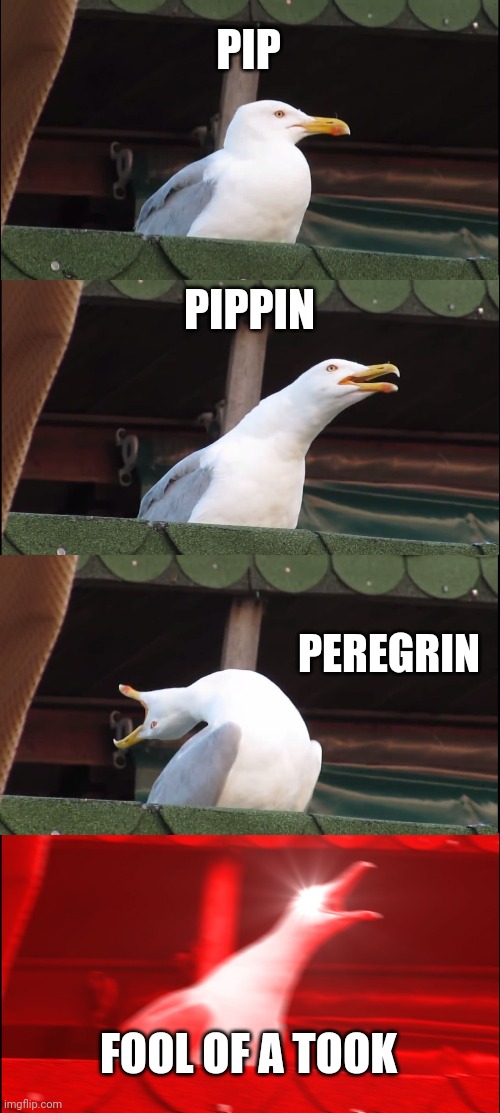
Typically, a "fool" is associated with someone who is
unwise or imprudent. What does it mean to be "un-wise"? Tolkien often uses the phrase "The Wise" to indicate those on the side of good, whether that be The Valar, the Eldar, or The White Council. In fact, Gandalf himself even chides Saruman's lack of wisdom by saying,
"he that breaks a thing to find out what it is has left the path of wisdom." (Fellowship of the Ring: Council of Elrond) Here we see that while
wisdom is associated with being good, a lack of wisdom can thereby be associated with evil. For recall, by the original definition of Augustine which is reiterated by Tolkien,
evil, in and of itself, is not a thing but a
lacking of good. Therefore, while
wisdom particularly in Tolkien's world, is inherently
good, we are told repeatedly that those who are evil have strayed from the path of wisdom. This connection is reiterated later when Gandalf tells Saruman,
"You have become a fool, Saruman, and yet pitiable. You might still have turned away from folly and evil" (Two Towers: The Voice of Saruman). Pippin is no doubt a fool, and his repeated unwise actions certainly do more to hinder the progress of the Fellowship than they do to lend aid.
The second event which I will call attention to happened shortly after the Battle of Helm's Deep. Gandalf, Aragorn, Legolas and Gimli were reunited with Merry and Pippin on the ruined outskirts of Isengard. After dealing with Saruman and beginning to head back towards Rohan, Pippin commits a second grave deed. He steals the Palantir from Gandalf's safekeeping, an act which he
knows goes directly against the path of wisdom and good.
"'You idiotic fool!' Pippin muttered to himself. 'You're going to get yourself into frightful trouble. Put it back quick!' But he found now that his knees quaked, and he did not dare to go near enough to the wizard to reach the bundle. 'I'll never get it back now without waking him,' he thought, 'not till I'm a bit calmer. So I may as well have a look first. Not just here though!'
He stole away, and sat down on a green hillock not far from his bed. The moon looked in over the edge of the dell. Pippin sat with his knees drawn up and the ball between them. He bent low over it, looking like a greedy child stooping over a bowl of food, in a corner away from others. He drew his cloak aside and gazed at it. The air seemed still and tense about him. At first the globe was dark, black as jet, with the
moonlight gleaming on its surface. Then there came a faint glow and stir in the heart of it, and it held his eyes, so that now he could not look away. Soon all the inside seemed on fire; the ball was spinning, or the lights within were revolving. Suddenly the lights went out. He gave a gasp and struggled; but he remained bent, clasping the ball with both hands. Closer and closer he bent, and then became rigid; his lips moved soundlessly for a while. Then with a strangled cry he fell back and lay still.
The cry was piercing. The guards leapt down from the banks. All the camp was soon astir." (Two Towers: The Palantir)
There are many points to unpack here. The first is that committing of a sinful act with full knowledge of the wrong one is doing constitutes "grave matter" and a "mortal sin." Pippin certainly knows he is committing a grave act but goes forward with it anyway. This is clearly not an act of good, but one of evil. Secondly, the disastrous impacts of this moment are far-reaching. Sauron, who up until this point had been in league with Saruman though did not know Saruman intended to seek the Ring on his own, now not only became aware of Saruman's treachery but also of his failures. Without an ally protecting the Gap of Rohan and keeping the Rohirrim distracted, Sauron's timeline for his attack against Gondor changes. This forces Gandalf to abandon King Theoden and company and ride in haste to Gondor to prepare for the assault against Minas Tirith. This also does not give the Rohirrim enough time to muster their full force to ride to the aid of Gondor. Seeking a faster passage, Aragorn opts to take the perilous road of the Paths of the Dead. In the end, we see that the forces of Men are triumphant against Mordor on the Pelennor Fields, as a good result is brought out of evil. But this does not absolve Peregrin's actions. Remember, like the creation of the snowflake, Iluvatar tells us that all evil things serve the purpose of bringing about a greater good. But that does not mean they are not evil. Pippin's action to steal and use the Palantir was a directly evil act, regardless of the end results at Pelennor.
Of all nine members of the Fellowship, Pippin was without a doubt the most "evil." This is true both in the internal sense and the external sense. Internally, Pippin certainly lacked the wisdom to be counted among "The Wise" and as we have seen wisdom and good are inherently linked. Therefore, as evil is the lacking of good, a privation of wisdom can only be seen as evil. Secondly, from an external perspective Pippin's actions do far more to hinder the progress of the Fellowship than they do to lend aid. In Moria his actions directly led to Gandalf's fall at the Bridge of Khazad-dum. After departing from Isengard, Pippin's deliberate choice to steal and use the Palantir led to a splintering of forces and nearly to the fall of Gondor. The Muster of the Rohirrim was incomplete at the time they rode for Minas Tirith and Aragorn was forced into a hasty journey by the Paths of the Dead. From the outset, it has been my contention that evil is the absence of good and that the ends, in this case, do not justify the means. Both Augustine and Iluvatar are clear that good results can come out of evil deeds. However, that does not make the deeds themselves less evil. Indeed, while the virtue of wisdom is associated with the good, the absence of that good, therefore, is foolishness. Due to the fact that his actions on multiple occasions worked in direct opposition to the Quest of the Ring, and he committed multiple foolish actions deliberately, I contend that
Peregrin Took was evil.
NPF was here
Re: They were evil!
Posted: Sun Jun 21, 2020 5:59 pm
by Androthelm
Elrond Halfelven, Master of the Homely House and a member of perhaps the most powerful and fated family in the world, is a coward and a spin-master who has convinced everyone that he is better off chilling in his secret mini-Gondolin than helping Middle-Earth.
Lets start at the beginning. It's the waning days of the first age, and Elrond and Elros are born in the Havens of Sirion. Attacked and pillaged by elves, it is only through the actions of mortal Eärendil that the victory of Morgoth is not complete over the world. Elrond and Elros are raised by Maglor, one of the final two sons of Fëanor -- who comes to realize that the motivation of the Noldor in returning to Middle-Earth is critically flawed and ends up taking his own life. Elrond and Elros are offered kinship either with the First or Second Children of Ilúvatar -- descended, as they are, from all three houses of the Edain and both the Moriquendi and Calaquendi. When faced with the option to live a short but potentially potent life or participate in the long, increasingly shadowy waning of the elves Elros chooses to follow his father's father's folk and live heroically.
Elrond chooses to wane. This attitude is defining, and will persist through the end of the Third Age.
Following the War of Wrath, Elrond goes to live with Gil-galad. He remains there, learning lore and growing in might -- and doing nothing. Gil-galad is a remarkably passive king, even as shadows begin to grow again across Middle-Earth. He is a Finrod and not a Fëanor. When Sauron shows up (in fair form, as "the Gift-Giver" Annatar), Gil-galad and Elrond smell something fishy and turn him away, but they don't, you know, warn the elves of Eregion or anything. Aman forbid you actually take direct action to stifle the works of evil.
And how about that direct action? By the time Gil-galad finally sends Elrond to assist the Noldor of Eregion in their defense against Sauron revealed, it's too late! They wait too long! The Eregion elves are scattered and flee, some joining with the forces of Gil-galad's folk which Elrond is marching eastward. GREAT! Elrond has a whole fresh army! Bolstered by refugee-reinforcements! Awesome! It is time, now, to defeat Sauron--
But, no. Elrond flees north. He avoids fighting, and rather than demonstrating his shame by marching back west--linking back up with the rest of Gil-galad's kingdom and perhaps petitioning Númenor for aide, he goes north and establishes a whole new hidden city! This man said: I was born among refugees from Gondolin, the Hidden City that was found out and betrayed. Clearly the best strategy here is to make a new hidden city." Okay. As long as you don't get betr--
NOPE! Doesn't even matter! Sauron found you without even needing a traitor! How'd he do it? process of elimination! You let him conquer the WHOLE REST OF THE CONTINENT???
And now Gil-galad is going to need to appeal to Númenor for aide anyway, and it's too bad he doesn't have a spare army and he's going to have to rescue you first.But now it's okay! Great! War over, Sauron beat, and you get a promotion! Elrond's terrible not-that-hidden city gets to be a massive elven outpost and Elrond himself is Gil-galad's vice-regent. Cute! Good for you.
What's that? Sauron, that dude you keep letting live even after he just regathers strength and comes back with a new army? He's waging war again? Nah, humans will probably get it. And they did! Great. Ar-Pharazon has this handled. No important advice you should probably give him, about how everybody who trusts Sauron gets betrayed. Nope.
What's that? Sauron betrayed Ar-Pharazon, and Númenor has been destroyed? Nothing needs to be done here!
What's that? Sauron has gathered another new army? No action needs to be taken.
Oh no, Sauron is about to conquer all of Middle-Earth again. Better take the next in a long line of massively overdue, probably too late actions. LAST ALLIANCE! Woo! Sauron bested! Not without pain -- Gil-galad and Elendil are dead. But great news -- the Ring of Power, the big one, the Evil one, the one he used to enslave all the other rings and almost destroyed all of Middle-Earth? Way back when. No, not the first time, with Morgoth. No, not the third time, when he tricked Ar-Pharazon. THE RING. IT'S TIME TO END THE RING. IT'S TIME TO FINALLY END THIS. ELROND. You are one of like SIX PEOPLE who has been around and in a consistent position of power since the First Age. END THIS.
Oh?
The kid says it's a weregild? He wants to hold onto it? If only somebody could explain to him that this is how Sauron did it last time, and the time before, and the time before, and how Morgoth did it before that, and before that, and--
JUST TELL HIM, ELROND. YOUR WHOLE THING IS SUPPOSED TO BE GOOD ADVICE.
What's this? Gandalf says the Necromancer is definitely Sauron? But Saruman says he's okay, so--
Listen, Galadriel trusts Gandalf more than Saruman. Cirdan probably trusts Gandalf more than Saruman--he gives him the ring, after all. Y'all can't like unanimously outvote the second choice for head of the White Council? That isn't in the bylaws? What's the point of a council, then??
And, sure, maybe he gives some good advice after that! He's helpful to Thorin & Co and he's helpful to the Fellowship and he's (sort of) helpful to Arnor in dealing with Angmar (but when Arnor falls he does sort of just grab the expensive stuff and bounce). And he ends up, finally, sending his sons to help Aragorn along with the Rangers instead of, uhhh, GOING HIMSELF AND BRINGING SOME ELVES.
Elrond, while perhaps not explicitly evil, is certainly dangerously inactive. As inactive as Chamberlain, softly appeasing and ignoring Sauron rather than taking action. Only he does that OVER AND OVER AND OVER AGAIN, OVER THE COURSE OF THREE THOUSAND YEARS.
This level of inaction cannot be unintentional.
Elrond Halfelven, son of Eärendil and Elwing and possessor of the ring Vilya, is EVIL.
Re: They were evil!
Posted: Sun Jul 05, 2020 4:09 pm
by Uruva
Elrond and Arwen are definitely shameful blots on their noble ancestry.
@Mojo I feel like you are arguing, perhaps, that all children are evil? Maybe it was Gandalf and Elrond, as argued above, that are the truly evil ones to allow some hormonal teen on a life-or-death (for the entire world) quest.
Re: They were evil!
Posted: Mon Jul 06, 2020 12:34 am
by Boromir88
If one accepts Gandalf was evil (which he clearly was) then you must also accept Aragorn was evil.
'Hope on then!' laughed Denethor. 'Do I not know thee, Mithrandir? Thy hope is to rule in my stead, to stand behind every throne, north, south, or west. I have read thy mind and its policies...So! With the left hand thou wouldst use me for a little while as a shield against Mordor, and with the right bring up this Ranger of the North to supplant me.' Pyre of Denethor
The entire claim of Aragorn is also in question. He attempts to incite a civil war in his lust for the throne of Gondor. Had Denethor not set himself on fire, Aragorn would have made a challenge to the throne, based off a claim that had already been legally rejected. It was determined Isildur forsook Gondor and left rulership to Meneldil. Based on that rejection and over 1,000 years of established precedent, Isildur's line was 'long bereft of lordship.'. And before anyone says Denethor was wrong to oppose Aragorn's claim, Gondor's allies in Rohan also make a point when Aragorn becomes too power hungry:
'It is not clear to me that the will of Theoden son of Thengel, even though he be lord of the Mark, should prevail over the will of Aragorn son of Arathorn, Elendil's heir of Gondor.'
'This is the house of Theoden, not of Aragorn, even were he King of Gondor in the seat of Denethor,' said Hama... The King of the Golden Hall
Apparently Aragorn wasn't aware that Rohan was now sovereign and legally given the lands of Calenardhon, based on Oath between Cirion and Eorl? You would think from this, Aragorn was challenging Rohan's sovereignty with his own claim with an authority he did not have.
1. He was not yet King of Gondor.
2. Even if he was, he would be breaking a sworn oath between Cirion and Eorl, by trying to assert his authority over the will of a King of Rohan. We are all aware of the dangers of breaking sworn oaths. Rohan had kept up their end of the oath, there would have been no justification for Aragorn to determine his will was greater than Theoden's.
One might argue that Gandalf was good at manipulating, peaceful and innocent people, but that is not the case with Aragorn. They are clearly accomplices in all their evilness:
'And my search would have been in vain, but for the help that I had from a friend: Aragorn, the greatest traveller and huntsman of this age of the world. Together we sought for Gollum down the whole length of Wilderland... The Shadow of the Past
A bit later, Gandalf admits to Frodo he threatened Gollum with fire, to get the truth out of him. At the Council of Elrond, Aragorn is quite cavalier about his treatment, and I daresay torture, of Gollum.
'He will not love me, I fear; for he bit me, and I was not gentle. Nothing more did I I ever get from his mouth than the marks of his teeth. I deemed it the worst part of my journey, the road back, watching him day and night, making him walk before me with a halter on his neck, gagged, until he was tamed by lack of drink and food, driving him ever towards Mirkwood.'
Gandalf tries to act morally superior by telling Frodo, Gollum should be pitied and there's a chance he's cured? Yet, with his left hand he puts the 'fear of fire' on Gollum. Then right hand goon, Aragorn ties him, gags him, and withholds food and water. :shock: Hypocrits.