



Rivvy’s Rambles on Writing
- Points: 1 590

Bard of Imladris
Posts: 1079
Joined: Thu May 14, 2020 2:40 am
[under construction placeholder. Will fill out later]
- Points: 964

Thain of The Mark
Posts: 470
Joined: Tue May 19, 2020 12:12 am
Spectacular. Iconic. Breathtaking. A lot of other affirming words that will garner me points, *not* that I care for filthy lucre.

Bealdorhaelend
Proud member of the Eastmark
Lead Healer, Edoras Infirmary
Shopkeeper, Cwep Ciese
- Points: 214

Chef
Posts: 680
Joined: Sun Apr 19, 2020 8:08 am
Agreed, this is stellar work. The choice to use square brackets around the placeholder instead of parentheses shows a clear command of the elements of style, while the casual incorrect capitalization and missing punctuation subverts it expertly, showing that you have not only mastered but indeed transcended the art of language. Truly a top notch ramble placeholder.
- Points: 2 588

Master Torturer
Posts: 3018
Joined: Thu May 14, 2020 11:22 am
I never learn.. Never read anything you write while drinking tea!! 18 years and still doing it..Narv wrote: ↑Tue Jul 07, 2020 6:38 pm Agreed, this is stellar work. The choice to use square brackets around the placeholder instead of parentheses shows a clear command of the elements of style, while the casual incorrect capitalization and missing punctuation subverts it expertly, showing that you have not only mastered but indeed transcended the art of language. Truly a top notch ramble placeholder.
- Points: 1 590
Bard of Imladris
Posts: 1079
Joined: Thu May 14, 2020 2:40 am
I love all of you
- Points: 1 590
Bard of Imladris
Posts: 1079
Joined: Thu May 14, 2020 2:40 am
Well you couldn't get a more fitting opening to a thread containing my rambles on writing. Why am I doing this? I'm going to be a teacher, probably teaching in a classroom in the middle of a pandemic. There's a chance that I will get COVID-19 and get permanently scarred from it since. So in case I lose my mind, I'm going to write down the thoughts to various aspects of my writing to preserve it for up until the Internet breaks, hopefully. So without further ado...
Rivvy's Rambles on Writing presents: ROLEPLAYING POST ANNOTATION
This is where Rivvy rambles on a recent RP post he did in terms of writing construction, strategy, idioms, cliches, regrets, change-of-decisions, and other information that would make an agent yell at Rivvy for spoiling his trade secrets.
RP post: BATTLE OF SUDDEN FLAME FLAME, POISON, AND LIGHTNING, located in the Ages of Arda RPG (viewtopic.php?f=10&t=297)
Context: Ages of Arda is an RPG spanning the entire history of middle earth. Currently, the post is taking place during the Battle of Sudden Flame.
RP post summary: General Eärcolanté and his cavalry try to flee from Morgoth's fiery rage. Lightning bolts further cut down the cavalry. At the end, General Eärcolanté's horse catches on fire.
In case you have no idea what The Battle of Sudden Flame is, it's when Morgoth, the first dark lord, turns the tide against the elves and begins his destruction of the elven kingdoms that are sometimes referenced in LOTR and The Hobbit. Currently a lot of the elven cavalry are stationed right next door to Morgoth's 3 volcanic mountains. So when the Dark Lord finally has his volcanoes erupt, the cavalry are forced to flee.
This post occurs midway through the flight. I am using multiple perspectives from multiple characters. It begins from the perspective of the general with "The cacophony deafened the frenzied gallop from his horse" because normally a horse galloping is loud from the perspective of the rider, but there's so much outside noise that a gallup becomes obscured. Anyone who ever been near a Dark Lord-powered volcanic eruption of this magnitude can probably imagine how loud it can be. The next sentence notates white steam coming from the land. Originally I was going to do sublimation, going directly from snow and ice to gas, but I decided to make it "appear" to be so to make it more scientifically plausible. "Liquid stage" is lingo from my science classes and may not have been the best fit here.
What makes good writing great is the addition of small details that actually are important but may not appear immediately. Two of them occur in the opening paragraphs: the snow becoming steam causing the cavalry to actually ride faster, and the inclusion of Ulmo lore. I planned the first small detail out before I made the post, giving a small realistic increase in the odds of survival, but the one in regards to Ulmo was a spur-of-the-moment decision as I placed myself in Eärcolanté's shoes and suddenly remembered that Ulmo was one of the few Valar who still actively protected the elves. Literary inclusions like these not only tie in nicely with the lore, but helps foreshadow later Ulmo interventions like Tuor in Gondolin. Whether or not it Ulmo actually did anything doesn't matter, because what's more important that it is plausible that an elf can believe that Ulmo did it to increase hope, which is a theme throughout Tolkien's writing. I infer the hope aspect in the second to last sentence.
Of course, realism dictates that rivers of flame and pyrochlastic flow will quickly dissipate the mist, so that of course happens.
These are two very short paragraphs. The first one I use the "blackening sky itself seemed to briefly shine brighter than even the sun" for multiple purposes. The first is clearly contrast, with darkness and light. The second hints to the reader what's about to happen, a lightning strike. The third, the Sun from the Silmarillion was made from the leftovers of one of the two trees, so here it appears that Morgoth's machinations achieved greater power than even the Valar's creation. This one sentence paragraph may seem short, but it contains a lot of connotations that even I may not know about.
The next short paragraph confirms the reader's possible suspicions (or corrects them). It is not immediately why "drop your weapons" is in there, because 1. the reason why Eärcolanté says this will be apparent in the next two POVs. 2. I trust the intelligence of most of my readers to either suspect it and be happy in their correct prediction, and 3. removing the explanation doesn't take away from the drama, and probably increases it.
This is a one-shot original character I created. Líruima being a captain is significant because that was the prior rank of Eärcolanté's when AoA stopped on the old plaza. Here I quickly demonstrate her preparedness and readiness, catching her up from the beginning of the battle to the present in two sentences. Now some writers may be tempted to put a little backstory in here. I deliberately chose not to at this point because it would've broke the rhythm of the flight. Keep the rhythm going! The difference in her interpretation of the mist is subtle but it further highlights her quality of focusing on the job at hand.
The significance of "Spread out" is layered. First it adds to Líruima's competence. Second, it hints at Eärcolanté's leadership style: sub-commanders have leadership power in his cavalry. Third, for the insightful reader who knows about electricity, two riders too closely together will get hit by one lightning bolt. Fourth, Ulmo's mist probably allowed them the milliseconds to spread out. There may be other layers I haven't came up with yet.
Here in paragraph 9, even though Líruima dropped her weapon, the tragic consequence of her readiness will cost her. The first hints are the hair floating upwards, as this happens prior to a lot of lightning victims being struck. Another cookie for the reader if they knew this already. The next paragraph is when she is struck mid-curse. It was mid-curse for two reasons: to show the immediacy of the bolt, and perhaps to hint that Morgoth himself struck down the horseman for cursing his name (using a name he despises, no less!).
Paragraph 10 is the eulogy paragraph. The first two sentences confirms to the reader that Líruima was struck and killed. The phrasing "So fell" is something I either echo from Tolkien or the LOTR movies. "Rising captain" indicates her future would've been bright. I specifically wrote that she chose to not have children as a lore reference to "Morgoth's Ring's section on the laws and customs of elves," and it makes sense as well. But primarily, this sentence was to strike a chord in most of the readers in some way or another. The last sentence of the eulogy refocuses on Líruima's primary desire to be in the military and her promise, as if to hint that these military notes were more valuable to her than her decision to not have children. I was debating whether or not to swap the last two sentences out, but I chose to focus on the military aspects of this one-shot character.
Oof, from one spectrum of competency to another with Rúmilo. The first paragraph is fairly straightforward callbacks to "I thought this was going to be all fun and games" invoked from pieces like All Quiet on the Western Front, to despair using Middle-Earth terminology. Remember when I brought up how Ulmo helped the cavalry? Here in this viewpoint we see someone thinking the other direction regarding the other Valar, who apparently have deserted the elves. In my personal philosophy, I always point out the lack of action is often times as significant as action (which derives from basic Daoist philosophy). Here I make it obvious for the reader the...heh... yin- to Ulmo's yang.
I had Rúmilo sob in the mane for multiple possible reasons. Perhaps he's trying to hide it, protect himself, and stay on the horse at the same time? Either way his concentration is clearly not on Eärcolanté's orders as he sees his implied role model, Líruima being killed. The next sentence is blatant foreshadowing :D if you know the lore.
His thoughts gets interrupted, perhaps with some readers shaking their heads at how this recruit did not even remove the barding from the horse. It is implied that he wasn't killed by the lightning bolt however as we get to see his last moments. Rúmilo dies in despair, seeing soldiers better than himself get struck down. I added the point about all his tears drying due to science, and well you'll be dehyrdrated soon too if rivers of flame rush at you! The eulogy was briefer than the one regarding Líruima, where this one focused on him being the progeny of others dying. Could also serve as a subtle contrast between him and the captain. I made the point of pointing out how there would be "no body to return to the waters" as references to elves going into the west, bodies like Boromir being transported along rivers, etc. Rúmilo gets no such honor like the others here, unfortunately.
Now this wasn't planned at all actually, and only on retrospect did I realize I sorta did a summary of the deaths in the post for impatient readers in paragraph 15.
It is unfortunate that the old AoA is on the old plaza, otherwise I would not have been so blatant as to show how the deaths of the soldiers moved Eärcolanté. Anyone who remembers the old AoA remembers him as an aloof elf with a checkered past who... isn't good at showing feelings. If this were the old AoA, I would've merely put the description of the winter frost on an emerging spring. This imagery is a callback to a similar image used by Tolkien in LOTR in describing Eowyn I believe. Eowyn and Eärcolanté are not that similar though, so that's the end of that comparison.
Second to last paragraph is where I show the upcoming danger that will befall our general. Kicking a horse does not sound really elvenlike, right? Here it shows the desperation. The gas appearing from the horse is the first hint to the reader that something awful is going to happen. The next hint is the general's hands which I show (rather than tell) how burnt they are. This is realistic because this is a death-adrenaline-pumping situation and we have no time for noticing burns until they are too late! For the last sentence of paragraph 16, I actually had to research horse hair terms and hopefully incorporated them correctly into the post.
And the last paragraph makes it obvious to the reader, and provides a good ending point (but what happens next?!) for our post. Create that anticipation, win over readers, and have them craving for your next post! Probably one of the oldest tricks in the book.
~~~
So there you have it, an Annotation of one of my RP posts. Questions, comments, suggestions? Feel free to bring them up!
Rivvy's Rambles on Writing presents: ROLEPLAYING POST ANNOTATION
This is where Rivvy rambles on a recent RP post he did in terms of writing construction, strategy, idioms, cliches, regrets, change-of-decisions, and other information that would make an agent yell at Rivvy for spoiling his trade secrets.
RP post: BATTLE OF SUDDEN FLAME FLAME, POISON, AND LIGHTNING, located in the Ages of Arda RPG (viewtopic.php?f=10&t=297)
Context: Ages of Arda is an RPG spanning the entire history of middle earth. Currently, the post is taking place during the Battle of Sudden Flame.
RP post summary: General Eärcolanté and his cavalry try to flee from Morgoth's fiery rage. Lightning bolts further cut down the cavalry. At the end, General Eärcolanté's horse catches on fire.
In case you have no idea what The Battle of Sudden Flame is, it's when Morgoth, the first dark lord, turns the tide against the elves and begins his destruction of the elven kingdoms that are sometimes referenced in LOTR and The Hobbit. Currently a lot of the elven cavalry are stationed right next door to Morgoth's 3 volcanic mountains. So when the Dark Lord finally has his volcanoes erupt, the cavalry are forced to flee.
Main writing paragraphs 1-2: Eärcolanté POV
This post occurs midway through the flight. I am using multiple perspectives from multiple characters. It begins from the perspective of the general with "The cacophony deafened the frenzied gallop from his horse" because normally a horse galloping is loud from the perspective of the rider, but there's so much outside noise that a gallup becomes obscured. Anyone who ever been near a Dark Lord-powered volcanic eruption of this magnitude can probably imagine how loud it can be. The next sentence notates white steam coming from the land. Originally I was going to do sublimation, going directly from snow and ice to gas, but I decided to make it "appear" to be so to make it more scientifically plausible. "Liquid stage" is lingo from my science classes and may not have been the best fit here.
What makes good writing great is the addition of small details that actually are important but may not appear immediately. Two of them occur in the opening paragraphs: the snow becoming steam causing the cavalry to actually ride faster, and the inclusion of Ulmo lore. I planned the first small detail out before I made the post, giving a small realistic increase in the odds of survival, but the one in regards to Ulmo was a spur-of-the-moment decision as I placed myself in Eärcolanté's shoes and suddenly remembered that Ulmo was one of the few Valar who still actively protected the elves. Literary inclusions like these not only tie in nicely with the lore, but helps foreshadow later Ulmo interventions like Tuor in Gondolin. Whether or not it Ulmo actually did anything doesn't matter, because what's more important that it is plausible that an elf can believe that Ulmo did it to increase hope, which is a theme throughout Tolkien's writing. I infer the hope aspect in the second to last sentence.
Of course, realism dictates that rivers of flame and pyrochlastic flow will quickly dissipate the mist, so that of course happens.
Main writing paragraphs 3-4: Eärcolanté POV
These are two very short paragraphs. The first one I use the "blackening sky itself seemed to briefly shine brighter than even the sun" for multiple purposes. The first is clearly contrast, with darkness and light. The second hints to the reader what's about to happen, a lightning strike. The third, the Sun from the Silmarillion was made from the leftovers of one of the two trees, so here it appears that Morgoth's machinations achieved greater power than even the Valar's creation. This one sentence paragraph may seem short, but it contains a lot of connotations that even I may not know about.
The next short paragraph confirms the reader's possible suspicions (or corrects them). It is not immediately why "drop your weapons" is in there, because 1. the reason why Eärcolanté says this will be apparent in the next two POVs. 2. I trust the intelligence of most of my readers to either suspect it and be happy in their correct prediction, and 3. removing the explanation doesn't take away from the drama, and probably increases it.
Main writing paragraphs 5-7: Líruima POV
This is a one-shot original character I created. Líruima being a captain is significant because that was the prior rank of Eärcolanté's when AoA stopped on the old plaza. Here I quickly demonstrate her preparedness and readiness, catching her up from the beginning of the battle to the present in two sentences. Now some writers may be tempted to put a little backstory in here. I deliberately chose not to at this point because it would've broke the rhythm of the flight. Keep the rhythm going! The difference in her interpretation of the mist is subtle but it further highlights her quality of focusing on the job at hand.
Main writing paragraphs 8-10: Líruima POV
The significance of "Spread out" is layered. First it adds to Líruima's competence. Second, it hints at Eärcolanté's leadership style: sub-commanders have leadership power in his cavalry. Third, for the insightful reader who knows about electricity, two riders too closely together will get hit by one lightning bolt. Fourth, Ulmo's mist probably allowed them the milliseconds to spread out. There may be other layers I haven't came up with yet.
Here in paragraph 9, even though Líruima dropped her weapon, the tragic consequence of her readiness will cost her. The first hints are the hair floating upwards, as this happens prior to a lot of lightning victims being struck. Another cookie for the reader if they knew this already. The next paragraph is when she is struck mid-curse. It was mid-curse for two reasons: to show the immediacy of the bolt, and perhaps to hint that Morgoth himself struck down the horseman for cursing his name (using a name he despises, no less!).
Paragraph 10 is the eulogy paragraph. The first two sentences confirms to the reader that Líruima was struck and killed. The phrasing "So fell" is something I either echo from Tolkien or the LOTR movies. "Rising captain" indicates her future would've been bright. I specifically wrote that she chose to not have children as a lore reference to "Morgoth's Ring's section on the laws and customs of elves," and it makes sense as well. But primarily, this sentence was to strike a chord in most of the readers in some way or another. The last sentence of the eulogy refocuses on Líruima's primary desire to be in the military and her promise, as if to hint that these military notes were more valuable to her than her decision to not have children. I was debating whether or not to swap the last two sentences out, but I chose to focus on the military aspects of this one-shot character.
Main writing paragraphs 11-14: Rúmilo POV
Oof, from one spectrum of competency to another with Rúmilo. The first paragraph is fairly straightforward callbacks to "I thought this was going to be all fun and games" invoked from pieces like All Quiet on the Western Front, to despair using Middle-Earth terminology. Remember when I brought up how Ulmo helped the cavalry? Here in this viewpoint we see someone thinking the other direction regarding the other Valar, who apparently have deserted the elves. In my personal philosophy, I always point out the lack of action is often times as significant as action (which derives from basic Daoist philosophy). Here I make it obvious for the reader the...heh... yin- to Ulmo's yang.
I had Rúmilo sob in the mane for multiple possible reasons. Perhaps he's trying to hide it, protect himself, and stay on the horse at the same time? Either way his concentration is clearly not on Eärcolanté's orders as he sees his implied role model, Líruima being killed. The next sentence is blatant foreshadowing :D if you know the lore.
His thoughts gets interrupted, perhaps with some readers shaking their heads at how this recruit did not even remove the barding from the horse. It is implied that he wasn't killed by the lightning bolt however as we get to see his last moments. Rúmilo dies in despair, seeing soldiers better than himself get struck down. I added the point about all his tears drying due to science, and well you'll be dehyrdrated soon too if rivers of flame rush at you! The eulogy was briefer than the one regarding Líruima, where this one focused on him being the progeny of others dying. Could also serve as a subtle contrast between him and the captain. I made the point of pointing out how there would be "no body to return to the waters" as references to elves going into the west, bodies like Boromir being transported along rivers, etc. Rúmilo gets no such honor like the others here, unfortunately.
Main writing paragraphs 15-17: Eärcolanté POV
Now this wasn't planned at all actually, and only on retrospect did I realize I sorta did a summary of the deaths in the post for impatient readers in paragraph 15.
It is unfortunate that the old AoA is on the old plaza, otherwise I would not have been so blatant as to show how the deaths of the soldiers moved Eärcolanté. Anyone who remembers the old AoA remembers him as an aloof elf with a checkered past who... isn't good at showing feelings. If this were the old AoA, I would've merely put the description of the winter frost on an emerging spring. This imagery is a callback to a similar image used by Tolkien in LOTR in describing Eowyn I believe. Eowyn and Eärcolanté are not that similar though, so that's the end of that comparison.
Second to last paragraph is where I show the upcoming danger that will befall our general. Kicking a horse does not sound really elvenlike, right? Here it shows the desperation. The gas appearing from the horse is the first hint to the reader that something awful is going to happen. The next hint is the general's hands which I show (rather than tell) how burnt they are. This is realistic because this is a death-adrenaline-pumping situation and we have no time for noticing burns until they are too late! For the last sentence of paragraph 16, I actually had to research horse hair terms and hopefully incorporated them correctly into the post.
And the last paragraph makes it obvious to the reader, and provides a good ending point (but what happens next?!) for our post. Create that anticipation, win over readers, and have them craving for your next post! Probably one of the oldest tricks in the book.
~~~
So there you have it, an Annotation of one of my RP posts. Questions, comments, suggestions? Feel free to bring them up!
- Points: 1 590
Bard of Imladris
Posts: 1079
Joined: Thu May 14, 2020 2:40 am
Rivvy's Rambles on Writing presents: ROLEPLAYING POST ANNOTATION
This is where Rivvy rambles on a recent RP post he did in terms of writing construction, strategy, idioms, cliches, regrets, change-of-decisions, and other information that would make an agent yell at Rivvy for spoiling his trade secrets.
RP post: BATTLE OF SUDDEN FLAME FLAME, BURNING, located in the Ages of Arda RPG (viewtopic.php?f=10&t=297&start=50
Context: Ages of Arda is an RPG spanning the entire history of middle earth. Currently, the post is taking place during the Battle of Sudden Flame.
RP post summary: General Eärcolanté's horse is ablaze, but he controls it long enough for him to get to Barad Eithel. He's a burning elf and streaks to the war room to announce that the cavalry is almost all annihilated.
Before we begin, I need to point out something. Originally this post was supposed to include the deaths of the 4 remaining named riders that I referenced in the last post (outside of Nemir, who is Aerlinn's character). But I decided to concentrate the post on Eärcolanté, because the last post ended on a cliffhanger with the horse on fire. I'm assuming the reader who is paying attention to my posts would prefer to place all their attention on the pressing situation of the general, rather than the other riders.
First paragraph is fairly straightforward. It directly connects from the cliffhanger from the prior post, in case the reader forgot. I also give a bit of reasoning why he doesn't combust as well (yet), hinting about his backstory.
We get to see a bit of the terror in the next paragraph, where the horse's screaming is audible even with everything going around the rider. Before that, I looked on youtube for clips of horses screaming, and an exaggeration of the noise would be metal being ripped apart. It also originally was going to be "fiber by fiber," then "tendril by tendril," until I finally went with just "ripped by the tendril." The slightly bucking horse was another minor detail added in.
Paragraph 3 is a character-defining one. This paragraph was crafted with care, as I was trying to make the action impressive yet not completely unrealistic (in a fantasy RPG), putting in more hints to the elf's backstory (his age, his eyes). The far-off land referenced, to the astute reader, could be Valinor. The red hands were a callback to the prior post, where his hands become red in the end. I pointed out how at this perilous moment, he's not letting the emotion show on his face, no grit of teeth, no frown. Voices have power in Tolkien's world, and here Eärcolanté puts what mortals would consider "elven magic" to use, when it's really a combination of his willpower, his relationship with the horse, and his grip. I hint more at just how old he is, and I end it leading to the next paragraph.
So paragraph 4 is a stand-alone, two sentence dialogue section. Let's talk about what I decided not to do. I did not put any exclamation marks, and I did not make a long dialogue. I kept the words short and concise for clarity and realism. If I put exclamation marks here, then it makes it seem he's trying to possess the horse. By not doing that, the elf is being assertive, yet not dictatorial. Here the two sentences work as I try to make the next paragraph make sense to the reader.
Thus what happens is the horse redirects their panic to the job at hand. I added in the detail of Eärcolanté being close to the horse because that helps eliminate air resistance from the rider and saves time, which an experienced rider like this elf realizes. Here I elaborate on his eyes again, the light from his own eyes overcoming the heat, creating a breath of fresh air. Add a bit more "elven power" by having the elf stem the immolation of his clothing just a little bit. It's a hope spot for the reader, and I wrap up the paragraph discussing how the fortress is close.
Realism catches up in paragraph 6. The next line of defense for our elf is his sweat, which isn't enough to douse his clothes that are on fire. The wording "melting snow" originally was "melting ice," which I felt was a little too leading for the topic of the next paragraph. Snow fits here as a callback to the previous post and the reader also remembers that this is happening in the winter where snow is usually on the ground. Here we also see hints of his hair about to be ablaze as well. He does not show pain because even humans don't realize how painful their burns are, much less elves. There is light at the end of the tunnel though; I increase the hope spot for Eärcolanté.
Now paragraph 7 takes us to what appears to be a flashback or a vision of sorts. The only thing that remains the same is the sky, while everything else has went from extreme heat to extreme cold. Science says that you will get burns in both situations if you’re not careful. Here I'm more explicit, and the reader now knows that this elf survived the Grinding Ice. The two elves going into the water are clearly people that Eärcolanté cares about, leading him to urge himself towards the spot where they were last seen. Notice how he actually visibly appears panicked in contrast to how calm he was when he was directing his horse onwards. I repeat the usage of "crackle akin to rusty metal being ripped by the tendril" on purpose. For one, ice sheets cracking does indeed make a great sound, and two, the astute reader recalls when I used it before and will anticipate what will happen in the next paragraph. This contrast is done on purpose. I also chose not to elaborate further on the relationship with the two elves, and let the reader figure out who those are. More incentive for the reader to figure out the mystery and unravel more and more about Eärcolanté.
The horse collapses, and screamed again probably, as a reader could speculate that the usage of the same term meant that the horse screamed once more. Regardless, our beloved is horse is down for the count permanently. But I switch focus back to the elf, as he is also on fire and possibly close to death. I add in details that would happen, having the bounded item on his back reveal itself through the flames as a spear. Notice how Eärcolanté injures himself from the spear. I would suggest remembering that aspect since the spear indeed has a history. He runs through the gate, and I add another detail as the lightning hits the gate on top. Perhaps Melkor was directing the lightning strike towards the elf but the flag stood in the way? In the last sentence I included more details to show the urgency. Like Eärcolanté not stopping to be doused.
We now move to the war room. I had him be doused offscreen because if he wasn't doused than that says a lot about how unready these soldiers are, which is simply not true. Hithlum had some of the hardiest soldiers in the wars against Morgoth. I elaborate the effects the fires have had on his body, and its not pretty. I don't go into that much detail, but let's just say our elf has seen better days. If you notice, he's naked since his clothes all burned off. But that's not important at all and focusing on things like his abdominal muscles at this point would detract from the message of the post. I acknowledge the previous poster, Turin Ringhûn, who posted as Hador, who is in the war council.
The elf speaks, notice all the ellipses, which could show fatigue or regret or whatever emotion the reader can interpret. He also apologizes at the end. Remember that, because Eärcolanté rarely apologizes.
The post ends with him falling facefirst to the floor. Ouch. Hopefully somebody will escort him to the healing section to get those wounds fixed! The final quote at the end provides the lore evidence for his hardiness.
Finally, did you notice something interesting? Not once did I use the word "general" here. He is by himself, for one, and two he is acting like a soldier. There are so no troops for Eärcolanté to command. Preset hierarchies crumble in times of chaos, so that the Battle of Sudden Flame made everyone in the Ard-Galen, regardless of experience, as mortal as a regular soldier.
So that was the end of the flight from the Ard-Galen. This post was the final part of the 3-parts. We started off with an entire cavalry, and now our elf is lying unconscious on a cold floor with almost all of his subordinates killed.
~~~
So there you have it, an Annotation of one of my RP posts. Questions, comments, suggestions? Feel free to bring them up!
This is where Rivvy rambles on a recent RP post he did in terms of writing construction, strategy, idioms, cliches, regrets, change-of-decisions, and other information that would make an agent yell at Rivvy for spoiling his trade secrets.
RP post: BATTLE OF SUDDEN FLAME FLAME, BURNING, located in the Ages of Arda RPG (viewtopic.php?f=10&t=297&start=50
Context: Ages of Arda is an RPG spanning the entire history of middle earth. Currently, the post is taking place during the Battle of Sudden Flame.
RP post summary: General Eärcolanté's horse is ablaze, but he controls it long enough for him to get to Barad Eithel. He's a burning elf and streaks to the war room to announce that the cavalry is almost all annihilated.
Before we begin, I need to point out something. Originally this post was supposed to include the deaths of the 4 remaining named riders that I referenced in the last post (outside of Nemir, who is Aerlinn's character). But I decided to concentrate the post on Eärcolanté, because the last post ended on a cliffhanger with the horse on fire. I'm assuming the reader who is paying attention to my posts would prefer to place all their attention on the pressing situation of the general, rather than the other riders.
Let's get started with Paragraphs 1-2:
First paragraph is fairly straightforward. It directly connects from the cliffhanger from the prior post, in case the reader forgot. I also give a bit of reasoning why he doesn't combust as well (yet), hinting about his backstory.
We get to see a bit of the terror in the next paragraph, where the horse's screaming is audible even with everything going around the rider. Before that, I looked on youtube for clips of horses screaming, and an exaggeration of the noise would be metal being ripped apart. It also originally was going to be "fiber by fiber," then "tendril by tendril," until I finally went with just "ripped by the tendril." The slightly bucking horse was another minor detail added in.
Paragraphs 3-5
Paragraph 3 is a character-defining one. This paragraph was crafted with care, as I was trying to make the action impressive yet not completely unrealistic (in a fantasy RPG), putting in more hints to the elf's backstory (his age, his eyes). The far-off land referenced, to the astute reader, could be Valinor. The red hands were a callback to the prior post, where his hands become red in the end. I pointed out how at this perilous moment, he's not letting the emotion show on his face, no grit of teeth, no frown. Voices have power in Tolkien's world, and here Eärcolanté puts what mortals would consider "elven magic" to use, when it's really a combination of his willpower, his relationship with the horse, and his grip. I hint more at just how old he is, and I end it leading to the next paragraph.
So paragraph 4 is a stand-alone, two sentence dialogue section. Let's talk about what I decided not to do. I did not put any exclamation marks, and I did not make a long dialogue. I kept the words short and concise for clarity and realism. If I put exclamation marks here, then it makes it seem he's trying to possess the horse. By not doing that, the elf is being assertive, yet not dictatorial. Here the two sentences work as I try to make the next paragraph make sense to the reader.
Thus what happens is the horse redirects their panic to the job at hand. I added in the detail of Eärcolanté being close to the horse because that helps eliminate air resistance from the rider and saves time, which an experienced rider like this elf realizes. Here I elaborate on his eyes again, the light from his own eyes overcoming the heat, creating a breath of fresh air. Add a bit more "elven power" by having the elf stem the immolation of his clothing just a little bit. It's a hope spot for the reader, and I wrap up the paragraph discussing how the fortress is close.
Paragraphs 6-8
Realism catches up in paragraph 6. The next line of defense for our elf is his sweat, which isn't enough to douse his clothes that are on fire. The wording "melting snow" originally was "melting ice," which I felt was a little too leading for the topic of the next paragraph. Snow fits here as a callback to the previous post and the reader also remembers that this is happening in the winter where snow is usually on the ground. Here we also see hints of his hair about to be ablaze as well. He does not show pain because even humans don't realize how painful their burns are, much less elves. There is light at the end of the tunnel though; I increase the hope spot for Eärcolanté.
Now paragraph 7 takes us to what appears to be a flashback or a vision of sorts. The only thing that remains the same is the sky, while everything else has went from extreme heat to extreme cold. Science says that you will get burns in both situations if you’re not careful. Here I'm more explicit, and the reader now knows that this elf survived the Grinding Ice. The two elves going into the water are clearly people that Eärcolanté cares about, leading him to urge himself towards the spot where they were last seen. Notice how he actually visibly appears panicked in contrast to how calm he was when he was directing his horse onwards. I repeat the usage of "crackle akin to rusty metal being ripped by the tendril" on purpose. For one, ice sheets cracking does indeed make a great sound, and two, the astute reader recalls when I used it before and will anticipate what will happen in the next paragraph. This contrast is done on purpose. I also chose not to elaborate further on the relationship with the two elves, and let the reader figure out who those are. More incentive for the reader to figure out the mystery and unravel more and more about Eärcolanté.
The horse collapses, and screamed again probably, as a reader could speculate that the usage of the same term meant that the horse screamed once more. Regardless, our beloved is horse is down for the count permanently. But I switch focus back to the elf, as he is also on fire and possibly close to death. I add in details that would happen, having the bounded item on his back reveal itself through the flames as a spear. Notice how Eärcolanté injures himself from the spear. I would suggest remembering that aspect since the spear indeed has a history. He runs through the gate, and I add another detail as the lightning hits the gate on top. Perhaps Melkor was directing the lightning strike towards the elf but the flag stood in the way? In the last sentence I included more details to show the urgency. Like Eärcolanté not stopping to be doused.
Paragraphs 9-11
We now move to the war room. I had him be doused offscreen because if he wasn't doused than that says a lot about how unready these soldiers are, which is simply not true. Hithlum had some of the hardiest soldiers in the wars against Morgoth. I elaborate the effects the fires have had on his body, and its not pretty. I don't go into that much detail, but let's just say our elf has seen better days. If you notice, he's naked since his clothes all burned off. But that's not important at all and focusing on things like his abdominal muscles at this point would detract from the message of the post. I acknowledge the previous poster, Turin Ringhûn, who posted as Hador, who is in the war council.
The elf speaks, notice all the ellipses, which could show fatigue or regret or whatever emotion the reader can interpret. He also apologizes at the end. Remember that, because Eärcolanté rarely apologizes.
The post ends with him falling facefirst to the floor. Ouch. Hopefully somebody will escort him to the healing section to get those wounds fixed! The final quote at the end provides the lore evidence for his hardiness.
Finally, did you notice something interesting? Not once did I use the word "general" here. He is by himself, for one, and two he is acting like a soldier. There are so no troops for Eärcolanté to command. Preset hierarchies crumble in times of chaos, so that the Battle of Sudden Flame made everyone in the Ard-Galen, regardless of experience, as mortal as a regular soldier.
So that was the end of the flight from the Ard-Galen. This post was the final part of the 3-parts. We started off with an entire cavalry, and now our elf is lying unconscious on a cold floor with almost all of his subordinates killed.
~~~
So there you have it, an Annotation of one of my RP posts. Questions, comments, suggestions? Feel free to bring them up!
- Points: 4 013

High Warden of Tower
Posts: 1800
Joined: Thu May 14, 2020 8:37 am
As someone who has been reading your RP for many years now, I have to say these are very interesting insights. I believed myself to be rather familiar with the characters you have written for a while, but you always prove there are more layers to unravel. 
All that is gold does not glitter, not all those who wander are lost
The old that is strong does not wither, deep roots are not touched by the frost.
The old that is strong does not wither, deep roots are not touched by the frost.
- Points: 1 590
Bard of Imladris
Posts: 1079
Joined: Thu May 14, 2020 2:40 am
That is the hope, @Ercassie! What was that tale of Two Cities quote where one never truly knows another person? Another quote that comes to mind is Gandalf being continually amazed at the new things he learns about hobbits even though he's been studying and interacting with them for a long long time.
People are complicated, very few are very straightforward and that is usually because they have not experienced much life outside their metaphorical "well." See the Shire. In the realms of Beleriand and Middle-Earth, particularly elves, the context is at times both static and chaotic, leading to potential character development. Life creates layers after all. This is not exclusive to elves, but dwarves, men, and hobbits as well.
Once an author is able to have their character(s) have all of these complex layers, yet the author finds their own personality has not changed in the same direction as their characters, then that is when an author can realize that they have disassociated with their character. That they have indeed created a new entity, which is significant in the context of Tolkien, as we know from Eru/Aule vs. Melkor.
People are complicated, very few are very straightforward and that is usually because they have not experienced much life outside their metaphorical "well." See the Shire. In the realms of Beleriand and Middle-Earth, particularly elves, the context is at times both static and chaotic, leading to potential character development. Life creates layers after all. This is not exclusive to elves, but dwarves, men, and hobbits as well.
Once an author is able to have their character(s) have all of these complex layers, yet the author finds their own personality has not changed in the same direction as their characters, then that is when an author can realize that they have disassociated with their character. That they have indeed created a new entity, which is significant in the context of Tolkien, as we know from Eru/Aule vs. Melkor.
- Points: 1 590
Bard of Imladris
Posts: 1079
Joined: Thu May 14, 2020 2:40 am
Rivvy's Rambles on Writing presents: ROLEPLAYING POST ANNOTATION
This is where Rivvy rambles on a recent RP post he did in terms of writing construction, strategy, idioms, cliches, regrets, change-of-decisions, and other information that would make an agent yell at Rivvy for spoiling his trade secrets.
RP post: Fangorn in the Forest of Neldoreth, located in the Ages of Arda RPG (viewtopic.php?f=10&t=297&start=50)
Context: Ages of Arda is an RPG spanning the entire history of middle earth. Currently, the post is taking place in the very protected Doriath during the Battle of Sudden Flame.
RP Post Summary: Fangorn's first post in this RPG. He decides to stay in Doriath for the winter to further investigate its beech trees. Noticing Galadriel, he greets her and asks what is on her mind.
Notes prior to post: So, this was my first time RPing as an ent, and what a big responsibility from the get-go to roleplay as Treebeard! This was arranged almost on a whim in Discord. I was asked by the GM, Aigronding, to play Treebeard as the GM thought I would be great as an ent. After all, I kinda have been sounding like one in real life. But anyways, I agreed and then we worked on the timeline on when and where to put him in. What is interesting about Treebeard is that he makes multiple references to "the Great Darkness" that came from "the North." He's not talking about Angmar, he's talking about Morgoth, because Treebeard references Morgoth's defeat before the Entwives were eradicated by Sauron in the second age. Once Morgoth came from the North, that was when the sundering of the Ents and the Entwives began, when the Entwives moved beyond the Anduin river.
At the same time, if the sundering occurred before the Battle of Sudden Flame, that kinda would downplay the very concept of a "Long Peace." Especially because Treebeard explicitly stated that the Entwives craved peace above all, as in their gardens not being disturbed by malevolence. So we hypothesized that it was the Battle of Sudden Flame that is the trigger for Morgoth's permanency as Beleriand's threat. We made more plans surrounding this, but you'll hopefully see that unfold as time goes on in the RPG. I've communicated with various members behind the scenes, and one of them is Thalionwen, who is playing Galadriel. Thus, the conversation between Treebeard and Galadriel is planned as a sort of outline with a majority of details being RPed along the way.
Anyways, let's move on to the analyzing of Treebeard's first post:
So notice that I'm using the name Fangorn instead of Treebeard. I did this for two reasons: 1. his Sindarin name is Fangorn. 2. Thingol has placed a language ban on Quenya, so Sindarin is the default language of Doriath. I wanted him to be in the Forest of Neldoreth at the time of the Battle of Sudden Flame, because if he had been in Dorthonion, like he usually is in the winters, I would have trouble believing he would just let the trees burn and not fall in battle against Morgoth's forces. He is a tree shepherd after all. But if he's over in Neldoreth, then he would not be immediately roused by directly seeing the trees. He would default to his non-hasty nature and think of a more... organized way to respond. But that'll be in regards to the next post.
Speaking of Neldoreth, Treebeard references this forest in The Two Towers, visiting it in Autumn. So believe it or not, I only was reminded of this as I was looking at the reference while I was writing the post that he went to various forests in different parts of the seasons. So I had to come up with a reason why he's not going to Dorthonion this winter. Thankfully, Neldoreth is populated by beech trees, per the quote. As I researched beech trees, I saw that in the winter many of their leaves actually stayed on their trees rather than falling down. I found that fascinating, and if I find it fascinating, Treebeard would experience that feeling doubly so. You'll see later in the post when I use this to my advantage in providing reasoning for him staying in Doriath at this moment in time.
Notice I don't start off in describing what the ent looks like. That's done on purpose because I know most readers already have a vision of what Treebeard looks like. Now recently, in a movie thread, Elenhir has noted that ents only have some attributes of trees if one only took a glance at them, but they were actually of flesh rather than wood. Another post indicated that they probably were not as tall as the movies made them out to be. But I leave it to my readers on what they imagine Treebeard looks like since he's a well-known character. Perhaps the reader can imagine a few less wrinkles in places to show him being younger in the first age, but I did not consider describing his physical attributes a priority.
What I did consider a priority was his feelings regarding Neldoreth. Here I mention how he finds beech trees fascinating, referencing that aspect of the leaves turning tan in winter. But I also use a little creative license in assuming he has witnessed Lúthien dancing causing flowers to grow, thus reminding him of Fimbrethil, who I presume also has that power but may/may not dance to facilitate the growing of the flowers (just imagine an entwife dancing like Lúthien and try not to chuckle). I also mention the summertime in Ossiriand, which Treebeard also mentions in the second book of LOTR. This is where I also hint where Fimbrethil is located (which was done with collaboration behind the scenes with Nia, who is playing that role).
In The Two Towers, Treebeard directly states that in the good old elder days, he indeed would spend a week just breathing in the fine air. So I did a callback to that in this second paragraph. His relationship with Thingol is another one where I needed to use a little logical thinking and creativity in regards to what Treebeard would most likely think of the elf-king. In LOTR, Treebeard actually cautioned Merry and Pippin to avoid getting entangled in Lorien as it was a weird place. Using that vein, I'm assuming that our ent regards Thingol as a weird person because he not only has the Girdle protecting the place, but he also instituted a language ban on Quenya! I see Doriath as weirder than Lorien, so I'm assuming Treebeard thinks that way too. This also gives a tiny hint in regards to a future post where we will get Treebeard's response to a certain new policy.
The next part of the paragraph I reference the battle which caused the end of the Green Elves in terms of their power in Ossiriand. It also conveniently means that there is a bunch of land for entwives to tend to, as I'm assuming that once the elves were depopulated/left, a lot of the plants became abandoned. I have Treebeard getting his news from trees, since that's who he communicates the most with. I also establish that the Long Peace has allowed our ent to travel everywhere including Neldoreth, providing both a reason why he's in Beleriand and lowering the sense of urgency in worrying about the threat up North.
So paragraph 3 is where I sorta use creativity to come up with a reason for Treebeard not to visit Dorthonion in the winter (at this moment). Because of my research of beech trees that I did while writing the post, I had him become interested in why the leaves aged but stayed on those particular trees. The second creative reason is including curiosity on whether or not the presence of Lúthien affected anything, thus also requiring him to investigate Region to see if there was any difference between Neldoreth and Region.
With paragraph 4, I was very careful to make it so that he had a feeling that something was wrong up north as a bit of insight. At the same time, because of the whole Girdle of Melian thing, along with the delay of the refugees just making their way south into Doriath, I had to make it so that it was only a hunch. And a hunch alone would not cause Treebeard to do something hasty like leave the forest to investigate. This also allows the opportunity to get more information out of somebody, and well enter Galadriel
As implied, the pair have met before. This is a reference to the Return of the King, where we know that they met before (along with Celeborn). Their relationship is interesting, and there is a lot unsaid and actually a lot of... possible tension between the pair as they kinda both talked shade about the other's forests behind the other's book. But that's an entire different subject. We do not know exactly of every single conversation and when they happened, but in RPG's like Ages of Arda, plausibility becomes key in filling in gaps. It's very plausible that Treebeard got permission from Thingol to visit Neldoreth whenever he wished, and therefore meet Galadriel and Celeborn there. It is also plausible that the ent received news from the elves.
Paragraph 6 is a direct response to Thalionwen's post as Galadriel. I basically summarize quite a few aspects of the entire post before this quote in dialogue form. Notice I specifically note that Treebeard is happy that elves care for the trees. An astute reader who has read Thalionwen's post as Galadriel should eagerly anticipate to the probable bad news that will be stated towards our ent.
Paragraph 7 provides the conversational cue for Galadriel to respond. I show the insight of Treebeard, and note once again that ents are not hasty. This will prepare the reader eventually for what our ent will plan in the next rp posts. But that is in the future. Our annotation then, ends here for now!
Postscript: I went to sleep after I posted and dreamt I was treebeard
~~~
So there you have it, an Annotation of one of my RP posts. Questions, comments, suggestions? Feel free to bring them up!
This is where Rivvy rambles on a recent RP post he did in terms of writing construction, strategy, idioms, cliches, regrets, change-of-decisions, and other information that would make an agent yell at Rivvy for spoiling his trade secrets.
RP post: Fangorn in the Forest of Neldoreth, located in the Ages of Arda RPG (viewtopic.php?f=10&t=297&start=50)
Context: Ages of Arda is an RPG spanning the entire history of middle earth. Currently, the post is taking place in the very protected Doriath during the Battle of Sudden Flame.
RP Post Summary: Fangorn's first post in this RPG. He decides to stay in Doriath for the winter to further investigate its beech trees. Noticing Galadriel, he greets her and asks what is on her mind.
Notes prior to post: So, this was my first time RPing as an ent, and what a big responsibility from the get-go to roleplay as Treebeard! This was arranged almost on a whim in Discord. I was asked by the GM, Aigronding, to play Treebeard as the GM thought I would be great as an ent. After all, I kinda have been sounding like one in real life. But anyways, I agreed and then we worked on the timeline on when and where to put him in. What is interesting about Treebeard is that he makes multiple references to "the Great Darkness" that came from "the North." He's not talking about Angmar, he's talking about Morgoth, because Treebeard references Morgoth's defeat before the Entwives were eradicated by Sauron in the second age. Once Morgoth came from the North, that was when the sundering of the Ents and the Entwives began, when the Entwives moved beyond the Anduin river.
At the same time, if the sundering occurred before the Battle of Sudden Flame, that kinda would downplay the very concept of a "Long Peace." Especially because Treebeard explicitly stated that the Entwives craved peace above all, as in their gardens not being disturbed by malevolence. So we hypothesized that it was the Battle of Sudden Flame that is the trigger for Morgoth's permanency as Beleriand's threat. We made more plans surrounding this, but you'll hopefully see that unfold as time goes on in the RPG. I've communicated with various members behind the scenes, and one of them is Thalionwen, who is playing Galadriel. Thus, the conversation between Treebeard and Galadriel is planned as a sort of outline with a majority of details being RPed along the way.
Anyways, let's move on to the analyzing of Treebeard's first post:
Setting the Scene and the Opening Quote
So notice that I'm using the name Fangorn instead of Treebeard. I did this for two reasons: 1. his Sindarin name is Fangorn. 2. Thingol has placed a language ban on Quenya, so Sindarin is the default language of Doriath. I wanted him to be in the Forest of Neldoreth at the time of the Battle of Sudden Flame, because if he had been in Dorthonion, like he usually is in the winters, I would have trouble believing he would just let the trees burn and not fall in battle against Morgoth's forces. He is a tree shepherd after all. But if he's over in Neldoreth, then he would not be immediately roused by directly seeing the trees. He would default to his non-hasty nature and think of a more... organized way to respond. But that'll be in regards to the next post.
Speaking of Neldoreth, Treebeard references this forest in The Two Towers, visiting it in Autumn. So believe it or not, I only was reminded of this as I was looking at the reference while I was writing the post that he went to various forests in different parts of the seasons. So I had to come up with a reason why he's not going to Dorthonion this winter. Thankfully, Neldoreth is populated by beech trees, per the quote. As I researched beech trees, I saw that in the winter many of their leaves actually stayed on their trees rather than falling down. I found that fascinating, and if I find it fascinating, Treebeard would experience that feeling doubly so. You'll see later in the post when I use this to my advantage in providing reasoning for him staying in Doriath at this moment in time.
Paragraph 1
Notice I don't start off in describing what the ent looks like. That's done on purpose because I know most readers already have a vision of what Treebeard looks like. Now recently, in a movie thread, Elenhir has noted that ents only have some attributes of trees if one only took a glance at them, but they were actually of flesh rather than wood. Another post indicated that they probably were not as tall as the movies made them out to be. But I leave it to my readers on what they imagine Treebeard looks like since he's a well-known character. Perhaps the reader can imagine a few less wrinkles in places to show him being younger in the first age, but I did not consider describing his physical attributes a priority.
What I did consider a priority was his feelings regarding Neldoreth. Here I mention how he finds beech trees fascinating, referencing that aspect of the leaves turning tan in winter. But I also use a little creative license in assuming he has witnessed Lúthien dancing causing flowers to grow, thus reminding him of Fimbrethil, who I presume also has that power but may/may not dance to facilitate the growing of the flowers (just imagine an entwife dancing like Lúthien and try not to chuckle). I also mention the summertime in Ossiriand, which Treebeard also mentions in the second book of LOTR. This is where I also hint where Fimbrethil is located (which was done with collaboration behind the scenes with Nia, who is playing that role).
Paragraph 2
In The Two Towers, Treebeard directly states that in the good old elder days, he indeed would spend a week just breathing in the fine air. So I did a callback to that in this second paragraph. His relationship with Thingol is another one where I needed to use a little logical thinking and creativity in regards to what Treebeard would most likely think of the elf-king. In LOTR, Treebeard actually cautioned Merry and Pippin to avoid getting entangled in Lorien as it was a weird place. Using that vein, I'm assuming that our ent regards Thingol as a weird person because he not only has the Girdle protecting the place, but he also instituted a language ban on Quenya! I see Doriath as weirder than Lorien, so I'm assuming Treebeard thinks that way too. This also gives a tiny hint in regards to a future post where we will get Treebeard's response to a certain new policy.
The next part of the paragraph I reference the battle which caused the end of the Green Elves in terms of their power in Ossiriand. It also conveniently means that there is a bunch of land for entwives to tend to, as I'm assuming that once the elves were depopulated/left, a lot of the plants became abandoned. I have Treebeard getting his news from trees, since that's who he communicates the most with. I also establish that the Long Peace has allowed our ent to travel everywhere including Neldoreth, providing both a reason why he's in Beleriand and lowering the sense of urgency in worrying about the threat up North.
Paragraphs 3-4
So paragraph 3 is where I sorta use creativity to come up with a reason for Treebeard not to visit Dorthonion in the winter (at this moment). Because of my research of beech trees that I did while writing the post, I had him become interested in why the leaves aged but stayed on those particular trees. The second creative reason is including curiosity on whether or not the presence of Lúthien affected anything, thus also requiring him to investigate Region to see if there was any difference between Neldoreth and Region.
With paragraph 4, I was very careful to make it so that he had a feeling that something was wrong up north as a bit of insight. At the same time, because of the whole Girdle of Melian thing, along with the delay of the refugees just making their way south into Doriath, I had to make it so that it was only a hunch. And a hunch alone would not cause Treebeard to do something hasty like leave the forest to investigate. This also allows the opportunity to get more information out of somebody, and well enter Galadriel
Paragraphs 5-7
As implied, the pair have met before. This is a reference to the Return of the King, where we know that they met before (along with Celeborn). Their relationship is interesting, and there is a lot unsaid and actually a lot of... possible tension between the pair as they kinda both talked shade about the other's forests behind the other's book. But that's an entire different subject. We do not know exactly of every single conversation and when they happened, but in RPG's like Ages of Arda, plausibility becomes key in filling in gaps. It's very plausible that Treebeard got permission from Thingol to visit Neldoreth whenever he wished, and therefore meet Galadriel and Celeborn there. It is also plausible that the ent received news from the elves.
Paragraph 6 is a direct response to Thalionwen's post as Galadriel. I basically summarize quite a few aspects of the entire post before this quote in dialogue form. Notice I specifically note that Treebeard is happy that elves care for the trees. An astute reader who has read Thalionwen's post as Galadriel should eagerly anticipate to the probable bad news that will be stated towards our ent.
Paragraph 7 provides the conversational cue for Galadriel to respond. I show the insight of Treebeard, and note once again that ents are not hasty. This will prepare the reader eventually for what our ent will plan in the next rp posts. But that is in the future. Our annotation then, ends here for now!
Postscript: I went to sleep after I posted and dreamt I was treebeard
~~~
So there you have it, an Annotation of one of my RP posts. Questions, comments, suggestions? Feel free to bring them up!
- Points: 1 590
Bard of Imladris
Posts: 1079
Joined: Thu May 14, 2020 2:40 am
Rivvy's Rambles on Writing presents: CHAPTER(s) ANNOTATION(s)
This is where Rivvy rambles on a chapter he did in terms of writing construction, strategy, idioms, cliches, regrets, change-of-decisions, and other information that would make an agent yell at Rivvy for spoiling his trade secrets. At the same time, though, he will keep some things hidden because Subtext is not meant to be discovered and not told.
Fanfiction Post: Outlaws of the Inland Sea, Chapter 1 (viewtopic.php?p=55374#p55374)
Context: The first piece of fiction writing that I've written in 2 years. And the first chapters of what will be a really epic tale that will hopefully be very long, entertaining, and thought provoking
Chapter Post Summary:
Chapter 1- guy gets put in jail, apologizes, and gets yelled at by guard who uses racial slurs. That’s about it.
Notes prior to post: Before my Mom's death, I had this idea all planned out for a crossover between Water Margin and Middle Earth. Then, after a period of mourning, then came the desire to listen more to the music of creation that was bouncing in my head. The first thought was: what setting?
The Wainrider saga in Gondorian history always interested me. The Death of Ondoher, his heirs, and pretty much the end of the direct male line of Anarion is one of the most critical events in Middle Earth history. From then forward the pieces came together. After a lot of thought, what seemed to be impossible, two seemingly incompatible works...
Why, all of a sudden, it not only became possible, it became easy in concept (not in execution!). Questions popped up, and I could answer them. For instance, what would be the equivalent of a high medieval setting in the East? The Song Dynasty of China, who in the 1100s was on the cusp of the Industrial Revolution and with its paper money/banking, just about to enter a capitalist revolution.
Technology great! Wealthy!... and all ripe for corruption, and still can be seen as evil by the West. But these people could not be straight up chaotic evil, no no. That would be incongruent with Tolkien's narrative. We need complexity! We need multi-dimensional characters!
We need Water Margin: the perfect hive of anti-heroes and complex characters.
The next challenge was... well... not getting this content cancelled. Water Margin, under a mediocre writer, would immediately get cancelled. Even the TV series versions are slanted towards directions that distract from the core themes of the story. That's why the adaptations differ from the source material, and I find the adaptations superior. So this challenge became its own ongoing project: how do I keep the essence of Water Margin without changing it? Well... let my hands change a few of the musical notes!
And there are ways to do so, that you will read in future posts in this thread. Worry not, I will not spoil much.
I'm not going to say much about this chapter because it would spoil a lot. I will point out that the latrine was a callback to the Great Plague, of course, in Middle Earth history. There originally was going to be much more of a conversation, sort of like an Arabian Nights thing. Then I reconsidered it, finding that to be unrealistic given the context that I will not spoil. There's also the practical stuff like "I don't understand the names you're saying," that just would bog the story down unnecessarily.
The phrase "rid us of your nomadic existence" was a callback towards a certain line in the FOTR movie.
I mention flames and darkness for a reason, those will be symbolic themes throughout the tale.
The part where I reveal that the prisoner was actually laughing was a psychological trick to get the reader's attention.
Brown bread was something that I saw could be prison food. Something that doesn't taste good but it would keep the body going.
And here is the transition line, "The long answer to these questions begins not in Gondor, nor Eriador, nor on any common Middle-Earth map. For miles beyond the Inland Sea of Rhun, southeast of the Last Desert, there existed the Eastern Empire whose capital was Dongjing. Our tale begins there in the next chapter." . The homage towards, at least, two of the Chinese classics that I read. At the end of each chapter there are literal cliffhangers each time.
That is all for now. I wrote this in a hurry. The Chapter 2 reflection shall be more organized
This is where Rivvy rambles on a chapter he did in terms of writing construction, strategy, idioms, cliches, regrets, change-of-decisions, and other information that would make an agent yell at Rivvy for spoiling his trade secrets. At the same time, though, he will keep some things hidden because Subtext is not meant to be discovered and not told.
Fanfiction Post: Outlaws of the Inland Sea, Chapter 1 (viewtopic.php?p=55374#p55374)
Context: The first piece of fiction writing that I've written in 2 years. And the first chapters of what will be a really epic tale that will hopefully be very long, entertaining, and thought provoking
Chapter Post Summary:
Chapter 1- guy gets put in jail, apologizes, and gets yelled at by guard who uses racial slurs. That’s about it.
Notes prior to post: Before my Mom's death, I had this idea all planned out for a crossover between Water Margin and Middle Earth. Then, after a period of mourning, then came the desire to listen more to the music of creation that was bouncing in my head. The first thought was: what setting?
The Wainrider saga in Gondorian history always interested me. The Death of Ondoher, his heirs, and pretty much the end of the direct male line of Anarion is one of the most critical events in Middle Earth history. From then forward the pieces came together. After a lot of thought, what seemed to be impossible, two seemingly incompatible works...
Why, all of a sudden, it not only became possible, it became easy in concept (not in execution!). Questions popped up, and I could answer them. For instance, what would be the equivalent of a high medieval setting in the East? The Song Dynasty of China, who in the 1100s was on the cusp of the Industrial Revolution and with its paper money/banking, just about to enter a capitalist revolution.
Technology great! Wealthy!... and all ripe for corruption, and still can be seen as evil by the West. But these people could not be straight up chaotic evil, no no. That would be incongruent with Tolkien's narrative. We need complexity! We need multi-dimensional characters!
We need Water Margin: the perfect hive of anti-heroes and complex characters.
The next challenge was... well... not getting this content cancelled. Water Margin, under a mediocre writer, would immediately get cancelled. Even the TV series versions are slanted towards directions that distract from the core themes of the story. That's why the adaptations differ from the source material, and I find the adaptations superior. So this challenge became its own ongoing project: how do I keep the essence of Water Margin without changing it? Well... let my hands change a few of the musical notes!
And there are ways to do so, that you will read in future posts in this thread. Worry not, I will not spoil much.
Chapter 1
I'm not going to say much about this chapter because it would spoil a lot. I will point out that the latrine was a callback to the Great Plague, of course, in Middle Earth history. There originally was going to be much more of a conversation, sort of like an Arabian Nights thing. Then I reconsidered it, finding that to be unrealistic given the context that I will not spoil. There's also the practical stuff like "I don't understand the names you're saying," that just would bog the story down unnecessarily.
The phrase "rid us of your nomadic existence" was a callback towards a certain line in the FOTR movie.
I mention flames and darkness for a reason, those will be symbolic themes throughout the tale.
The part where I reveal that the prisoner was actually laughing was a psychological trick to get the reader's attention.
Brown bread was something that I saw could be prison food. Something that doesn't taste good but it would keep the body going.
And here is the transition line, "The long answer to these questions begins not in Gondor, nor Eriador, nor on any common Middle-Earth map. For miles beyond the Inland Sea of Rhun, southeast of the Last Desert, there existed the Eastern Empire whose capital was Dongjing. Our tale begins there in the next chapter." . The homage towards, at least, two of the Chinese classics that I read. At the end of each chapter there are literal cliffhangers each time.
That is all for now. I wrote this in a hurry. The Chapter 2 reflection shall be more organized
- Points: 1 590
Bard of Imladris
Posts: 1079
Joined: Thu May 14, 2020 2:40 am
Rivvy's Rambles on Writing presents: CHAPTER ANNOTATION
This is where Rivvy rambles on a chapter he did in terms of writing construction, strategy, idioms, cliches, regrets, change-of-decisions, and other information that would make an agent yell at Rivvy for spoiling his trade secrets. At the same time, though, he will keep some things hidden because Subtext is not meant to be discovered so easily.
Fanfiction Post: Outlaws of the Inland Sea, Chapter 2
Chapter Post Summary:
Chapter 2- Wang Jin, a corvée laborer and a master of many weapons is heading to the capital for a job. She beats up an entire gang because they were making a mockery of fighting and is caught by a constable.
Notes prior to post:
Why a fanfiction on Water Margin? Is a fanfic on Water Margin really a fanfic?
Water Margin technically is a historical fiction novel, except, unlike Romance of the Three Kingdoms (relying on actual historical biographies), Water Margin relies on a bunch of scattered folk tales all bound together into an overarching narrative related to an actual event. Think Les Miserables, except with more characters that are larger than life, much more focus on fights, and coarser language. There are iconic stories within Water Margin, all with famous art depictions from both China and Japan. I'll leave you to decipher which arcs in Water Margin are more memorable than the others. I chose this work because I love it, and because I love this work, I find a lot of faults in this book and I HATE a bunch of themes that one could infer from it! It would be so easily cancelled in today's environment through a shallow readthrough. So yes, I want to create an adaptation to make it more acceptable, more accessible, while still containing many of its core themes.
Middle Earth just happens to be the perfect setting for this to happen.
Water Margin convinced me that there should be no negative association with the term "fanfiction." For one, its adaptations are generally superior, and a technical "fanfic," The Golden Lotus, is on par with Don Quixote and The Tale of Genji in terms of literary significance. All books (even history books!) are fanfiction as each time a sentence is laid out, there is chaff. One cannot truly communicate everything on writing. There's a reason why in Tolkien wrote that if an elf wrote history, there would be pages and pages beyond count and it would take beyond a human lifetime to read it. So, the inference here is that all of Tolkien's tales are fanfiction based on the rules of his own universe! Relating this back to Water Margin, because of The Golden Lotus, the only reason why this work would be classified as "fanfiction" is because I'm using locations and mythology from Tolkien's universe.
Sturgeon's Revelation applies to all writing though: 90% of all written things are forgettable or garbage. So when I interpret people saying "treat it as fanfiction," I interpret it as "treat it as bad writing." What I absolutely disagree with is disregarding literature solely because it can be classified as "fanfiction."
The main reason why I prefer the adaptations of Water Margin over the original source is that the characters are more fleshed out and have more agency. This includes the women. I sometimes have trouble distinguishing between certain women in Water Margin, even the ones that are actually heroes. Contrast that with Romance of the Three Kingdoms in which although the women are (generally) not the warriors there, there is agency among people like Lady Wu and Cao Cao's daughter. There’s a reason why Water Margin is considered misogynistic, and as we move further into these annotations, you’ll begin to see why. One of my goals here is to create a more diversified set of characters as it not only makes the protagonists more memorable, it makes the antagonists more memorable too.
Now, in terms of the preparation in writing the chapter...
In the beginning, this chapter was tough to write. I had images in my head of the first episode of the 1998 Water Margin. That TV series' opening contains the opening credits over this famous painting (I've only copied in one part of the painting):
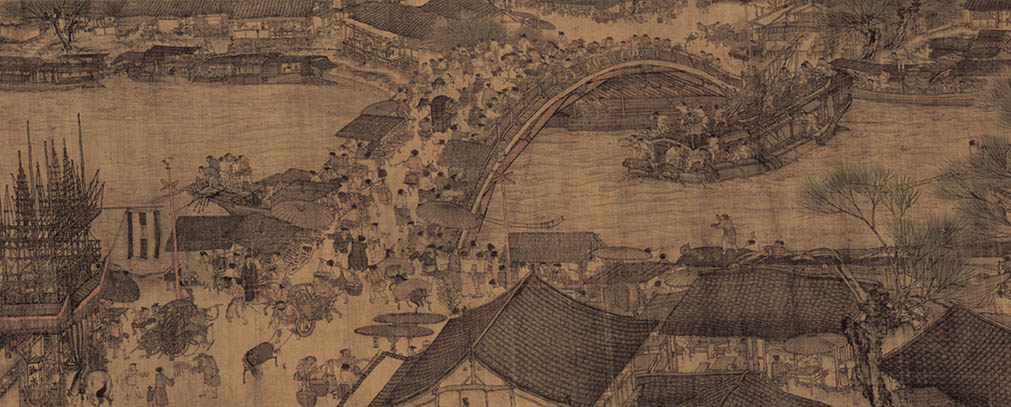
In high school I wrote an an entire essay on this work: Along the River During the Qingming Festival. The picture you see is only a small part of a large horizontal scroll painting that has so many things.
So initially I wanted to do a couple of things:
1. Establish Dongjing as the beginning setting for the first part of the work.
2. Introduce a young Wang Jin. Switch the character into a woman.
3. Make the chapter memorable.
I was not going to incorporate details of the first chapter of Water Margin in this second chapter. The 2011 version does a really good job of incorporating the tale stated in chapter 1, but I will so no more on that (for now). In fact, the events of this chapter is referenced in chapter 2, but does not technically happen in the chapter. The events are more of a homage towards the first episode of the 1998 TV series.
In the first episode there was a pretty famous brawl in the beginning in which you have Wang Jin pretty much demolish all of Gao Qiu's gang along with himself. It's a good lopsided fighting scene. You can see it from 6 minutes 12 seconds to 8 minutes and 6 seconds (unfortunately for some reason the uploader muted the sound during this fight even though for the rest of the TV series they did not mute another single thing): https://www.youtube.com/watch?v=yf935Cd ... ChinaDrama. I wanted to put a modified version of that into this chapter.
That was pretty all there was to it in terms of the planning before the writing.
In Water Margin, Wang Jin doesn't beat up Gao. Wang Sheng, his father, beat up Gao. The 1998 tv adaptation (a classic) made it so that Wang Jin beat up Gao.
The title of the chapter went through a few changes. Initially it was the "Rise of Gao," because the beginning of the second chapter in Water Margin detailed the rise of Gao Qiu. Then I thought to myself at the end of writing this chapter... what kind of rise is that? More like the "Fall of Gao." I ended the chapter before even explaining how this person rose! Notice how this chapter focuses much more on Wang Jin instead of the titular character in the title. This is done on purpose. I'll tell you why when I get to that part where the readers find out which person is Wang Jin.
Dongjing in Mandarin literally means "Eastern Capital," so I kept that name. Third Age Year 1924 was 20 years before the death of Ondoher, which gives a solid amount of time for this entire epic story to take place.
First paragraph: I know quite a few of the readers who read the chapter title will assume that this person is Gao. The brown bread is a transition from the prelude. I describe the bridge part of the painting as the initial setting,
Second to fourth paragraph: Notice the contrast between the past visits. The visit in adolescence gives a hint as to where this character's interests have become. Also notice the inclusion of the Lantern Festival. That is not just a blatant copying of a holiday, think about what's inside a lantern and also think about what the Numenoreans worshipped in the Second Age. The glorification of light vs. the worshipping of darkness.
Sixth paragraph: Last Desert and Wereworms are something I borrowed from The Hobbit. They would know, after all, given that they were once in the East.
Seventh paragraph: Reference's towards the father are given in only two sentences. While there is an implied heavy influence, the limited focus is done on purpose to gear the focus on the reader towards the young woman.
Eighth to tenth paragraph: establish that this character is physically strong and durable. Chinese wheelbarrows, unlike other wheelbarrows, are structured ingeniously so that you can put as much weight as the wheelbarrow can hold (if you balance it), but when you drive it, it's practically weightless. Corvée labor was used by quite a few Chinese dynasties, but the implication that she is put in so much danger is that something made it so that outside labor work became a responsibility for pretty much everyone, rather than just the men. Inclusion of middle earth things in here to remind reader that this takes place in middle earth.
Eleventh paragraph: I had to do research on what a baldric was. Notice how she uses a sabre and not a sword.
Twelfth paragraph: Our first Wainrider reference, and it is evident that they do not control all of the east. I did that on purpose because if you look at the Tale of Years, they all of a sudden show up and then no longer appear again in the Third Age. They are distinguished from the Easterlings in general. So I took this as that they were a threat and menace to both the East and the West (and the South too). Notice how greed is such a big power that they can endanger entire species (reflection of real life).
The Letter of Recommendation: So this one required a bit of research. In retrospect I should've used the Wikipedia article on the 18 weapon masteries for martial arts, but oh well. I modified a significant weapon mastery because of... reasons. Note how there's a general pattern in terms how good the character is at certain weapons vs. others. One can make implications on how physically strong they are based on that. I did this specifically to maintain the suspension of disbelief for most readers as this is the first person they're encountering in the story.
Next three paragraphs: Wang Jin is identified! This is not Gao! A minor swerve for viewers to try and make them pause. Strings of coins were indeed a currency in Imperial China. The weapon on back law was something I made up, as it is generally harder to pull out (and put back in) weapons from the back. The law would therefore make sense. In Chinese culture, the lighter your skin, the more likely you don't work at a farm or something. It's a wealth and status thing and not a race thing.... This still exists in China. So the more pale you are, the more beautiful you are in China. Wang Jin is wearing the clothing her male counterpart wears in the first episode of the 1998 Water Margin series.
Following skip, first five paragraphs: The hilarious thing about the first episode, is that the guy gets beat up for like one minute while Wang Jin is watching to allow for exposition on who Gao is. That means the viewer gets interrupted by the person getting punched, kicked, thrown into stands, get hit by objects, etc. I am lampshading this. The gamblers and the artists are not in that episode, but I include them in here because its plausible and it sticks out.
Following skip, sixth paragraph: this person is a guy in Water Margin. I have reasons for this that'll be explained later. Flowers are associated with the character in Water Margin
Following skip, seventh to eighth paragraph: a mistake anybody could make, and well, if you're not from there, you'll get looked at strangely. Subtle showing of Wang Jin's views on who could be a leader. Yanny/Laurel is a reference towards a psychological phenomenon that occurred like 3 years ago where if you heard the name "laurel," you could hear the name "yanny."
Following skip, ninth to twelfth paragraph: The facial scars thing is reflected in the first episode, and the humor bit was my touch. Here we are introduced to Gao in proper. Football was a thing in China during the dynasties, also known as cuju. More humor here. Lampshading that the guy gets beat up for quite some time in the episode.
Following skip, thirteenth to seventeenth paragraph: Brothel has a negative association in the west because it was seen as a one-dimensional thing where you would only do one thing. Meanwhile, over in China and Japan, courtesans are seen as some of the best painters, singers, and poets, and are typically women. As this society appears to be more "progressive," in terms of male-female roles, males can become courtesans as well in large abundance. I guess something happened in this Empire that lessened the growing sexism that was going on in the time period that Water Margin was in. Will explain that later.
Tiger Mask is a wrestler in Japan that can plausibly be played by nearly anyone. Tulkas is a wrestler, but is he The Tulkas? Fixed matches have been a thing since Ancient Greece, and when there's gambling involved... there will be fixed matches. So professional wrestling can plausibly can become a thing in middle earth. There were wrestlers in Water Margin.
Following skip, eighteenth-nineteenth paragraph: Lampshading the first episode fight and giving a reason why the guy in the episode is... well... able to run away in the actual episode.
Following skip, twentieth-twenty second paragraph: Wang Jin not only is an expert at weapons, she can also do unarmed combat. I researched how to strengthen one's fists and used that info. Knuckles do get harder... not good for when you're older but yeah. This whole thing sets up and maintains the suspension of disbelief that Wang Jin is going to completely thrash this entire group. The middle earth creatures and Wainriders are a callback to earlier in the post, with different weapons catered towards the different creatures (calling back to her weapon expertise). Here is also our first Sauron reference! Notice he's a destroyer god, trying to keep the canon that he's still technically worshipped as a god.
Following skip, twenty-third to thirty-second paragraph: Here's the fight scene. Quick and snappy for each ruffian. Each strike is purposeful and has impact. "That woman hit that little girl" was a callback towards an episode in "Invincible." Teeth are broken... remember that detail.
Rest of the passage: fairly straightforward. Callback to sore arms. Cliffhanger.
By the way, there's an entire song in the 1998 Water Margin OST dedicated to this scene. When I first watched the TV series with my mom... this track hooked me! The track is used in further fighting scenes throughout the TV series as well: https://www.youtube.com/watch?v=hNVMVL6 ... =Kryptopex
Reflection: This post did its job. I found a bunch of grammar errors that I fixed when I uploaded to fanfiction.net, but what I also realized that this post is perfect as a representation of culture shock. Culture shock happened to me when I saw monks in stereotypical garb using smartphones. Already there is a stark difference between this setting and the West in terms of people. It seems that there are more modern entities and ideas, but does that automatically make the East good? Now we're incorporating concepts like 'bystander effect,' 'unreliable police,' and 'gambling.' The victim is not rescued for their benefit, but for the selfish benefit of the rescuer. Would people in Gondor consider this society to not be of 'good will'? Absolutely! But is it the same type of evil as orcs? No! For Aragorn found both good and evil and had to uncover the plots of Sauron. This society is not blatantly chaotic evil, it is very different. Overall, it's meant to create some intrigue and interest for the reader. Something...different.
Welcome to the Eastern Empire, to a World of Illusions.
This is where Rivvy rambles on a chapter he did in terms of writing construction, strategy, idioms, cliches, regrets, change-of-decisions, and other information that would make an agent yell at Rivvy for spoiling his trade secrets. At the same time, though, he will keep some things hidden because Subtext is not meant to be discovered so easily.
Fanfiction Post: Outlaws of the Inland Sea, Chapter 2
Chapter Post Summary:
Chapter 2- Wang Jin, a corvée laborer and a master of many weapons is heading to the capital for a job. She beats up an entire gang because they were making a mockery of fighting and is caught by a constable.
Notes prior to post:
Why a fanfiction on Water Margin? Is a fanfic on Water Margin really a fanfic?
Water Margin technically is a historical fiction novel, except, unlike Romance of the Three Kingdoms (relying on actual historical biographies), Water Margin relies on a bunch of scattered folk tales all bound together into an overarching narrative related to an actual event. Think Les Miserables, except with more characters that are larger than life, much more focus on fights, and coarser language. There are iconic stories within Water Margin, all with famous art depictions from both China and Japan. I'll leave you to decipher which arcs in Water Margin are more memorable than the others. I chose this work because I love it, and because I love this work, I find a lot of faults in this book and I HATE a bunch of themes that one could infer from it! It would be so easily cancelled in today's environment through a shallow readthrough. So yes, I want to create an adaptation to make it more acceptable, more accessible, while still containing many of its core themes.
Middle Earth just happens to be the perfect setting for this to happen.
Water Margin convinced me that there should be no negative association with the term "fanfiction." For one, its adaptations are generally superior, and a technical "fanfic," The Golden Lotus, is on par with Don Quixote and The Tale of Genji in terms of literary significance. All books (even history books!) are fanfiction as each time a sentence is laid out, there is chaff. One cannot truly communicate everything on writing. There's a reason why in Tolkien wrote that if an elf wrote history, there would be pages and pages beyond count and it would take beyond a human lifetime to read it. So, the inference here is that all of Tolkien's tales are fanfiction based on the rules of his own universe! Relating this back to Water Margin, because of The Golden Lotus, the only reason why this work would be classified as "fanfiction" is because I'm using locations and mythology from Tolkien's universe.
Sturgeon's Revelation applies to all writing though: 90% of all written things are forgettable or garbage. So when I interpret people saying "treat it as fanfiction," I interpret it as "treat it as bad writing." What I absolutely disagree with is disregarding literature solely because it can be classified as "fanfiction."
The main reason why I prefer the adaptations of Water Margin over the original source is that the characters are more fleshed out and have more agency. This includes the women. I sometimes have trouble distinguishing between certain women in Water Margin, even the ones that are actually heroes. Contrast that with Romance of the Three Kingdoms in which although the women are (generally) not the warriors there, there is agency among people like Lady Wu and Cao Cao's daughter. There’s a reason why Water Margin is considered misogynistic, and as we move further into these annotations, you’ll begin to see why. One of my goals here is to create a more diversified set of characters as it not only makes the protagonists more memorable, it makes the antagonists more memorable too.
Now, in terms of the preparation in writing the chapter...
In the beginning, this chapter was tough to write. I had images in my head of the first episode of the 1998 Water Margin. That TV series' opening contains the opening credits over this famous painting (I've only copied in one part of the painting):
In high school I wrote an an entire essay on this work: Along the River During the Qingming Festival. The picture you see is only a small part of a large horizontal scroll painting that has so many things.
So initially I wanted to do a couple of things:
1. Establish Dongjing as the beginning setting for the first part of the work.
2. Introduce a young Wang Jin. Switch the character into a woman.
3. Make the chapter memorable.
I was not going to incorporate details of the first chapter of Water Margin in this second chapter. The 2011 version does a really good job of incorporating the tale stated in chapter 1, but I will so no more on that (for now). In fact, the events of this chapter is referenced in chapter 2, but does not technically happen in the chapter. The events are more of a homage towards the first episode of the 1998 TV series.
In the first episode there was a pretty famous brawl in the beginning in which you have Wang Jin pretty much demolish all of Gao Qiu's gang along with himself. It's a good lopsided fighting scene. You can see it from 6 minutes 12 seconds to 8 minutes and 6 seconds (unfortunately for some reason the uploader muted the sound during this fight even though for the rest of the TV series they did not mute another single thing): https://www.youtube.com/watch?v=yf935Cd ... ChinaDrama. I wanted to put a modified version of that into this chapter.
That was pretty all there was to it in terms of the planning before the writing.
Chapter 2
In Water Margin, Wang Jin doesn't beat up Gao. Wang Sheng, his father, beat up Gao. The 1998 tv adaptation (a classic) made it so that Wang Jin beat up Gao.
The title of the chapter went through a few changes. Initially it was the "Rise of Gao," because the beginning of the second chapter in Water Margin detailed the rise of Gao Qiu. Then I thought to myself at the end of writing this chapter... what kind of rise is that? More like the "Fall of Gao." I ended the chapter before even explaining how this person rose! Notice how this chapter focuses much more on Wang Jin instead of the titular character in the title. This is done on purpose. I'll tell you why when I get to that part where the readers find out which person is Wang Jin.
Dongjing in Mandarin literally means "Eastern Capital," so I kept that name. Third Age Year 1924 was 20 years before the death of Ondoher, which gives a solid amount of time for this entire epic story to take place.
First paragraph: I know quite a few of the readers who read the chapter title will assume that this person is Gao. The brown bread is a transition from the prelude. I describe the bridge part of the painting as the initial setting,
Second to fourth paragraph: Notice the contrast between the past visits. The visit in adolescence gives a hint as to where this character's interests have become. Also notice the inclusion of the Lantern Festival. That is not just a blatant copying of a holiday, think about what's inside a lantern and also think about what the Numenoreans worshipped in the Second Age. The glorification of light vs. the worshipping of darkness.
Sixth paragraph: Last Desert and Wereworms are something I borrowed from The Hobbit. They would know, after all, given that they were once in the East.
Seventh paragraph: Reference's towards the father are given in only two sentences. While there is an implied heavy influence, the limited focus is done on purpose to gear the focus on the reader towards the young woman.
Eighth to tenth paragraph: establish that this character is physically strong and durable. Chinese wheelbarrows, unlike other wheelbarrows, are structured ingeniously so that you can put as much weight as the wheelbarrow can hold (if you balance it), but when you drive it, it's practically weightless. Corvée labor was used by quite a few Chinese dynasties, but the implication that she is put in so much danger is that something made it so that outside labor work became a responsibility for pretty much everyone, rather than just the men. Inclusion of middle earth things in here to remind reader that this takes place in middle earth.
Eleventh paragraph: I had to do research on what a baldric was. Notice how she uses a sabre and not a sword.
Twelfth paragraph: Our first Wainrider reference, and it is evident that they do not control all of the east. I did that on purpose because if you look at the Tale of Years, they all of a sudden show up and then no longer appear again in the Third Age. They are distinguished from the Easterlings in general. So I took this as that they were a threat and menace to both the East and the West (and the South too). Notice how greed is such a big power that they can endanger entire species (reflection of real life).
The Letter of Recommendation: So this one required a bit of research. In retrospect I should've used the Wikipedia article on the 18 weapon masteries for martial arts, but oh well. I modified a significant weapon mastery because of... reasons. Note how there's a general pattern in terms how good the character is at certain weapons vs. others. One can make implications on how physically strong they are based on that. I did this specifically to maintain the suspension of disbelief for most readers as this is the first person they're encountering in the story.
Next three paragraphs: Wang Jin is identified! This is not Gao! A minor swerve for viewers to try and make them pause. Strings of coins were indeed a currency in Imperial China. The weapon on back law was something I made up, as it is generally harder to pull out (and put back in) weapons from the back. The law would therefore make sense. In Chinese culture, the lighter your skin, the more likely you don't work at a farm or something. It's a wealth and status thing and not a race thing.... This still exists in China. So the more pale you are, the more beautiful you are in China. Wang Jin is wearing the clothing her male counterpart wears in the first episode of the 1998 Water Margin series.
Following skip, first five paragraphs: The hilarious thing about the first episode, is that the guy gets beat up for like one minute while Wang Jin is watching to allow for exposition on who Gao is. That means the viewer gets interrupted by the person getting punched, kicked, thrown into stands, get hit by objects, etc. I am lampshading this. The gamblers and the artists are not in that episode, but I include them in here because its plausible and it sticks out.
Following skip, sixth paragraph: this person is a guy in Water Margin. I have reasons for this that'll be explained later. Flowers are associated with the character in Water Margin
Following skip, seventh to eighth paragraph: a mistake anybody could make, and well, if you're not from there, you'll get looked at strangely. Subtle showing of Wang Jin's views on who could be a leader. Yanny/Laurel is a reference towards a psychological phenomenon that occurred like 3 years ago where if you heard the name "laurel," you could hear the name "yanny."
Following skip, ninth to twelfth paragraph: The facial scars thing is reflected in the first episode, and the humor bit was my touch. Here we are introduced to Gao in proper. Football was a thing in China during the dynasties, also known as cuju. More humor here. Lampshading that the guy gets beat up for quite some time in the episode.
Following skip, thirteenth to seventeenth paragraph: Brothel has a negative association in the west because it was seen as a one-dimensional thing where you would only do one thing. Meanwhile, over in China and Japan, courtesans are seen as some of the best painters, singers, and poets, and are typically women. As this society appears to be more "progressive," in terms of male-female roles, males can become courtesans as well in large abundance. I guess something happened in this Empire that lessened the growing sexism that was going on in the time period that Water Margin was in. Will explain that later.
Tiger Mask is a wrestler in Japan that can plausibly be played by nearly anyone. Tulkas is a wrestler, but is he The Tulkas? Fixed matches have been a thing since Ancient Greece, and when there's gambling involved... there will be fixed matches. So professional wrestling can plausibly can become a thing in middle earth. There were wrestlers in Water Margin.
Following skip, eighteenth-nineteenth paragraph: Lampshading the first episode fight and giving a reason why the guy in the episode is... well... able to run away in the actual episode.
Following skip, twentieth-twenty second paragraph: Wang Jin not only is an expert at weapons, she can also do unarmed combat. I researched how to strengthen one's fists and used that info. Knuckles do get harder... not good for when you're older but yeah. This whole thing sets up and maintains the suspension of disbelief that Wang Jin is going to completely thrash this entire group. The middle earth creatures and Wainriders are a callback to earlier in the post, with different weapons catered towards the different creatures (calling back to her weapon expertise). Here is also our first Sauron reference! Notice he's a destroyer god, trying to keep the canon that he's still technically worshipped as a god.
Following skip, twenty-third to thirty-second paragraph: Here's the fight scene. Quick and snappy for each ruffian. Each strike is purposeful and has impact. "That woman hit that little girl" was a callback towards an episode in "Invincible." Teeth are broken... remember that detail.
Rest of the passage: fairly straightforward. Callback to sore arms. Cliffhanger.
By the way, there's an entire song in the 1998 Water Margin OST dedicated to this scene. When I first watched the TV series with my mom... this track hooked me! The track is used in further fighting scenes throughout the TV series as well: https://www.youtube.com/watch?v=hNVMVL6 ... =Kryptopex
Reflection: This post did its job. I found a bunch of grammar errors that I fixed when I uploaded to fanfiction.net, but what I also realized that this post is perfect as a representation of culture shock. Culture shock happened to me when I saw monks in stereotypical garb using smartphones. Already there is a stark difference between this setting and the West in terms of people. It seems that there are more modern entities and ideas, but does that automatically make the East good? Now we're incorporating concepts like 'bystander effect,' 'unreliable police,' and 'gambling.' The victim is not rescued for their benefit, but for the selfish benefit of the rescuer. Would people in Gondor consider this society to not be of 'good will'? Absolutely! But is it the same type of evil as orcs? No! For Aragorn found both good and evil and had to uncover the plots of Sauron. This society is not blatantly chaotic evil, it is very different. Overall, it's meant to create some intrigue and interest for the reader. Something...different.
Welcome to the Eastern Empire, to a World of Illusions.

