




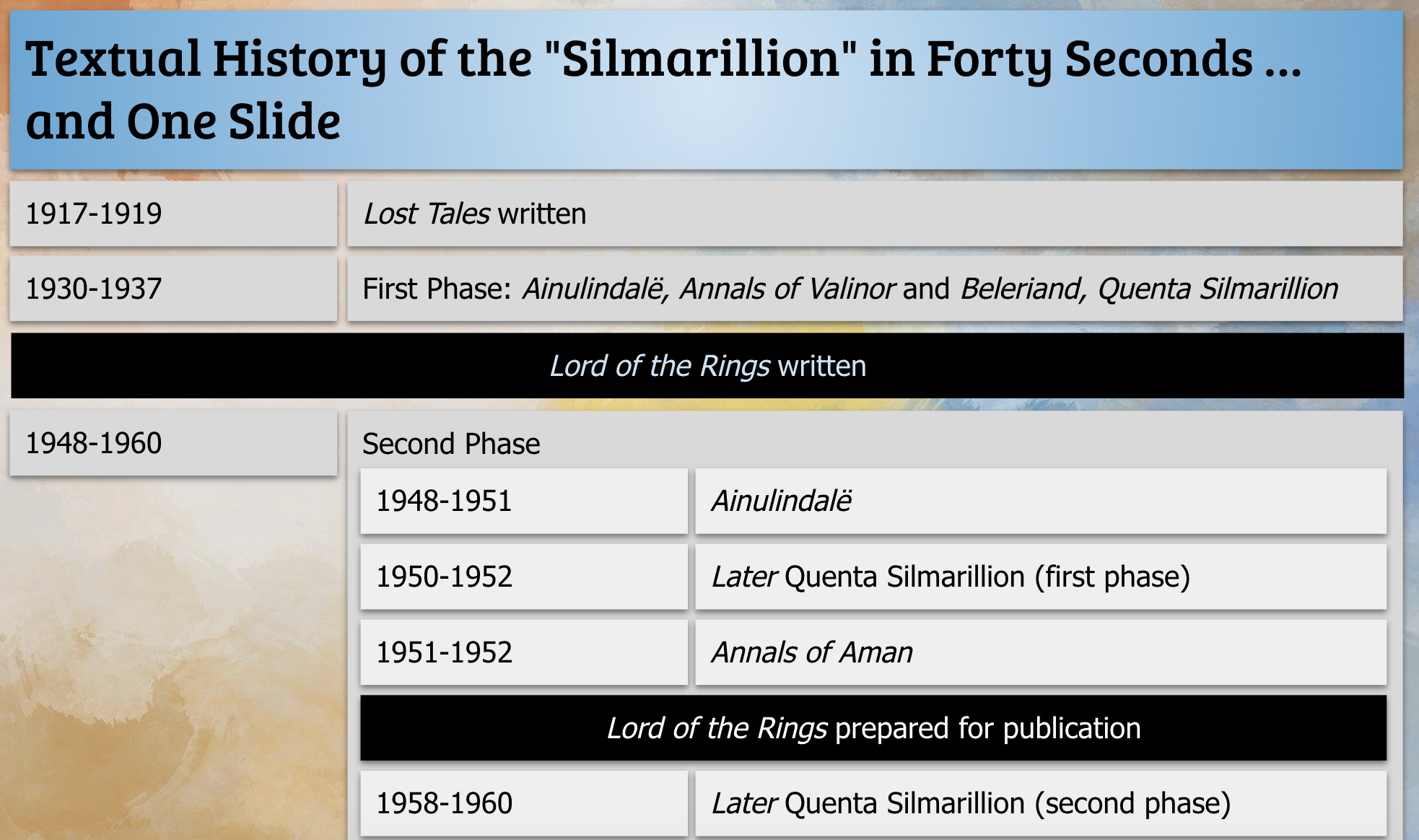
Dawn's essay considers the 'Second Phase' and Tolkien's emerging notion that, as Douglas Kane puts it,
Dawn does not question the intention, but points out that the point of view embedded in the stories is Elvish and that Tolkien did not attempt to change this - and that to have done so would have required rewriting everything. Her argument seems to me convincing.it seems clear (at least in retrospect) that Tolkien intended … the Quenta itself … to be a mix of Elvish history and Mannish myths preserved by the Númenóreans. (Arda Reconstructed, p. 253).
So arises the fundamental contradiction that Lore should help us navigate. Given any text, not only the Quenta but also say the Ainulindalë, it appears to be legitimate to read it as both (a) a mortal's report of Elvish lore, (b) an instance of Mannish lore containing (corrupted) memories of the true Elvish lore (in which the world was apparently always round!!!). But while (a) seems to be what most people go for, it would seem that canon should be (b), at least if canon is understood as Tolkien's mature intention, or vision of the unified tradition of his sub-created Secondary World.
To this I add two observations from my own research.
1. Prior to this Second Phase of post-LotR Silmarillion composition Tolkien evidently conceived of his Elvish stories as a tradition from the ancient history of our world. 'The Lost Road' (1936-7, unfinished) introduces the 'Fall of Numenor' as the 'last myth of the ancient world told by the Elves' and yet sets the tale as the conclusion to a story of time travel from the present. What changed between First and Second Phases, in addition to composition of LotR, was composition of 'On Fairy-stories', which is where the notion of a 'Secondary World' first appears. Therefore, it would seem, those who take (a) thereby align their reading of The Silmarillion as tales told not of some other, fantasy world, but of this, our Primary World. But if this is so, the very idea of canon as it is understood in Lore is of dubious applicability. At the least, the relationship of Primary and Secondary Worlds must be clarified with regard to where derive these canonical texts.
2. Somewhere in a letter Tolkien talks of finishing LotR in 1948. But slowly I've worked out that he meant finishing the narrative. So actually this Second Phase begins when Tolkien is in the midst of writing the appendices of LotR, which he appears still to be doing in 1951 when he writes his famous letter to Milton Waldman. In other words, the first part of the Second Phase (pre-LotR prepared for publication) might usefully include also the appendices to LotR, and we should envisage Tolkien in these first years of the 1950s, the other side of the new Hobbit story, and now reviewing in a different light the Great Tales and the Lore of this world of Three imagined Ages. The appendices of LotR are the first restatement of the new conception of the Elvish stories as set in a 'Secondary World.'
One may therefore situate this whole vision of the Second Phase - the vision of canon and a Secondary World inherited by plaza Lore - as originating in a desire of the artist that LotR, which is about to be published, may soon be read with the proper background required to appreciate its myriad echoes and interweaving of the Great Tales. So from an outside perspective, this vision of canon arises out of the desire of an artist to achieve a literary effect, which is a curious and marvellous effect for sure, but hardly the only frame by which we can read the story.
But it is the frame that the author wished for us, and as such the very idea of plaza Lore is at its heart pure and wonderful - it is the aspiration to receive the gift of the author in its fullness. Only that reception has hitherto been somewhat muddled as to how to read a text from an ancient age of the world, and also it may be that the gift, on the closest inspection, no longer works, or at least, not quite as the author had wished for.

 Read the Ainulindalë (if this is still about the same topic as in the gender thread) from an elven point of view, than the mortals. Then you're much closer to actual content how their views were on the whole matter who they were and what the existence is of the Valar and Maiar within the context of the Ainur. I always found that an easier point to start from, than possibly a (distorted) viewpoint from the mortals, who copied from older texts that already existed. Prof. Tolkien wrote multiple versions to get the most correct one, which is natural process to happen. How many times have I written a piece of text, erased a part, wrote a new parts and mixed stuff up? With the rising of the age, a writer's views change constantly and this reflects back in the narratives they write. That happened to Tolkien, this is happening to me, and with every other writer who were alive at some point in history and writer who still are today, and will happen to future writers. I feel that Tolkien left behind a work he wished for his readers to enjoy, or so this is/was my experience from reading his works.


 Thanks for your great reply. You have a greater sense on the general regard of scholars and lorists even in your bluntness and I can only give you right, because my knowledge is very little of them. I can't tell you why there is little historial mindedness, even within Tolkien fandom and scholarship.
