
History of Canon

Discussions in Middle-earth lore, language and books.
Post Reply
Tree
Points: 4 777 
Posts: 3136
Joined: Sun May 17, 2020 7:54 pm
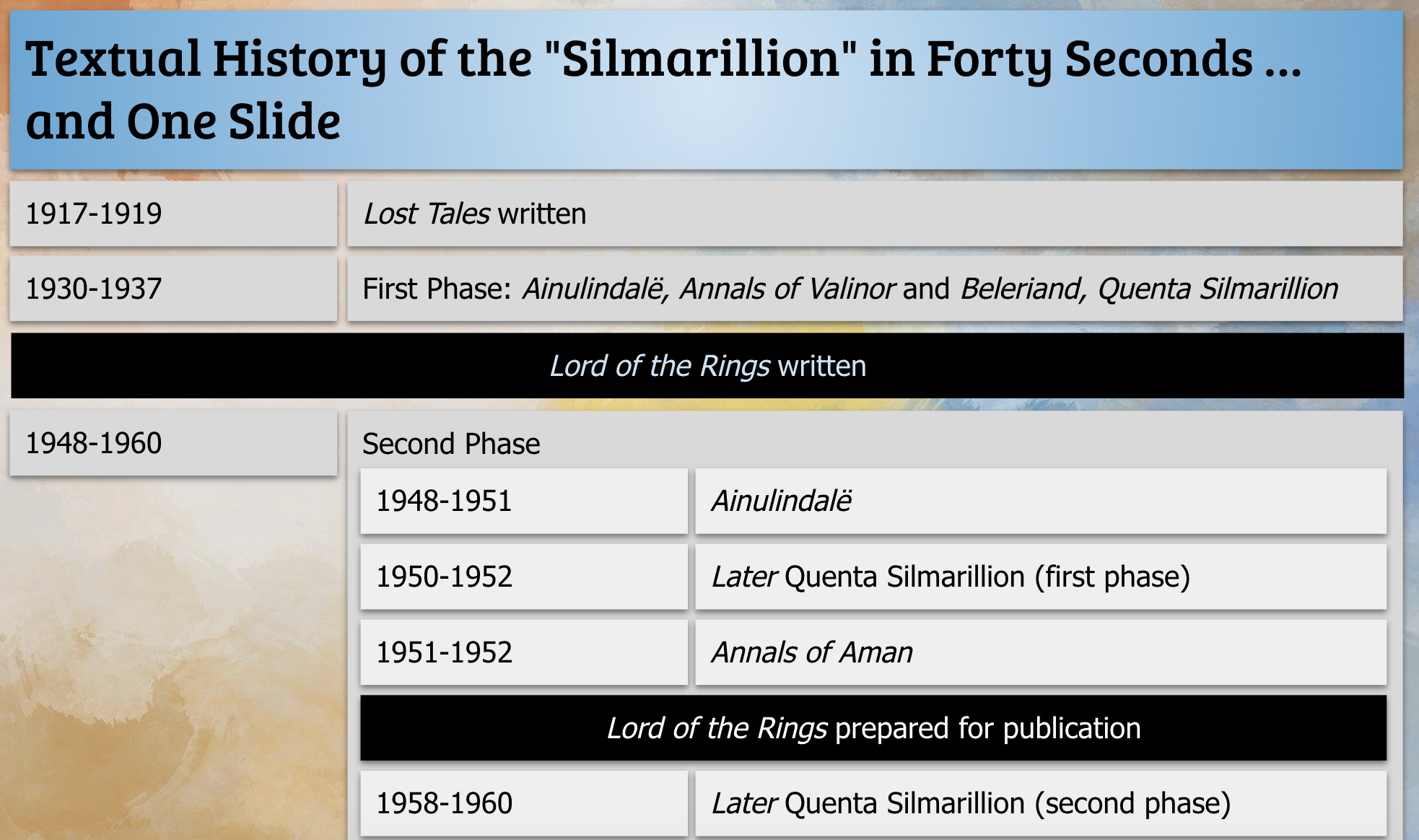
This is an attempt to get my head around the 'big question', based on the account given by Dawn Walls-Thumma in this recent essay on the authorship of the Silmarillion, from which I link the following table:

Image

Dawn's essay considers the 'Second Phase' and Tolkien's emerging notion that, as Douglas Kane puts it,
it seems clear (at least in retrospect) that Tolkien intended … the Quenta itself … to be a mix of Elvish history and Mannish myths preserved by the Númenóreans. (Arda Reconstructed, p. 253).
Dawn does not question the intention, but points out that the point of view embedded in the stories is Elvish and that Tolkien did not attempt to change this - and that to have done so would have required rewriting everything. Her argument seems to me convincing.

So arises the fundamental contradiction that Lore should help us navigate. Given any text, not only the Quenta but also say the Ainulindalë, it appears to be legitimate to read it as both (a) a mortal's report of Elvish lore, (b) an instance of Mannish lore containing (corrupted) memories of the true Elvish lore (in which the world was apparently always round!!!). But while (a) seems to be what most people go for, it would seem that canon should be (b), at least if canon is understood as Tolkien's mature intention, or vision of the unified tradition of his sub-created Secondary World.

To this I add two observations from my own research.

1. Prior to this Second Phase of post-LotR Silmarillion composition Tolkien evidently conceived of his Elvish stories as a tradition from the ancient history of our world. 'The Lost Road' (1936-7, unfinished) introduces the 'Fall of Numenor' as the 'last myth of the ancient world told by the Elves' and yet sets the tale as the conclusion to a story of time travel from the present. What changed between First and Second Phases, in addition to composition of LotR, was composition of 'On Fairy-stories', which is where the notion of a 'Secondary World' first appears. Therefore, it would seem, those who take (a) thereby align their reading of The Silmarillion as tales told not of some other, fantasy world, but of this, our Primary World. But if this is so, the very idea of canon as it is understood in Lore is of dubious applicability. At the least, the relationship of Primary and Secondary Worlds must be clarified with regard to where derive these canonical texts.

2. Somewhere in a letter Tolkien talks of finishing LotR in 1948. But slowly I've worked out that he meant finishing the narrative. So actually this Second Phase begins when Tolkien is in the midst of writing the appendices of LotR, which he appears still to be doing in 1951 when he writes his famous letter to Milton Waldman. In other words, the first part of the Second Phase (pre-LotR prepared for publication) might usefully include also the appendices to LotR, and we should envisage Tolkien in these first years of the 1950s, the other side of the new Hobbit story, and now reviewing in a different light the Great Tales and the Lore of this world of Three imagined Ages. The appendices of LotR are the first restatement of the new conception of the Elvish stories as set in a 'Secondary World.'

One may therefore situate this whole vision of the Second Phase - the vision of canon and a Secondary World inherited by plaza Lore - as originating in a desire of the artist that LotR, which is about to be published, may soon be read with the proper background required to appreciate its myriad echoes and interweaving of the Great Tales. So from an outside perspective, this vision of canon arises out of the desire of an artist to achieve a literary effect, which is a curious and marvellous effect for sure, but hardly the only frame by which we can read the story.

But it is the frame that the author wished for us, and as such the very idea of plaza Lore is at its heart pure and wonderful - it is the aspiration to receive the gift of the author in its fullness. Only that reception has hitherto been somewhat muddled as to how to read a text from an ancient age of the world, and also it may be that the gift, on the closest inspection, no longer works, or at least, not quite as the author had wished for.
Eat earth. Dig deep. Drink water.

New Soul
Points: 2 817 
Posts: 3091
Joined: Thu Sep 02, 2021 6:24 am
I have no idea what I have to make of the text above. :confused: Read the Ainulindalë (if this is still about the same topic as in the gender thread) from an elven point of view, than the mortals. Then you're much closer to actual content how their views were on the whole matter who they were and what the existence is of the Valar and Maiar within the context of the Ainur. I always found that an easier point to start from, than possibly a (distorted) viewpoint from the mortals, who copied from older texts that already existed. Prof. Tolkien wrote multiple versions to get the most correct one, which is natural process to happen. How many times have I written a piece of text, erased a part, wrote a new parts and mixed stuff up? With the rising of the age, a writer's views change constantly and this reflects back in the narratives they write. That happened to Tolkien, this is happening to me, and with every other writer who were alive at some point in history and writer who still are today, and will happen to future writers. I feel that Tolkien left behind a work he wished for his readers to enjoy, or so this is/was my experience from reading his works. :shrug:
Just call me Aiks or Aikári. Notify is off.
Find me stuff in Gondolin.
And let us embark to Valinor!

Tree
Points: 4 777 
Posts: 3136
Joined: Sun May 17, 2020 7:54 pm
Aikári Salmarinian wrote: Sun Aug 06, 2023 2:55 pm Prof. Tolkien wrote multiple versions to get the most correct one, which is natural process to happen.
Indeed, but your formulation begs the question of what Tolkien deemed correct, which asks a question about his intentions between around 1916 and 1973. You appear to identify the intention of Tolkien only with making the text enjoyable for the reader, but Tolkien's intention was also to present a body of tradition. Half a century is a long period in any life, and the mature intention of presenting a tradition that comes down to us through the Numenoreans generates a radically different image of tradition than the early image of a body of texts recorded by an Anglo-Saxon sailor from the words of an Elf.

Imagine that the ancient Frisians or some other Germanic tribe who lived in your area of the world had left a record of their ancient myths and legends. Now imagine that our only version of these myths and legends was a version of the (now lost) Frisian writings preserved by the Romans. Reading this second version we would always have to watch out for Roman projections because they could not get their head around the original and garbled it.

One may or may not wish to read these texts of Tolkien as intended (by Tolkien) as part of a tradition. If you do not, that is OK. But Tolkien wished them to be read as such, and Lore takes up the challenge of receiving them as such. As such, it is (or should be) the proper business of Lore to approach matters of canon though a source-critical lens, scrutinizing the text for possible errors introduced by the unconscious (or conscious) biases of the intermediaries through whom it has come down to us.
Eat earth. Dig deep. Drink water.

New Soul
Points: 2 817 
Posts: 3091
Joined: Thu Sep 02, 2021 6:24 am
Yes, I enjoy it from the perspective of the reader, because if you don't do as writer to make your tale enjoyable, people will not buy your product. And you will not have funds to produce more of your tale and share it with the world. That is the one element. Law of economics.

What you refer to as a body of tradition is a second element and stands loose from the enjoyment element. This places into what and how Tolkien wrote this all together and where the recourses lay for the inspiration in our world. Elves and Saxon sailors got nothing to do with that. British traditions are important to English people, but outside of it? It is just not that important to other nationalities than those who are British or hold a close connection.

I understand your point on the Frisians, but unfortunate they left no written records really. I can tell you that it is from a Roman source (Tacitus) that we know of the peoples who lived in the Germanic areas. Those were the Ingvaeones (Northsea Germans), which were basically the Frisians, Saxons, Jutes and Angles. The second were the Irminones (Middle Germany to Donau), which were basically the Cherusci, Chatti, Hermunduri, Marcomanni and Quadi. The third were the Istvaeones (Elbe Germans), which were basically peoples who lived around the Elbe river. The Germanic peoples 2000 years ago relied on oral traditions and left very little behind. Therefore what the Romans wrote hold significance, even it is from their point of view. We can always strip down what the culture was of the Germanic peoples by what the Romans wrote and what is found with archeology and radiocarbondating of the Frisians and Batavians in my area.

In a sense I wouldn't like it really if people who go through my stories with a 'source-critical lens, scrutinizing the text for possible errors introduced by the unconscious (or conscious) biases of the intermediaries through whom it has come down to us'. They are a timestamp which should be received precise as they are intended for. I find the biases of those earlier times an enriching element into how our way of thought was in that particular period of time was. Being aware of that points out how far we have come from with civilisation. But condemning it, searching for wrongs, is not the way for me to approach it, whatever the content. I don't feel we do honour to Tolkien's work with that. But that is my feeling about it.

I heard yesterday this with a video I was watching, the words were very captivating:

"There is always something over these farmhouses, something that is really hard to describe. There is a certain beauty to them, not now they look but how in they feel. They were once home to generations, a place full of all the memories and events that make us human. Happy and sad. The people who built them, the people who made them their own, the people who carved out the land to construct them, they are now gone. Often time without any story or any history written to give us a look into who they even were. They exist somewhere between what was and what is. A relic to a not so distant past, to a time when we were different, more resilient, more in touch with the land, more in touch with our fellow human and with the world around us even. As they fade from our memories, they seem to fade from existence as if one is somehow tied to the other. Reclaimed into the ground in a way that is a humbling reminder for us and our hubris to the natural order of things. The old barns and concrete silos rise like headstones on the horizon, monuments to a time, monuments to a way of life and people that are all but gone. Like a dream you wake up from sure you’ll remember all only somehow completely forget. But you remember, something inside you know what it was that was lost along the way. The thing you forgot you even knew. You can somehow almost feel it in the peace and serenity."

In a sense this is what I also feel about the works of Tolkien. They enrich our sense of the world. Something we should preserve, not destroy.
Just call me Aiks or Aikári. Notify is off.
Find me stuff in Gondolin.
And let us embark to Valinor!

Tree
Points: 4 777 
Posts: 3136
Joined: Sun May 17, 2020 7:54 pm
Aikári Salmarinian wrote: Mon Aug 07, 2023 10:50 pm
In a sense I wouldn't like it really if people who go through my stories with a 'source-critical lens,scrutinizing the text for possible errors introduced by the unconscious (or conscious) biases of the intermediaries through whom it has come down to us'. They are a timestamp which should be received precise as they are intended for. I find the biases of those earlier times an enriching element into how our way of thought was in that particular period of time was. Being aware of that points out how far we have come from with civilisation. But condemning it, searching for wrongs, is not the way for me to approach it, whatever the content. I don't feel we do honour to Tolkien's work with that. But that is my feeling about it.

"There is always something over these farmhouses, something that is really hard to describe. There is a certain beauty to them, not now they look but how in they feel. They were once home to generations, a place full of all the memories and events that make us human. Happy and sad. The people who built them, the people who made them their own, the people who carved out the land to construct them, they are now gone. Often time without any story or any history written to give us a look into who they even were. They exist somewhere between what was and what is. A relic to a not so distant past, to a time when we were different, more resilient, more in touch with the land, more in touch with our fellow human and with the world around us even. As they fade from our memories, they seem to fade from existence as if one is somehow tied to the other. Reclaimed into the ground in a way that is a humbling reminder for us and our hubris to the natural order of things. The old barns and concrete silos rise like headstones on the horizon, monuments to a time, monuments to a way of life and people that are all but gone like a dream you wake up from sure you’ll remember all only somehow completely forget. But you remember, something inside you know what it was that was lost along the way. The thing you forgot you even knew. You can somehow almost feel it in the peace and serenity."
Hi Aiks, I really like what you write here and also the quote. It appeals to me because I am by training and by inclination a historian. I think that the context of my recent posts suggests i am saying something that i am not.

I am saying that in Lore discussions - here on this plaza - we are engaged in dialogue with each other, and not laying down the Lore like some heavenly judge. And so, as we all know, we must respect each other's differences and also make the effort to find out what someone is trying to say (not just drop a quotation and reference on their heads).

What you say about a story as a timestamp seems to be absolutely correct. And as you are aware, times change and with them our values. This sets up a tension that should be explored, and fan-fiction is one way of doing so. Lore should provide another, but that way has not yet been worked out. In pointing out that Tolkien conceived of his texts as part of a tradition I am merely pointing out how, from the perspective of Lore, it is possible to rise above the muddled attitude that equates the meaning of a text with Tolkien's early 20th-century values - he was far cleverer than this and made something that transcends his own values.

What you say about destroying disturbs me. I am by early training and deep inclination a 'historian,' and have spent over three decades reading the works of dead Victorian and Edwardian scholars. As a historian I feel (quite passionately) that my task is to restore the voice of those whose voices are either ignored or twisted for other ends in contemporary society - i mean the voices of those who are now dead. I have been reading traditional Lorists and Tolkien scholars for well over a decade now and, to be blunt, much of what I read is a terrible destruction of the past. People pick and choose that bit of the past that speaks to them, and ignore the rest; and what they do choose they read as if it was written yesterday and more often than not fail to catch the actual meaning. That is disturbing, though I think it is what always happens with the past - and precisely why we should read the texts of the past (imagined or real) with critical eyes.

Tolkien was historically-minded - one of the greatest historical minds that England has ever produced, though (again) the Lorists and Tolkien scholars tend to be blind to this. He knew better than most how traditions are fragmented, distorted, and lost in time. Just the same historically-minded approach that is required to do Tolkien Studies properly is required to read the texts of the imagined tradition. Unfortunately, respect for the dead and historical-mindedness are very rare today, and it is a question in itself why this seems especially so within Tolkien fandom and scholarship.
Eat earth. Dig deep. Drink water.

Bard of Imladris
Points: 1 590 
Posts: 1079
Joined: Thu May 14, 2020 2:40 am
Hroom hrum, I have been summoned by a mention. Was there someone that wished to ask me a question?

Tree
Points: 4 777 
Posts: 3136
Joined: Sun May 17, 2020 7:54 pm
Many questions, @Rivvy Elf! How is China? For starters. (I think there was a paragraph with a mention that I deleted with an edit - sorry.)

Edited this one too cos of a spelling mistake. But was tempted to delete the mention to mess with your head (but refrained!)
Last edited by Chrysophylax Dives on Tue Aug 08, 2023 8:40 am, edited 1 time in total.
Eat earth. Dig deep. Drink water.

New Soul
Points: 2 817 
Posts: 3091
Joined: Thu Sep 02, 2021 6:24 am
Rivvy: You may all answer all you like, but I haven't summoned you here to answer questions. I hope you have a great time in China. :thumbs:

Chrys: Hey too! I'll regard you as an unofficial full-fetched historian then with three decades of extensive reading of old English works. Undoubtly your knowledge is far more broader than mine is, but true we can all learn, me included. You will not hear from me that it is wrong. :wink:

I see and hear people out in the field (not here on the forum) who really take stand against all what I was taught to regard in a positive sense. Troelsfo lightly tipped the point of obsession with neutral gender pronouns in another thread. But that is just a single element in a much wider ranger of what - I feel - is a form of destruction in European Thought. Why that is, beat me? I think it is better I just don't know. You have popped up the thread of "Primary/Secondary Believe and innerconsistency of reality". Troelsfo opening post clears out a lot with his quotes for me. But what for me most is striking... is the difference between his post and yours. Troelsfo restricts largely to what Tolkien wrote and gives his direct opinion over it. While you introduce scholars who interpreted Tolkien, and then weave yours through it. And I got a troubling feeling, it's there my own misunderstanding starts.

Chrys wrote:
Tolkien was historically-minded - one of the greatest historical minds that England has ever produced -, though (again) the Lorists and Tolkien scholars tend to be blind to this. He knew better than most how traditions are fragmented, distorted, and lost in time. Just the same historically-minded approach that is required to do Tolkien Studies properly is required to read the texts of the imagined tradition. Unfortunately, respect for the dead and historical-mindedness are very rare today, and it is a question in itself why this seems especially so within Tolkien fandom and scholarship.


I totally agree on that with you. :clap: Thanks for your great reply. You have a greater sense on the general regard of scholars and lorists even in your bluntness and I can only give you right, because my knowledge is very little of them. I can't tell you why there is little historial mindedness, even within Tolkien fandom and scholarship. :shrug: Therefore is that I feel I understand Troelsfo's post quite better than yours in that thread. I believe it was you who suggested about a year ago to read Tolkien's essay of Fairytales. But that particular thread I can't find back.

Victorian and Edwardian writers I read solely for my pleasure as a Dutch woman. The Duth historical value of literature is largely of the last 70 years and covers fields like drugs, sex, murder and jealousy and only published in the Dutch language, not foreign. Not particular my taste of subjects. It is what I call polder literature, not more than the clay and dirt we live in. I regard that as unreadable. *yawns* What I like more are to read works from French and Germany of old classical writers and there is a lot of them from the 18th and 19th century. The same for German and French music. That comes from my grandparents who grew up in the pre-war era (<1939). In the middle class of that time boys and girls were educated with an European sense of literature and music from Britain, French and Germany. After WWII much of that didn't touch my mother, but did my dad. After his military service he chased for many years after all sorts of old castles across Europe and saw extensively such homesteads in the west of old cultural Europe that was not locked behind the Iron Curtain of the Russians. My dad recommended to me lots of books and so also the Hobbit and the Lord of the Rings to read as a teenager.

True, our norms and values change, but I have always been warned to be careful with that, particular my paternal grandpa, to apply them on older documents. But you are right, I am not without judgment about them, even I try not to do it. Perhaps I shouldn't emphasize on it so much?

And sorry about your child, life is hard on us at times. *sends hugs*
Just call me Aiks or Aikári. Notify is off.
Find me stuff in Gondolin.
And let us embark to Valinor!

Post Reply