



 It's a fun tale in a child's imagination. That are many more of them. But not all English fairytales I do know. It is more an amalgation between Dutch and German or French fairytales on the mainland. It is not Tom Thumb, but Little Thumb (Klein Duimpje). The kid is not taller than your thumb. The giant is an Ogr in the tale.
 Bombadil
- Points: 2 835

New Soul
Posts: 3110
Joined: Thu Sep 02, 2021 6:24 am
Priya: Off course I have heard about the seven miles boots. It's a fun tale in a child's imagination. That are many more of them. But not all English fairytales I do know. It is more an amalgation between Dutch and German or French fairytales on the mainland. It is not Tom Thumb, but Little Thumb (Klein Duimpje). The kid is not taller than your thumb. The giant is an Ogr in the tale.
It's a fun tale in a child's imagination. That are many more of them. But not all English fairytales I do know. It is more an amalgation between Dutch and German or French fairytales on the mainland. It is not Tom Thumb, but Little Thumb (Klein Duimpje). The kid is not taller than your thumb. The giant is an Ogr in the tale. Just call me Aiks or Aikári. Notify is off.
Find me stuff in Gondolin.
And let us embark to Valinor!
Find me stuff in Gondolin.
And let us embark to Valinor!
- Points: 932
New Soul
Posts: 368
Joined: Wed Jun 22, 2022 1:00 am
Well, I’ve caught Chrysophylax Dives’s attention in a short inquiry of his use of the word ‘widdershins’ in another thread. After the prior discussion of Bombadil’s connection to the little old magical fairy-man who appears now and again in classic fairy tales, I had planned to expose Bombadil’s links to some of the gods of higher mythologies. But I think I’ll defer those revelations to future posts and instead concentrate on ‘widdershins’ and how important it is to understanding TFotR.
However it’s going to take a few posts and some groundwork to make sense of it all. My intent is to try and view Tom Bombadil through the lens of a suppositious affiliation to ‘fairyland’ – specifically with respect to The Lord of the Rings. In employing such an angle several slightly odd textual matters begin to fall into place. When combined – these next few posts will hopefully end up providing us with more meaning to the Bombadil segment of the tale, while exposing a layer of narrative depth hitherto unappreciated or, for that matter, simply not fathomed.
My hope is that a re-look at the initial leg of the journey across the Barrow-downs from a dual viewpoint of Celtic mythology and fairy tale will grant the reader a vastly new perception of Tolkien’s contrived landscape. It is quite possible much more was put into the midday halt and accompanying scenery than has so far been understood. Accordingly, we will finally grasp the cardinal essence of the storyline behind the Barrow-downs mini-adventure. Bared will be a woven-in intricacy so paramount and so subtly finessed, that it has escaped every single reader of Tolkien’s masterpiece since publication. And I do not make so bold a claim lightly!
A Faërie Rooted to the Soil of Europe
Before the reader gets too consumed in musing upon the merit of this subtitle, it is emphasized upfront that this post is not meant to be a generic discussion of ‘faërie’. Nor is it one that delves into the Elven domains in Middle-earth. Rather, it is one tailored to considering the idea of Tom’s residence being situated nearby, or within, a faërie of sorts itself. One completely separate from the sea-reachable faërie Tolkien so extensively wrote about. But before we get too deep, some discussion of terminology ought to come in useful.
Now the Professor employed the term ‘faërie’ (in capitalized or lower-case form, with spelling variants) many times within his works. Thankfully he furnished us with his own definition at a time closely coinciding with the early formation and editing of The Lord of the Rings chapters depicting Tom. In his March 1939 ‘Fairy-Stories’ lecture, Tolkien told us:
“Faërie is a perilous land, …”,
– The Monsters and the Critics and Other Essays, On Fairy-stories – pg. 109, HarperCollins, 1983 (my underlined emphasis)
“… a … land, full of wonder …”,
– The Monsters and the Critics and Other Essays, On Fairy-stories – pg. 109, HarperCollins, 1983 (my underlined emphasis)
serving as
“… the realm or state in which fairies have their being.”
– The Monsters and the Critics and Other Essays, On Fairy-stories – pg. 113, HarperCollins, 1983 (my underlined emphasis)
For him, faërie was primarily a place – the so-called ‘Perilous Realm’. Putting aside the question of whether such a land or fairies really exist outside of imagination, Tolkien believed that possibly the concept and origin of faërie began with man as a sub-creator in triggering the ‘invention’ of a fairy tale. And that tale might have been born indirectly from hearsay or directly from personal experience; yet it would likely have possessed at least a nugget of truth. A genuine fairy tale always exhibits a magical face and is, more often than not, set in the land of Faërie. A place which is not only the natural habitation of fays (fairy folk to us) but, according to the Professor, also contains creatures such as:
“… elves and … dwarfs, witches, trolls, giants, or dragons: …”.
- The Monsters and the Critics and Other Essays, On Fairy-stories – pg. 113, HarperCollins, 1983
Tolkien made plain that for humans with a natural bent towards make-believe:
“Fantasy, the making or glimpsing of Other-worlds, was the heart of the desire of Faërie.”
– The Monsters and the Critics and Other Essays, On Fairy-stories – pg. 135, HarperCollins, 1983
Of great significance is his employment of the term: “Other-worlds”. Most notably it is delineated in plural form. And thus the case can be made that when engaged in creating his own fantasy, ‘Faërie’ was not in his mind limited to a singular ‘Other-world’. Yes, there could not be just a single faërie where all these fantastic creatures existed in some corner or at some time within its own chronological history. So for us, it is essential to grasp the concept of a multiplicity of otherworlds being present in Tolkien’s literature. These can simply be equated to secondary worlds, being distinct from our primary one.
The most definite and obvious otherworld of his sub-created mythology is voiced in Bilbo’s poetic recital at Rivendell:
“… from Otherworld beyond the Sea …”.
– The Fellowship of the Ring, Many Meetings, Poem: Eärendil was a mariner
The fabled province of the ‘gods’, in which lay ‘Elvenhome’, and once part of the Primary World had, due to the transgressions of men, been sundered away into a separate otherworld. Initially termed as ‘Faëry’ in some of the earliest works of the mythology (see The Book of Lost Tales Vols. I & II) – by the time of The Hobbit it had become titled:
“… Faërie in the West.”
- The Hobbit, Flies and Spiders
Naturally, as the publication of The Hobbit was swiftly followed by the inception of The Lord of the Rings which in turn, early on, was hindered by preparation for the Andrew Lang Lecture, one might wonder whether multiple worlds in the forefront of Tolkien’s mind actively led to another jump in a developing mythology. After all, though witches, trolls, giants, dragons and other such fantastical beings ‘intrude’ into our Primary World – they really belong to Faërie; but for Tolkien, certainly not the ‘Faërie in the West’. Because the idyllic ‘Blessed Realm’ where:
“… naught faded nor withered, neither was there any stain upon flower or leaf in that land, nor any corruption or sickness in anything that lived; …”,
- The Silmarillion, Of the Beginning of Days
was wholly incompatible. I simply cannot emphasize that enough!
And so where exactly was the faërie of all those monsters and fay creatures? Was it just a place that resided in his mind, or the minds of other fairy tale inventors? Maybe – but Tolkien might well have thought there was more to the matter. A shred of doubt would have been enough to build upon. As such, I believe that for The Lord of the Rings Tolkien subcreated a faërie adjoining Middle-earth. One consistent with existing real-world mythology associated to the soil of England and nearby lands. Intimately connected to ‘Middle-earth Faërie’ (my coining) and central to the plan, was Tom Bombadil.
… more to come
However it’s going to take a few posts and some groundwork to make sense of it all. My intent is to try and view Tom Bombadil through the lens of a suppositious affiliation to ‘fairyland’ – specifically with respect to The Lord of the Rings. In employing such an angle several slightly odd textual matters begin to fall into place. When combined – these next few posts will hopefully end up providing us with more meaning to the Bombadil segment of the tale, while exposing a layer of narrative depth hitherto unappreciated or, for that matter, simply not fathomed.
My hope is that a re-look at the initial leg of the journey across the Barrow-downs from a dual viewpoint of Celtic mythology and fairy tale will grant the reader a vastly new perception of Tolkien’s contrived landscape. It is quite possible much more was put into the midday halt and accompanying scenery than has so far been understood. Accordingly, we will finally grasp the cardinal essence of the storyline behind the Barrow-downs mini-adventure. Bared will be a woven-in intricacy so paramount and so subtly finessed, that it has escaped every single reader of Tolkien’s masterpiece since publication. And I do not make so bold a claim lightly!
A Faërie Rooted to the Soil of Europe
Before the reader gets too consumed in musing upon the merit of this subtitle, it is emphasized upfront that this post is not meant to be a generic discussion of ‘faërie’. Nor is it one that delves into the Elven domains in Middle-earth. Rather, it is one tailored to considering the idea of Tom’s residence being situated nearby, or within, a faërie of sorts itself. One completely separate from the sea-reachable faërie Tolkien so extensively wrote about. But before we get too deep, some discussion of terminology ought to come in useful.
Now the Professor employed the term ‘faërie’ (in capitalized or lower-case form, with spelling variants) many times within his works. Thankfully he furnished us with his own definition at a time closely coinciding with the early formation and editing of The Lord of the Rings chapters depicting Tom. In his March 1939 ‘Fairy-Stories’ lecture, Tolkien told us:
“Faërie is a perilous land, …”,
– The Monsters and the Critics and Other Essays, On Fairy-stories – pg. 109, HarperCollins, 1983 (my underlined emphasis)
“… a … land, full of wonder …”,
– The Monsters and the Critics and Other Essays, On Fairy-stories – pg. 109, HarperCollins, 1983 (my underlined emphasis)
serving as
“… the realm or state in which fairies have their being.”
– The Monsters and the Critics and Other Essays, On Fairy-stories – pg. 113, HarperCollins, 1983 (my underlined emphasis)
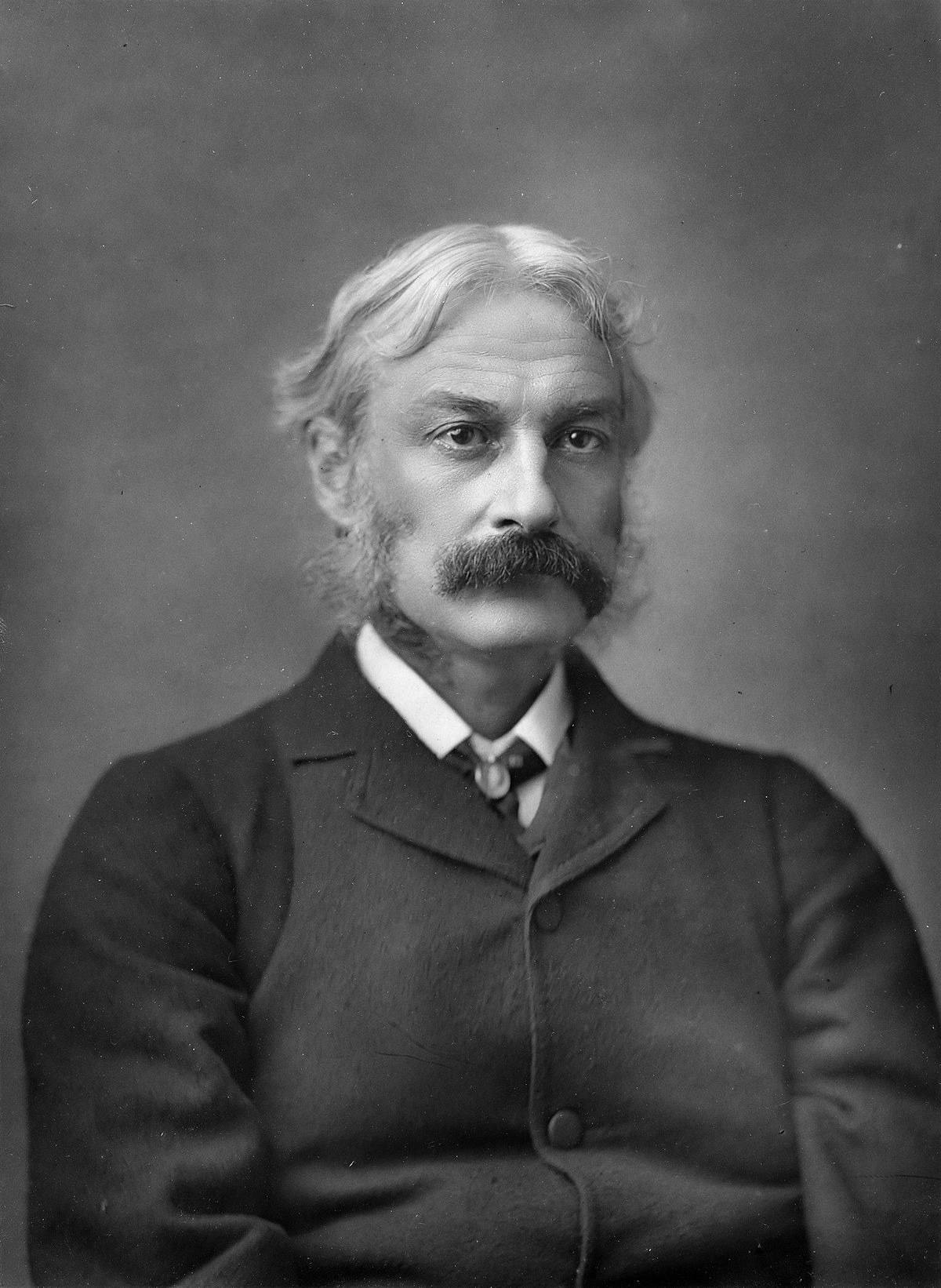
Andrew Lang, 1844-1912
For him, faërie was primarily a place – the so-called ‘Perilous Realm’. Putting aside the question of whether such a land or fairies really exist outside of imagination, Tolkien believed that possibly the concept and origin of faërie began with man as a sub-creator in triggering the ‘invention’ of a fairy tale. And that tale might have been born indirectly from hearsay or directly from personal experience; yet it would likely have possessed at least a nugget of truth. A genuine fairy tale always exhibits a magical face and is, more often than not, set in the land of Faërie. A place which is not only the natural habitation of fays (fairy folk to us) but, according to the Professor, also contains creatures such as:
“… elves and … dwarfs, witches, trolls, giants, or dragons: …”.
- The Monsters and the Critics and Other Essays, On Fairy-stories – pg. 113, HarperCollins, 1983
Tolkien made plain that for humans with a natural bent towards make-believe:
“Fantasy, the making or glimpsing of Other-worlds, was the heart of the desire of Faërie.”
– The Monsters and the Critics and Other Essays, On Fairy-stories – pg. 135, HarperCollins, 1983
Of great significance is his employment of the term: “Other-worlds”. Most notably it is delineated in plural form. And thus the case can be made that when engaged in creating his own fantasy, ‘Faërie’ was not in his mind limited to a singular ‘Other-world’. Yes, there could not be just a single faërie where all these fantastic creatures existed in some corner or at some time within its own chronological history. So for us, it is essential to grasp the concept of a multiplicity of otherworlds being present in Tolkien’s literature. These can simply be equated to secondary worlds, being distinct from our primary one.
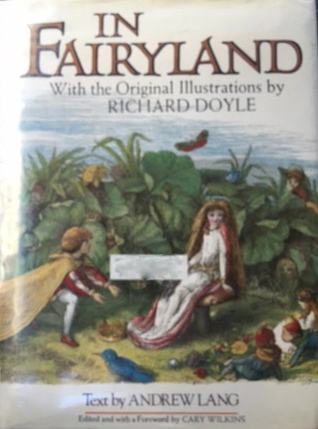
‘In Fairyland’, Andrew Lang, Originally illustrated 1870 (above 1979 reprint)
The most definite and obvious otherworld of his sub-created mythology is voiced in Bilbo’s poetic recital at Rivendell:
“… from Otherworld beyond the Sea …”.
– The Fellowship of the Ring, Many Meetings, Poem: Eärendil was a mariner
The fabled province of the ‘gods’, in which lay ‘Elvenhome’, and once part of the Primary World had, due to the transgressions of men, been sundered away into a separate otherworld. Initially termed as ‘Faëry’ in some of the earliest works of the mythology (see The Book of Lost Tales Vols. I & II) – by the time of The Hobbit it had become titled:
“… Faërie in the West.”
- The Hobbit, Flies and Spiders
Naturally, as the publication of The Hobbit was swiftly followed by the inception of The Lord of the Rings which in turn, early on, was hindered by preparation for the Andrew Lang Lecture, one might wonder whether multiple worlds in the forefront of Tolkien’s mind actively led to another jump in a developing mythology. After all, though witches, trolls, giants, dragons and other such fantastical beings ‘intrude’ into our Primary World – they really belong to Faërie; but for Tolkien, certainly not the ‘Faërie in the West’. Because the idyllic ‘Blessed Realm’ where:
“… naught faded nor withered, neither was there any stain upon flower or leaf in that land, nor any corruption or sickness in anything that lived; …”,
- The Silmarillion, Of the Beginning of Days
was wholly incompatible. I simply cannot emphasize that enough!
And so where exactly was the faërie of all those monsters and fay creatures? Was it just a place that resided in his mind, or the minds of other fairy tale inventors? Maybe – but Tolkien might well have thought there was more to the matter. A shred of doubt would have been enough to build upon. As such, I believe that for The Lord of the Rings Tolkien subcreated a faërie adjoining Middle-earth. One consistent with existing real-world mythology associated to the soil of England and nearby lands. Intimately connected to ‘Middle-earth Faërie’ (my coining) and central to the plan, was Tom Bombadil.
… more to come
Last edited by Priya on Sun Apr 27, 2025 6:36 pm, edited 1 time in total.
- Points: 4 777

Tree
Posts: 3136
Joined: Sun May 17, 2020 7:54 pm
Priya, this is so interesting. Thank you! Reading spurs various thoughts, but I don't wish to disturb your flow and so I may make a separate thread. One very minor quibble here. It seems to me worthwhile distinguishing between the 1939 Andrew Lang lecture and the 1947 essay that was worked out of it, composed in summer 1943. Flieger and Anderson present what appears to be the draft of the lecture, and there seems to be a big step from lecture to essay. I think you are quoting the essay composed 1943 to illustrate what Tolkien was thinking in 1939. Actually, my memory is that what you are quoting is also found in the 1939 lecture draft, but it is worth making sure.
The lecture was worked up in early 1939, and so pretty soon after writing the Bombadil chapters. The essay in summer 1943, after the story had reached the fall of Isengard and Pippin's encounter with Sauron in the Orthanc Stone. These years may possibly be the most creative of Tolkien's life, so it is worth considering if and how his own thought developed between lecture and essay.
The lecture was worked up in early 1939, and so pretty soon after writing the Bombadil chapters. The essay in summer 1943, after the story had reached the fall of Isengard and Pippin's encounter with Sauron in the Orthanc Stone. These years may possibly be the most creative of Tolkien's life, so it is worth considering if and how his own thought developed between lecture and essay.
Eat earth. Dig deep. Drink water.
- Points: 2 835
New Soul
Posts: 3110
Joined: Thu Sep 02, 2021 6:24 am
Priya: Indeed you have.  The more the merrier. *g* Widdershins? I never came across in the thirty years of the Legendarium reading. That is new to me. True the Barrowdawns never had my imagination really or better my appreciation. Mine starts really with the Fellowship and the Dwarf and Elf developing friendship. What is it with the photo of Andrew Lang? That puzzles me a bit.
  Did Prof. Tolkien hold a lecture about this writer that you know off?
Chrys: You don't disturb the flow. Feel welcome, I love your comment too to read and learn from.
The more the merrier. *g* Widdershins? I never came across in the thirty years of the Legendarium reading. That is new to me. True the Barrowdawns never had my imagination really or better my appreciation. Mine starts really with the Fellowship and the Dwarf and Elf developing friendship. What is it with the photo of Andrew Lang? That puzzles me a bit. Did Prof. Tolkien hold a lecture about this writer that you know off? Chrys: You don't disturb the flow. Feel welcome, I love your comment too to read and learn from.
Just call me Aiks or Aikári. Notify is off.
Find me stuff in Gondolin.
And let us embark to Valinor!
Find me stuff in Gondolin.
And let us embark to Valinor!
- Points: 4 777
Tree
Posts: 3136
Joined: Sun May 17, 2020 7:54 pm
Aiks, each year the University of St Andrews in Scotland hosts an annual Andrew Lang lecture, and in 1939 the speaker was J.R.R. Tolkien. He gave a lecture on fairy-stories and, in 1943, worked the lecture up into the essay 'On Fairy-stories'. Andrew Lang was a late-Victorian/Edwardian folklorist, who became famous because he and his wife edited the coloured fairy-story collections that Tolkien's generation grew up with as children. (Of these, the Blue Fairy Book was the first and is the one dissected by Tolkien in his lecture.)
Eat earth. Dig deep. Drink water.
- Points: 2 835
New Soul
Posts: 3110
Joined: Thu Sep 02, 2021 6:24 am
Chrys: I know of that speech Tolkien gave and worked it even out in a story segment of Wolf von Wittgenberg for one of the Cottage Contests. Was that an Andrew Lang Lecture moment? Oh I never knew it that detail. Thanks for the connection! How stupid of me... 
Just call me Aiks or Aikári. Notify is off.
Find me stuff in Gondolin.
And let us embark to Valinor!
Find me stuff in Gondolin.
And let us embark to Valinor!
- Points: 4 777
Tree
Posts: 3136
Joined: Sun May 17, 2020 7:54 pm
Hoi @Priya, where are you? You always post in (my) morning around breakfast time. I was hoping to read the next Bombadil installment with my porridge!
Eat earth. Dig deep. Drink water.
- Points: 932
New Soul
Posts: 368
Joined: Wed Jun 22, 2022 1:00 am
Hello Chrysophylax Dives
Yes, the actual contents of The Lecture are a little sketchy. But I seem to recall that what I quoted as being part of the Lecture material actually made it in. I will have to go back and double check that is the case. But thanks for pointing out to readers of this thread that the OFS essay in The Monsters and the Critics and Other Essays was a result of a couple of updates - separated by several years.
I’m in California.
Eating porridge? With Goldilocks, or the three bears?
… continued from my previous post
Yet one might ask:
‘Why bother? Was it absolutely necessary to create another faërie? And where is the proof?’
The first part to answering the above is bound to ‘his’ Elves. Needed to be dealt with was the dilemma posed by those elves who chose to remain in Middle-earth after the Third Age. Those that had:
“… long before made their irrevocable choice, preferring Middle-earth to paradise …”.
– The Letters of J.R.R. Tolkien, Letter #154 – 25 September 1954, Edited by H. Carpenter, 1981
What happened to them? Where did these immortals go? Where are they now? Believable answers had to be provided. And believability is probably what spurred him to change their fate* for The Lord of the Rings. Though Tolkien never provided explicit and detailed explanations**, nevertheless he left sufficient clues.
The spirit to body relationship for Elves was different than mankind’s. Repeatedly we were told that elven spirits slowly consumed their physical bodies from within. To mortal eyes – they faded.
But their bodies did not fade into nothingness. Instead, I contend, Tolkien eventually*** came up with the idea of them fading into another dimension: what I have termed Middle-earth Faërie. Such that in the Primary World they eventually became:
“The Lingerers whose bodily forms could no longer be seen by us mortals, or seen only dimly and fitfully.”
- Morgoth’s Ring, The Later Quenta Silmarillion 2 – pg. 224, 1993
And we know their disappearance occurred after:
“… the Third Age …” which was “… a Twilight Age, a Medium Aevum, the first of the broken and changed world; the last of the lingering dominion of visible fully incarnate Elves, …”.
- The Letters of J.R.R. Tolkien, Letter #131 – late 1951, Edited by H. Carpenter, 1981
Yes, Eru had to have provided a fitting place (after the Third Age) for his longeval and beloved First Born – enamored with Middle-earth and unwilling to forsake it:
“The ‘waning’ of the Elvish hroar must therefore be part of the History of Arda as envisaged by Eru, …”.
- Morgoth’s Ring, Athrabeth Finrod ah Andreth – pg. 342, 1993 (Tolkien’s emphasis)
The second part to satisfying those previous presumed questions again reverts back to Tolkien’s basic desire to blend in some of the most ancient folklore and legends of the European continent and thus provide coherent mythological roots. His famous denial of C.S. Lewis’s:
“… myths are lies, even though lies breathed through silver.”, - Tolkien A biography, Jack – pg. 147, H. Carpenter, 1977
left him to search deeply for those elusive and hidden grains of ‘truth’.
Absolutely necessary then, would be the presence of historical connections to our own world. After all, if there was little to nothing ancestral in common – we might as well be reading a story set on an entirely make-believe planet. Yes, maybe one similar to Earth, but certainly not authentic, nor one we could happily relate to or empathize with:
“I have … constructed an imaginary time, but kept my feet on my own mother-earth for place. I prefer that to the contemporary mode of seeking remote globes in ‘space’. However curious, they are alien, and not lovable with the love of blood-kin.”
– The Letters of J.R.R. Tolkien, Letter #211 – 14 October 1958, Edited by H. Carpenter, 1981
Then it was those historic links which were so essential. And this aim could best be achieved by entangling some of our world’s records of ancient myth, legends, folklore and fairy tales deeply into his own storyline. To be maintained was:
“… the literary pretence of historicity and dependence on record …”.
- The Letters of J.R.R. Tolkien, Letter #129 – 10 September 1950, Edited by H. Carpenter, 1981 (my underlined emphasis)
Then what were the instances where the land of Faërie pops out to the forefront in our early literature? Where exactly does a close-quarters faërie loom large?
Actually the records are reasonably numerous and there is sufficient evidence Tolkien knew all below and others too:
(a) Thomas the Rhymer being carried off into fairyland upon the Queen of Faërie’s milk-white steed.
(b) Pwyll, Prince of Dyfed, entering Annwn while lost in a magical fog and spending a year in the Welsh otherworld per the Mabinogion.
(c) Sir Orfeo entering the realm of Faërie.
(d) King Arthur’s Avalon – described as both across the water in the west but also at Glastonbury Tor.
(e) The ‘Land below Woolpit’ where two legendary green children emerged according to Ralph of Coggeshall.
(f) The fabled realm below hilly mounds in the legends of the Celtic Tuatha-de-Dannan.

What we need to recognize is that access to a local land-situated kind of faërie has been extensively reported. And in times close to our own – far off from Tolkien’s mythic Ages. It is observable such reports were replete with creatures just like the Professor’s elves.
… more to come
* We can glean this from the chronological development of the ‘Doom of Mandos’.
Before The Lord of the Rings ~1937:
“Slain or fading their spirits went back to the halls of Mandos …”.
– The Shaping of Middle-earth, The Quenta IV – pg. 100
“… slain or wasted with grief, they died not from the earth, and their spirits went back to the halls of Mandos, …”.
– The Lost Road and other Writings, Quenta Silmarillion – pg. 247
But by 1958, after the publication of The Lord of the Rings:
“ ‘… those that endure in Middle-earth … shall wane, and become as shadows of regret …’ ”.
- Morgoth’s Ring, The Annals of Aman – pg. 118, 1993
** It must be emphasized that the various manuscripts making up the ‘Histories of the Elves’ (and Tolkien’s notes pertaining to them) are of the ‘Elder Days’. At this stage the phenomenon of ‘fading’ was a far future event. It is hinted that even the Valar were not fully aware of Eru’s plan. After Tolkien had ‘completed’The Lord of the Rings and set it aside, we have ~1951:
“And some have said that the Vision ceased ere … the fading of the Firstborn; …”.
- Morgoth’s Ring, Ainulindale Version D – pg. 31, 1993
So it was impossible for Tolkien to have been too explicit on this matter. For even by the Third Age, ‘fading’ had not occurred to any significant degree. But in later times, closer to our own, we can reconcile the elves in an otherworld per Smith of Wootton Major and the elves in ‘Faërie’ per On Fairy-stories as those once of Middle-earth faded into another dimension. The existence of a secondary Faërie then neatly, and completely ties up all of Tolkien’s mythological writings as regards the fate of the remaining Middle-earth elves.
*** The contention is that Tolkien abandoned the idea of elves (interchangeably termed fairies) becoming:
“… small and tenuous, filmy and transparent …”.
– The Book of Lost Tales 2, The History of Eriol or Aelfwine – pg. 326
Because the reason for such changes, namely the waxing of men, simply wasn’t credible.
Yes, the actual contents of The Lecture are a little sketchy. But I seem to recall that what I quoted as being part of the Lecture material actually made it in. I will have to go back and double check that is the case. But thanks for pointing out to readers of this thread that the OFS essay in The Monsters and the Critics and Other Essays was a result of a couple of updates - separated by several years.
I’m in California.
Eating porridge? With Goldilocks, or the three bears?
—————
… continued from my previous post
Yet one might ask:
‘Why bother? Was it absolutely necessary to create another faërie? And where is the proof?’
The first part to answering the above is bound to ‘his’ Elves. Needed to be dealt with was the dilemma posed by those elves who chose to remain in Middle-earth after the Third Age. Those that had:
“… long before made their irrevocable choice, preferring Middle-earth to paradise …”.
– The Letters of J.R.R. Tolkien, Letter #154 – 25 September 1954, Edited by H. Carpenter, 1981
What happened to them? Where did these immortals go? Where are they now? Believable answers had to be provided. And believability is probably what spurred him to change their fate* for The Lord of the Rings. Though Tolkien never provided explicit and detailed explanations**, nevertheless he left sufficient clues.
The spirit to body relationship for Elves was different than mankind’s. Repeatedly we were told that elven spirits slowly consumed their physical bodies from within. To mortal eyes – they faded.
But their bodies did not fade into nothingness. Instead, I contend, Tolkien eventually*** came up with the idea of them fading into another dimension: what I have termed Middle-earth Faërie. Such that in the Primary World they eventually became:
“The Lingerers whose bodily forms could no longer be seen by us mortals, or seen only dimly and fitfully.”
- Morgoth’s Ring, The Later Quenta Silmarillion 2 – pg. 224, 1993
And we know their disappearance occurred after:
“… the Third Age …” which was “… a Twilight Age, a Medium Aevum, the first of the broken and changed world; the last of the lingering dominion of visible fully incarnate Elves, …”.
- The Letters of J.R.R. Tolkien, Letter #131 – late 1951, Edited by H. Carpenter, 1981
Yes, Eru had to have provided a fitting place (after the Third Age) for his longeval and beloved First Born – enamored with Middle-earth and unwilling to forsake it:
“The ‘waning’ of the Elvish hroar must therefore be part of the History of Arda as envisaged by Eru, …”.
- Morgoth’s Ring, Athrabeth Finrod ah Andreth – pg. 342, 1993 (Tolkien’s emphasis)
The second part to satisfying those previous presumed questions again reverts back to Tolkien’s basic desire to blend in some of the most ancient folklore and legends of the European continent and thus provide coherent mythological roots. His famous denial of C.S. Lewis’s:
“… myths are lies, even though lies breathed through silver.”, - Tolkien A biography, Jack – pg. 147, H. Carpenter, 1977
left him to search deeply for those elusive and hidden grains of ‘truth’.
Absolutely necessary then, would be the presence of historical connections to our own world. After all, if there was little to nothing ancestral in common – we might as well be reading a story set on an entirely make-believe planet. Yes, maybe one similar to Earth, but certainly not authentic, nor one we could happily relate to or empathize with:
“I have … constructed an imaginary time, but kept my feet on my own mother-earth for place. I prefer that to the contemporary mode of seeking remote globes in ‘space’. However curious, they are alien, and not lovable with the love of blood-kin.”
– The Letters of J.R.R. Tolkien, Letter #211 – 14 October 1958, Edited by H. Carpenter, 1981
Then it was those historic links which were so essential. And this aim could best be achieved by entangling some of our world’s records of ancient myth, legends, folklore and fairy tales deeply into his own storyline. To be maintained was:
“… the literary pretence of historicity and dependence on record …”.
- The Letters of J.R.R. Tolkien, Letter #129 – 10 September 1950, Edited by H. Carpenter, 1981 (my underlined emphasis)
Then what were the instances where the land of Faërie pops out to the forefront in our early literature? Where exactly does a close-quarters faërie loom large?
Actually the records are reasonably numerous and there is sufficient evidence Tolkien knew all below and others too:
(a) Thomas the Rhymer being carried off into fairyland upon the Queen of Faërie’s milk-white steed.
(b) Pwyll, Prince of Dyfed, entering Annwn while lost in a magical fog and spending a year in the Welsh otherworld per the Mabinogion.
(c) Sir Orfeo entering the realm of Faërie.
(d) King Arthur’s Avalon – described as both across the water in the west but also at Glastonbury Tor.
(e) The ‘Land below Woolpit’ where two legendary green children emerged according to Ralph of Coggeshall.
(f) The fabled realm below hilly mounds in the legends of the Celtic Tuatha-de-Dannan.
‘Riders of the Sidhe’, John Duncan, 1911
What we need to recognize is that access to a local land-situated kind of faërie has been extensively reported. And in times close to our own – far off from Tolkien’s mythic Ages. It is observable such reports were replete with creatures just like the Professor’s elves.
… more to come
* We can glean this from the chronological development of the ‘Doom of Mandos’.
Before The Lord of the Rings ~1937:
“Slain or fading their spirits went back to the halls of Mandos …”.
– The Shaping of Middle-earth, The Quenta IV – pg. 100
“… slain or wasted with grief, they died not from the earth, and their spirits went back to the halls of Mandos, …”.
– The Lost Road and other Writings, Quenta Silmarillion – pg. 247
But by 1958, after the publication of The Lord of the Rings:
“ ‘… those that endure in Middle-earth … shall wane, and become as shadows of regret …’ ”.
- Morgoth’s Ring, The Annals of Aman – pg. 118, 1993
** It must be emphasized that the various manuscripts making up the ‘Histories of the Elves’ (and Tolkien’s notes pertaining to them) are of the ‘Elder Days’. At this stage the phenomenon of ‘fading’ was a far future event. It is hinted that even the Valar were not fully aware of Eru’s plan. After Tolkien had ‘completed’The Lord of the Rings and set it aside, we have ~1951:
“And some have said that the Vision ceased ere … the fading of the Firstborn; …”.
- Morgoth’s Ring, Ainulindale Version D – pg. 31, 1993
So it was impossible for Tolkien to have been too explicit on this matter. For even by the Third Age, ‘fading’ had not occurred to any significant degree. But in later times, closer to our own, we can reconcile the elves in an otherworld per Smith of Wootton Major and the elves in ‘Faërie’ per On Fairy-stories as those once of Middle-earth faded into another dimension. The existence of a secondary Faërie then neatly, and completely ties up all of Tolkien’s mythological writings as regards the fate of the remaining Middle-earth elves.
*** The contention is that Tolkien abandoned the idea of elves (interchangeably termed fairies) becoming:
“… small and tenuous, filmy and transparent …”.
– The Book of Lost Tales 2, The History of Eriol or Aelfwine – pg. 326
Because the reason for such changes, namely the waxing of men, simply wasn’t credible.
Last edited by Priya on Sun Apr 27, 2025 7:31 pm, edited 2 times in total.
- Points: 4 777
Tree
Posts: 3136
Joined: Sun May 17, 2020 7:54 pm
Three bears are all out, at school and the like. Goldilocks has vanished. And once again my porridge is cold!
But cold porridge is a small price to pay. I am liking this very much so far, Priya.
:)
But cold porridge is a small price to pay. I am liking this very much so far, Priya.
:)
Eat earth. Dig deep. Drink water.
- Points: 932
New Soul
Posts: 368
Joined: Wed Jun 22, 2022 1:00 am
Recognizing the Closeness of Faërie
Postulating the existence of other worlds might be all fine and dandy – but one is entitled to ask:
‘Where is the evidence of a ‘Middle-earth Faërie’ in The Lord of the Rings, and how does Bombadil fit in?’
The answers to both questions have will be greatly expanded on in the next few posts. On my part, Tom has consistently been advocated as a fleshed-out manifestation of a faërie-being throughout my output so far. But to aid our understanding, I need to revisit Tom’s dwelling and its location.
Tom’s residence lay, I surmise, on the very boundary of two worlds. Those being our Primary World and the one I loosely describe as Middle-earth Faërie. For us considering the matter – a leading remark in The Lord of the Rings, which other scholars have picked up on, is the crossing of a seemingly magical threshold in passing through Tom’s doorway. The manner of description has a teasing hint of the supernatural to it:
“… the hobbits stood upon the threshold and a golden light was all about them.”
– The Fellowship of the Ring, In the House of Tom Bombadil
Another hint is the ‘coincidental’ meeting of the hobbits and Tom in the Old Forest:
“ ‘… Just chance brought me then, if chance you call it. …’ ”.
– The Fellowship of the Ring, In the House of Tom Bombadil
In discussing fairies (interchangeably termed elves), seemingly this encounter was echoed in On Fairy-stories:
“Our fates are sundered, and our paths seldom meet. Even upon the borders of Faërie we encounter them only at some chance crossing of the ways.”
– The Monsters and the Critics and Other Essays, On Fairy-stories – pg. 113, HarperCollins, 1983 (my underlined emphasis)
Perhaps as well as elves, Tolkien had Tom in mind. Especially because he was simultaneously drafting him into The Lords of the Rings as well as preparing his Andrew Lang address:
“Most good ‘fairy-stories’ are about the aventures of men in the Perilous Realm or upon its shadowy marches.”
– The Monsters and the Critics and Other Essays, On Fairy-stories – pg. 113, HarperCollins, 1983 (Tolkien’s italicized emphasis on ‘aventures’, French for ‘adventures’, it also has other connotations in Middle-English & Latin)
Was the hobbits’ escape from the malevolent Old Forest followed by a dreamlike trek to Tom’s abode – effectively on the shadowy marches of the Perilous Realm? The problem faced by the inquisitive scholar, trying all too hard to extract the truth from The Lord of the Rings, and summarized so neatly by Tolkien is that:
“It is difficult to define the boundaries of this realm.”
– Tolkien On Fairy-stories, Manuscript B MS. 6 F 12 – pg. 262, V. Flieger & D. Anderson, 2014
Unfortunately, there is:
“… no password or signpost that will announce infallibly when the border is crossed.”
– Tolkien On Fairy-stories, Manuscript B MS. 6 F 15 – pg. 265, V. Flieger & D. Anderson, 2014
All on offer, as a meager clue, that a crossing had been made was:
“Magic (even if not explicitly named) is one of the tokens by which you shall know it: …”.
– Tolkien On Fairy-stories, Manuscript B MS. 6 F 16 – pg. 266, V. Flieger & D. Anderson, 2014
One had to recognize that not only:
“Over the border there will be magic, though it will not always be open or named.”,
– Tolkien On Fairy-stories, Manuscript B MS. 6 F 15 – pg. 265, V. Flieger & D. Anderson, 2014
but pointedly according to other thoughts:
“On the border there would be Magic …”.
– Tolkien On Fairy-stories, Manuscript B MS. 6 F 10 – pg. 259, V. Flieger & D. Anderson, 2014
Some readers will probably disagree – but arguably the most magical place depicted in any part of the novel was Tom’s residential zone. Though what appears to be ‘magic’ is used elsewhere, never was it employed so often or as astonishingly as during the travelers’ short stay.
To those not in the know, potent magic must have been invoked by Tom to keep rainfall off all but his boots. Making the ring vanish having rendered it ineffectual must have astounded the hobbits. It must have seemed like the most powerful sorcery of all. And then there is that dreamlike vision of the Undying Lands which only happened once throughout Frodo’s travels. Its description and occurrence in Tom’s presence matches, better than anything else, Tolkien’s own definition of a ‘Faërian Drama’ in On Fairy-stories. So collectively, surely these were unmistakable trademarks of Faërie! Had Frodo and company crossed over the border? Probably not – but they must have been really, really close!
Subtle is the best way to describe Tolkien’s methodology. A substratal detail such as the smell of ‘apple-wood’ burning in Tom’s hearth teases the knowledgeable. Yet though the aroma is from a fruit tree connected to both the fairy lore* of the Celts and even more strongly with the Arthurian otherworld Avalon: The Island of Apples – the fragrance is too soft an undertone to use as absolute proof. Yet perhaps I should not be hasty – and neglect philological inquiry into a Celtic otherworld which:
“Like the gardens of the Hesperides is the ‘insula pomorum** quae fortunata vocatur,’ v. Merlini p. 393; conf. the sacred apple-wood, …”.
– Teutonic Mythology, Volume IV, Chapter XXV – pg. 1545, J. Grimm – translated by J. Stallybrass, 1888
After all, based on material in Geoffrey of Monmouth’s Vita Merlini, madness came upon Merlin (Myrddin) who retreated to the woods to become a kind of wild man. While that account conveyed a composite personality of madman, seer and bard, notably the legendary wizard also had a relationship with a water-entity: The Lady of the Lake. Indeed then – characterized shades allotted to Bombadil are hard to dismiss!
*Apple-tree wood, a female fairy and the Celtic otherworld are all linked:
“… a silver branch of the sacred apple-tree bearing blossoms … borne by the Fairy Woman is a passport to Tír N-aill; …”.
- The Fairy-Faith in Celtic Countries, Chapter VI, W.Y. Evans-Wentz, 1911 (Tír N-aill is the Celtic otherworld)
Thus the burning of apple-wood in a hearth adjacent to where Goldberry had sat is potentially a sign of access to Faërie being near at hand.
** ‘Insula Pomorum’ (Isle of Apples) as Tolkien referred to it in The Fall of Arthur (see The J.R.R. Tolkien Companion and Guide, Reader’s Guide 2017 Edition, The Fall of Arthur by Christina Scull & Wayne Hammond).
Postulating the existence of other worlds might be all fine and dandy – but one is entitled to ask:
‘Where is the evidence of a ‘Middle-earth Faërie’ in The Lord of the Rings, and how does Bombadil fit in?’
The answers to both questions have will be greatly expanded on in the next few posts. On my part, Tom has consistently been advocated as a fleshed-out manifestation of a faërie-being throughout my output so far. But to aid our understanding, I need to revisit Tom’s dwelling and its location.
Tom’s residence lay, I surmise, on the very boundary of two worlds. Those being our Primary World and the one I loosely describe as Middle-earth Faërie. For us considering the matter – a leading remark in The Lord of the Rings, which other scholars have picked up on, is the crossing of a seemingly magical threshold in passing through Tom’s doorway. The manner of description has a teasing hint of the supernatural to it:
“… the hobbits stood upon the threshold and a golden light was all about them.”
– The Fellowship of the Ring, In the House of Tom Bombadil
Another hint is the ‘coincidental’ meeting of the hobbits and Tom in the Old Forest:
“ ‘… Just chance brought me then, if chance you call it. …’ ”.
– The Fellowship of the Ring, In the House of Tom Bombadil
In discussing fairies (interchangeably termed elves), seemingly this encounter was echoed in On Fairy-stories:
“Our fates are sundered, and our paths seldom meet. Even upon the borders of Faërie we encounter them only at some chance crossing of the ways.”
– The Monsters and the Critics and Other Essays, On Fairy-stories – pg. 113, HarperCollins, 1983 (my underlined emphasis)
Perhaps as well as elves, Tolkien had Tom in mind. Especially because he was simultaneously drafting him into The Lords of the Rings as well as preparing his Andrew Lang address:
“Most good ‘fairy-stories’ are about the aventures of men in the Perilous Realm or upon its shadowy marches.”
– The Monsters and the Critics and Other Essays, On Fairy-stories – pg. 113, HarperCollins, 1983 (Tolkien’s italicized emphasis on ‘aventures’, French for ‘adventures’, it also has other connotations in Middle-English & Latin)
Was the hobbits’ escape from the malevolent Old Forest followed by a dreamlike trek to Tom’s abode – effectively on the shadowy marches of the Perilous Realm? The problem faced by the inquisitive scholar, trying all too hard to extract the truth from The Lord of the Rings, and summarized so neatly by Tolkien is that:
“It is difficult to define the boundaries of this realm.”
– Tolkien On Fairy-stories, Manuscript B MS. 6 F 12 – pg. 262, V. Flieger & D. Anderson, 2014
Unfortunately, there is:
“… no password or signpost that will announce infallibly when the border is crossed.”
– Tolkien On Fairy-stories, Manuscript B MS. 6 F 15 – pg. 265, V. Flieger & D. Anderson, 2014
A Non-directional Signpost?
All on offer, as a meager clue, that a crossing had been made was:
“Magic (even if not explicitly named) is one of the tokens by which you shall know it: …”.
– Tolkien On Fairy-stories, Manuscript B MS. 6 F 16 – pg. 266, V. Flieger & D. Anderson, 2014
One had to recognize that not only:
“Over the border there will be magic, though it will not always be open or named.”,
– Tolkien On Fairy-stories, Manuscript B MS. 6 F 15 – pg. 265, V. Flieger & D. Anderson, 2014
but pointedly according to other thoughts:
“On the border there would be Magic …”.
– Tolkien On Fairy-stories, Manuscript B MS. 6 F 10 – pg. 259, V. Flieger & D. Anderson, 2014
Some readers will probably disagree – but arguably the most magical place depicted in any part of the novel was Tom’s residential zone. Though what appears to be ‘magic’ is used elsewhere, never was it employed so often or as astonishingly as during the travelers’ short stay.
To those not in the know, potent magic must have been invoked by Tom to keep rainfall off all but his boots. Making the ring vanish having rendered it ineffectual must have astounded the hobbits. It must have seemed like the most powerful sorcery of all. And then there is that dreamlike vision of the Undying Lands which only happened once throughout Frodo’s travels. Its description and occurrence in Tom’s presence matches, better than anything else, Tolkien’s own definition of a ‘Faërian Drama’ in On Fairy-stories. So collectively, surely these were unmistakable trademarks of Faërie! Had Frodo and company crossed over the border? Probably not – but they must have been really, really close!
Subtle is the best way to describe Tolkien’s methodology. A substratal detail such as the smell of ‘apple-wood’ burning in Tom’s hearth teases the knowledgeable. Yet though the aroma is from a fruit tree connected to both the fairy lore* of the Celts and even more strongly with the Arthurian otherworld Avalon: The Island of Apples – the fragrance is too soft an undertone to use as absolute proof. Yet perhaps I should not be hasty – and neglect philological inquiry into a Celtic otherworld which:
“Like the gardens of the Hesperides is the ‘insula pomorum** quae fortunata vocatur,’ v. Merlini p. 393; conf. the sacred apple-wood, …”.
– Teutonic Mythology, Volume IV, Chapter XXV – pg. 1545, J. Grimm – translated by J. Stallybrass, 1888
After all, based on material in Geoffrey of Monmouth’s Vita Merlini, madness came upon Merlin (Myrddin) who retreated to the woods to become a kind of wild man. While that account conveyed a composite personality of madman, seer and bard, notably the legendary wizard also had a relationship with a water-entity: The Lady of the Lake. Indeed then – characterized shades allotted to Bombadil are hard to dismiss!
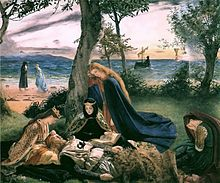
‘The Death of King Arthur in Avalon’, James Archer, 1860
*Apple-tree wood, a female fairy and the Celtic otherworld are all linked:
“… a silver branch of the sacred apple-tree bearing blossoms … borne by the Fairy Woman is a passport to Tír N-aill; …”.
- The Fairy-Faith in Celtic Countries, Chapter VI, W.Y. Evans-Wentz, 1911 (Tír N-aill is the Celtic otherworld)
Thus the burning of apple-wood in a hearth adjacent to where Goldberry had sat is potentially a sign of access to Faërie being near at hand.
** ‘Insula Pomorum’ (Isle of Apples) as Tolkien referred to it in The Fall of Arthur (see The J.R.R. Tolkien Companion and Guide, Reader’s Guide 2017 Edition, The Fall of Arthur by Christina Scull & Wayne Hammond).
Last edited by Priya on Sun Apr 27, 2025 7:03 pm, edited 1 time in total.
- Points: 2 835
New Soul
Posts: 3110
Joined: Thu Sep 02, 2021 6:24 am
I think we have been blown off course in the discussion? Or are we returning to where we were before?
Just call me Aiks or Aikári. Notify is off.
Find me stuff in Gondolin.
And let us embark to Valinor!
Find me stuff in Gondolin.
And let us embark to Valinor!
- Points: 932
New Soul
Posts: 368
Joined: Wed Jun 22, 2022 1:00 am
Hello Aiks
I know I’ve side-tracked a bit. However my intent was to lay a foundation for the revelations to come. Another Faërie and the Bombadils being linked to it, will help us understand the Barrow-downs adventure a little more clearly. At least that is my hope!
Sorry for being so long-winded.
Part 1 - The Legendary Fairy-mound
‘Belt-up Tom! Belt-up as a knight should when going into battle against the forces of evil. And wear that precious belt every day – for who knows when the wicked will strike!’
Is that the advice Tolkien would have given his beloved creation? Hmm … what exactly lay underneath that bright blue jacket? What held up his ‘green’ stockings that The Lord of the Rings reader should have been told – and that Tolkien full well knew?
The Professor belatedly revealed the source of Tom’s near-invincibility in 1962 many years after The Lord of the Rings was published. Oh no, the updated The Adventures of Tom Bombadil poem cannot be ignored. It is unquestionably part of the mythology and most definitely inseparable from it. Tom’s possession of a very particular belt meant a hidden power protected him when worn:
“… green were his girdle …”.
– The Adventures of Tom Bombadil, 1962 release (my underlined emphasis)
Because the girdle was ‘green’, we must heed Tolkien's 1925 note in Sir Gawain and the Green Knight:
“… green was a fairy colour, …”.
- Sir Gawain and the Green Knight, pg. 86 line 151, J.R.R. Tolkien and E.V. Gordon, 1925
Undoubtedly the girdle, in Tolkien’s mind, the same as the one owned by the wife of Lord Bertilak of Hautdesert – a fay (fairy) creature from the medieval Sir Gawain and the Green Knight tale. The legendary girdle itself was a potent source of defense, shielding its wearer (under specific terms) from being slain in combat or else how:
“For whoever goes girdled with this green riband, while he keeps it well clasped closely about him, there is none so hardy under heaven that to hew him were able; for he could not be killed by any cunning of hand.”
– ‘Sir Gawain and the Green Knight’, W.P. Ker Lecture Paper, 1953

Taught by Tolkien at Leeds and Oxford over many years, and the subject of his own published academic views, the Arthurian romance was one which he could justly claim to be an expert of. It seems that once again Tolkien’s desire to link ancient fairy tale to his own myth is exhibited through selection of this fabled article. Who was the original owner, he must surely have pondered while studying Sir Gawain and the Green Knight? Where did it come from and how was it passed on? Was it handed down to Bertilak by another fay owner? Though I have speculatively provided answers, perhaps it doesn’t really matter. What we now know with almost absolute certainty is that Tom once possessed it.
Tom in the tale was so cocksure of himself. Maybe some of the swagger came from a concealed item of clothing. Endowed with a miraculous quality, its magic could only be overcome by someone mightier than the one who had placed the enchantment or by deceitful guile. Despite Lady Bertilak’s claim, those were the usual provisos.
Yet the chances are it wasn’t just the green girdle which was pulled from Sir Gawain and the Green Knight and surreptitiously absorbed into The Lord of the Rings mythology. A strong suspicion exists that Tolkien also represented Sir Gawain’s quest destination: the ‘Green Chapel’. Subtly placed in the Barrow-downs adventure are indications of a similar sacred feature in the landscape.
In Sir Gawain and the Green Knight – the Green Chapel in Tolkien’s own words was:
“… nothing else than a fairy mound; …”.
– Sir Gawain and the Green Knight, Note to Line 151, J.R.R. Tolkien & E.V. Gordon, 1925
“… a hollow green mound.”
- Sir Gawain and the Green Knight, Introduction – pg. ix, J.R.R. Tolkien & E.V. Gordon, 1925
It was barely more than a hillock of grass featuring a depression. As such, the eerie location resonates with the shallow hill which the hobbits encountered soon after leaving Tom and Goldberry:
“About mid-day they came to a hill whose top was wide and flattened, like a shallow saucer …”.
– The Fellowship of the Ring, Fog on the Barrow-downs
The slope being mild enough to ride their ponies up meant that it was just a gentle tumulus. After riding across they decided to turn and descend:
“ … into the hollow circle.”
– The Fellowship of the Ring, Fog on the Barrow-downs
Be that as it may, this too was a hallowed place with its single stone standing ominously in the hollow’s center. Yet not sacred to pagans (or obviously Christians) – but instead to fairy-folk. For I believe this was pictured as another ‘fairy mound’. And it was to Celtic legends that Tolkien turned for the halt in the journey.
…. to be continued
I know I’ve side-tracked a bit. However my intent was to lay a foundation for the revelations to come. Another Faërie and the Bombadils being linked to it, will help us understand the Barrow-downs adventure a little more clearly. At least that is my hope!
Sorry for being so long-winded.
—————
Sir Tom and the Green Hill at Night
Part 1 - The Legendary Fairy-mound
‘Belt-up Tom! Belt-up as a knight should when going into battle against the forces of evil. And wear that precious belt every day – for who knows when the wicked will strike!’
Is that the advice Tolkien would have given his beloved creation? Hmm … what exactly lay underneath that bright blue jacket? What held up his ‘green’ stockings that The Lord of the Rings reader should have been told – and that Tolkien full well knew?
The Professor belatedly revealed the source of Tom’s near-invincibility in 1962 many years after The Lord of the Rings was published. Oh no, the updated The Adventures of Tom Bombadil poem cannot be ignored. It is unquestionably part of the mythology and most definitely inseparable from it. Tom’s possession of a very particular belt meant a hidden power protected him when worn:
“… green were his girdle …”.
– The Adventures of Tom Bombadil, 1962 release (my underlined emphasis)
Because the girdle was ‘green’, we must heed Tolkien's 1925 note in Sir Gawain and the Green Knight:
“… green was a fairy colour, …”.
- Sir Gawain and the Green Knight, pg. 86 line 151, J.R.R. Tolkien and E.V. Gordon, 1925
Undoubtedly the girdle, in Tolkien’s mind, the same as the one owned by the wife of Lord Bertilak of Hautdesert – a fay (fairy) creature from the medieval Sir Gawain and the Green Knight tale. The legendary girdle itself was a potent source of defense, shielding its wearer (under specific terms) from being slain in combat or else how:
“For whoever goes girdled with this green riband, while he keeps it well clasped closely about him, there is none so hardy under heaven that to hew him were able; for he could not be killed by any cunning of hand.”
– ‘Sir Gawain and the Green Knight’, W.P. Ker Lecture Paper, 1953
Taught by Tolkien at Leeds and Oxford over many years, and the subject of his own published academic views, the Arthurian romance was one which he could justly claim to be an expert of. It seems that once again Tolkien’s desire to link ancient fairy tale to his own myth is exhibited through selection of this fabled article. Who was the original owner, he must surely have pondered while studying Sir Gawain and the Green Knight? Where did it come from and how was it passed on? Was it handed down to Bertilak by another fay owner? Though I have speculatively provided answers, perhaps it doesn’t really matter. What we now know with almost absolute certainty is that Tom once possessed it.
Tom in the tale was so cocksure of himself. Maybe some of the swagger came from a concealed item of clothing. Endowed with a miraculous quality, its magic could only be overcome by someone mightier than the one who had placed the enchantment or by deceitful guile. Despite Lady Bertilak’s claim, those were the usual provisos.
Yet the chances are it wasn’t just the green girdle which was pulled from Sir Gawain and the Green Knight and surreptitiously absorbed into The Lord of the Rings mythology. A strong suspicion exists that Tolkien also represented Sir Gawain’s quest destination: the ‘Green Chapel’. Subtly placed in the Barrow-downs adventure are indications of a similar sacred feature in the landscape.
In Sir Gawain and the Green Knight – the Green Chapel in Tolkien’s own words was:
“… nothing else than a fairy mound; …”.
– Sir Gawain and the Green Knight, Note to Line 151, J.R.R. Tolkien & E.V. Gordon, 1925
“… a hollow green mound.”
- Sir Gawain and the Green Knight, Introduction – pg. ix, J.R.R. Tolkien & E.V. Gordon, 1925
It was barely more than a hillock of grass featuring a depression. As such, the eerie location resonates with the shallow hill which the hobbits encountered soon after leaving Tom and Goldberry:
“About mid-day they came to a hill whose top was wide and flattened, like a shallow saucer …”.
– The Fellowship of the Ring, Fog on the Barrow-downs
The slope being mild enough to ride their ponies up meant that it was just a gentle tumulus. After riding across they decided to turn and descend:
“ … into the hollow circle.”
– The Fellowship of the Ring, Fog on the Barrow-downs
Be that as it may, this too was a hallowed place with its single stone standing ominously in the hollow’s center. Yet not sacred to pagans (or obviously Christians) – but instead to fairy-folk. For I believe this was pictured as another ‘fairy mound’. And it was to Celtic legends that Tolkien turned for the halt in the journey.
…. to be continued
Last edited by Priya on Sun Apr 27, 2025 7:09 pm, edited 1 time in total.
- Points: 4 777
Tree
Posts: 3136
Joined: Sun May 17, 2020 7:54 pm
Aiks, Priya is putting out a lot of material in an attempt to gain an incredibly wide perspective. Patience and careful reading on our part is required. Have faith! I do not know exactly how this is going to go, but I feel in my bones that attention and focus on our part will be rewarded.
Eat earth. Dig deep. Drink water.
- Points: 932
New Soul
Posts: 368
Joined: Wed Jun 22, 2022 1:00 am
Hello Chrysophylax Dives & Aiks
Believe you me - I’m grateful for your continuous interest, encouragement and helpful/perceptive comments.
After introducing the concept of a European soil-based faerie and discerning its possible proximity to Tom’s residence - the following post might seem strange. Because I’m now switching my attention to the shallow hill near the Wight’s abode far away on the other side of the Down’s. However, trust me, according to my research there are legitimate connections which will eventually become much more lucid. And as such, the prior collection of posts will be tied-in with a good measure of coherence in completing the overall picture!
- continued from my prior post
Exactly why were Celtic legends made use of by Tolkien? - is a reasonable question to ask. Well, I can do no better than repeat and reemphasize a prior articulation using established scholars’ words. At a higher level:
“Tolkien’s works are deliberately complex and multi-layered, drawing on many traditions, … The principal conceit of Tolkien’s legendarium is that it stands as a lost prehistoric tradition, of which the many myths and legends we know in our own primary world are meant (fictively, by Tolkien) to be echoes, fragments, and transformations.”
– Tolkien and the Study of His Sources, Tolkien and Source Criticism: Remarking and Remaking – pg. 40, J. Fisher, 2011
At a lower level, seeding was accomplished through:
“… the author’s habitual practice of working through early English texts to trace their “deep roots” back to some hypothetical prehistory.”
– Tolkien Studies Vol 8, Tolkien’s Goldberry and The Maid of the Moor, J. Bowers, 2011
Thus, it should come as no surprise (as we have already seen) how textual fragments from both sophisticated legends and unsophisticated fairy tales were subsumed into The Lord of the Rings. Effectively this meant we were left with an enveloping work containing germinated beginnings from which shoots would eventually grow and intertwine into the Tree of Tales. For fundamentally Tolkien’s opus:
“… is a ‘fairy-story’, but one written … for adults.”
– The Letters of J.R.R. Tolkien, Letter #181 – January or February 1956, Edited by H. Carpenter, 1981 (Tolkien’s emphasis)
With the premise that the focus would be:
“… ‘English’ … that is because I am English … no one of us can really invent or ‘create’ in a void, we can only reconstruct and perhaps impress a personal pattern on ‘ancestral’ material …”.
– Letter to L.M. Cutts, 26 October 1958 (Tolkien’s emphasis)
And that ancestral material would have to include Celtic facets. Simply because the most ancient visible surviving prehistory of England (particularly Oxfordshire and Berkshire) are neolithic mounds, barrows and stone monoliths left behind by the primeval forefathers of those people. Including transfigured snippets from Celtic tales fundamentally made sense since such records form some of the oldest written links to these monuments and features. Nor must we forget how one of Tolkien’s early memories was a recollection of one of only two surviving words spoken by pre-Celtic aboriginal inhabitants of the British Isles. For us it is not just the word ‘ond’ which is of significance, but the fact that it meant ‘stone’. Yes, necessarily a core theme would be the inclusion of ‘old stone’ for his novel:
“… nothing of the languages of primitive peoples (before the Celts or Germanic invaders) is now known, except perhaps ond = ‘stone’ (+ one other now forgotten).”
– The Letters of J.R.R. Tolkien, Letter #324 – 4-5 June 1971, Edited by H. Carpenter, 1981

Some scholars will no doubt point to Tolkien’s aversion to Celtic myth for which he felt:
“… a certain distaste: largely for their fundamental unreason. They have bright colour, but are like a broken stained glass window reassembled without design. They are in fact ‘mad’ … but I don’t believe I am.”
– The Letters of J.R.R. Tolkien, Letter #19 – 16 December 1937, Edited by H. Carpenter, 1981 (Tolkien’s emphasis)
However given an extensive collection of books in his personal library – we know the Professor was well-versed in numerous tales of the ancient inhabitants of the British Isles:
“I do know Celtic things (many in their original languages Irish and Welsh), …”.
– The Letters of J.R.R. Tolkien, Letter #19 – 16 December 1937, Edited by H. Carpenter, 1981
Obviously his proficiency was sufficient to warrant award of the inaugural lecture under the O’Donnell Trust in 1955. Titled: English and Welsh, the published piece covered much specific to Welsh Celtic legends.
The Professor was absolutely right. Celtic tales were in many cases disjointed, repetitive and of overlapping themes without ordered structure (unlike those of the Greeks). A lack of coherency bothered Tolkien – because these were legends fringing his own beloved England. Yet he had no choice but to deal with them as much had seeped across porous borders – especially when it came to fairies and Faërie:
“The English fairy … has borrowed more and more … from Ireland and Scotland, … from the daoine sithe …”.
- Tolkien On Fairy-stories, Manuscript B MS. 4 F73-120 – pgs. 212 & 213, V. Flieger & D. Anderson, 2014
Nonetheless, even with a lack of ordered consistency, some sense could be grasped and cleverly Tolkien blended select pieces together to make a cogent narrative for his own book:
“… this is an ‘imaginary’ world …”,
– The Letters of J.R.R. Tolkien, Letter #190 – 3 July 1956, Edited by H. Carpenter, 1981 (Tolkien’s emphasis)
created to possess:
“… coherent structure which it took me years to work out.”
– The Letters of J.R.R. Tolkien, Letter #190 – 3 July 1956, Edited by H. Carpenter, 1981
As well as the standing stones and associated ring formations, part of the plan was to transfer the rolling hills and gentle tumuli of his local countryside to a similar zone in the book. Indeed, the landscape of the Lambourn Downs*, just a few miles from his home town of Oxford, harbors many kindred features which he could have based the scenery of the Barrow-downs chapter upon. One famous mound in Oxfordshire – the bowl barrow Dragon Hill, is highly reminiscent of Tolkien’s design. In any event, it was particularly important that a hill was included. For from a fairy tale standpoint, time and again, this would be the place where magical happenings first sprung.

Bearing all this in mind I cannot help but believe Tolkien largely based the shallow hill of the Downs on one slightly further afield; indeed, one sited in Ireland: the famed ‘Hill of Tara’!
… more to come
* We know Tolkien visited Lambourn as early as 1912:
“Tolkien goes walking in Berkshire, … He is near Lambourn on 21 and 23 August, … and once more in Lambourn 30-31 August.”
– J.R.R. Tolkien Companion and Guide 2017 Edition, Chronology, Summer vacation 1912, C. Scull & W. Hammond
Believe you me - I’m grateful for your continuous interest, encouragement and helpful/perceptive comments.
After introducing the concept of a European soil-based faerie and discerning its possible proximity to Tom’s residence - the following post might seem strange. Because I’m now switching my attention to the shallow hill near the Wight’s abode far away on the other side of the Down’s. However, trust me, according to my research there are legitimate connections which will eventually become much more lucid. And as such, the prior collection of posts will be tied-in with a good measure of coherence in completing the overall picture!
—————
- continued from my prior post
Exactly why were Celtic legends made use of by Tolkien? - is a reasonable question to ask. Well, I can do no better than repeat and reemphasize a prior articulation using established scholars’ words. At a higher level:
“Tolkien’s works are deliberately complex and multi-layered, drawing on many traditions, … The principal conceit of Tolkien’s legendarium is that it stands as a lost prehistoric tradition, of which the many myths and legends we know in our own primary world are meant (fictively, by Tolkien) to be echoes, fragments, and transformations.”
– Tolkien and the Study of His Sources, Tolkien and Source Criticism: Remarking and Remaking – pg. 40, J. Fisher, 2011
At a lower level, seeding was accomplished through:
“… the author’s habitual practice of working through early English texts to trace their “deep roots” back to some hypothetical prehistory.”
– Tolkien Studies Vol 8, Tolkien’s Goldberry and The Maid of the Moor, J. Bowers, 2011
Thus, it should come as no surprise (as we have already seen) how textual fragments from both sophisticated legends and unsophisticated fairy tales were subsumed into The Lord of the Rings. Effectively this meant we were left with an enveloping work containing germinated beginnings from which shoots would eventually grow and intertwine into the Tree of Tales. For fundamentally Tolkien’s opus:
“… is a ‘fairy-story’, but one written … for adults.”
– The Letters of J.R.R. Tolkien, Letter #181 – January or February 1956, Edited by H. Carpenter, 1981 (Tolkien’s emphasis)
With the premise that the focus would be:
“… ‘English’ … that is because I am English … no one of us can really invent or ‘create’ in a void, we can only reconstruct and perhaps impress a personal pattern on ‘ancestral’ material …”.
– Letter to L.M. Cutts, 26 October 1958 (Tolkien’s emphasis)
And that ancestral material would have to include Celtic facets. Simply because the most ancient visible surviving prehistory of England (particularly Oxfordshire and Berkshire) are neolithic mounds, barrows and stone monoliths left behind by the primeval forefathers of those people. Including transfigured snippets from Celtic tales fundamentally made sense since such records form some of the oldest written links to these monuments and features. Nor must we forget how one of Tolkien’s early memories was a recollection of one of only two surviving words spoken by pre-Celtic aboriginal inhabitants of the British Isles. For us it is not just the word ‘ond’ which is of significance, but the fact that it meant ‘stone’. Yes, necessarily a core theme would be the inclusion of ‘old stone’ for his novel:
“… nothing of the languages of primitive peoples (before the Celts or Germanic invaders) is now known, except perhaps ond = ‘stone’ (+ one other now forgotten).”
– The Letters of J.R.R. Tolkien, Letter #324 – 4-5 June 1971, Edited by H. Carpenter, 1981
Lambourn Seven Barrows, Berkshire
Some scholars will no doubt point to Tolkien’s aversion to Celtic myth for which he felt:
“… a certain distaste: largely for their fundamental unreason. They have bright colour, but are like a broken stained glass window reassembled without design. They are in fact ‘mad’ … but I don’t believe I am.”
– The Letters of J.R.R. Tolkien, Letter #19 – 16 December 1937, Edited by H. Carpenter, 1981 (Tolkien’s emphasis)
However given an extensive collection of books in his personal library – we know the Professor was well-versed in numerous tales of the ancient inhabitants of the British Isles:
“I do know Celtic things (many in their original languages Irish and Welsh), …”.
– The Letters of J.R.R. Tolkien, Letter #19 – 16 December 1937, Edited by H. Carpenter, 1981
Obviously his proficiency was sufficient to warrant award of the inaugural lecture under the O’Donnell Trust in 1955. Titled: English and Welsh, the published piece covered much specific to Welsh Celtic legends.
The Professor was absolutely right. Celtic tales were in many cases disjointed, repetitive and of overlapping themes without ordered structure (unlike those of the Greeks). A lack of coherency bothered Tolkien – because these were legends fringing his own beloved England. Yet he had no choice but to deal with them as much had seeped across porous borders – especially when it came to fairies and Faërie:
“The English fairy … has borrowed more and more … from Ireland and Scotland, … from the daoine sithe …”.
- Tolkien On Fairy-stories, Manuscript B MS. 4 F73-120 – pgs. 212 & 213, V. Flieger & D. Anderson, 2014
Nonetheless, even with a lack of ordered consistency, some sense could be grasped and cleverly Tolkien blended select pieces together to make a cogent narrative for his own book:
“… this is an ‘imaginary’ world …”,
– The Letters of J.R.R. Tolkien, Letter #190 – 3 July 1956, Edited by H. Carpenter, 1981 (Tolkien’s emphasis)
created to possess:
“… coherent structure which it took me years to work out.”
– The Letters of J.R.R. Tolkien, Letter #190 – 3 July 1956, Edited by H. Carpenter, 1981
As well as the standing stones and associated ring formations, part of the plan was to transfer the rolling hills and gentle tumuli of his local countryside to a similar zone in the book. Indeed, the landscape of the Lambourn Downs*, just a few miles from his home town of Oxford, harbors many kindred features which he could have based the scenery of the Barrow-downs chapter upon. One famous mound in Oxfordshire – the bowl barrow Dragon Hill, is highly reminiscent of Tolkien’s design. In any event, it was particularly important that a hill was included. For from a fairy tale standpoint, time and again, this would be the place where magical happenings first sprung.
Dragon Hill, Oxfordshire
Bearing all this in mind I cannot help but believe Tolkien largely based the shallow hill of the Downs on one slightly further afield; indeed, one sited in Ireland: the famed ‘Hill of Tara’!
… more to come
* We know Tolkien visited Lambourn as early as 1912:
“Tolkien goes walking in Berkshire, … He is near Lambourn on 21 and 23 August, … and once more in Lambourn 30-31 August.”
– J.R.R. Tolkien Companion and Guide 2017 Edition, Chronology, Summer vacation 1912, C. Scull & W. Hammond
Last edited by Priya on Sun Apr 27, 2025 7:15 pm, edited 2 times in total.
- Points: 2 835
New Soul
Posts: 3110
Joined: Thu Sep 02, 2021 6:24 am
Priya: The fundament is that the Celtic and all Nordic legends and myths have an orally tradition thousand years longer at least that Greek and Roman legends and myths. There is quite much known from the earlier settlers before the Celts and Germanic peoples. And words are found in names for forests, mounts, hills, lakes, rivers, mountains, marches. And I think there might be traces with Basque, which is an language isolate in Europe today. Since the Basques do live on the western fringes of Southwest Europe, they are likely an original part, or at least the language, from a southern wave of homo sapiens people from Africa, coming to Europe who settled in the green delta of the Northsea? But yeah just what I think.
The scientific literature has a difficult relation with anything that was orally transmitted, and written down in the 10th and 11th centuries, about what their (pagan) origins could be. It is not limited to English recourses only. And this attitude has not changed in a hundred years. In prehistoric times peoples moved around, using the land with the seasons, they took the tongues they spoke with them and consequently their legends and myths as well. The nature around them was taken up in those myths, and what a dragon was to them, was in reality a dangerous prehistoric beast you had to watch out for. The same places we live today, were once very different in environmental layout.
The scientific literature has a difficult relation with anything that was orally transmitted, and written down in the 10th and 11th centuries, about what their (pagan) origins could be. It is not limited to English recourses only. And this attitude has not changed in a hundred years. In prehistoric times peoples moved around, using the land with the seasons, they took the tongues they spoke with them and consequently their legends and myths as well. The nature around them was taken up in those myths, and what a dragon was to them, was in reality a dangerous prehistoric beast you had to watch out for. The same places we live today, were once very different in environmental layout.
Just call me Aiks or Aikári. Notify is off.
Find me stuff in Gondolin.
And let us embark to Valinor!
Find me stuff in Gondolin.
And let us embark to Valinor!
- Points: 932
New Soul
Posts: 368
Joined: Wed Jun 22, 2022 1:00 am
Hello Aiks
I’m impressed with your knowledge on the migration of legends and early peoples into and across Europe. Yes I agree, for a very long time - tales must have been transmitted orally.
Later on - I have a new thread I’d like to present which discusses the Basques and Mr Baggins. You might find it quite interesting because it touches on where Tolkien might have got our favorite hero’s first name: Bilbo!
…. see my prior post
Part 2 - The Influence of Tara and Lugh
Hmm … Ireland eh?
Time to take a deep breath. Before the incredulous among us scoff at the idea, it must be pointed out that the hobbits’ early journey had covered the equivalent of England and Wales:
“ ‘The Shire’ is based on rural England and not any other country in the world …”,
– The Letters of J.R.R. Tolkien, Letter #190 – 3 July 1956, Edited by H. Carpenter, 1981 (Tolkien’s emphasis)
“Buckland … occupied a position with regard to the Shire such as Wales does to England; …”.
– The Peoples of Middle-earth, The Appendix on Languages – pg. 50
In the agglomerate land mass of Middle-earth it is not unbelievable that the next major leg across the wholly unfamiliar territory of the Downs was conceived to represent the rolling hills of Ireland*.
Getting back to Tara – as legend has it within hollow hills dwelt the race of the Fairies. Here in Irish folklore lay the entrance to the underground land of the Celtic daoine sithe (Tuatha Dé Dannan**). A spiritual place whose famed hill, in folklore, is acknowledged simply as a fairy mound*** under the guardianship of the greatest of Celtic gods: Lugh (also known as Lug and Lugus).

The hill of the novel was not meant to be an identical copy – but one whose resemblance was unmistakably akin to the knowledgeable. The shallow Irish hill in County Meath was ‘slightly’ modified in terms of architectural features for the tale. Instead of two distinct mounds at the top, Tolkien merged them together to make one:
“… shallow saucer with a green mounded rim.”
– The Fellowship of the Ring, Fog on the Barrow-downs

The ditches and outer humps were discarded while the hollow turfed circle at the hill’s summit was kept. Perhaps the circle was the source of the legendary ‘fairy ring’ – the place where the fairies would come out to dance. This then, was no innocuous tumulus. Nor were those close by barrows, steeped in dread and mystery. Isolated and underneath all this region lay a land of our world’s fable. Without the reader being made explicitly aware, Tolkien subcreated and inserted ‘Middle-earth Faërie’!
So significantly, the dished hill was marked by a special stone. In the middle of the hollow Tolkien placed the equivalent of Tara’s ‘Stone of Destiny’.

This was Frodo’s destiny – to lie above the realm of the fairies oblivious of the matter!
… to be continued
* It is interesting to note that the Barrow-downs was a place of evil repute in hobbit lore:
“… the Barrow-downs had as sinister a reputation in hobbit-legend as the Forest itself.”
– The Fellowship of the Ring, The Old Forest
If Tolkien had modeled the Barrow-downs on Ireland, then it would tie-in a remarkably frank and puzzling statement:
“In a 1979 transcription of a discussion on J.R.R. Tolkien and C.S. Lewis, George Sayer tells a remarkable story about Tolkien describing Ireland as ‘naturally evil.’ He could ‘feel,’ Sayer relates, ‘evil coming up from the earth, from the peat bogs, from the clumps of trees, even from the cliffs, and this evil was only held in check by the great devotion of the southern Irish to their religion.’ ”.
– Perilous Realms, Two North’s and Their English Blend – pg. 19, M. Burns, 2005
One might wonder whether Warren Lewis expressed such a feeling at an Inklings meeting about Ireland, and Tolkien took note:
“There is something wrong with this country – some sullen brooding presence over it, a vague sense of something mean and cruel and sinister: …”.
– Brothers and Friends: The Diaries of Major Warren Hamilton Lewis, Diary entry: 9 August 1933 – pg. 111, Editors C. Kilby & M.L. Mead, 1982
Ireland too has its fair share of ancient stone rings. An example is shown below.

** Much of our knowledge of the Tuatha Dé Dannan stems from the Irish Book of Invasions (Lebor Gabála Érenn) – a mythological history of early Ireland. Imparted information related in this post has been disseminated from various sources such as James MacKillop’s Myths and Legends of the Celts, 2005, Thomas Rolleston’s Myths & Legends of the Celtic Race, 1911 and Sir John Rhys’s Welsh and Manx (Volumes 1 & 2, 1901).
*** One of the ring forts adjacent to the Hill of Tara and part of the complex is specifically named: Rath Lugh.
I’m impressed with your knowledge on the migration of legends and early peoples into and across Europe. Yes I agree, for a very long time - tales must have been transmitted orally.
Later on - I have a new thread I’d like to present which discusses the Basques and Mr Baggins. You might find it quite interesting because it touches on where Tolkien might have got our favorite hero’s first name: Bilbo!
—————
…. see my prior post
Part 2 - The Influence of Tara and Lugh
Hmm … Ireland eh?
Time to take a deep breath. Before the incredulous among us scoff at the idea, it must be pointed out that the hobbits’ early journey had covered the equivalent of England and Wales:
“ ‘The Shire’ is based on rural England and not any other country in the world …”,
– The Letters of J.R.R. Tolkien, Letter #190 – 3 July 1956, Edited by H. Carpenter, 1981 (Tolkien’s emphasis)
“Buckland … occupied a position with regard to the Shire such as Wales does to England; …”.
– The Peoples of Middle-earth, The Appendix on Languages – pg. 50
In the agglomerate land mass of Middle-earth it is not unbelievable that the next major leg across the wholly unfamiliar territory of the Downs was conceived to represent the rolling hills of Ireland*.
Getting back to Tara – as legend has it within hollow hills dwelt the race of the Fairies. Here in Irish folklore lay the entrance to the underground land of the Celtic daoine sithe (Tuatha Dé Dannan**). A spiritual place whose famed hill, in folklore, is acknowledged simply as a fairy mound*** under the guardianship of the greatest of Celtic gods: Lugh (also known as Lug and Lugus).
The Historic Hill of Tara, County Meath, Ireland
The hill of the novel was not meant to be an identical copy – but one whose resemblance was unmistakably akin to the knowledgeable. The shallow Irish hill in County Meath was ‘slightly’ modified in terms of architectural features for the tale. Instead of two distinct mounds at the top, Tolkien merged them together to make one:
“… shallow saucer with a green mounded rim.”
– The Fellowship of the Ring, Fog on the Barrow-downs
Two rimmed mounds at the top of the Hill of Tara and a Barrow
(Mound on right with round saucer-like inner bowl,
Mound on left with the ‘Stone of Destiny’, Barrow – upper right corner)
The ditches and outer humps were discarded while the hollow turfed circle at the hill’s summit was kept. Perhaps the circle was the source of the legendary ‘fairy ring’ – the place where the fairies would come out to dance. This then, was no innocuous tumulus. Nor were those close by barrows, steeped in dread and mystery. Isolated and underneath all this region lay a land of our world’s fable. Without the reader being made explicitly aware, Tolkien subcreated and inserted ‘Middle-earth Faërie’!
So significantly, the dished hill was marked by a special stone. In the middle of the hollow Tolkien placed the equivalent of Tara’s ‘Stone of Destiny’.
Lia Fáil: The ‘Stone of Destiny’ – atop Hill of Tara
This was Frodo’s destiny – to lie above the realm of the fairies oblivious of the matter!
… to be continued
* It is interesting to note that the Barrow-downs was a place of evil repute in hobbit lore:
“… the Barrow-downs had as sinister a reputation in hobbit-legend as the Forest itself.”
– The Fellowship of the Ring, The Old Forest
If Tolkien had modeled the Barrow-downs on Ireland, then it would tie-in a remarkably frank and puzzling statement:
“In a 1979 transcription of a discussion on J.R.R. Tolkien and C.S. Lewis, George Sayer tells a remarkable story about Tolkien describing Ireland as ‘naturally evil.’ He could ‘feel,’ Sayer relates, ‘evil coming up from the earth, from the peat bogs, from the clumps of trees, even from the cliffs, and this evil was only held in check by the great devotion of the southern Irish to their religion.’ ”.
– Perilous Realms, Two North’s and Their English Blend – pg. 19, M. Burns, 2005
One might wonder whether Warren Lewis expressed such a feeling at an Inklings meeting about Ireland, and Tolkien took note:
“There is something wrong with this country – some sullen brooding presence over it, a vague sense of something mean and cruel and sinister: …”.
– Brothers and Friends: The Diaries of Major Warren Hamilton Lewis, Diary entry: 9 August 1933 – pg. 111, Editors C. Kilby & M.L. Mead, 1982
Ireland too has its fair share of ancient stone rings. An example is shown below.
‘Drombeg Circle’ – County Cork, Ireland
** Much of our knowledge of the Tuatha Dé Dannan stems from the Irish Book of Invasions (Lebor Gabála Érenn) – a mythological history of early Ireland. Imparted information related in this post has been disseminated from various sources such as James MacKillop’s Myths and Legends of the Celts, 2005, Thomas Rolleston’s Myths & Legends of the Celtic Race, 1911 and Sir John Rhys’s Welsh and Manx (Volumes 1 & 2, 1901).
*** One of the ring forts adjacent to the Hill of Tara and part of the complex is specifically named: Rath Lugh.
Last edited by Priya on Sun Apr 27, 2025 7:22 pm, edited 1 time in total.
- Points: 2 835
New Soul
Posts: 3110
Joined: Thu Sep 02, 2021 6:24 am
Priya: I love to sniff around in our epoch that is about 12.000 years old and operates under the name Holocene. So if you tell that same year 2024AD and H12.024, will feel utterly differently. 2024AD display the sense our (christian) civilisation is 2000 years old, from as much the Roman times. But over H12.024 you get the historical sense included. Our oldest written sources in North-Europe are about 1000 years old, around the Mediterranean Sea with the Basin what has been discovered 2000 to 5000 years old. But sometimes there is a little outing into the last ages of the Pleistocene Epoch too for when and how migrations happened. Everything was passed down orally, in foodmaking, in craftmanship, plant knowledge, animal varieties, in the events that happened. It relays fully on human memory, the skills you like or must to make your own. I could continue to write, but I won't do.
Oh a new discussion? Is it something you have to research yet, or have you done it already? A relationship between the Basques and the name of Baggins? Or did I bring you up this idea?
As for the barrows and downs... Lugh sounds like a very old rooted name. Time to check on Wiki, what is known about it. Hills/mounds where dead are buried long ago, were mount to become a part of folktales and myths, because the knowledge whose buried and the content of the burial has become lost. So yeah it is easy to poet a mound to the fairyfolk and believe it is their dwelling, as the myths tell us. But ground probes and carbondating tell us quite a lot, if there it is an articifical mound or a natural hill.
How much we love to analyse these days and have the instruments to do so, that it even can carry a scientific lable? The sense that people had in nomadic times about themselves, was deeply routed in magic, the visible and invisible world. It was one place, intertwined. Alone in a rough and merciless wilderness meant certain death, and the ability to learn any craft needed to survive is not so strange, as it is given to Lugh who declares: "He offers his services as a wright, a smith, a champion, a swordsman, a harpist, a hero, a poet, a historian, a sorcerer, and a craftsman." Imaginative we are today, these nomads were too, even it is 7000 or 8000 years ago. Our societies have changed and progressed, but our imagination not.
Thanks for your Ireland's folktales!
Oh a new discussion? Is it something you have to research yet, or have you done it already? A relationship between the Basques and the name of Baggins? Or did I bring you up this idea?
As for the barrows and downs... Lugh sounds like a very old rooted name. Time to check on Wiki, what is known about it. Hills/mounds where dead are buried long ago, were mount to become a part of folktales and myths, because the knowledge whose buried and the content of the burial has become lost. So yeah it is easy to poet a mound to the fairyfolk and believe it is their dwelling, as the myths tell us. But ground probes and carbondating tell us quite a lot, if there it is an articifical mound or a natural hill.
How much we love to analyse these days and have the instruments to do so, that it even can carry a scientific lable? The sense that people had in nomadic times about themselves, was deeply routed in magic, the visible and invisible world. It was one place, intertwined. Alone in a rough and merciless wilderness meant certain death, and the ability to learn any craft needed to survive is not so strange, as it is given to Lugh who declares: "He offers his services as a wright, a smith, a champion, a swordsman, a harpist, a hero, a poet, a historian, a sorcerer, and a craftsman." Imaginative we are today, these nomads were too, even it is 7000 or 8000 years ago. Our societies have changed and progressed, but our imagination not.
Thanks for your Ireland's folktales!
Just call me Aiks or Aikári. Notify is off.
Find me stuff in Gondolin.
And let us embark to Valinor!
Find me stuff in Gondolin.
And let us embark to Valinor!
- Points: 932
New Soul
Posts: 368
Joined: Wed Jun 22, 2022 1:00 am
Hey Aiks
It’s delightful to read that you’re interested in the historic development of Europe in early epochs. I too have an interest there. The Bilbo/Basque connection is already complete, and I will try to put it on the Plaza soon.
It seems to me, that where the Professor obtained the name Bilbo - is one of those secrets Tolkien deliberately kept to himself. If we can figure it out - an elusive loose end could be put to bed.
Unfortunately, just like the origin of ‘Tom, Bert and Bill’, Tolkien was reluctant to provide his source. And according to my research - for good reason!
…. continued from my prior post
To slumber against a sacred stone was no accidental act. The hobbits, as the reader was made aware, took:
“… a sleep they had never meant to take.”
– The Fellowship of the Ring, Fog on the Barrow-downs
Described as a “warning finger” and imbued with otherworldly powers the enchanted standing stone was characterized to resemble Tara’s. Furthermore, it shared commonality with the one the Irish hero Cuchulainn* (recorded as a reincarnation of Lugh) fell asleep against:
“Cuchulainn went away to a menhir where he sat down and fell asleep.”
– The Fairy-Faith in Celtic Countries, Chapter VI – The Sick-Bed of Cuchulainn – pg. 345, W.Y. Evans Wentz, 1911
Although men were the supposed shapers and erectors of menhirs, no absolute proof existed. The Celts of Brittany, where menhirs are closely clustered (more so than anywhere else in Europe), spoke of legends telling of fairies carrying enormous stones:
“The fairy builders, says tradition, went about their work in no haphazard manner. Those among them who possessed a talent for design drew the plans of the proposed structure, the less gifted acting as carriers, labourers, and masons. Apron-carrying was not their only method of porterage, for some bore the stones on their heads, or one under each arm, …”.
– Legends & Romances of Brittany, Chapter II, L. Spence, 1917
So if fashioned and positioned by fairies, some of these stones were likely spell-bound. Unfortunately, the hobbits knew not what peril they were in. Foolishly they had not heeded the first of Tom’s warnings:
“ ‘… Don’t you go a-meddling with old stone …’ ”.
– The Fellowship of the Ring, In the House of Tom Bombadil
Even more unfortunately, they had slept on the wrong side:
“… they set their backs against the east side of the stone.”
– The Fellowship of the Ring, Fog on the Barrow-downs
Positioning themselves on the ‘trigger’ side had unleashed a magical fog – starting the process of opening up a way for mortals to enter the Perilous Realm. As the Sun’s power waned thick fog** rolled in much like that encountered by the Irish hero Conn at Tara. Irish legend has it that when touched (by Conn the rightful king of Ireland), the stone:
“… screamed all over the land. This was followed by a thick fog, out of which rode a fairy prince, …”.
– Lectures on the Origin and Growth of Religion as illustrated by Celtic Heathendom, The Zeus of the Insular Celts – pg. 205, J. Rhys, 1888
Swiftly this was followed by teleportation to Lugh’s house, suggesting a magical link between Tara and the demigod’s residence.
In any case, when it came to the Sone of Destiny – for all others who touched it, there would be nothing but complete silence. And so quite appropriately (presuming similar modeling) the hobbits sensed no immediately obvious effect slumped up against the standing stone of the dished hill. Nevertheless that Middle-earth ‘otherworld’ for the novel (which the Celts termed as the Annwn or the Sidhe), and whose entrance was to be heralded by the sudden appearance of two magical standing stones, would soon be accessible. For Frodo***:
“… suddenly he saw, towering ominous before him and leaning slightly towards one another like the pillars of a headless door, two huge standing stones.”
– The Fellowship of the Ring, Fog on the Barrow-downs
This mysterious hill with its ominously erect stone was the key to opening a portal linking two different planes of reality. A dangerous place it was for common folk, amid equally dangerous barrows close by. But no matter what the peril – aid would be there for those who asked. For the hobbits had a mighty fay being on their side. An angelic knight would emerge from between two magical menhirs – perhaps modeled on those real ones adjacent to Tara.

With his legendary seven-league boots**** he would be there in a flash:
“… Bright blue his jacket is and his boots are yellow. … His songs are stronger songs, and his feet are faster.”
– The Fellowship of the Ring, Fog on the Barrow-downs
Using Faërie of fairy tale lore, Tolkien employed not only ‘Other Place’ but had the hobbits unknowingly:
“… open a door on Other Time, …”.
– Tolkien On Fairy-stories, Manuscript B MS. 4 F73-120 – pg. 228, V. Flieger & D. Anderson, 2014
Upon emergence back through the doorway created by the two standing stones, Frodo’s friends were long gone. His all too brief venture into the Otherworld of Middle-earth Faërie reflected our world’s reports:
“There are, for instance, many stories telling how men and women have disappeared and spent years among the fairies, without noticing the passage of time, or appearing to grow older.”
– The Monsters and the Critics and Other Essays, On Fairy-stories – Note F, HarperCollins, 1983
Our Primary world and this Middle-earth Faërie (Faery) touched, but both occupied a different space in the Universe, and both operated under different clock cycles:
“There must be some way or ways of access from and to Faery … but it is also necessary that Faery and the world [of Men], though in contact, should occupy a different time and space, or occupy them in different modes …”.
– Smith of Wootton Major: Extended Edition, Tolkien Essay, Edited by V. Flieger, 2005
“If Faery Time is at points contiguous with ours, the contiguity will occur in related points in space.”
– Smith of Wootton Major: Extended Edition, Tolkien Essay, Edited by V. Flieger, 2005
So by inadvertently entering Faery, Frodo avoided initial capture by the Wight and thus escaped from the deep ‘sleep’ spell and ceremonial dressing imposed upon the other three hobbits. It allowed him to call for aid.
…. to be continued
*Tolkien was certainly aware of Cuchulainn – see Sir Gawain and the Green Knight, J.R.R. Tolkien & E.V. Gordon, 1925 – Note to Line 2452. It seems probable that a connection to Lugh was also known:
“Lugh appears to Dechtire, the mother of Cúchulainn, and tells her that he himself is her little child, i.e. that the child is a reincarnation of himself; and Cúchulainn, when inquired of as to his birth, points proudly to his descent from Lugh.”
– The Fairy-Faith in Celtic Countries, Reincarnation of the Tuatha De Danann, W.Y. Evans Wentz, 1911
Curiously, Cuchulainn on his way to battle (in the Great Defeat on the Plain of Muirthemne) encounters a supernatural washer woman at a ford – a supposed goddess of water.
** The imagery presented by the central pillar and the fog cloud bending over the heads of the hobbits in the dished hollow, is one of a mushroom (or toadstool) under which little two-legged little beings circled. Perhaps Tolkien tried to intentionally convey that the source of our world’s myths and folklore about fairy mushrooms/circles was ultimately his story!
*** If not personally accompanied by a fairy being, sometimes the equivalent of a ‘passport’ was required by a mortal to enter faërie. In Smith of Wootton Major a ‘fay-star’ (originally per an early draft – a ‘magic ring’) served as a key. Frodo, of course, possessed the One Ring. This magical object – existing in multiple worlds – it seems reasonable to presume, fulfilled the necessary visa.
**** Tolkien’s awareness of such a magical item cannot be doubted. See – Tolkien On Fairy-stories, Manuscript B MS. 4 F73-120 – pg. 250, 2014 by Verlyn Flieger & Douglas Anderson.
It’s delightful to read that you’re interested in the historic development of Europe in early epochs. I too have an interest there. The Bilbo/Basque connection is already complete, and I will try to put it on the Plaza soon.
It seems to me, that where the Professor obtained the name Bilbo - is one of those secrets Tolkien deliberately kept to himself. If we can figure it out - an elusive loose end could be put to bed.
Unfortunately, just like the origin of ‘Tom, Bert and Bill’, Tolkien was reluctant to provide his source. And according to my research - for good reason!
So Lugh is a ‘Master’ of many trades, maybe just like Bombadil is a ‘Master’!Lugh who declares: "He offers his services as a wright, a smith, a champion, a swordsman, a harpist, a hero, a poet, a historian, a sorcerer, and a craftsman."
—————
…. continued from my prior post
To slumber against a sacred stone was no accidental act. The hobbits, as the reader was made aware, took:
“… a sleep they had never meant to take.”
– The Fellowship of the Ring, Fog on the Barrow-downs
Described as a “warning finger” and imbued with otherworldly powers the enchanted standing stone was characterized to resemble Tara’s. Furthermore, it shared commonality with the one the Irish hero Cuchulainn* (recorded as a reincarnation of Lugh) fell asleep against:
“Cuchulainn went away to a menhir where he sat down and fell asleep.”
– The Fairy-Faith in Celtic Countries, Chapter VI – The Sick-Bed of Cuchulainn – pg. 345, W.Y. Evans Wentz, 1911
Although men were the supposed shapers and erectors of menhirs, no absolute proof existed. The Celts of Brittany, where menhirs are closely clustered (more so than anywhere else in Europe), spoke of legends telling of fairies carrying enormous stones:
“The fairy builders, says tradition, went about their work in no haphazard manner. Those among them who possessed a talent for design drew the plans of the proposed structure, the less gifted acting as carriers, labourers, and masons. Apron-carrying was not their only method of porterage, for some bore the stones on their heads, or one under each arm, …”.
– Legends & Romances of Brittany, Chapter II, L. Spence, 1917
So if fashioned and positioned by fairies, some of these stones were likely spell-bound. Unfortunately, the hobbits knew not what peril they were in. Foolishly they had not heeded the first of Tom’s warnings:
“ ‘… Don’t you go a-meddling with old stone …’ ”.
– The Fellowship of the Ring, In the House of Tom Bombadil
Even more unfortunately, they had slept on the wrong side:
“… they set their backs against the east side of the stone.”
– The Fellowship of the Ring, Fog on the Barrow-downs
Positioning themselves on the ‘trigger’ side had unleashed a magical fog – starting the process of opening up a way for mortals to enter the Perilous Realm. As the Sun’s power waned thick fog** rolled in much like that encountered by the Irish hero Conn at Tara. Irish legend has it that when touched (by Conn the rightful king of Ireland), the stone:
“… screamed all over the land. This was followed by a thick fog, out of which rode a fairy prince, …”.
– Lectures on the Origin and Growth of Religion as illustrated by Celtic Heathendom, The Zeus of the Insular Celts – pg. 205, J. Rhys, 1888
Swiftly this was followed by teleportation to Lugh’s house, suggesting a magical link between Tara and the demigod’s residence.
In any case, when it came to the Sone of Destiny – for all others who touched it, there would be nothing but complete silence. And so quite appropriately (presuming similar modeling) the hobbits sensed no immediately obvious effect slumped up against the standing stone of the dished hill. Nevertheless that Middle-earth ‘otherworld’ for the novel (which the Celts termed as the Annwn or the Sidhe), and whose entrance was to be heralded by the sudden appearance of two magical standing stones, would soon be accessible. For Frodo***:
“… suddenly he saw, towering ominous before him and leaning slightly towards one another like the pillars of a headless door, two huge standing stones.”
– The Fellowship of the Ring, Fog on the Barrow-downs
This mysterious hill with its ominously erect stone was the key to opening a portal linking two different planes of reality. A dangerous place it was for common folk, amid equally dangerous barrows close by. But no matter what the peril – aid would be there for those who asked. For the hobbits had a mighty fay being on their side. An angelic knight would emerge from between two magical menhirs – perhaps modeled on those real ones adjacent to Tara.
On the fringes of the Hill of Tara beside a Church are two standing stones
With his legendary seven-league boots**** he would be there in a flash:
“… Bright blue his jacket is and his boots are yellow. … His songs are stronger songs, and his feet are faster.”
– The Fellowship of the Ring, Fog on the Barrow-downs
Using Faërie of fairy tale lore, Tolkien employed not only ‘Other Place’ but had the hobbits unknowingly:
“… open a door on Other Time, …”.
– Tolkien On Fairy-stories, Manuscript B MS. 4 F73-120 – pg. 228, V. Flieger & D. Anderson, 2014
Upon emergence back through the doorway created by the two standing stones, Frodo’s friends were long gone. His all too brief venture into the Otherworld of Middle-earth Faërie reflected our world’s reports:
“There are, for instance, many stories telling how men and women have disappeared and spent years among the fairies, without noticing the passage of time, or appearing to grow older.”
– The Monsters and the Critics and Other Essays, On Fairy-stories – Note F, HarperCollins, 1983
Our Primary world and this Middle-earth Faërie (Faery) touched, but both occupied a different space in the Universe, and both operated under different clock cycles:
“There must be some way or ways of access from and to Faery … but it is also necessary that Faery and the world [of Men], though in contact, should occupy a different time and space, or occupy them in different modes …”.
– Smith of Wootton Major: Extended Edition, Tolkien Essay, Edited by V. Flieger, 2005
“If Faery Time is at points contiguous with ours, the contiguity will occur in related points in space.”
– Smith of Wootton Major: Extended Edition, Tolkien Essay, Edited by V. Flieger, 2005
So by inadvertently entering Faery, Frodo avoided initial capture by the Wight and thus escaped from the deep ‘sleep’ spell and ceremonial dressing imposed upon the other three hobbits. It allowed him to call for aid.
…. to be continued
*Tolkien was certainly aware of Cuchulainn – see Sir Gawain and the Green Knight, J.R.R. Tolkien & E.V. Gordon, 1925 – Note to Line 2452. It seems probable that a connection to Lugh was also known:
“Lugh appears to Dechtire, the mother of Cúchulainn, and tells her that he himself is her little child, i.e. that the child is a reincarnation of himself; and Cúchulainn, when inquired of as to his birth, points proudly to his descent from Lugh.”
– The Fairy-Faith in Celtic Countries, Reincarnation of the Tuatha De Danann, W.Y. Evans Wentz, 1911
Curiously, Cuchulainn on his way to battle (in the Great Defeat on the Plain of Muirthemne) encounters a supernatural washer woman at a ford – a supposed goddess of water.
** The imagery presented by the central pillar and the fog cloud bending over the heads of the hobbits in the dished hollow, is one of a mushroom (or toadstool) under which little two-legged little beings circled. Perhaps Tolkien tried to intentionally convey that the source of our world’s myths and folklore about fairy mushrooms/circles was ultimately his story!
*** If not personally accompanied by a fairy being, sometimes the equivalent of a ‘passport’ was required by a mortal to enter faërie. In Smith of Wootton Major a ‘fay-star’ (originally per an early draft – a ‘magic ring’) served as a key. Frodo, of course, possessed the One Ring. This magical object – existing in multiple worlds – it seems reasonable to presume, fulfilled the necessary visa.
**** Tolkien’s awareness of such a magical item cannot be doubted. See – Tolkien On Fairy-stories, Manuscript B MS. 4 F73-120 – pg. 250, 2014 by Verlyn Flieger & Douglas Anderson.
Last edited by Priya on Sun Apr 27, 2025 7:29 pm, edited 1 time in total.
- Points: 2 835
New Soul
Posts: 3110
Joined: Thu Sep 02, 2021 6:24 am
Priya: It is known Tolkien barely shared how he researched other than was needed for his academic works. For non academic books source materials are not required. So yeah in all novels, romans and other books you don't often find a list of literature that has been used for writing the tale, or material.
I was taught in school about the prehistory that it were primitive times with an accent they were kind of stupid, if you get my meaning. That has luckily swapped around totally. Oral laws were just as severe as our written laws today. Our intelligence is not more or less than our ancestors, so yes, their primitive societies were complex in their own sense by their oral traditions, the believe in magic and in the impact of the natural world around. Home was not a stone or wooden building as we associate quite often, but the group of people (clan or family unit), that was home. If you have a chance to watch, I would suggest Alpha (2018), epic adventure in Europe 20.000 years ago, in the last millenniums of the Pleistocene.
Gateway says this on Bilbo: "John D. Rateliff has suggested that the name Bilbo is very likely a name invented by Tolkien, a "short, simple, made-up name appropriate for a hero of a children's book or light-hearted fantasy story".[33] It has also been noted by Jim Allan that bilbo is a kind of Spanish sword deriving its name from Bilbao. The element bil ("sword") is found in some Germanic names (such as Bilihar).[34]"
So yes I can see, where your idea might derive a relation between the Basques and the Bilbo name starts for you. I don't know if it went over another route, but Jim Allen's works you are familiar, I think? I just have it from the website, I have not read any of Allen's works. I am not engaged in asking where Tolkien found his inspirations.
I was taught in school about the prehistory that it were primitive times with an accent they were kind of stupid, if you get my meaning. That has luckily swapped around totally. Oral laws were just as severe as our written laws today. Our intelligence is not more or less than our ancestors, so yes, their primitive societies were complex in their own sense by their oral traditions, the believe in magic and in the impact of the natural world around. Home was not a stone or wooden building as we associate quite often, but the group of people (clan or family unit), that was home. If you have a chance to watch, I would suggest Alpha (2018), epic adventure in Europe 20.000 years ago, in the last millenniums of the Pleistocene.
Gateway says this on Bilbo: "John D. Rateliff has suggested that the name Bilbo is very likely a name invented by Tolkien, a "short, simple, made-up name appropriate for a hero of a children's book or light-hearted fantasy story".[33] It has also been noted by Jim Allan that bilbo is a kind of Spanish sword deriving its name from Bilbao. The element bil ("sword") is found in some Germanic names (such as Bilihar).[34]"
So yes I can see, where your idea might derive a relation between the Basques and the Bilbo name starts for you. I don't know if it went over another route, but Jim Allen's works you are familiar, I think? I just have it from the website, I have not read any of Allen's works. I am not engaged in asking where Tolkien found his inspirations.
Just call me Aiks or Aikári. Notify is off.
Find me stuff in Gondolin.
And let us embark to Valinor!
Find me stuff in Gondolin.
And let us embark to Valinor!
- Points: 932
New Soul
Posts: 368
Joined: Wed Jun 22, 2022 1:00 am
Hello Aiks
I don’t agree with John Rateliff or Jim Allan. I think Tolkien plucked the name from an ancient piece of English Literature. Let’s see if you buy both the source and the evidence I intend to supply!
… continued from my prior post
In emulating Lugh, the god of ‘oaths and sworn contracts’, Tom then consummated an implied promise:
“… he taught them a rhyme to sing, if they should … fall into any danger …”.
– The Fellowship of the Ring, In the House of Tom Bombadil
Belted for battle with an enchanted green girdle – Tom would fulfill the compact and save them from disaster. In the nick of time he would arrive, but less like a mortal knight and more like a divine fairy. For the legend of Conn at Tara tells us that the “fairy prince” from the fog:
“… disclosed the future history of his country …” and “… is stated to have been called Lug, …”.
– Lectures on the Origin and Growth of Religion as illustrated by Celtic Heathendom, The Zeus of the Insular Celts – pg. 210, J. Rhys, 1888
Because the disclosure was about future Irish monarchs we have a situation paralleled in The Lord of the Rings. Another fairy-like being similarly transmitted to the hobbits a faërian projection of lordly men and a Gondorian king from the past with a premonition of perhaps one to come. When Bombadil:
“… spoke they had a vision as it were of a great expanse of years behind them, like a vast shadowy plain over which there strode shapes of Men, tall and grim with bright swords, and last came one with a star on his brow.”
– The Fellowship of the Ring, Fog on the Barrow-downs
As myth handed down from time immemorial perhaps the Barrow-downs scene became distorted. Perhaps the fairy prince that rode out from the fog was really Tom on Fatty Lumpkin! And just maybe the legend morphed even more from a fairy rescue to one made by a demigod:
“… Lug … as a sun-god occupies a distinguished place in Irish legend.”
– Lectures on the Origin and Growth of Religion as illustrated by Celtic Heathendom, The Zeus of the Insular Celts – pg. 210, J. Rhys, 1888

Indeed, it is not hard to see shades of the hypothetical origin of the ‘red-cheeked’ Celtic solar god Lugh in The Lord of the Rings. For very powerfully depicted, there was a ‘red-faced’ Tom at the barrow:
“… framed against the light of the sun rising red behind him.”
– The Fellowship of the Ring, Fog on the Barrow-downs
Notably, the 5,000 year old neolithic barrow at Tara is also reminiscent of the Wight’s dwelling. Not just because it is known as ‘The Mound of the Hostages’; but because its entrance faces ‘east’. And by invoking the Sun’s energy at dawn as it rose in the east – the Wight was evicted from the Barrow:
“… Vanish in the sunlight!”
– The Fellowship of the Ring, Fog on the Barrow-downs

Adding to a solar deity manifestation was Lugh’s other role as a Storm god – echoed in the following semblance:
“ ‘… I’ll sing a wind up and blow leaf and branch away. …’ ”.
– The Fellowship of the Ring, The Old Forest
Connected to the underworld by his mother’s marriage to the Formorian god Balor, Lugh shares a similarity of below earth mastery with Tom. Because Bombadil’s voice was heard:
“… as if it was coming down through the ground …”.
– The Fellowship of the Ring, Fog on the Barrow-downs
Lugh was more powerful than the Formorian leader, and arch enemy of the Tuatha Dé Dannan, the baleful ‘one-eyed’ Balor. Exhibiting supremacy over the ‘eye’, the ‘trickster’ Lugh defeated Balor of the ‘Evil Eye’ just as Tom defeated Sauron’s magic:
“Then Tom put the Ring round the end of his little finger … There was no sign of Tom disappearing!”,
- The Fellowship of the Ring, In the House of Tom Bombadil
“Tom … spun the Ring in the air – and it vanished with a flash.”
– The Fellowship of the Ring, In the House of Tom Bombadil
Hopping and chanting before going into battle, Lugh’s unorthodox behavior was also mimicked in the skirmish involving Old Man Willow:
“… a deep glad was singing carelessly and … singing nonsense … hopping … along the path, … there came into view a man, or so it seemed.”
– The Fellowship of the Ring, The Old Forest
From what we can tell from surviving statues, Lugh was crowned with leaves just like Tom’s:
“… thick brown hair was crowned with autumn leaves.”
- The Fellowship of the Ring, In the House of Tom Bombadil
Last but not least is that the Celtic god was titled Lugh Lámfada meaning ‘Lugh of the Long Arm’. Once again this was cleverly characterized in The Lord of the Rings. This time through Master* Bombadil immobilizing the hobbits beyond arm’s length:
“… holding up one hand, and they stopped short, as if they had been struck stiff.”
– The Fellowship of the Ring, The Old Forest (my underlined emphasis)
… more to come
* Lugh was also described to be a ‘master of all trades’ which is perhaps reflected by Tolkien’s assignation of a ‘master’ title to Bombadil.
I don’t agree with John Rateliff or Jim Allan. I think Tolkien plucked the name from an ancient piece of English Literature. Let’s see if you buy both the source and the evidence I intend to supply!
————
… continued from my prior post
In emulating Lugh, the god of ‘oaths and sworn contracts’, Tom then consummated an implied promise:
“… he taught them a rhyme to sing, if they should … fall into any danger …”.
– The Fellowship of the Ring, In the House of Tom Bombadil
Belted for battle with an enchanted green girdle – Tom would fulfill the compact and save them from disaster. In the nick of time he would arrive, but less like a mortal knight and more like a divine fairy. For the legend of Conn at Tara tells us that the “fairy prince” from the fog:
“… disclosed the future history of his country …” and “… is stated to have been called Lug, …”.
– Lectures on the Origin and Growth of Religion as illustrated by Celtic Heathendom, The Zeus of the Insular Celts – pg. 210, J. Rhys, 1888
Because the disclosure was about future Irish monarchs we have a situation paralleled in The Lord of the Rings. Another fairy-like being similarly transmitted to the hobbits a faërian projection of lordly men and a Gondorian king from the past with a premonition of perhaps one to come. When Bombadil:
“… spoke they had a vision as it were of a great expanse of years behind them, like a vast shadowy plain over which there strode shapes of Men, tall and grim with bright swords, and last came one with a star on his brow.”
– The Fellowship of the Ring, Fog on the Barrow-downs
As myth handed down from time immemorial perhaps the Barrow-downs scene became distorted. Perhaps the fairy prince that rode out from the fog was really Tom on Fatty Lumpkin! And just maybe the legend morphed even more from a fairy rescue to one made by a demigod:
“… Lug … as a sun-god occupies a distinguished place in Irish legend.”
– Lectures on the Origin and Growth of Religion as illustrated by Celtic Heathendom, The Zeus of the Insular Celts – pg. 210, J. Rhys, 1888
Lugh, shown triple-faced, Reims region, France
Indeed, it is not hard to see shades of the hypothetical origin of the ‘red-cheeked’ Celtic solar god Lugh in The Lord of the Rings. For very powerfully depicted, there was a ‘red-faced’ Tom at the barrow:
“… framed against the light of the sun rising red behind him.”
– The Fellowship of the Ring, Fog on the Barrow-downs
Notably, the 5,000 year old neolithic barrow at Tara is also reminiscent of the Wight’s dwelling. Not just because it is known as ‘The Mound of the Hostages’; but because its entrance faces ‘east’. And by invoking the Sun’s energy at dawn as it rose in the east – the Wight was evicted from the Barrow:
“… Vanish in the sunlight!”
– The Fellowship of the Ring, Fog on the Barrow-downs
‘The Mound of the Hostages’, Tara
Adding to a solar deity manifestation was Lugh’s other role as a Storm god – echoed in the following semblance:
“ ‘… I’ll sing a wind up and blow leaf and branch away. …’ ”.
– The Fellowship of the Ring, The Old Forest
Connected to the underworld by his mother’s marriage to the Formorian god Balor, Lugh shares a similarity of below earth mastery with Tom. Because Bombadil’s voice was heard:
“… as if it was coming down through the ground …”.
– The Fellowship of the Ring, Fog on the Barrow-downs
Lugh was more powerful than the Formorian leader, and arch enemy of the Tuatha Dé Dannan, the baleful ‘one-eyed’ Balor. Exhibiting supremacy over the ‘eye’, the ‘trickster’ Lugh defeated Balor of the ‘Evil Eye’ just as Tom defeated Sauron’s magic:
“Then Tom put the Ring round the end of his little finger … There was no sign of Tom disappearing!”,
- The Fellowship of the Ring, In the House of Tom Bombadil
“Tom … spun the Ring in the air – and it vanished with a flash.”
– The Fellowship of the Ring, In the House of Tom Bombadil
Hopping and chanting before going into battle, Lugh’s unorthodox behavior was also mimicked in the skirmish involving Old Man Willow:
“… a deep glad was singing carelessly and … singing nonsense … hopping … along the path, … there came into view a man, or so it seemed.”
– The Fellowship of the Ring, The Old Forest
From what we can tell from surviving statues, Lugh was crowned with leaves just like Tom’s:
“… thick brown hair was crowned with autumn leaves.”
- The Fellowship of the Ring, In the House of Tom Bombadil
Last but not least is that the Celtic god was titled Lugh Lámfada meaning ‘Lugh of the Long Arm’. Once again this was cleverly characterized in The Lord of the Rings. This time through Master* Bombadil immobilizing the hobbits beyond arm’s length:
“… holding up one hand, and they stopped short, as if they had been struck stiff.”
– The Fellowship of the Ring, The Old Forest (my underlined emphasis)
… more to come
* Lugh was also described to be a ‘master of all trades’ which is perhaps reflected by Tolkien’s assignation of a ‘master’ title to Bombadil.
Last edited by Priya on Sun Apr 27, 2025 7:36 pm, edited 1 time in total.
- Points: 2 835
New Soul
Posts: 3110
Joined: Thu Sep 02, 2021 6:24 am
Priya: Aww I see. I didn't ask for your (dis)agreement, only your familiarity with them. True you don't have to agree. I take neither conclusion or argument for myself, as I haven't read any of their works and cannot judge. I came only across them what was posted on Gateway. Either can be right or wrong. I think there are no wrongs in that case, just thoughts of how it could have been researched. Sure I am interested to yours. We'll discuss further in a new thread by then!
But back to the discussion at hand, it is nice to follow up your discussion on Tom and a possible relation with the Irish god Lugh and the legend behind it. I can't say if Lugh stood as example to Tom, I find it coincidence that it fits nicely. Means also you are real good arguer and researcher. But I knew that already about you and something I enjoy, though as ignorant amateur I feel myself sometimes a bit differently. That stems from extensive storywriting as a lover of his Legendarium.
But back to the discussion at hand, it is nice to follow up your discussion on Tom and a possible relation with the Irish god Lugh and the legend behind it. I can't say if Lugh stood as example to Tom, I find it coincidence that it fits nicely. Means also you are real good arguer and researcher.
But I knew that already about you and something I enjoy, though as ignorant amateur I feel myself sometimes a bit differently. That stems from extensive storywriting as a lover of his Legendarium.Just call me Aiks or Aikári. Notify is off.
Find me stuff in Gondolin.
And let us embark to Valinor!
Find me stuff in Gondolin.
And let us embark to Valinor!
- Points: 932
New Soul
Posts: 368
Joined: Wed Jun 22, 2022 1:00 am
Hello Aiks
There is a little more evidence/reasoning to expose about Tolkien assigning a deliberate connection of Tom to Lugh. It will help fill in the question of why Tolkien could well have chosen this famous Celtic god.
But - I know I have yet to even address ‘widdershins’. I hope this isn’t getting tiresome.
Tying up more Textual Mysteries
Hmm … yes I know there is a lot to ponder upon; yet a mixture of fairy tales and Celtic legends allows us to solve and finally fully comprehend another mysterious happening in the fog-laden chapter. We should acknowledge that there is still much to uncover, and remind ourselves only Tolkien knew it all. Even the most renowned of scholars has noted there are things in the novel that appear inexplicable:
“The scene with the wight is especially mysterious …”.
– J.R.R. Tolkien Author of the Century, Chapter II – pg. 67, T. Shippey, 2014
What exactly was the green light in the Wight’s barrow that seemed to emanate from the ground about Frodo and then slowly intensify?
“… a pale greenish light was growing round him. … the light seemed to be coming out of himself, and from the floor beside him, …”.
– The Fellowship of the Ring, Fog on the Barrow-downs
The scholar John Garth has put forward a theory* that the scene may have been linked to Tolkien’s World War I trench warfare experiences and the combative deployment of poisonous gases. But this idea appears tenuous. Especially because Tolkien refers to the aura as ‘light’. A far better and more believable explanation is that here we have simply a continuation of a Faërie theme. In tandem with my fairy tale approach advocated all along, very succinctly – the green light was part of Tolkien’s vision of Middle-earth Faërie. Here by the tumuli of the barrows, where two different worlds came closest to touching, the veil was thinnest. It was here why we can truly understand why:
“… green was a fairy colour, …”.
– Sir Gawain and the Green Knight, Note to Line 151, J.R.R. Tolkien & E.V. Gordon, 1925
And that was because Tolkien added to its folklore importance by giving his Middle-earth Faërie a ‘green sun’! A sun which was beginning its ascent** in fairyland below!

Have you fallen over? If not read on, because quite astoundingly it is all codified in On Fairy-stories.
In perhaps his most interesting paper, advice from a personal perspective on secondary world-building faithfully flowed down into his own novel. For an inexperienced novelist trying to invent a fantasy world, Tolkien lectured:
“Anyone … can say the green sun. Many can then imagine or picture it. But that is not enough …”.
– The Monsters and the Critics and Other Essays, On Fairy-stories – pg. 140, HarperCollins, 1983
Surely Tolkien took the words of St. Augustine who mused upon the creativity of man. Emphasizing that though he had never seen a ‘green sun’ nevertheless it was within his:
“… power to conceive of it as square, …” or “… what color I please, …”.
– The Doctrinal Treatises of St Augustine of Hippo, Book XI Chapter 8 – pg. 156, translated by J. Verlag/J. Beck, 2012
Picking up from where St. Augustine left off, Tolkien warned intense effort would be necessary:
“To make a Secondary World inside which the green sun*** will be credible, commanding Secondary Belief, will probably require labour and thought, …”.
– The Monsters and the Critics and Other Essays, On Fairy-stories – pg. 140, HarperCollins, 1983
Otherwise, it would not possess “an inner consistency of reality”. The reader would disengage and be thrust back into the Primary World. However if sufficient credible*** ‘realism’ was input, at the end of the exercise would be success:
“Few attempt such difficult tasks. But when they are attempted and in any degree accomplished then we have a rare achievement of Art: indeed narrative art, storymaking in its primary and most potent mode.”
– The Monsters and the Critics and Other Essays, On Fairy-stories – pg. 140, HarperCollins, 1983
A virtual confession was thus voiced in his paper On Fairy-stories. Tolkien in no roundabout way told us his intentions for The Lord of the Rings. How could he not practice what he preached? Especially as to all intents and purposes confirmation was later openly aired. The Lord of the Rings:
“… was a practical demonstration of the views … expressed.”,
– The Letters of J.R.R. Tolkien, Letter #234 – 22 November 1961, Edited by H. Carpenter, 1981
in that ever so revealing ‘Fairy Stories’ lecture paper. A ‘green sun’ for Middle-earth Faërie was Tolkien’s creative artistry at its very best!
Lastly (for this article) when it comes to Tara, Bombadil and Celtic fairy tales, it is really not that surprising that Tolkien strengthened the trio’s relationship by deliberately including an archaeological artifact of relevance: a brooch. One rooted on the famous ‘Brooch of Tara’.

Being arguably the most treasured of all Ireland’s ancient jewelry it is the only significant piece associated to the Hill of Tara. Again in a remarkable parallel, the most precious item of jewelry from the barrow-hoard was a brooch****!
… more to come
* Frodo and the Great War, in The Lord of the Rings, 1954–2004: Scholarship in Honor of Richard E. Blackwelder, ed. Wayne Hammond and Christina Scull (Milwaukee: Marquette University Press, 2006).
** As opposed to it having ‘set’ when Frodo entered Middle-earth Faërie in passing between the standing stones. One can conclude that after Frodo’s sword-stroke the Wight ‘shrieked’ a counter-spell in retaliation. This instantaneously sealed off the barrow from Middle-earth Faërie (and thus the green sun’s light) in a presumed attempt to cut off external aid.
*** The idea seems to have intrigued Tolkien at least since 1931: “You may say green sun or dead life and set the imagination leaping.”
– The Monsters and the Critics: And Other Essays, A Secret Vice – pg. 219, HarperCollins, 1983. Also see Editor’s Commentary by Verlyn Flieger & Douglas Anderson – Tolkien On Fairy-stories, pg. 111, 2014.
**** One might conjecture this would necessarily have to contain details from our world’s myths, legends, fairy tales and history interwoven to form a coherent harmonized whole.
There is a little more evidence/reasoning to expose about Tolkien assigning a deliberate connection of Tom to Lugh. It will help fill in the question of why Tolkien could well have chosen this famous Celtic god.
But - I know I have yet to even address ‘widdershins’. I hope this isn’t getting tiresome.
———
Tying up more Textual Mysteries
Hmm … yes I know there is a lot to ponder upon; yet a mixture of fairy tales and Celtic legends allows us to solve and finally fully comprehend another mysterious happening in the fog-laden chapter. We should acknowledge that there is still much to uncover, and remind ourselves only Tolkien knew it all. Even the most renowned of scholars has noted there are things in the novel that appear inexplicable:
“The scene with the wight is especially mysterious …”.
– J.R.R. Tolkien Author of the Century, Chapter II – pg. 67, T. Shippey, 2014
What exactly was the green light in the Wight’s barrow that seemed to emanate from the ground about Frodo and then slowly intensify?
“… a pale greenish light was growing round him. … the light seemed to be coming out of himself, and from the floor beside him, …”.
– The Fellowship of the Ring, Fog on the Barrow-downs
The scholar John Garth has put forward a theory* that the scene may have been linked to Tolkien’s World War I trench warfare experiences and the combative deployment of poisonous gases. But this idea appears tenuous. Especially because Tolkien refers to the aura as ‘light’. A far better and more believable explanation is that here we have simply a continuation of a Faërie theme. In tandem with my fairy tale approach advocated all along, very succinctly – the green light was part of Tolkien’s vision of Middle-earth Faërie. Here by the tumuli of the barrows, where two different worlds came closest to touching, the veil was thinnest. It was here why we can truly understand why:
“… green was a fairy colour, …”.
– Sir Gawain and the Green Knight, Note to Line 151, J.R.R. Tolkien & E.V. Gordon, 1925
And that was because Tolkien added to its folklore importance by giving his Middle-earth Faërie a ‘green sun’! A sun which was beginning its ascent** in fairyland below!
A Rising Green Sun (or thereabouts!)
Have you fallen over? If not read on, because quite astoundingly it is all codified in On Fairy-stories.
In perhaps his most interesting paper, advice from a personal perspective on secondary world-building faithfully flowed down into his own novel. For an inexperienced novelist trying to invent a fantasy world, Tolkien lectured:
“Anyone … can say the green sun. Many can then imagine or picture it. But that is not enough …”.
– The Monsters and the Critics and Other Essays, On Fairy-stories – pg. 140, HarperCollins, 1983
Surely Tolkien took the words of St. Augustine who mused upon the creativity of man. Emphasizing that though he had never seen a ‘green sun’ nevertheless it was within his:
“… power to conceive of it as square, …” or “… what color I please, …”.
– The Doctrinal Treatises of St Augustine of Hippo, Book XI Chapter 8 – pg. 156, translated by J. Verlag/J. Beck, 2012
Picking up from where St. Augustine left off, Tolkien warned intense effort would be necessary:
“To make a Secondary World inside which the green sun*** will be credible, commanding Secondary Belief, will probably require labour and thought, …”.
– The Monsters and the Critics and Other Essays, On Fairy-stories – pg. 140, HarperCollins, 1983
Otherwise, it would not possess “an inner consistency of reality”. The reader would disengage and be thrust back into the Primary World. However if sufficient credible*** ‘realism’ was input, at the end of the exercise would be success:
“Few attempt such difficult tasks. But when they are attempted and in any degree accomplished then we have a rare achievement of Art: indeed narrative art, storymaking in its primary and most potent mode.”
– The Monsters and the Critics and Other Essays, On Fairy-stories – pg. 140, HarperCollins, 1983
A virtual confession was thus voiced in his paper On Fairy-stories. Tolkien in no roundabout way told us his intentions for The Lord of the Rings. How could he not practice what he preached? Especially as to all intents and purposes confirmation was later openly aired. The Lord of the Rings:
“… was a practical demonstration of the views … expressed.”,
– The Letters of J.R.R. Tolkien, Letter #234 – 22 November 1961, Edited by H. Carpenter, 1981
in that ever so revealing ‘Fairy Stories’ lecture paper. A ‘green sun’ for Middle-earth Faërie was Tolkien’s creative artistry at its very best!
Lastly (for this article) when it comes to Tara, Bombadil and Celtic fairy tales, it is really not that surprising that Tolkien strengthened the trio’s relationship by deliberately including an archaeological artifact of relevance: a brooch. One rooted on the famous ‘Brooch of Tara’.
The Celtic Brooch of Tara
Being arguably the most treasured of all Ireland’s ancient jewelry it is the only significant piece associated to the Hill of Tara. Again in a remarkable parallel, the most precious item of jewelry from the barrow-hoard was a brooch****!
… more to come
* Frodo and the Great War, in The Lord of the Rings, 1954–2004: Scholarship in Honor of Richard E. Blackwelder, ed. Wayne Hammond and Christina Scull (Milwaukee: Marquette University Press, 2006).
** As opposed to it having ‘set’ when Frodo entered Middle-earth Faërie in passing between the standing stones. One can conclude that after Frodo’s sword-stroke the Wight ‘shrieked’ a counter-spell in retaliation. This instantaneously sealed off the barrow from Middle-earth Faërie (and thus the green sun’s light) in a presumed attempt to cut off external aid.
*** The idea seems to have intrigued Tolkien at least since 1931: “You may say green sun or dead life and set the imagination leaping.”
– The Monsters and the Critics: And Other Essays, A Secret Vice – pg. 219, HarperCollins, 1983. Also see Editor’s Commentary by Verlyn Flieger & Douglas Anderson – Tolkien On Fairy-stories, pg. 111, 2014.
**** One might conjecture this would necessarily have to contain details from our world’s myths, legends, fairy tales and history interwoven to form a coherent harmonized whole.
Last edited by Priya on Sun Apr 27, 2025 8:31 pm, edited 1 time in total.
- Points: 4 777
Tree
Posts: 3136
Joined: Sun May 17, 2020 7:54 pm
Balor of the Evil Eye is a leader of the Fomorians.From Wikipedia Tuatha Dé Danann: a supernatural race in Irish mythology; many are thought to represent deities of pre-Christian Gaelic Ireland. They dwell in the Otherworld but interact with humans and the human world. They are associated with the sídhe: prominent ancient burial mounds, which are entrances to Otherworld realms. Their traditional rivals are the Fomorians. Prominent members of the Tuath Dé include the Dagda ("the great god"); The Morrígan ("the great queen"); Lugh; Nuada; Aengus; Brigid; Manannán; Dian Cecht the healer; and Goibniu the smith, one of the Trí Dé Dána ("three gods of craft")
Silky Gooseness wondered about a connection between Balor and Sauron, the Eye. On my part, I wonder about a connection between Nuada of the silver hand and Sauron of the Ring. Nuada's cult spread from prehistoric Ireland to Wales, where a temple was built in late Roman times. Tolkien in his 1932 'Name Nodens' identifies the name 'Nodens' found on Latin inscriptions in the ruins of the temple with Nuada of the Tuath Dé.Silky Gooseness wrote: ↑Sat Mar 09, 2024 8:02 pm Balor’s appears to be a physical eye on his person: in his forehead; a fiery and venomous eye which can transfix and “poison” opponents.
Priya, with regard to your hypothesis that Bombadil is Lugh, this note on the name Nodens might be illuminating, no?
Tolkien concludes that Nodens became a proper name but was originally a title, the meaning of which was forgotten. The name once meant The Catcher. He concludes his etymological note:
Priya, I am convinced that Bombadil arose in part through Tolkien's ongoing reflections on Nodens the Catcher. Bombadil is one who cannot be caught (except by Goldberry).Whether the god was called the ‘snarer’ or the ‘catcher’ or the ‘hunter’ in some sinister sense, or merely as being a lord of venery, mere etymology can hardly say. It is suggestive, however, in this connexion that the most remarkable thing about Nuada was his hand, and that without his hand his power was lost. Even in the dimmed memories of Welsh legend in Maw ereint we hear still an echo of the ancient fame of the magic hand of Nodens the Catcher.
Eat earth. Dig deep. Drink water.
- Points: 932
New Soul
Posts: 368
Joined: Wed Jun 22, 2022 1:00 am
Part 3: The Opening Command – Simply Childe’s Play
This section has been split into three parts. The themes discussed under the first two subtitles will aid a deeper understanding of the revelation in the final subsection.
Without doubt Tom and Goldberry are gelling together thematically with fays, fairy-stories and faërie. The links are becoming strong. And while right now Tolkien’s choice of ‘Lugh’ is intriguing and somewhat bemusing, the real reason will soon become quite clear. However, for the fog-bound hill episode there is one vital piece of the puzzle missing. One link is still needed to bring them all and in the darkness bind them.
If I am right, for the first time we have already grasped much of the true story behind the Barrow-downs adventure. However, we will soon fully comprehend what happened between the sojourn at the green-mounded hill and Frodo’s capture by the Barrow-wight.
When it comes to fairyland – Tolkien’s masterstroke has yet to be revealed. It is so subtly concealed that the embedding is a piece of literary genius to be marveled at. We shall finally understand the mechanism behind ‘the way in’. Exposed will be the ‘Open Sesame’ command and how masterfully Tolkien linked it to English fairy tale!
Adults and Detail
A matter unrecognized among general readers, and perhaps some scholars, is that at outset Tolkien envisaged The Lord of the Rings to be of roughly similar length to The Hobbit. At a point some fourteen months after first putting pen to paper, he felt he was over halfway through as:
“… The Lord of the Rings – had reached Chapter 12 (and had been re-written several times), running to over 300 MS. pages …”,
– The Letters of J.R.R. Tolkien, Letter #35 – 2 February 1939, Edited by H. Carpenter, 1981
requiring an additional:
“… 200 at least to finish the story that has developed.”
– The Letters of J.R.R. Tolkien, Letter #35 – 2 February 1939, Edited by H. Carpenter, 1981
Aiming for around 20 chapters (assuming ~60 percent had already been written), the entire tale would have run to about where Farewell to Lórien ends up being in the finished item. Anticipated was a relatively short production, and knowing so we must realize that the entire Bombadil & Barrow-downs episode would have constituted a substantial part of the book. Given as much, we ought not to be surprised if Tolkien input intense effort into the early chapters. And indeed he did – of a scholastic nature. For far more academic material was inserted than will ever come across no matter how many re-readings are undertaken. That is unless the reader is well-acquainted with botany, fairy tales, European mythologies, medieval works, Christianity – and can connect the ingenious infusion of all five within the text.

For these initial twelve chapters Tolkien complained:
“The writing of The Lord of the Rings is laborious, because I have been doing it as well as I know how, and considering every word.”
– The Letters of J.R.R. Tolkien, Letter #35 – 2 February 1939, Edited by H. Carpenter, 1981
Not that the rest was less diligently crafted:
“It is written in my life-blood, …”.
– The Letters of J.R.R. Tolkien, Letter #109 – 31 July 1947, Edited by H. Carpenter, 1981
“… I am a pedant devoted to accuracy, even in what may appear to others unimportant matters.”
– The Letters of J.R.R. Tolkien, Letter #294 – 8 February 1967, Edited by H. Carpenter, 1981
The Professor had poured his heart and soul into the exercise. Using immense skill he left an underlying structure which few have fully comprehended; and that is especially true when it comes to Tom and Goldberry. Such attention to detail was particularly necessary because the targeted audience was an older age group – a faction more critical and certainly less forgiving than young folk:
“I really meant it was running its course, and forgetting ‘children’, and was becoming more terrifying than the Hobbit. It may prove quite unsuitable. It is more ‘adult’ …”,
– The Letters of J.R.R. Tolkien, Letter #34 – 13 October 1938, Edited by H. Carpenter, 1981 (Tolkien’s emphasis)
“I think The Lord of the Rings is in itself a good deal better than The Hobbit, but it may not prove a very fit sequel. It is more grown up – but the audience for which The Hobbit was written has done that also.”
– The Letters of J.R.R. Tolkien, Letter #35 – 2 February 1939, Edited by H. Carpenter, 1981
Already a flavor of the professional criticism to come had been received from both peer writers and the media in the aftermath of The Hobbit. For example, the then-acclaimed author Arthur Ransome had quibbled about an irksome inconsistency of:
“… Gandalf’s use of the term ‘excitable little man’ as a description of Bilbo. He cited other, similar uses of ‘man’ or ‘men’ to describe dwarves and goblins.”
- The Letters of J.R.R. Tolkien, Letter #20 notes – 19 December 1937, Edited by H. Carpenter, 1981 (Editor’s emphasis)
Even more worryingly The Observer had published a letter questioning the originality of the name: ‘Hobbit’. Tolkien vigorously defended the story’s core invention but readily admitted some minor discrepancies had crept in, and improvements were desirable. Still, he had been primed as to the type and depth of critiquing to come.
So though Tolkien had been conditioned to expect research, only under specific circumstances would it be sanctioned for The Lord of the Rings:
“When they have read it, some readers will (I suppose) wish … to analyze it, … they are, of course, at liberty to do these things – so long as they have first read it with attention throughout.”
– The Letters of J.R.R. Tolkien, Letter #329 – October 1971, Edited by H. Carpenter, 1981 (Tolkien’s italicized emphasis on ‘first’)
It had to be diligently performed, be objective in nature and undertaken with careful thought. Those are obvious baseline criteria for a pedantic philologist – because in no uncertain terms Tolkien demanded we pay attention to the text. However while still alive, he felt independently conducted research was unnecessary as he was always there to be directly asked:
“I do not know why they should research … after all, I hold the key.”
– Niekas interview, late spring 1967

The trouble with all this is that the Professor, though willing to expand on many topics, was reluctant to give us the keys to Bombadil. Whenever asked, the questions were deflected or cryptically responded to. So to ferret out answers we are left with limited options. Nevertheless, our quest requires us to take a path.
The path I have chosen – is one that really is not so strange. Indeed, it is one we can discern from many of his comments as entirely valid. A roadway paved of blended mythology and fairy tale was simply a continuation of the themes underlying The Hobbit. The road headed in the right direction, because undoubtedly noted was glowing published praise. The Observer was a highly reputable English newspaper of the time whose opinions carried weight:
“ ‘… one of the book’s charms appears to be its Spenserian harmonising of the brilliant threads of so many branches of epic, mythology, and Victorian fairy literature.’ ”
– The Letters of J.R.R. Tolkien, Letter #25 – early 1938, Edited by H. Carpenter, 1981
Tolkien confirmed the approach had mostly been correctly interpreted:
“As for the rest of the tale it is, … derived from (previously digested) epic, mythology, and fairy-story …”.
– The Letters of J.R.R. Tolkien, Letter #25 – early 1938, Edited by H. Carpenter, 1981
And so encouraged by success, it is fairly obvious that following a tried and tested route was a no-brainer when it came to The Lord of the Rings:
“There ought to be things that people who liked the old mixture will find to have a similar taste.”
– The Letters of J.R.R. Tolkien, Letter #35 – 2 February 1939, Edited by H. Carpenter, 1981
His own tastes echoed the desires of many others. Nor was he afraid to admit the internal seed came deeply implanted:
“But an equally basic passion of mine ab initio was for myth (not allegory!) and for fairy-story, and above all for heroic legend on the brink of fairy-tale and history, …”.
– The Letters of J.R.R. Tolkien, Letter #131 – late 1951, Edited by H. Carpenter, 1981
A later admission relates how relieved he felt knowing his long-standing belief was vilified:
“… it remains an unfailing delight to me to find my own belief justified: that the ‘fairy-story’ is really an adult genre, …”.
– The Letters of J.R.R. Tolkien, Letter #159 – 3 March 1955, Edited by H. Carpenter, 1981 (Tolkien’s emphasis)
‘So where are we heading?’ one might ask. ‘There’s nothing radical here – it’s common knowledge Tolkien tailored The Lord of the Rings towards adults, and his extraordinary efforts in formulating the text are equally well-known among scholars’:
“Hardly a word in its 600,000 or more has been unconsidered. And the placing, size, style, and contribution to the whole of all the features, incidents, and chapters has been laboriously pondered.”
– The Letters of J.R.R. Tolkien, Letter #131 – late 1951, Edited by H. Carpenter, 1981
… to be continued
This section has been split into three parts. The themes discussed under the first two subtitles will aid a deeper understanding of the revelation in the final subsection.
Without doubt Tom and Goldberry are gelling together thematically with fays, fairy-stories and faërie. The links are becoming strong. And while right now Tolkien’s choice of ‘Lugh’ is intriguing and somewhat bemusing, the real reason will soon become quite clear. However, for the fog-bound hill episode there is one vital piece of the puzzle missing. One link is still needed to bring them all and in the darkness bind them.
If I am right, for the first time we have already grasped much of the true story behind the Barrow-downs adventure. However, we will soon fully comprehend what happened between the sojourn at the green-mounded hill and Frodo’s capture by the Barrow-wight.
When it comes to fairyland – Tolkien’s masterstroke has yet to be revealed. It is so subtly concealed that the embedding is a piece of literary genius to be marveled at. We shall finally understand the mechanism behind ‘the way in’. Exposed will be the ‘Open Sesame’ command and how masterfully Tolkien linked it to English fairy tale!
Adults and Detail
A matter unrecognized among general readers, and perhaps some scholars, is that at outset Tolkien envisaged The Lord of the Rings to be of roughly similar length to The Hobbit. At a point some fourteen months after first putting pen to paper, he felt he was over halfway through as:
“… The Lord of the Rings – had reached Chapter 12 (and had been re-written several times), running to over 300 MS. pages …”,
– The Letters of J.R.R. Tolkien, Letter #35 – 2 February 1939, Edited by H. Carpenter, 1981
requiring an additional:
“… 200 at least to finish the story that has developed.”
– The Letters of J.R.R. Tolkien, Letter #35 – 2 February 1939, Edited by H. Carpenter, 1981
Aiming for around 20 chapters (assuming ~60 percent had already been written), the entire tale would have run to about where Farewell to Lórien ends up being in the finished item. Anticipated was a relatively short production, and knowing so we must realize that the entire Bombadil & Barrow-downs episode would have constituted a substantial part of the book. Given as much, we ought not to be surprised if Tolkien input intense effort into the early chapters. And indeed he did – of a scholastic nature. For far more academic material was inserted than will ever come across no matter how many re-readings are undertaken. That is unless the reader is well-acquainted with botany, fairy tales, European mythologies, medieval works, Christianity – and can connect the ingenious infusion of all five within the text.
The Easton Press Editions of Tolkien’s most famous Works
(Side-by-side thickness comparisons are deceptive)
For these initial twelve chapters Tolkien complained:
“The writing of The Lord of the Rings is laborious, because I have been doing it as well as I know how, and considering every word.”
– The Letters of J.R.R. Tolkien, Letter #35 – 2 February 1939, Edited by H. Carpenter, 1981
Not that the rest was less diligently crafted:
“It is written in my life-blood, …”.
– The Letters of J.R.R. Tolkien, Letter #109 – 31 July 1947, Edited by H. Carpenter, 1981
“… I am a pedant devoted to accuracy, even in what may appear to others unimportant matters.”
– The Letters of J.R.R. Tolkien, Letter #294 – 8 February 1967, Edited by H. Carpenter, 1981
The Professor had poured his heart and soul into the exercise. Using immense skill he left an underlying structure which few have fully comprehended; and that is especially true when it comes to Tom and Goldberry. Such attention to detail was particularly necessary because the targeted audience was an older age group – a faction more critical and certainly less forgiving than young folk:
“I really meant it was running its course, and forgetting ‘children’, and was becoming more terrifying than the Hobbit. It may prove quite unsuitable. It is more ‘adult’ …”,
– The Letters of J.R.R. Tolkien, Letter #34 – 13 October 1938, Edited by H. Carpenter, 1981 (Tolkien’s emphasis)
“I think The Lord of the Rings is in itself a good deal better than The Hobbit, but it may not prove a very fit sequel. It is more grown up – but the audience for which The Hobbit was written has done that also.”
– The Letters of J.R.R. Tolkien, Letter #35 – 2 February 1939, Edited by H. Carpenter, 1981
Already a flavor of the professional criticism to come had been received from both peer writers and the media in the aftermath of The Hobbit. For example, the then-acclaimed author Arthur Ransome had quibbled about an irksome inconsistency of:
“… Gandalf’s use of the term ‘excitable little man’ as a description of Bilbo. He cited other, similar uses of ‘man’ or ‘men’ to describe dwarves and goblins.”
- The Letters of J.R.R. Tolkien, Letter #20 notes – 19 December 1937, Edited by H. Carpenter, 1981 (Editor’s emphasis)
Even more worryingly The Observer had published a letter questioning the originality of the name: ‘Hobbit’. Tolkien vigorously defended the story’s core invention but readily admitted some minor discrepancies had crept in, and improvements were desirable. Still, he had been primed as to the type and depth of critiquing to come.
So though Tolkien had been conditioned to expect research, only under specific circumstances would it be sanctioned for The Lord of the Rings:
“When they have read it, some readers will (I suppose) wish … to analyze it, … they are, of course, at liberty to do these things – so long as they have first read it with attention throughout.”
– The Letters of J.R.R. Tolkien, Letter #329 – October 1971, Edited by H. Carpenter, 1981 (Tolkien’s italicized emphasis on ‘first’)
It had to be diligently performed, be objective in nature and undertaken with careful thought. Those are obvious baseline criteria for a pedantic philologist – because in no uncertain terms Tolkien demanded we pay attention to the text. However while still alive, he felt independently conducted research was unnecessary as he was always there to be directly asked:
“I do not know why they should research … after all, I hold the key.”
– Niekas interview, late spring 1967
Cover of Niekas Fanzine #18 – containing transcript of Tolkien interview, 1967
The trouble with all this is that the Professor, though willing to expand on many topics, was reluctant to give us the keys to Bombadil. Whenever asked, the questions were deflected or cryptically responded to. So to ferret out answers we are left with limited options. Nevertheless, our quest requires us to take a path.
The path I have chosen – is one that really is not so strange. Indeed, it is one we can discern from many of his comments as entirely valid. A roadway paved of blended mythology and fairy tale was simply a continuation of the themes underlying The Hobbit. The road headed in the right direction, because undoubtedly noted was glowing published praise. The Observer was a highly reputable English newspaper of the time whose opinions carried weight:
“ ‘… one of the book’s charms appears to be its Spenserian harmonising of the brilliant threads of so many branches of epic, mythology, and Victorian fairy literature.’ ”
– The Letters of J.R.R. Tolkien, Letter #25 – early 1938, Edited by H. Carpenter, 1981
Tolkien confirmed the approach had mostly been correctly interpreted:
“As for the rest of the tale it is, … derived from (previously digested) epic, mythology, and fairy-story …”.
– The Letters of J.R.R. Tolkien, Letter #25 – early 1938, Edited by H. Carpenter, 1981
And so encouraged by success, it is fairly obvious that following a tried and tested route was a no-brainer when it came to The Lord of the Rings:
“There ought to be things that people who liked the old mixture will find to have a similar taste.”
– The Letters of J.R.R. Tolkien, Letter #35 – 2 February 1939, Edited by H. Carpenter, 1981
His own tastes echoed the desires of many others. Nor was he afraid to admit the internal seed came deeply implanted:
“But an equally basic passion of mine ab initio was for myth (not allegory!) and for fairy-story, and above all for heroic legend on the brink of fairy-tale and history, …”.
– The Letters of J.R.R. Tolkien, Letter #131 – late 1951, Edited by H. Carpenter, 1981
A later admission relates how relieved he felt knowing his long-standing belief was vilified:
“… it remains an unfailing delight to me to find my own belief justified: that the ‘fairy-story’ is really an adult genre, …”.
– The Letters of J.R.R. Tolkien, Letter #159 – 3 March 1955, Edited by H. Carpenter, 1981 (Tolkien’s emphasis)
‘So where are we heading?’ one might ask. ‘There’s nothing radical here – it’s common knowledge Tolkien tailored The Lord of the Rings towards adults, and his extraordinary efforts in formulating the text are equally well-known among scholars’:
“Hardly a word in its 600,000 or more has been unconsidered. And the placing, size, style, and contribution to the whole of all the features, incidents, and chapters has been laboriously pondered.”
– The Letters of J.R.R. Tolkien, Letter #131 – late 1951, Edited by H. Carpenter, 1981
… to be continued
Last edited by Priya on Sun Apr 27, 2025 8:36 pm, edited 2 times in total.
- Points: 932
New Soul
Posts: 368
Joined: Wed Jun 22, 2022 1:00 am
Hello Chrysophylax Dives
To be honest - I didn’t find a ‘solid enough’ connection to Nodens/Nuada. However I could well have missed something. Usually I try to find a minimum of at least three reasonably decent links (which one might note - I easily exceeded with Lugh), before I begin to form a theoretical connection which has a chance of holding up.
But long ago, I mentally noted that in poetry Tom captured Goldberry by the rushes and there was perhaps a sexual connotation in Tom’s “lover” taunt.
This ties in with the ‘snarer’ and ‘venery’ comments in Tolkien’s contribution.
By the way, the etymology and word root sourcing discussion in the Lydney Park paper is frankly beyond me. I’m not qualified or well-versed enough to critique the correctness of the methodology or resulting conclusions.
You raise an interesting topic. And Bombadil’s connection to other Celtic gods is a matter I’ve actively researched in the past.Priya, I am convinced that Bombadil arose in part through Tolkien's ongoing reflections on Nodens the Catcher. Bombadil is one who cannot be caught (except by Goldberry).
To be honest - I didn’t find a ‘solid enough’ connection to Nodens/Nuada. However I could well have missed something. Usually I try to find a minimum of at least three reasonably decent links (which one might note - I easily exceeded with Lugh), before I begin to form a theoretical connection which has a chance of holding up.
But long ago, I mentally noted that in poetry Tom captured Goldberry by the rushes and there was perhaps a sexual connotation in Tom’s “lover” taunt.
This ties in with the ‘snarer’ and ‘venery’ comments in Tolkien’s contribution.
By the way, the etymology and word root sourcing discussion in the Lydney Park paper is frankly beyond me. I’m not qualified or well-versed enough to critique the correctness of the methodology or resulting conclusions.
- Points: 4 777
Tree
Posts: 3136
Joined: Sun May 17, 2020 7:54 pm
Priya, I am not going to bang on about Nodens of Lydney Park for the sake of it (edit: I went and did that on another thread!) But I will venture two methodological claims. Firstly, the poetry is everything and the 1934 poem is all about catching - which theme is continued by Goldberry in LotR with Bombadil's wife telling Frodo that nobody has ever caught Tom (it is actually delicious). I venture to suggest that the intention and performance of the poetry is worth more than a hundred hidden details of the secondary world of the story. Secondly, I feel that you betray the standard fear of the scholarship that has marred Tolkien scholarship from day one. Like you, I am not qualified to critique Tolkien's philological practice! The very idea makes my stomach queasy. But that in no way shape or form entails that you and I cannot read 'The Name Nodens' and extract some very important information, not to say guidelines for thinking about names and stories in time. Fear and avoidance of the scholarship mars all the authorities you mention and quote from in other posts.
My Seeing Stones series on Beowulf begins and ends with pointing out how stupid has been the reading of the 1936 allegory of the tower that has reigned as consensus for 50 years among all the 'Tolkien scholars'. It has reigned as such because these so-called scholars do not carefully read Tolkien's scholarship. 'The Name Nodens' (1932) is another jewel like 'Beowulf: the Monsters and the Critics' (1936) - it sets out before us a map of how Tolkien was thinking about stories, more useful than anything found in any of the secondary literature.
OK. I climb down off my soap box.
My Seeing Stones series on Beowulf begins and ends with pointing out how stupid has been the reading of the 1936 allegory of the tower that has reigned as consensus for 50 years among all the 'Tolkien scholars'. It has reigned as such because these so-called scholars do not carefully read Tolkien's scholarship. 'The Name Nodens' (1932) is another jewel like 'Beowulf: the Monsters and the Critics' (1936) - it sets out before us a map of how Tolkien was thinking about stories, more useful than anything found in any of the secondary literature.
OK. I climb down off my soap box.
Eat earth. Dig deep. Drink water.
- Points: 932
New Soul
Posts: 368
Joined: Wed Jun 22, 2022 1:00 am
Hello Chrysophylax Dives
I’m quite amused by this last post of yours. But seriously - we all try to make sense of what we can. But deep/learned philology/etymology are too specialist for the average researcher - which I am.
When it comes to gods of lust and catchers of females, a Celtic Nodens/Nuada shares commonality with Greco-Roman gods. I see little to differentiate the two. I personally need something more substantial to tie-in Bombadil scholastically. However, the good news (as you will see in a future post) that along with Lugh, I’ve decided that Bombadil exhibits sufficient similarities to the Celtic gods (demi-gods): Esus and Lleu Llaw Gyffes, to warrant attention.
Where am I heading with all this?
You must by now have guessed that my take is Tolkien decided to make Bombadil (& Goldberry) the ultimate source of many of our European myths, legends and fairy-stories, with distortion and diffusion (per OFS) playing their part!
I’m quite amused by this last post of yours. But seriously - we all try to make sense of what we can. But deep/learned philology/etymology are too specialist for the average researcher - which I am.
When it comes to gods of lust and catchers of females, a Celtic Nodens/Nuada shares commonality with Greco-Roman gods. I see little to differentiate the two. I personally need something more substantial to tie-in Bombadil scholastically. However, the good news (as you will see in a future post) that along with Lugh, I’ve decided that Bombadil exhibits sufficient similarities to the Celtic gods (demi-gods): Esus and Lleu Llaw Gyffes, to warrant attention.
Where am I heading with all this?
You must by now have guessed that my take is Tolkien decided to make Bombadil (& Goldberry) the ultimate source of many of our European myths, legends and fairy-stories, with distortion and diffusion (per OFS) playing their part!
Last edited by Priya on Wed May 29, 2024 1:00 am, edited 1 time in total.
- Points: 932
New Soul
Posts: 368
Joined: Wed Jun 22, 2022 1:00 am
Cross-fertilization of English and Celtic Fairy Tales
Moving chronologically back to the new story’s beginning, of the many early problems Tolkien faced in constructing an elaborate tale – there were two that particularly concern us. The first was what was he going to do with Tom Bombadil; meaning – what role and function would he serve? The second was a major preoccupation in preparing an ‘Andrew Lang’ Fairy-stories lecture paper. Refreshing his memory on Andrew Lang’s twelve fairy-story books (and many other fairy tales) must have had an impact in itself. Dealing academically with ‘faërie’ and ‘fairies’, over the course of five months, might simultaneously have led to contemplating roles and firming up genera for our merry couple. Particularly as this time period overlapped with his formulation/revision of the chapters involving Bombadil.

In putting out a thesis about fairyland and fairies – was his new ‘fairy tale’ going to be devoid of such a place and creatures? Were the many historical accounts telling of fairy encounters on European soil just mumbo jumbo? Were the tales of how men and women had disappeared with the fairies, oblivious of a different pace of time in the mortal world, totally fictitious? Hmm … these were issues not easily ruled upon. Though eventually a decision had to be made.
When it came down to it – the choice was quite straightforward. For The Lord of the Rings key lacunae would need filling. Unfortunately, his ‘race’ of Elves just wouldn’t do; for he felt his beings were:
“… very little akin to the Elves and Fairies of Europe; …”.
- The Letters of J.R.R. Tolkien, Letter #144 – 25 April 1954, Edited by H. Carpenter, 1981
Such a point cannot be stressed enough. And so we must divorce ourselves from thinking European fairies and Tolkien’s Elves were synonymous or equivalents. The Professor’s position even appears to exclude the Tuatha Dé Danann, which many scholars would find a touch incredulous. Nonetheless, for Master Bombadil it was the tradition of English fairies that Tolkien wished to flesh out.
Now if we look carefully there is not a single explicit mention of the word ‘faërie’ or creatures called ‘fay’, ‘fairy’ or similar namesakes in the entire novel. However, omission of specific terminology wouldn’t pose too much of a problem as long as the book contained such life forms and buried within were reasonable pointers inferring so. It’s my belief that dwelling on the subtopics of ‘faërie’ and ‘fairies’ for his lecture essay presented a neat solution about what to do with Tom and Goldberry. An:
“… ‘adventure’ on the way.”,
– The Letters of J.R.R. Tolkien, Letter #153 – September 1954, Edited by H. Carpenter, 1981 (Tolkien’s emphasis)
rendered an ideal plot device.
But there was another problem. Till then he had only ever described one faërie to the public at large, namely the: ‘Faërie in the West’. But that’s not the way it was going to be. He needed to more solidly connect our folklore/legends/myths with his mythical age. Thus ultimately he was faced with the dilemma posed by all the accounts of a ‘local’ faërie in European historical literature, particularly those tied to the soil of the British Isles. Moreover, there existed a plethora of relatively recent records pertaining to supernatural and very ‘peculiar’ fairy-like beings, ranging from tiny to ~human-size, espied in England and nearby lands. These were in no way reconcilable with the demigods and High Elves dwelling in a paradise-like otherworld sited across an expanse of water from his preexisting Silmarillion mythology. Nor were any of the ‘peculiar’ sort anything like the noble elves of Middle-earth. A thousand years of our world’s chronicled reports could not be simply brushed under the carpet. There had to be something more to it all.
My personal thoughts are that Tolkien wrestled with such dilemmas actively. Giving due consideration to these matters – a tandem solution was at hand. I believe he thought it best to include faërie-beings associated to a new ‘Middle-earth Faërie’ specifically created for the novel. With one inspired swipe of logic a tenable path opened up offering a solution with Tom and Goldberry at its heart.
Now the concept of two faëries is by no means an unfamiliar one. For the Celts of Ireland – the land of Tír na nÓg – an idyllic island situated far out west in the ocean is deeply embedded in their fairy-lore. Equally relevant is the one below hills in which the sidhe folk dwelt. Likewise in Welsh Celtic legends there are also two faëries purported to exist. In Arthurian lore (naturalized later to England) – the land of Avalon is also storied to be across a watery expanse, while Annwn is situated under the earth. But it is possibly a direct account of a folkloric otherworld below the very soil of England that spurred Tolkien to design in Middle-earth Faërie. The extraordinary account of the famed Woolpit children emerging from underground in Suffolk in the twelfth century is an intriguing tale evoking debate even to this day. It was Ralph of Coggeshall and William of Newburgh who both recorded how two strange green-skinned children were found by locals, lost and unable to communicate in English.
Practically starving, all the boy and girl would eat were ‘green beans’ which they devoured readily. Later after learning the language – the girl claimed they had emerged from another land and had gotten lost after stumbling out of a cavern. They had then become disoriented by the bright Sun; a Sun which didn’t exist in their world. Astoundingly she recounted all the folk in their land were green tinged too.

Tolkien might well have been fascinated*. Hmm … ‘beans’ – a legendary item in English fairy tales! Were green beans solely responsible for their pallor? Were beans regular fairy-food, and is that why the Green Knight (in Sir Gawain and the Green Knight) portrayed a similarly hue? Then were the children from faërie? Perhaps the account was inaccurately documented. Perhaps there really was a green sun** in an otherworld below England, and it was the cause of such skin shading. Perhaps it remained slightly below the horizon – leaving the general aura of light described by the children as true!
It is these sorts of ideas and thoughts that may well have whirred about in the Professor’s mind. Particularly because in our crucial creationary period he confessed an attraction towards stories of strange lands below the earth:
“I am extremely fond of the genre, even having read Land under England with some pleasure …”.
– The Letters of J.R.R. Tolkien, Letter #26 – 4 March 1938, Edited by H. Carpenter, 1981
Inevitably and inexorably – one can understand why a Middle-earth Faërie was included in The Lord of the Rings, and as I have suggested – how it came to possess a green sun.
Now Fairyland as a locally accessible otherworld in historical literature has always had a strong connection to ‘green hills’ in our world. The fairy tale accounts are numerous – and as examples I have listed an assortment below from both Britain and Ireland.
Celtic Tales:
“ ‘I come from the Plains of the Ever Living,’ she said, ‘there where there is neither death nor sin. … And in all our pleasure we have no strife. And because we have our homes in the round green hills, men call us the Hill Folk.’ ”,
– Celtic Fairy Tales, Connla and the Fairy Maiden – pg. 1, J. Jacobs, 1892 (my underlined emphasis)
“The Queen o Fairies she caught me, In yon green hill to dwell.”,
- The English and Scottish Popular Ballads – Part II, Tam Lin – pg. 342, F.J. Child, 1898 (my underlined emphasis)
“On a certain night the old man told him the green round hill, where the fairies kept the boy, would be open.”
– Popular Tales of the West Highlands Vol. II, The Smith and the Fairies – pg. 29, J.F. Campbell, 1890 (my underlined emphasis)
English Tales:
“Away rode the prince and Kate through the greenwood, … They rode on and on till they came to a green hill. The prince here drew bridle and spoke, ‘Open, open, green hill, and let the young prince in …’ ”,
– English Fairy Tales, Kate Crackernuts – pg. 200, J. Jacobs, 1890 (my underlined emphasis)
“Once upon a time … there was wont to walk many harmless spirits called fairies, dancing in brave order in fairy rings on green hills with sweet music.”
– Fairy Gold: A Book of Old English Fairy Tales, Robin Goodfellow – pg. 129, E. Rhys, 1906 (my underlined emphasis)
“ ‘Go on a little further,’ said the henwife, ‘till you come to a round green hill, surrounded with terrace-rings, from the bottom to the top; go round it three times, widershins, and each time say: Open, door! Open, door! And let me come in. …’ ”,
– English Fairy Tales, Childe Rowland – pg. 120, J. Jacobs, 1890 (my underlined emphasis)
… to be continued
* The tale of The Green Children was published in Edwin Hartland’s English Fairy and Other Folk Tales, 1890. Per ‘Bibliographies’ in Tolkien On Fairy-stories, 2014 by Verlyn Flieger & Douglas Anderson, Tolkien consulted this book for his On Fairy-stories paper.
** It is possible Tolkien envisaged that an atmospheric condition in Middle-earth Faërie led to its sun appearing green. Tolkien did give the impression, in his On Fairy-stories paper, that the sun of our Primary World and that of the Secondary World of Faërie – were one and the same.
Moving chronologically back to the new story’s beginning, of the many early problems Tolkien faced in constructing an elaborate tale – there were two that particularly concern us. The first was what was he going to do with Tom Bombadil; meaning – what role and function would he serve? The second was a major preoccupation in preparing an ‘Andrew Lang’ Fairy-stories lecture paper. Refreshing his memory on Andrew Lang’s twelve fairy-story books (and many other fairy tales) must have had an impact in itself. Dealing academically with ‘faërie’ and ‘fairies’, over the course of five months, might simultaneously have led to contemplating roles and firming up genera for our merry couple. Particularly as this time period overlapped with his formulation/revision of the chapters involving Bombadil.
Andrew Lang’s Twelve Colored Fairy Books
In putting out a thesis about fairyland and fairies – was his new ‘fairy tale’ going to be devoid of such a place and creatures? Were the many historical accounts telling of fairy encounters on European soil just mumbo jumbo? Were the tales of how men and women had disappeared with the fairies, oblivious of a different pace of time in the mortal world, totally fictitious? Hmm … these were issues not easily ruled upon. Though eventually a decision had to be made.
When it came down to it – the choice was quite straightforward. For The Lord of the Rings key lacunae would need filling. Unfortunately, his ‘race’ of Elves just wouldn’t do; for he felt his beings were:
“… very little akin to the Elves and Fairies of Europe; …”.
- The Letters of J.R.R. Tolkien, Letter #144 – 25 April 1954, Edited by H. Carpenter, 1981
Such a point cannot be stressed enough. And so we must divorce ourselves from thinking European fairies and Tolkien’s Elves were synonymous or equivalents. The Professor’s position even appears to exclude the Tuatha Dé Danann, which many scholars would find a touch incredulous. Nonetheless, for Master Bombadil it was the tradition of English fairies that Tolkien wished to flesh out.
Now if we look carefully there is not a single explicit mention of the word ‘faërie’ or creatures called ‘fay’, ‘fairy’ or similar namesakes in the entire novel. However, omission of specific terminology wouldn’t pose too much of a problem as long as the book contained such life forms and buried within were reasonable pointers inferring so. It’s my belief that dwelling on the subtopics of ‘faërie’ and ‘fairies’ for his lecture essay presented a neat solution about what to do with Tom and Goldberry. An:
“… ‘adventure’ on the way.”,
– The Letters of J.R.R. Tolkien, Letter #153 – September 1954, Edited by H. Carpenter, 1981 (Tolkien’s emphasis)
rendered an ideal plot device.
But there was another problem. Till then he had only ever described one faërie to the public at large, namely the: ‘Faërie in the West’. But that’s not the way it was going to be. He needed to more solidly connect our folklore/legends/myths with his mythical age. Thus ultimately he was faced with the dilemma posed by all the accounts of a ‘local’ faërie in European historical literature, particularly those tied to the soil of the British Isles. Moreover, there existed a plethora of relatively recent records pertaining to supernatural and very ‘peculiar’ fairy-like beings, ranging from tiny to ~human-size, espied in England and nearby lands. These were in no way reconcilable with the demigods and High Elves dwelling in a paradise-like otherworld sited across an expanse of water from his preexisting Silmarillion mythology. Nor were any of the ‘peculiar’ sort anything like the noble elves of Middle-earth. A thousand years of our world’s chronicled reports could not be simply brushed under the carpet. There had to be something more to it all.
My personal thoughts are that Tolkien wrestled with such dilemmas actively. Giving due consideration to these matters – a tandem solution was at hand. I believe he thought it best to include faërie-beings associated to a new ‘Middle-earth Faërie’ specifically created for the novel. With one inspired swipe of logic a tenable path opened up offering a solution with Tom and Goldberry at its heart.
Now the concept of two faëries is by no means an unfamiliar one. For the Celts of Ireland – the land of Tír na nÓg – an idyllic island situated far out west in the ocean is deeply embedded in their fairy-lore. Equally relevant is the one below hills in which the sidhe folk dwelt. Likewise in Welsh Celtic legends there are also two faëries purported to exist. In Arthurian lore (naturalized later to England) – the land of Avalon is also storied to be across a watery expanse, while Annwn is situated under the earth. But it is possibly a direct account of a folkloric otherworld below the very soil of England that spurred Tolkien to design in Middle-earth Faërie. The extraordinary account of the famed Woolpit children emerging from underground in Suffolk in the twelfth century is an intriguing tale evoking debate even to this day. It was Ralph of Coggeshall and William of Newburgh who both recorded how two strange green-skinned children were found by locals, lost and unable to communicate in English.
Practically starving, all the boy and girl would eat were ‘green beans’ which they devoured readily. Later after learning the language – the girl claimed they had emerged from another land and had gotten lost after stumbling out of a cavern. They had then become disoriented by the bright Sun; a Sun which didn’t exist in their world. Astoundingly she recounted all the folk in their land were green tinged too.
Woolpit Village sign honoring The Green Children
Tolkien might well have been fascinated*. Hmm … ‘beans’ – a legendary item in English fairy tales! Were green beans solely responsible for their pallor? Were beans regular fairy-food, and is that why the Green Knight (in Sir Gawain and the Green Knight) portrayed a similarly hue? Then were the children from faërie? Perhaps the account was inaccurately documented. Perhaps there really was a green sun** in an otherworld below England, and it was the cause of such skin shading. Perhaps it remained slightly below the horizon – leaving the general aura of light described by the children as true!
It is these sorts of ideas and thoughts that may well have whirred about in the Professor’s mind. Particularly because in our crucial creationary period he confessed an attraction towards stories of strange lands below the earth:
“I am extremely fond of the genre, even having read Land under England with some pleasure …”.
– The Letters of J.R.R. Tolkien, Letter #26 – 4 March 1938, Edited by H. Carpenter, 1981
Inevitably and inexorably – one can understand why a Middle-earth Faërie was included in The Lord of the Rings, and as I have suggested – how it came to possess a green sun.
Now Fairyland as a locally accessible otherworld in historical literature has always had a strong connection to ‘green hills’ in our world. The fairy tale accounts are numerous – and as examples I have listed an assortment below from both Britain and Ireland.
Celtic Tales:
“ ‘I come from the Plains of the Ever Living,’ she said, ‘there where there is neither death nor sin. … And in all our pleasure we have no strife. And because we have our homes in the round green hills, men call us the Hill Folk.’ ”,
– Celtic Fairy Tales, Connla and the Fairy Maiden – pg. 1, J. Jacobs, 1892 (my underlined emphasis)
“The Queen o Fairies she caught me, In yon green hill to dwell.”,
- The English and Scottish Popular Ballads – Part II, Tam Lin – pg. 342, F.J. Child, 1898 (my underlined emphasis)
“On a certain night the old man told him the green round hill, where the fairies kept the boy, would be open.”
– Popular Tales of the West Highlands Vol. II, The Smith and the Fairies – pg. 29, J.F. Campbell, 1890 (my underlined emphasis)
English Tales:
“Away rode the prince and Kate through the greenwood, … They rode on and on till they came to a green hill. The prince here drew bridle and spoke, ‘Open, open, green hill, and let the young prince in …’ ”,
– English Fairy Tales, Kate Crackernuts – pg. 200, J. Jacobs, 1890 (my underlined emphasis)
“Once upon a time … there was wont to walk many harmless spirits called fairies, dancing in brave order in fairy rings on green hills with sweet music.”
– Fairy Gold: A Book of Old English Fairy Tales, Robin Goodfellow – pg. 129, E. Rhys, 1906 (my underlined emphasis)
“ ‘Go on a little further,’ said the henwife, ‘till you come to a round green hill, surrounded with terrace-rings, from the bottom to the top; go round it three times, widershins, and each time say: Open, door! Open, door! And let me come in. …’ ”,
– English Fairy Tales, Childe Rowland – pg. 120, J. Jacobs, 1890 (my underlined emphasis)
… to be continued
* The tale of The Green Children was published in Edwin Hartland’s English Fairy and Other Folk Tales, 1890. Per ‘Bibliographies’ in Tolkien On Fairy-stories, 2014 by Verlyn Flieger & Douglas Anderson, Tolkien consulted this book for his On Fairy-stories paper.
** It is possible Tolkien envisaged that an atmospheric condition in Middle-earth Faërie led to its sun appearing green. Tolkien did give the impression, in his On Fairy-stories paper, that the sun of our Primary World and that of the Secondary World of Faërie – were one and the same.
Last edited by Priya on Sun Apr 27, 2025 8:42 pm, edited 1 time in total.
- Points: 932
New Soul
Posts: 368
Joined: Wed Jun 22, 2022 1:00 am
… continuation from my previous post
Not only ‘hills’, but a connection of ‘mist/fog’ with fairies also existed. The Tuatha Dé Danann concealed themselves at times with the féth fíada or fairy mist (also known as the: ceo Sídhe). The Welsh fairies, the Tylwyth Teg, according to Sir John Rhys’ investigations* frequented mountainsides covered with mist. Moreover, sometimes a monolith or impressive structure was involved:
“The … tenant … of the farm of Auchriachan in Strathavon, while … on a hill … found himself suddenly enveloped in a dense fog. … Suddenly he beheld a light … and found that it proceeded from a strange-looking edifice. The door was open, and he … learned that this was an abode of the fairies …”.
- The Fairy Mythology, The Stolen Ox – pg. 390, T. Keightley, 1870 (my underlined emphasis)
And so in the process of constructing Fog on the Barrow-downs, it might have been another Welsh tale which caught the Professor’s eye:
“One day when it was cloudy and misty, a shepherd boy going to the mountains … came to a hollow place … where he saw a number of round rings. He recognized the place as one he had often heard of as dangerous … He tried to get away from there, but he could not. Then an old, merry, blue-eyed man** appeared. The boy, … followed the old man, and the old man said to him, ‘Do not speak a word till I tell you.’ In a little while they came to a menhir (long stone). The old man tapped it three times, and then lifted it up. A narrow path with steps descending was revealed, … ‘Follow me,’ said the old man, ‘no harm will come to you.’ …”.
- The Fairy-Faith in Celtic Countries, Einion and Olwen – pg. 161, W.Y. Evans Wentz, 1911 (my underlined emphasis)
The blue-eyed old man descended into an otherworld. A merry old man endowed with the characteristics of a creature of faërie – and one Tolkien could reconcile as Bombadil perhaps? Equally interesting is the hollow setting and the menhir, and it being key to entry. Once again we have the usual number of ‘three’ so abundantly common in fairy tales. Perhaps then, there was a covert way into an underground faërie; perhaps it involved a green hill, a ringed hollow place, fog, a solitary menhir and the number three?
What this Welsh Celtic tale resembled in part was The Adventures of Covan the Brown-haired*** – a Scottish Celtic fairy tale. And that equally may have resonated with the Professor. Because therein was another old man, the ‘Spirit of old Age’, who was linked to a youthful golden-haired damsel depicted as combing her hair. The story itself centered on three sons who sought their sister after a mysterious disappearance. It was the youngest who in the end succeeded and saved not only his sister, but restored his brothers who had been turned to stone.

Tolkien probably felt much had got mixed up in the ‘pot of soup’. Yet his sympathies appear to have belonged to the English and their fairy tales (as opposed to Celtic ones), believing they reflected a truer account of fairies:
“… the English) have the true tradition of the fairies, of whom the Íras and the Wéalas (the Irish and Welsh) tell garbled things.”
– The Book of Lost Tales, Volume II, The History of Eriol or Ælfwine – pg. 290, 1984
His former tutor Sir John Rhys (Professor of Celtic Studies at Oxford) had deduced that much cross-fertilization had taken place between English and Celtic tales. Tolkien might have found it hard to disagree with one particular case. Because The Adventures of Covan the Brown-haired and Einion and Olwen**** certainly resonate with that great English fairy tale: Childe Rowland. And it was a tale that Tolkien must surely have known given he extracted the following quote from William Shakespeare’s King Lear for his English & Welsh O’Donnell lecture:
“Child Rowland to the dark tower came,
His word was stil,
Fie, foh, and fum, I smell the blood of a British man,”
- King Lear, Act 3, Scene 4 – spoken by Edgar, W. Shakespeare, 1605
* See multiple instances documented in Celtic Folklore: Welsh and Manx, Vol. I, The Fairies’ Revenge & Fairy Ways and Words, 1901 by John Rhys – one of Tolkien’s lecturers at the University of Oxford.
The Welsh Fairy Book, 1908 by William Jenkyn Thomas also documents the Tylwyth Teg located on a foggy mountainside in the tale of The Forbidden Mountain.
** In other versions he is a “little fat old man with merry blue eyes” (see Welsh Folk-lore A Collection of the Folk-tales and Legends of North Wales, Men Captured by Fairies, 1887 by Elias Owen; also see Celtic Folklore: Welsh and Manx – Vol. I, The Fairies’ Revenge – pg. 112). Curiously the ‘little old man leading a mortal to an otherworld’ also arises in Owen Goes A-Wooing in The Welsh Fairy Book, 1908 by William Jenkyn Thomas.
*** The tale was published in Andrew Lang’s: The Orange Fairy Book, 1906.
**** The tale was repeated by Professor John Rhys in Celtic Folklore: Welsh and Manx – Volume I, The Fairies’ Revenge and appears in The Welsh Fairy Book, 1908 by William Jenkyn Thomas under Einion and the Fair Family.

Not only ‘hills’, but a connection of ‘mist/fog’ with fairies also existed. The Tuatha Dé Danann concealed themselves at times with the féth fíada or fairy mist (also known as the: ceo Sídhe). The Welsh fairies, the Tylwyth Teg, according to Sir John Rhys’ investigations* frequented mountainsides covered with mist. Moreover, sometimes a monolith or impressive structure was involved:
“The … tenant … of the farm of Auchriachan in Strathavon, while … on a hill … found himself suddenly enveloped in a dense fog. … Suddenly he beheld a light … and found that it proceeded from a strange-looking edifice. The door was open, and he … learned that this was an abode of the fairies …”.
- The Fairy Mythology, The Stolen Ox – pg. 390, T. Keightley, 1870 (my underlined emphasis)
And so in the process of constructing Fog on the Barrow-downs, it might have been another Welsh tale which caught the Professor’s eye:
“One day when it was cloudy and misty, a shepherd boy going to the mountains … came to a hollow place … where he saw a number of round rings. He recognized the place as one he had often heard of as dangerous … He tried to get away from there, but he could not. Then an old, merry, blue-eyed man** appeared. The boy, … followed the old man, and the old man said to him, ‘Do not speak a word till I tell you.’ In a little while they came to a menhir (long stone). The old man tapped it three times, and then lifted it up. A narrow path with steps descending was revealed, … ‘Follow me,’ said the old man, ‘no harm will come to you.’ …”.
- The Fairy-Faith in Celtic Countries, Einion and Olwen – pg. 161, W.Y. Evans Wentz, 1911 (my underlined emphasis)
The blue-eyed old man descended into an otherworld. A merry old man endowed with the characteristics of a creature of faërie – and one Tolkien could reconcile as Bombadil perhaps? Equally interesting is the hollow setting and the menhir, and it being key to entry. Once again we have the usual number of ‘three’ so abundantly common in fairy tales. Perhaps then, there was a covert way into an underground faërie; perhaps it involved a green hill, a ringed hollow place, fog, a solitary menhir and the number three?
What this Welsh Celtic tale resembled in part was The Adventures of Covan the Brown-haired*** – a Scottish Celtic fairy tale. And that equally may have resonated with the Professor. Because therein was another old man, the ‘Spirit of old Age’, who was linked to a youthful golden-haired damsel depicted as combing her hair. The story itself centered on three sons who sought their sister after a mysterious disappearance. It was the youngest who in the end succeeded and saved not only his sister, but restored his brothers who had been turned to stone.
‘Covan the Brown-haired’, The Orange Fairy Book, Andrew Lang, 1906
Tolkien probably felt much had got mixed up in the ‘pot of soup’. Yet his sympathies appear to have belonged to the English and their fairy tales (as opposed to Celtic ones), believing they reflected a truer account of fairies:
“… the English) have the true tradition of the fairies, of whom the Íras and the Wéalas (the Irish and Welsh) tell garbled things.”
– The Book of Lost Tales, Volume II, The History of Eriol or Ælfwine – pg. 290, 1984
His former tutor Sir John Rhys (Professor of Celtic Studies at Oxford) had deduced that much cross-fertilization had taken place between English and Celtic tales. Tolkien might have found it hard to disagree with one particular case. Because The Adventures of Covan the Brown-haired and Einion and Olwen**** certainly resonate with that great English fairy tale: Childe Rowland. And it was a tale that Tolkien must surely have known given he extracted the following quote from William Shakespeare’s King Lear for his English & Welsh O’Donnell lecture:
“Child Rowland to the dark tower came,
His word was stil,
Fie, foh, and fum, I smell the blood of a British man,”
- King Lear, Act 3, Scene 4 – spoken by Edgar, W. Shakespeare, 1605
* See multiple instances documented in Celtic Folklore: Welsh and Manx, Vol. I, The Fairies’ Revenge & Fairy Ways and Words, 1901 by John Rhys – one of Tolkien’s lecturers at the University of Oxford.
The Welsh Fairy Book, 1908 by William Jenkyn Thomas also documents the Tylwyth Teg located on a foggy mountainside in the tale of The Forbidden Mountain.
** In other versions he is a “little fat old man with merry blue eyes” (see Welsh Folk-lore A Collection of the Folk-tales and Legends of North Wales, Men Captured by Fairies, 1887 by Elias Owen; also see Celtic Folklore: Welsh and Manx – Vol. I, The Fairies’ Revenge – pg. 112). Curiously the ‘little old man leading a mortal to an otherworld’ also arises in Owen Goes A-Wooing in The Welsh Fairy Book, 1908 by William Jenkyn Thomas.
*** The tale was published in Andrew Lang’s: The Orange Fairy Book, 1906.
**** The tale was repeated by Professor John Rhys in Celtic Folklore: Welsh and Manx – Volume I, The Fairies’ Revenge and appears in The Welsh Fairy Book, 1908 by William Jenkyn Thomas under Einion and the Fair Family.
Einion and the Fair Family, W.J. Thomas, 1908
Last edited by Priya on Sun Apr 27, 2025 8:46 pm, edited 1 time in total.
- Points: 2 835
New Soul
Posts: 3110
Joined: Thu Sep 02, 2021 6:24 am
Priya: You have added really a lot to keep up with since Sunday. So I am not reacting to all. The picture are the northern lights and are the disturbances in the Earth's magnetosphere caused by solar wind. Educated as the professor was he was certainly aware of this phenomenon, but also aware of what ancient societies made of those lights in the magical reality of their world. The Aurora lights comes in all shades of the light spectrum, like rainbows. Green suns sounds to me far-fetched, even what is written in the essay. I don't believe in that.
A brooch would be used to fasten a cloak together around the shoulders, like the Tara one.
I don't know about about Tolkien's likes and tastes much can be discovered from the letters. I think most expressions are euphemisms for something else. As was often done in those times, to express acceptable thoughts and keep the deeper ones covered (post from Tuesday).
Covan is the step up into the Undin thought almost. The tale can be read and heard >>here<<.
A brooch would be used to fasten a cloak together around the shoulders, like the Tara one.
I don't know about about Tolkien's likes and tastes much can be discovered from the letters. I think most expressions are euphemisms for something else. As was often done in those times, to express acceptable thoughts and keep the deeper ones covered (post from Tuesday).
Covan is the step up into the Undin thought almost. The tale can be read and heard >>here<<.
Just call me Aiks or Aikári. Notify is off.
Find me stuff in Gondolin.
And let us embark to Valinor!
Find me stuff in Gondolin.
And let us embark to Valinor!
- Points: 932
New Soul
Posts: 368
Joined: Wed Jun 22, 2022 1:00 am
The Way into Middle-earth Faërie
Now Wilfred Rowland Childe, a poet and critic, was a family friend of the Tolkien’s – and indeed Christopher’s godfather. However, as far as I can tell, he had nothing to do with our story of interest: Childe Rowland. Regarded by the great folklorist Joseph Jacobs as his favorite tale, its salubrious historical significance was not passed over but instead emphasized:
“… ‘Childe Rowland,’ is mentioned by Shakespeare in King Lear, and is probably, as I have shown, the source of Milton’s Comus. … Certainly no other folk-tale in the world can claim so distinguished an offspring.”
– English Fairy Tales, Childe Rowland, Preface (pg. x) & Notes and References (pg. 239), J. Jacobs, 1890
The story centers around a quest by the youngest son of a widow to bring back his missing sister, Burd Ellen*, to the mortal world. Two of his brothers failed and during the process of trying had been captured by an Elf king in Elfland (also called the ‘Land of Faery’**). Merlin, the famous wizard in Arthurian lore, features prominently in relating the cause behind the mysterious disappearance of the young girl; furthermore, advice is provided to all three brothers on how to win her back. In the end it is Childe Rowland who rescues his sister and saves his other siblings too.
There are a number of points in the tale which directly interest us when it comes to The Lord of the Rings. These include a mention of ‘Middle-earth’, a ‘Dark Tower’, the hero being a ‘widows’ son’, a variant of the famous giant refrain: ‘fe-fi-fo-fum’, as well as a ‘restoration of souls’. However, I will not dwell on these further – except to reiterate (what scholars have already noted) that here we see yet more examples of links to Tolkien’s novel involving classic fairy tale. Instead, what I want to focus on is the way Burd Ellen inadvertently entered Elfland and then relate that back to The Lord of the Rings.
Although there are several recorded ways for mortals to stumble into the fabled realm of the fairies, I have a feeling Tolkien was intrigued by Burd Ellen’s accidental entry method in chasing a ball around a sacred site. Childe Rowland seeking an explanation is informed by the ‘Warlock Merlin’ that she:
“… ‘must have been carried off by the fairies, because she went round the church ‘wider-shins’ – the opposite way to the sun. …’ ”.
- English Fairy Tales, Childe Rowland – pg. 118, J. Jacobs, 1890
Jacobs explains:
“ ‘Widershins’ is probably … analogous to the German ‘wider Schein,’ against the appearance of the sun, ‘counterclockwise’ as the mathematicians say—i.e., W., S., E., N., instead of with the sun and the hands of a clock; …”.
– English Fairy Tales, Childe Rowland Notes and References – pg. 245, J. Jacobs, 1890
Apparently as ancient pagan tradition has it, to travel contrary to the Sun’s course is considered unlucky as ones’ shadow is always left behind. Even some Christians believed, to go widershins (aka widdershins) – meaning to travel around an object counterclockwise – was an act hostile to the Creator’s design. Burd Ellen ran against the light, so that her shadow was not visible to her – and this left her vulnerable.

Childe Rowland is not the only example of a British fairy tale where the term ‘widershins’ is employed. The prose version of the Tam Lin ballad also uses it:
“ ‘But how did you get there, Tamlane?’ said Burd Janet. ‘I was a-hunting one day, and as I rode widershins round yon hill, a deep drowsiness fell upon me, and when I awoke, behold! I was in Elfland. …’ ”.
– More English Fairy Tales, Tamlane – pgs. 159-160, J. Jacobs, 1894
Yet it seems too easy for an individual mortal to attain a passport to enter faërie simply by completing one widershins circuit around a hill or a place of worship. If my intuition is correct, Tolkien thought along the same lines.
In pagan worship standing stones were objects central to druid rites, and of course in prehistory there were no churches. Getting into faërie in ancient times was more believable if menhirs were involved, and just like the Childe Rowland depiction, the number of circuits made was that ubiquitous fairy-tale number ‘three’:
“ ‘Go on a little further, … till you come to a round green hill, surrounded with terrace-rings, from the bottom to the top; go round it three times, widershins, and each time say: Open, door! open, door! And let me come in. and the third time the door will open, and you may go in.’ ”
– English Fairy Tales, Childe Rowland – pgs. 120-121, J. Jacobs, 1890 (my underlined emphasis)
Another case of ‘third time pays for all’! Then perhaps in fairy tale lies the ancient proverb’s source!
… to be continued
* In Flora Annie Steel’s: English Fairytales, Childe Rowland, 1918 – the sister is called ‘Burd Helen’.
** See Flora Annie Steel’s: English Fairytales, Childe Rowland, 1918.
Now Wilfred Rowland Childe, a poet and critic, was a family friend of the Tolkien’s – and indeed Christopher’s godfather. However, as far as I can tell, he had nothing to do with our story of interest: Childe Rowland. Regarded by the great folklorist Joseph Jacobs as his favorite tale, its salubrious historical significance was not passed over but instead emphasized:
“… ‘Childe Rowland,’ is mentioned by Shakespeare in King Lear, and is probably, as I have shown, the source of Milton’s Comus. … Certainly no other folk-tale in the world can claim so distinguished an offspring.”
– English Fairy Tales, Childe Rowland, Preface (pg. x) & Notes and References (pg. 239), J. Jacobs, 1890
The story centers around a quest by the youngest son of a widow to bring back his missing sister, Burd Ellen*, to the mortal world. Two of his brothers failed and during the process of trying had been captured by an Elf king in Elfland (also called the ‘Land of Faery’**). Merlin, the famous wizard in Arthurian lore, features prominently in relating the cause behind the mysterious disappearance of the young girl; furthermore, advice is provided to all three brothers on how to win her back. In the end it is Childe Rowland who rescues his sister and saves his other siblings too.
There are a number of points in the tale which directly interest us when it comes to The Lord of the Rings. These include a mention of ‘Middle-earth’, a ‘Dark Tower’, the hero being a ‘widows’ son’, a variant of the famous giant refrain: ‘fe-fi-fo-fum’, as well as a ‘restoration of souls’. However, I will not dwell on these further – except to reiterate (what scholars have already noted) that here we see yet more examples of links to Tolkien’s novel involving classic fairy tale. Instead, what I want to focus on is the way Burd Ellen inadvertently entered Elfland and then relate that back to The Lord of the Rings.
Although there are several recorded ways for mortals to stumble into the fabled realm of the fairies, I have a feeling Tolkien was intrigued by Burd Ellen’s accidental entry method in chasing a ball around a sacred site. Childe Rowland seeking an explanation is informed by the ‘Warlock Merlin’ that she:
“… ‘must have been carried off by the fairies, because she went round the church ‘wider-shins’ – the opposite way to the sun. …’ ”.
- English Fairy Tales, Childe Rowland – pg. 118, J. Jacobs, 1890
Jacobs explains:
“ ‘Widershins’ is probably … analogous to the German ‘wider Schein,’ against the appearance of the sun, ‘counterclockwise’ as the mathematicians say—i.e., W., S., E., N., instead of with the sun and the hands of a clock; …”.
– English Fairy Tales, Childe Rowland Notes and References – pg. 245, J. Jacobs, 1890
Apparently as ancient pagan tradition has it, to travel contrary to the Sun’s course is considered unlucky as ones’ shadow is always left behind. Even some Christians believed, to go widershins (aka widdershins) – meaning to travel around an object counterclockwise – was an act hostile to the Creator’s design. Burd Ellen ran against the light, so that her shadow was not visible to her – and this left her vulnerable.
‘Burd Ellen’, English Fairy Tales by Joseph Jacobs, Illustration by John Batten, 1890
Childe Rowland is not the only example of a British fairy tale where the term ‘widershins’ is employed. The prose version of the Tam Lin ballad also uses it:
“ ‘But how did you get there, Tamlane?’ said Burd Janet. ‘I was a-hunting one day, and as I rode widershins round yon hill, a deep drowsiness fell upon me, and when I awoke, behold! I was in Elfland. …’ ”.
– More English Fairy Tales, Tamlane – pgs. 159-160, J. Jacobs, 1894
Yet it seems too easy for an individual mortal to attain a passport to enter faërie simply by completing one widershins circuit around a hill or a place of worship. If my intuition is correct, Tolkien thought along the same lines.
In pagan worship standing stones were objects central to druid rites, and of course in prehistory there were no churches. Getting into faërie in ancient times was more believable if menhirs were involved, and just like the Childe Rowland depiction, the number of circuits made was that ubiquitous fairy-tale number ‘three’:
“ ‘Go on a little further, … till you come to a round green hill, surrounded with terrace-rings, from the bottom to the top; go round it three times, widershins, and each time say: Open, door! open, door! And let me come in. and the third time the door will open, and you may go in.’ ”
– English Fairy Tales, Childe Rowland – pgs. 120-121, J. Jacobs, 1890 (my underlined emphasis)
Another case of ‘third time pays for all’! Then perhaps in fairy tale lies the ancient proverb’s source!
… to be continued
* In Flora Annie Steel’s: English Fairytales, Childe Rowland, 1918 – the sister is called ‘Burd Helen’.
** See Flora Annie Steel’s: English Fairytales, Childe Rowland, 1918.
Last edited by Priya on Sun Apr 27, 2025 8:49 pm, edited 1 time in total.
- Points: 932
New Soul
Posts: 368
Joined: Wed Jun 22, 2022 1:00 am
Hello Aiks
Northern Lights - yes. It was rather cheeky on my part. But I hoped the photo might illuminate the reader’s imagination as to what aura a green sun might cast!
Please forgive the length of this post - I want to wrap up ‘widdershins’ and provide the ‘truth’ behind the Barrow-downs adventure.
… continued from my previous post
With that it’s now time to turn to The Lord of the Rings and understand how cleverly Tolkien manipulated the text when it came to the green-rimmed hill and standing stone sitting atop. By including some most mysterious events, he left us a puzzle to solve. Oh no – he wasn’t about to explain each and every point as fairy tales so often do for children. This was a riddle – a riddle meant for adults – in an adult fairy tale. It was up to us to arrive at a solution. And if we look carefully and think like adults – indeed we can!
The Fog on the Barrow-downs text tells us that in coming from the south, the hobbits reached a dished hill with a mounded rim and rode up and across its top. Peering towards the north, presumably when close to or at the northern rim, they decided not to descend but to take a break. At this point it is clear the four friends had bypassed the center of the hollow and its standing stone. The only question we need to concern ourselves with right now is:
‘On which side of the enchanted stone had they passed?’
In looking northwards atop his pony, we are told Frodo also glanced towards the east however the sight made him uneasy:
“… on that side the hills were higher and looked down upon them; and all those hills were crowned with green mounds, and on some were standing stones, pointing upwards like jagged teeth out of green gums.”
– The Fellowship of the Ring, Fog on the Barrow-downs
Given that the text tells us:
“… they turned from the sight …”,
– The Fellowship of the Ring, Fog on the Barrow-downs
in deciding to ride towards the center of the hollow, the logical deduction is that indeed the hobbits had passed by the stone on the eastern side as opposed to the western one. Otherwise, they would have turned towards those disconcerting range of high hills. The turn had to be an anticlockwise one conducted north-east of the stone. Thus, they had come from the south, then must have ridden past the stone’s eastern side and left it behind them as they had made their way to the hill top’s northern perimeter. Karen Wynn Fonstad was one scholar who certainly agreed.

So indeed, we can safely conclude about a half a circuit had been completed ‘widdershins’ by the point the decision was taken to head backwards down into the hollow from their northern vantage point.
After reaching the solitary stone and unloading the pack-pony, they set their backs on its east face. Presumably, so slouched, the hollow was deep enough to mask the view of the menacing eastern hills. Anyhow – at their awakening, as the fog rolled in, the text tells us they then made a beeline for:
“… the western rim.”,
- The Fellowship of the Ring, Fog on the Barrow-downs
only to see the Sun set before their eyes. The next question we have to ask ourselves is: ‘Which way around the menhir did they go?
This is the first ‘riddle in the dark’ left for us to solve!

The text is not explicit. And Tolkien possibly left it that way intentionally. In this case we must, as adults, make a logical deduction.
But to do that – we must gather what little information is available. On top, we must seriously contemplate the possibility of Tolkien having followed the examples prevalent in fairy-stories. Did they complete one anticlockwise circuit and go around the stone widdershins or not? Did four hobbits meet a minimum of at least three complete laps? Well, he left it for us to deduce knowing full well that those who were prepared to scrutinize the text and who were well-versed in English fairy tales would have been able to astutely guess the correct answer!
Using the lore embedded in fairy tales in combination with faith in our judgement might have been fine with the Professor. Once at the stone, there is after all mathematically a 25% chance that an anticlockwise route was taken – which are odds not to be sneered at. But I believe Tolkien would have both expected and wanted us to use logical reasoning to obtain the most likely answer. As an example it is worth repeating his line of thinking when it came to the question of Shadowfax accompanying Gandalf aboard ship:
“I think Shadowfax certainly went with Gandalf [across the Sea], though this is not stated. I feel it is better not to state everything (and indeed it is more realistic, since in chronicles and accounts of ‘real’ history, many facts that some enquirer would like to know are omitted, and the truth has to be discovered or guessed from such evidence as there is).”
– The Letters of J.R.R. Tolkien, Letter #268 – 19 January 1965, Edited by H. Carpenter, 1981 (Tolkien’s emphasis)
In other words, there is nothing wrong in mentally challenging oneself to solve the ‘riddle’ using intellect, logic and “such evidence as there is”. Which path around the stone would the hobbits have taken after awakening in fright? Which way around would they have gone in heading towards the western rim of the hollow?
To solve our dilemma we must ask ourselves: ‘Would their secondary focus have been northwards towards leaving the Downs or southwards back towards Bombadil?’
Logic tells us that despite temporarily heading west their eventual path lay northwards. One can easily imagine them glancing that way in hope of a glimpse through the fog, over the shallow rim, of that all important:
“… gate-like opening at the far northward end of the long valley …”.
- The Fellowship of the Ring, Fog on the Barrow-downs
Perhaps they would espy the tops of the:
“… two steep shoulders.”,
- The Fellowship of the Ring, Fog on the Barrow-downs
guarding the gap. For earlier – such a sight is when:
“… their hearts rose, …”.
– The Fellowship of the Ring, Fog on the Barrow-downs
Yes, for the company – the:
“… hopeful view …”.
– The Fellowship of the Ring, Fog on the Barrow-downs
lay ahead, and northwards. Heading backwards was not an option. Thus with such an aim, one might reason they rounded the menhir on the north side. Ergo in reaching the hollow’s western rim, a three-quarters circuit widdershins around the standing stone resulted.
But what about on their way back to the stone? For surely they must have returned to gather belongings? This is then the second ‘riddle in the dark’ needing a solution!
Again we can employ a dose of logic. The ponies and their positioning are key here. We must recall the text states, after initially reaching the standing stone, the hobbits had dismounted and removed all packs so that:
“Their ponies unburdened strayed upon the grass.”
– The Fellowship of the Ring, Fog on the Barrow-downs
Once at the western rim, as the Sun set and the fog closed in, clearly conveyed is a hurry to leave that forbidding place. It seems logical the hobbits would next have directly headed towards the ponies, then led them back towards the standing stone to re-lade their gear which must have been earlier offloaded nearby it.
But in which quadrant were the ponies?
Tolkien left us a telling clue in that Bombadil later related the ponies:
“… sniff danger ahead which you walk right into; and if they run to save themselves, then they run the right way.”
– The Fellowship of the Ring, Fog on the Barrow-downs
And in this late hour an air of glumness had ominously descended. A ‘sixth-sense’ gloom seems to have hung over the beasts in being portrayed in the hollow:
“… standing crowded together with their heads down.”
– The Fellowship of the Ring, Fog on the Barrow-downs
If I were to hazard a guess – I would say they were located in one of the two southern quadrants closest to Bombadil and furthest from the impending danger beyond the hill’s northern slope. Thus in gathering the ponies and then heading back towards the standing stone to collect the pony packs – one complete circuit ought to have been made ‘widdershins’ by each hobbit! At least three in total!

Finally – Tolkien’s masterful ploy, so adeptly inserted that it’s hardly noticeable, is revealed for all to marvel at. This is why Tom didn’t want the hobbits:
“ ‘… a-meddling with old stone …’ ”.
- The Fellowship of the Ring, In the House of Tom Bombadil
Because this was the way for a mortal to open a door leading to fairyland. No church** – but an ancient standing stone. Not three taps on a menhir but collectively three times around one widdershins! For indeed after leaving the hill, the sudden magical appearance of two new standing stones functioning:
“… like the pillars of a headless door, …”
– The Fellowship of the Ring, Fog on the Barrow-downs
where there had been none before – provided the entrance into what I term: Middle-earth Faërie!
So for the first time ever and after seventy years, we can connect all the pieces of the puzzle and truly comprehend the essence of this portion of the story. But more so, we can appreciate Tolkien’s genius in the way English fairy tale was once again woven into the story along with ‘riddles in the dark’ for adults to solve!
* A Dorothy Sayers novel of 1934 starring Lord Peter Wimsey employs the term ‘widdershins’ in the same sense as Childe Rowland:
“… it is unlucky to walk about a church widdershins, …”.
– The Nine Tailors, D.L. Sayers, 1934
From The Letters of J.R.R. Tolkien, Edited by H. Carpenter, 1981 – according to Letter #71 of 1944 Tolkien “… followed P. Wimsey from his attractive beginnings so far, …”. Thus, it’s deducible Tolkien had more than likely run across a rather interesting Germanic rooted term before The Lord of the Rings.
** The presence of a church nearby to the ‘Stone of Destiny’ at Tara is remarkable in itself. Had fairy tale matters got mixed-up in the ‘Cauldron of Story’? Perhaps Tolkien felt the true circuits in Childe Rowland had been misrecorded; widershins not around a church, but rather around an enchanted standing stone.
Northern Lights - yes. It was rather cheeky on my part. But I hoped the photo might illuminate the reader’s imagination as to what aura a green sun might cast!
Please forgive the length of this post - I want to wrap up ‘widdershins’ and provide the ‘truth’ behind the Barrow-downs adventure.
… continued from my previous post
With that it’s now time to turn to The Lord of the Rings and understand how cleverly Tolkien manipulated the text when it came to the green-rimmed hill and standing stone sitting atop. By including some most mysterious events, he left us a puzzle to solve. Oh no – he wasn’t about to explain each and every point as fairy tales so often do for children. This was a riddle – a riddle meant for adults – in an adult fairy tale. It was up to us to arrive at a solution. And if we look carefully and think like adults – indeed we can!
The Fog on the Barrow-downs text tells us that in coming from the south, the hobbits reached a dished hill with a mounded rim and rode up and across its top. Peering towards the north, presumably when close to or at the northern rim, they decided not to descend but to take a break. At this point it is clear the four friends had bypassed the center of the hollow and its standing stone. The only question we need to concern ourselves with right now is:
‘On which side of the enchanted stone had they passed?’
In looking northwards atop his pony, we are told Frodo also glanced towards the east however the sight made him uneasy:
“… on that side the hills were higher and looked down upon them; and all those hills were crowned with green mounds, and on some were standing stones, pointing upwards like jagged teeth out of green gums.”
– The Fellowship of the Ring, Fog on the Barrow-downs
Given that the text tells us:
“… they turned from the sight …”,
– The Fellowship of the Ring, Fog on the Barrow-downs
in deciding to ride towards the center of the hollow, the logical deduction is that indeed the hobbits had passed by the stone on the eastern side as opposed to the western one. Otherwise, they would have turned towards those disconcerting range of high hills. The turn had to be an anticlockwise one conducted north-east of the stone. Thus, they had come from the south, then must have ridden past the stone’s eastern side and left it behind them as they had made their way to the hill top’s northern perimeter. Karen Wynn Fonstad was one scholar who certainly agreed.
Extract from ‘The Atlas of Middle-earth’, Karen Wynn Fonstad
So indeed, we can safely conclude about a half a circuit had been completed ‘widdershins’ by the point the decision was taken to head backwards down into the hollow from their northern vantage point.
After reaching the solitary stone and unloading the pack-pony, they set their backs on its east face. Presumably, so slouched, the hollow was deep enough to mask the view of the menacing eastern hills. Anyhow – at their awakening, as the fog rolled in, the text tells us they then made a beeline for:
“… the western rim.”,
- The Fellowship of the Ring, Fog on the Barrow-downs
only to see the Sun set before their eyes. The next question we have to ask ourselves is: ‘Which way around the menhir did they go?
This is the first ‘riddle in the dark’ left for us to solve!
‘Plucked from the Fairy Circle’ by Thomas Henry Thomas, Illustration from Wirt Sikes’ British Goblins, 1880 – Note direction of travel is counterclockwise
The text is not explicit. And Tolkien possibly left it that way intentionally. In this case we must, as adults, make a logical deduction.
But to do that – we must gather what little information is available. On top, we must seriously contemplate the possibility of Tolkien having followed the examples prevalent in fairy-stories. Did they complete one anticlockwise circuit and go around the stone widdershins or not? Did four hobbits meet a minimum of at least three complete laps? Well, he left it for us to deduce knowing full well that those who were prepared to scrutinize the text and who were well-versed in English fairy tales would have been able to astutely guess the correct answer!
Using the lore embedded in fairy tales in combination with faith in our judgement might have been fine with the Professor. Once at the stone, there is after all mathematically a 25% chance that an anticlockwise route was taken – which are odds not to be sneered at. But I believe Tolkien would have both expected and wanted us to use logical reasoning to obtain the most likely answer. As an example it is worth repeating his line of thinking when it came to the question of Shadowfax accompanying Gandalf aboard ship:
“I think Shadowfax certainly went with Gandalf [across the Sea], though this is not stated. I feel it is better not to state everything (and indeed it is more realistic, since in chronicles and accounts of ‘real’ history, many facts that some enquirer would like to know are omitted, and the truth has to be discovered or guessed from such evidence as there is).”
– The Letters of J.R.R. Tolkien, Letter #268 – 19 January 1965, Edited by H. Carpenter, 1981 (Tolkien’s emphasis)
In other words, there is nothing wrong in mentally challenging oneself to solve the ‘riddle’ using intellect, logic and “such evidence as there is”. Which path around the stone would the hobbits have taken after awakening in fright? Which way around would they have gone in heading towards the western rim of the hollow?
To solve our dilemma we must ask ourselves: ‘Would their secondary focus have been northwards towards leaving the Downs or southwards back towards Bombadil?’
Logic tells us that despite temporarily heading west their eventual path lay northwards. One can easily imagine them glancing that way in hope of a glimpse through the fog, over the shallow rim, of that all important:
“… gate-like opening at the far northward end of the long valley …”.
- The Fellowship of the Ring, Fog on the Barrow-downs
Perhaps they would espy the tops of the:
“… two steep shoulders.”,
- The Fellowship of the Ring, Fog on the Barrow-downs
guarding the gap. For earlier – such a sight is when:
“… their hearts rose, …”.
– The Fellowship of the Ring, Fog on the Barrow-downs
Yes, for the company – the:
“… hopeful view …”.
– The Fellowship of the Ring, Fog on the Barrow-downs
lay ahead, and northwards. Heading backwards was not an option. Thus with such an aim, one might reason they rounded the menhir on the north side. Ergo in reaching the hollow’s western rim, a three-quarters circuit widdershins around the standing stone resulted.
But what about on their way back to the stone? For surely they must have returned to gather belongings? This is then the second ‘riddle in the dark’ needing a solution!
Again we can employ a dose of logic. The ponies and their positioning are key here. We must recall the text states, after initially reaching the standing stone, the hobbits had dismounted and removed all packs so that:
“Their ponies unburdened strayed upon the grass.”
– The Fellowship of the Ring, Fog on the Barrow-downs
Once at the western rim, as the Sun set and the fog closed in, clearly conveyed is a hurry to leave that forbidding place. It seems logical the hobbits would next have directly headed towards the ponies, then led them back towards the standing stone to re-lade their gear which must have been earlier offloaded nearby it.
But in which quadrant were the ponies?
Tolkien left us a telling clue in that Bombadil later related the ponies:
“… sniff danger ahead which you walk right into; and if they run to save themselves, then they run the right way.”
– The Fellowship of the Ring, Fog on the Barrow-downs
And in this late hour an air of glumness had ominously descended. A ‘sixth-sense’ gloom seems to have hung over the beasts in being portrayed in the hollow:
“… standing crowded together with their heads down.”
– The Fellowship of the Ring, Fog on the Barrow-downs
If I were to hazard a guess – I would say they were located in one of the two southern quadrants closest to Bombadil and furthest from the impending danger beyond the hill’s northern slope. Thus in gathering the ponies and then heading back towards the standing stone to collect the pony packs – one complete circuit ought to have been made ‘widdershins’ by each hobbit! At least three in total!
Counterclockwise – Widershins* (Widdershins)
Finally – Tolkien’s masterful ploy, so adeptly inserted that it’s hardly noticeable, is revealed for all to marvel at. This is why Tom didn’t want the hobbits:
“ ‘… a-meddling with old stone …’ ”.
- The Fellowship of the Ring, In the House of Tom Bombadil
Because this was the way for a mortal to open a door leading to fairyland. No church** – but an ancient standing stone. Not three taps on a menhir but collectively three times around one widdershins! For indeed after leaving the hill, the sudden magical appearance of two new standing stones functioning:
“… like the pillars of a headless door, …”
– The Fellowship of the Ring, Fog on the Barrow-downs
where there had been none before – provided the entrance into what I term: Middle-earth Faërie!
So for the first time ever and after seventy years, we can connect all the pieces of the puzzle and truly comprehend the essence of this portion of the story. But more so, we can appreciate Tolkien’s genius in the way English fairy tale was once again woven into the story along with ‘riddles in the dark’ for adults to solve!
* A Dorothy Sayers novel of 1934 starring Lord Peter Wimsey employs the term ‘widdershins’ in the same sense as Childe Rowland:
“… it is unlucky to walk about a church widdershins, …”.
– The Nine Tailors, D.L. Sayers, 1934
From The Letters of J.R.R. Tolkien, Edited by H. Carpenter, 1981 – according to Letter #71 of 1944 Tolkien “… followed P. Wimsey from his attractive beginnings so far, …”. Thus, it’s deducible Tolkien had more than likely run across a rather interesting Germanic rooted term before The Lord of the Rings.
** The presence of a church nearby to the ‘Stone of Destiny’ at Tara is remarkable in itself. Had fairy tale matters got mixed-up in the ‘Cauldron of Story’? Perhaps Tolkien felt the true circuits in Childe Rowland had been misrecorded; widershins not around a church, but rather around an enchanted standing stone.
The Hill of Tara – Stone of Destiny (center) and Church (upper right)
Last edited by Priya on Sun Apr 27, 2025 8:54 pm, edited 1 time in total.
- Points: 2 835
New Soul
Posts: 3110
Joined: Thu Sep 02, 2021 6:24 am
Hi Priya: The widdershins *reads* I think it is typical English term from the past, you don't hear it nowadays. The fourth hobbits travelled West - East, so it is quite logical to take it over the southern layout of the stone. A person travelling East -West would go over the north side. I would approach it as a roundabout work in traffic, in righthand traffic, that is always counterclockwise. For lefthand traffic it is clockwise. I don't think the hobbits went really three times around the stone, it is passing through moment. Bit of rest and getting on.
Having read a bit back in the text, it is noon at the stone when they sit down and have break, and promptly fall asleep in the sunlight. By the time they wake up the sun is in the west and going down, it's evening. So aye, the fog will rise up when the land cools off. From these plans nothing happens: 'Splendid!' said Frodo. 'If we make as good going this afternoon as we have done this morning, we shall have left the Downs before the Sun sets and be jogging on in search of a camping place.' I viewed it always as their own fault, they get lost in rising mist in the evening.
it is nice solving plot of you about three laps around the stone. I can't tell if Tolkien was right or not. The church or the prehistoric graves? Here is a better, older plan of the area of Tara. There are around five or more of those burial sites on the hill. And was once a great hall too. From the Neolithic to Iron Age. The church is from 1822 - 1823AD. The earliest sign of a church presence is 1190AD.
Having read a bit back in the text, it is noon at the stone when they sit down and have break, and promptly fall asleep in the sunlight. By the time they wake up the sun is in the west and going down, it's evening. So aye, the fog will rise up when the land cools off. From these plans nothing happens: 'Splendid!' said Frodo. 'If we make as good going this afternoon as we have done this morning, we shall have left the Downs before the Sun sets and be jogging on in search of a camping place.' I viewed it always as their own fault, they get lost in rising mist in the evening.
it is nice solving plot of you about three laps around the stone.
I can't tell if Tolkien was right or not. The church or the prehistoric graves? Here is a better, older plan of the area of Tara. There are around five or more of those burial sites on the hill. And was once a great hall too. From the Neolithic to Iron Age. The church is from 1822 - 1823AD. The earliest sign of a church presence is 1190AD.Just call me Aiks or Aikári. Notify is off.
Find me stuff in Gondolin.
And let us embark to Valinor!
Find me stuff in Gondolin.
And let us embark to Valinor!
- Points: 932
New Soul
Posts: 368
Joined: Wed Jun 22, 2022 1:00 am
Findings Discussion - Barrow-downs Episode
So with that last post summing up how ‘widdershins’ was so cleverly woven into the tale, I’m going to reemphasize some of the more important findings from my last fifteen or so posts.
As well as attempting to reconcile from where Tolkien might have pulled literary fragments, experiences and information from our real-world into The Lord of the Rings, my ultimate aim has been one notch higher. And that is to use source knowledge to understand the story. Because my contention is that without it - we cannot make sense of specific text in The Lord of the Rings. Text such as:
“… Tom can’t be always near to open doors …”.
“ … ‘Whoa! Whoa! steady there!’ cried the old man, holding up one hand, and they stopped short, as if they had been struck stiff.
“ ‘ … Don’t you go a-meddling with old stone …’ “.
“… suddenly he saw, towering ominous before him and leaning slightly towards one another like the pillars of a headless door, two huge standing stones. He could not remember having seen any sign of these in the valley, when he looked out from the hill in the morning.”
“He had passed between them almost before he was aware: and even as he did so darkness seemed to fall round him.”
Sam!’ he called. ‘Pippin! Merry! Come along! Why don’t you keep up?’
There was no answer.
“… he ran back past the stones shouting wildly: ‘Sam! Sam! Merry! Pippin!’ The pony bolted into the mist and vanished.”
“Though Frodo looked about him on every side he saw no sign of the great stones standing like a gate, …”.
“… a pale greenish light was growing round him.”
“ … the light seemed to be coming out of himself, and from the floor beside him, …”.
“After a long slow moment he heard plain, but far away, as if it was coming down through the ground or through thick walls, an answering voice singing:
Old Tom Bombadil is a merry fellow, …”.
I’m sad to say that until now I have not seen any scholarship that addresses these items adequately, and none that tackles them collectively. Indeed, there is very little published about them at all. What does exist barely scratches the surface. But my feeling is that a very important part of the tale has been missing from our understanding.
This all leads me to conclude that there really are no ‘experts’. Very simply if one is unable to explain the story - how can an expertise be claimed? The only ‘expert’ was the Professor himself. In any case:
Do you now understand the episode on the Barrow-downs?
Do you understand why Tolkien decided to include a shallow green mounded hill with a single standing stone in the middle of its hollow?
Do you understand how the landscape ties in with Celtic Lore and Tara?
Do you understand why Tolkien employed fog?
Do you now understand how a purposely designed route around the central standing stone was surreptitiously inserted into the text?
Do you understand why magical menhirs (forming a gate) appeared and later disappeared?
… Why there was darkness upon passing between the standing stones?
… Why Frodo’s friends didn’t answer him after he’d passed through the gateway formed by the standing stones?
Do you understand why a time-lapse occurred in the separation of Frodo from his friends?
Do you understand how Tom used ‘open doors’ to arrive so quickly in his rescue?
Do you understand how the episode ties in with Faërie and Tolkien’s pointed comment in OFS?
“Most good “fairy-stories” are about the adventures of men in the Perilous Realm or upon its shadowy marches.”
Yes - central to Tolkien’s plan was the inclusion and presence of another Faërie:
So with that last post summing up how ‘widdershins’ was so cleverly woven into the tale, I’m going to reemphasize some of the more important findings from my last fifteen or so posts.
As well as attempting to reconcile from where Tolkien might have pulled literary fragments, experiences and information from our real-world into The Lord of the Rings, my ultimate aim has been one notch higher. And that is to use source knowledge to understand the story. Because my contention is that without it - we cannot make sense of specific text in The Lord of the Rings. Text such as:
“… Tom can’t be always near to open doors …”.
“ … ‘Whoa! Whoa! steady there!’ cried the old man, holding up one hand, and they stopped short, as if they had been struck stiff.
“ ‘ … Don’t you go a-meddling with old stone …’ “.
“… suddenly he saw, towering ominous before him and leaning slightly towards one another like the pillars of a headless door, two huge standing stones. He could not remember having seen any sign of these in the valley, when he looked out from the hill in the morning.”
“He had passed between them almost before he was aware: and even as he did so darkness seemed to fall round him.”
Sam!’ he called. ‘Pippin! Merry! Come along! Why don’t you keep up?’
There was no answer.
“… he ran back past the stones shouting wildly: ‘Sam! Sam! Merry! Pippin!’ The pony bolted into the mist and vanished.”
“Though Frodo looked about him on every side he saw no sign of the great stones standing like a gate, …”.
“… a pale greenish light was growing round him.”
“ … the light seemed to be coming out of himself, and from the floor beside him, …”.
“After a long slow moment he heard plain, but far away, as if it was coming down through the ground or through thick walls, an answering voice singing:
Old Tom Bombadil is a merry fellow, …”.
I’m sad to say that until now I have not seen any scholarship that addresses these items adequately, and none that tackles them collectively. Indeed, there is very little published about them at all. What does exist barely scratches the surface. But my feeling is that a very important part of the tale has been missing from our understanding.
This all leads me to conclude that there really are no ‘experts’. Very simply if one is unable to explain the story - how can an expertise be claimed? The only ‘expert’ was the Professor himself. In any case:
Do you now understand the episode on the Barrow-downs?
Do you understand why Tolkien decided to include a shallow green mounded hill with a single standing stone in the middle of its hollow?
Do you understand how the landscape ties in with Celtic Lore and Tara?
Do you understand why Tolkien employed fog?
Do you now understand how a purposely designed route around the central standing stone was surreptitiously inserted into the text?
Do you understand why magical menhirs (forming a gate) appeared and later disappeared?
… Why there was darkness upon passing between the standing stones?
… Why Frodo’s friends didn’t answer him after he’d passed through the gateway formed by the standing stones?
Do you understand why a time-lapse occurred in the separation of Frodo from his friends?
Do you understand how Tom used ‘open doors’ to arrive so quickly in his rescue?
Do you understand how the episode ties in with Faërie and Tolkien’s pointed comment in OFS?
“Most good “fairy-stories” are about the adventures of men in the Perilous Realm or upon its shadowy marches.”
Yes - central to Tolkien’s plan was the inclusion and presence of another Faërie:
Middle-earth Faërie !!!
Last edited by Priya on Mon Apr 28, 2025 5:10 am, edited 1 time in total.
- Points: 2 835
New Soul
Posts: 3110
Joined: Thu Sep 02, 2021 6:24 am
Priya: Ah, the working of some summarisation, I see. I'll wait what more comes up. 
Just call me Aiks or Aikári. Notify is off.
Find me stuff in Gondolin.
And let us embark to Valinor!
Find me stuff in Gondolin.
And let us embark to Valinor!
- Points: 932
New Soul
Posts: 368
Joined: Wed Jun 22, 2022 1:00 am
Religion and Paganism Mixed into Fairy tale
Tolkien once poignantly wrote:
“… I have always been seeking material, things of a certain tone and air, and not simple knowledge. Also – and here I hope I shall not sound absurd – I was from early days grieved by the poverty of my own beloved country: it had no stories of its own (bound up with its tongue and soil), not of the quality that I sought, and found (as an ingredient) in legends of other lands.”
– The Letters of J.R.R. Tolkien, Letter #131 – late 1951, Edited by H. Carpenter, 1981
This indeed is a rather sorrowful soul baring. And many scholars have presumed it to convey the driving impulse behind the sprouting of his mythology. Yet though the Silmarillion tales began the journey, undoubtedly an eventual carryover to The Lord of the Rings aimed at and resulted in a grander and largely unified work. The heart of the newer myth was based, of course, upon the race of Hobbits and the Shire – Tolkien’s representation of an ancient people in rural England from a bygone era.
One way of providing connectivity to his feigned epoch, as I have already much emphasized throughout this thread, was through recorded mythological and related works. The Professor was patently aware that there existed an abundance of folklore and simple fairy tales which the English could claim as their very own. Sadly alongside the plethora of ‘lower mythologies’, written epics from long ago were distinctly lacking. What survived of ‘higher mythologies’ had grave faults:
“… the Arthurian world, but powerful as it is, it is imperfectly naturalized, associated with the soil of Britain but not with English; and does not replace what I felt to be missing. For one thing its ‘faerie’ is too lavish, and fantastical, incoherent and repetitive. For another and more important thing: it is involved in, and explicitly contains the Christian religion.”
– The Letters of J.R.R. Tolkien, Letter #131 – late 1951, Edited by H. Carpenter, 1981 (Tolkien’s emphasis)
It was the latter matter which obviously perturbed him most. However, Tolkien almost entirely dodged the issue when it came to ‘religion’. He left a rather feeble and unsatisfactory explanation:
“For reasons which I will not elaborate, that seems to me fatal. Myth and fairy-story must, as all art, reflect and contain in solution elements of moral and religious truth (or error), but not explicit, not in the known form of the primary ‘real’ world.”
– The Letters of J.R.R. Tolkien, Letter #131 – late 1951, Edited by H. Carpenter, 1981 (Tolkien’s emphasis)
Hmm … surprising – because don’t all fairy tales contain some ingredients of what we find in our ‘real’ world? So why was it a taboo, in his eyes, for such stories to possess explicit elements of our religions? Why, for example, shouldn’t the Sir Gawain and the Green Knight story (whose root clearly lies after the New Testament) contain open references to Christianity? Why shouldn’t it still be classifiable as a ‘true’ fairy tale? Didn’t fairies come under the rule of the God he worshipped?
Tolkien had already given us an answer. It was: ‘yes’:
“God is the Lord, of angels, and of men – and of elves.”
– The Monsters and the Critics and Other Essays, On Fairy-stories – pg. 156, HarperCollins, 1983
In which case – why should an incompatibility exist?
While writing The Lord of the Rings he had declared:
“The Gospels contain a fairy-story, or a story of a larger kind which embraces all the essence of fairy-stories.”
– The Monsters and the Critics and Other Essays, On Fairy-stories – pg. 155, HarperCollins, 1983
But by the time of finishing up his own fairy-story, he made sure nothing overt paralleled the Christian Gospels:
“… I have not put in, or have cut out, practically all references to anything like ‘religion’, to cults or practices, in the imaginary world.”
– The Letters of J.R.R. Tolkien, Letter #142 – 2 December 1953, Edited by H. Carpenter, 1981 (Tolkien’s emphasis)
So it seems to Tolkien – submerged religious symbolism was acceptable. However, there was something not quite right about mixing-in historical religious accounts. For one thing being, to a degree, datable:
“They did not occur ‘once upon a time’.”
– Tolkien On Fairy-stories, Manuscript B MS. 14 F 32-34 – pg. 286, V. Flieger & D. Anderson, 2014 (Tolkien’s emphasis)
Thus, the result could not be classifiable as ‘pure’ fairy-story. And that would be a detrimental thing.
Unless there is some standard, unbeknownst to me, I suspect Tolkien’s reasoning was more personal than justifiable by logic or innate law of the Universe. Because we cannot even entertain that when Tolkien talked of ‘time’ – he meant the tale was ‘always’ set outside of our primary Time. Such a possibility doesn’t add up – because that wasn’t the case for The Lord of the Rings.
What Tolkien fundamentally desired to experience was a particular effect. A quality, I’m quite sure that not all academics would agree as essential. Yet for him, ‘true’ fairy-story necessarily had to possess:
“… a sense of a great uncharted abyss of time, of other worlds and other modes.”
– Tolkien On Fairy-stories, Manuscript B MS. 4 F 73-120 – pg. 243, V. Flieger & D. Anderson, 2014
In any case for our fairy tale of interest, the setting in antiquity of The Lord of the Rings was such that:
“… the ‘Third Age’ was not a Christian world.”
– The Letters of J.R.R. Tolkien, Letter #165 – c. June 1955, Edited by H. Carpenter, 1981 (Tolkien’s emphasis)

Despite an essentially pagan era, Tolkien articulated that:
“I have deliberately written a tale, which is built on or out of certain ‘religious’ ideas, but is not an allegory of them (or anything else), and does not mention them overtly, still less preach them, …”.
– The Letters of J.R.R. Tolkien, Letter #211 – 14 October 1958, Edited by H. Carpenter, 1981 (Tolkien’s emphasis, and italicized emphasis on ‘not’)
So what were these ‘religious’ ideas? How had he built them into his story? Obviously they weren’t ‘explicit’, so where are they concealed? And more importantly for us – how, beyond what we have already seen, is Tom Bombadil involved?
… to be continued
Tolkien once poignantly wrote:
“… I have always been seeking material, things of a certain tone and air, and not simple knowledge. Also – and here I hope I shall not sound absurd – I was from early days grieved by the poverty of my own beloved country: it had no stories of its own (bound up with its tongue and soil), not of the quality that I sought, and found (as an ingredient) in legends of other lands.”
– The Letters of J.R.R. Tolkien, Letter #131 – late 1951, Edited by H. Carpenter, 1981
This indeed is a rather sorrowful soul baring. And many scholars have presumed it to convey the driving impulse behind the sprouting of his mythology. Yet though the Silmarillion tales began the journey, undoubtedly an eventual carryover to The Lord of the Rings aimed at and resulted in a grander and largely unified work. The heart of the newer myth was based, of course, upon the race of Hobbits and the Shire – Tolkien’s representation of an ancient people in rural England from a bygone era.
One way of providing connectivity to his feigned epoch, as I have already much emphasized throughout this thread, was through recorded mythological and related works. The Professor was patently aware that there existed an abundance of folklore and simple fairy tales which the English could claim as their very own. Sadly alongside the plethora of ‘lower mythologies’, written epics from long ago were distinctly lacking. What survived of ‘higher mythologies’ had grave faults:
“… the Arthurian world, but powerful as it is, it is imperfectly naturalized, associated with the soil of Britain but not with English; and does not replace what I felt to be missing. For one thing its ‘faerie’ is too lavish, and fantastical, incoherent and repetitive. For another and more important thing: it is involved in, and explicitly contains the Christian religion.”
– The Letters of J.R.R. Tolkien, Letter #131 – late 1951, Edited by H. Carpenter, 1981 (Tolkien’s emphasis)
It was the latter matter which obviously perturbed him most. However, Tolkien almost entirely dodged the issue when it came to ‘religion’. He left a rather feeble and unsatisfactory explanation:
“For reasons which I will not elaborate, that seems to me fatal. Myth and fairy-story must, as all art, reflect and contain in solution elements of moral and religious truth (or error), but not explicit, not in the known form of the primary ‘real’ world.”
– The Letters of J.R.R. Tolkien, Letter #131 – late 1951, Edited by H. Carpenter, 1981 (Tolkien’s emphasis)
Hmm … surprising – because don’t all fairy tales contain some ingredients of what we find in our ‘real’ world? So why was it a taboo, in his eyes, for such stories to possess explicit elements of our religions? Why, for example, shouldn’t the Sir Gawain and the Green Knight story (whose root clearly lies after the New Testament) contain open references to Christianity? Why shouldn’t it still be classifiable as a ‘true’ fairy tale? Didn’t fairies come under the rule of the God he worshipped?
Tolkien had already given us an answer. It was: ‘yes’:
“God is the Lord, of angels, and of men – and of elves.”
– The Monsters and the Critics and Other Essays, On Fairy-stories – pg. 156, HarperCollins, 1983
In which case – why should an incompatibility exist?
While writing The Lord of the Rings he had declared:
“The Gospels contain a fairy-story, or a story of a larger kind which embraces all the essence of fairy-stories.”
– The Monsters and the Critics and Other Essays, On Fairy-stories – pg. 155, HarperCollins, 1983
But by the time of finishing up his own fairy-story, he made sure nothing overt paralleled the Christian Gospels:
“… I have not put in, or have cut out, practically all references to anything like ‘religion’, to cults or practices, in the imaginary world.”
– The Letters of J.R.R. Tolkien, Letter #142 – 2 December 1953, Edited by H. Carpenter, 1981 (Tolkien’s emphasis)
So it seems to Tolkien – submerged religious symbolism was acceptable. However, there was something not quite right about mixing-in historical religious accounts. For one thing being, to a degree, datable:
“They did not occur ‘once upon a time’.”
– Tolkien On Fairy-stories, Manuscript B MS. 14 F 32-34 – pg. 286, V. Flieger & D. Anderson, 2014 (Tolkien’s emphasis)
Thus, the result could not be classifiable as ‘pure’ fairy-story. And that would be a detrimental thing.
Unless there is some standard, unbeknownst to me, I suspect Tolkien’s reasoning was more personal than justifiable by logic or innate law of the Universe. Because we cannot even entertain that when Tolkien talked of ‘time’ – he meant the tale was ‘always’ set outside of our primary Time. Such a possibility doesn’t add up – because that wasn’t the case for The Lord of the Rings.
What Tolkien fundamentally desired to experience was a particular effect. A quality, I’m quite sure that not all academics would agree as essential. Yet for him, ‘true’ fairy-story necessarily had to possess:
“… a sense of a great uncharted abyss of time, of other worlds and other modes.”
– Tolkien On Fairy-stories, Manuscript B MS. 4 F 73-120 – pg. 243, V. Flieger & D. Anderson, 2014
In any case for our fairy tale of interest, the setting in antiquity of The Lord of the Rings was such that:
“… the ‘Third Age’ was not a Christian world.”
– The Letters of J.R.R. Tolkien, Letter #165 – c. June 1955, Edited by H. Carpenter, 1981 (Tolkien’s emphasis)
Tolkien rejected inclusion of overt Christianity for the Third Age
Despite an essentially pagan era, Tolkien articulated that:
“I have deliberately written a tale, which is built on or out of certain ‘religious’ ideas, but is not an allegory of them (or anything else), and does not mention them overtly, still less preach them, …”.
– The Letters of J.R.R. Tolkien, Letter #211 – 14 October 1958, Edited by H. Carpenter, 1981 (Tolkien’s emphasis, and italicized emphasis on ‘not’)
So what were these ‘religious’ ideas? How had he built them into his story? Obviously they weren’t ‘explicit’, so where are they concealed? And more importantly for us – how, beyond what we have already seen, is Tom Bombadil involved?
… to be continued
Last edited by Priya on Mon Apr 28, 2025 5:14 am, edited 1 time in total.
- Points: 2 835
New Soul
Posts: 3110
Joined: Thu Sep 02, 2021 6:24 am
Hi Priya: Interesting exposition. I read through the Letter #131. Tolkien is pretty verbose in the letter, but that provides us a good insight what was on his mind. I think he ought have put more interest in the 'watered materials from folk-books' in his England. The less popular, but even heroic stuff that is not scientifically researched. If I read further, it is really a letter of the tongue, it is indeed poignant. I have a good idea the lower English mythologies are around, but you have to search much harder and visit local libraries and archives.
Tolkien references to cosmogony, which is an explanatory model for the formation and development of the universe. I think the success of the Legendarium is that there are no christian references in it at all, but that it is a universe in the own, legit context. And thus 'pagan'. As we review our prehistoric past up to the christian times, I wouldn't really put 'pagan' on the Legendarium. Don't ask me why, it is just a feeling not to do it. The letter has an explanatory context how all three Eras are connected together. As Tolkien tells in good detail, I am not going to repeat in the thread. The Hobbits are a kind of drawing for the rural folk of England in real time. The last sentence at the end of the letter with two questionmarks tells a lot about the reader, Milton Waldman.
The letter #211 gives the answer at the bottom: "But I would like to say, if the tale 'about' something is, (except itself), it not, as in general is thought, is about 'power'. The search for power is only the motive force that the events let unfold, and is relatively unimportant. It is primarily about Mortality and Immortality, and the 'Escapes': a long life in the time and an accumulating memory." These three are the very likely 'religious' ideas he references earlier to. Otherwise he wouldn't have explained/added in his answer to Rhona Beare.
These are my thoughts.
Tolkien references to cosmogony, which is an explanatory model for the formation and development of the universe. I think the success of the Legendarium is that there are no christian references in it at all, but that it is a universe in the own, legit context. And thus 'pagan'. As we review our prehistoric past up to the christian times, I wouldn't really put 'pagan' on the Legendarium. Don't ask me why, it is just a feeling not to do it. The letter has an explanatory context how all three Eras are connected together. As Tolkien tells in good detail, I am not going to repeat in the thread. The Hobbits are a kind of drawing for the rural folk of England in real time. The last sentence at the end of the letter with two questionmarks tells a lot about the reader, Milton Waldman.
The letter #211 gives the answer at the bottom: "But I would like to say, if the tale 'about' something is, (except itself), it not, as in general is thought, is about 'power'. The search for power is only the motive force that the events let unfold, and is relatively unimportant. It is primarily about Mortality and Immortality, and the 'Escapes': a long life in the time and an accumulating memory." These three are the very likely 'religious' ideas he references earlier to. Otherwise he wouldn't have explained/added in his answer to Rhona Beare.
These are my thoughts.
Just call me Aiks or Aikári. Notify is off.
Find me stuff in Gondolin.
And let us embark to Valinor!
Find me stuff in Gondolin.
And let us embark to Valinor!
- Points: 932
New Soul
Posts: 368
Joined: Wed Jun 22, 2022 1:00 am
Good thoughts Aiks - I don’t disagree with any of them!
Even more impressive is your command of the English Language!!!
… continued from my previous post
Perhaps one of the keys to Tolkien’s rationale with Tom lies in his On Fairy-stories paper:
“Andrew Lang said, … that mythology and religion … are two distinct things that have become inextricably entangled, though mythology is in itself almost devoid of religious significance.”
– The Monsters and the Critics and Other Essays, On Fairy-stories – pg. 124, HarperCollins, 1983
So though undoubtedly myth and religion had over the ages become interwoven, it is the Professor’s openness to historical sundering and re-fusion that attracts my attention:
“Yet these things have in fact become entangled — or maybe they were sundered long ago and have since groped slowly, through a labyrinth of error, through confusion, back towards re-fusion.”
– The Monsters and the Critics and Other Essays, On Fairy-stories – pg. 125, HarperCollins, 1983
Was Tom caught up in an intricate ‘Web of Story’ involving sundering and re-fusion? The reason why I ask is that, as already revealed in this thread, we have his unexpected association to the mythological Celtic god Lugh and the Christian archangel Michael. Remarkably there is a strong affinity between them in our world.
Clustered across the landscape of Oxfordshire and Berkshire are a multitude of churches named after St. Michael. Researchers have pointed out that a unique St. Michael ‘ley line’ exists over a large extent of southern England. Very simply put, ley lines are alignments of monuments, religious places and prehistoric sites in a straight line. It is possible Tolkien was aware of Alfred Watkins and his ley line theory*, but at the time of writing his opus the St. Michael one had not been discovered. Though I’m sure the Professor would have been quite unsurprised that the English St. Michael ley line ran across both Berkshire and Oxfordshire – yes, Bombadil country!

Even without specific ley line knowledge, I have little doubt Tolkien knew St. Michael permeated the soil of the local countryside; and that belonging ran deep into history. Evidence suggests a cult of the archangel flourished in England during the Middle Ages. It appears St. Michael took over from the pagan god Lugh:
“In the Gnosis, St. Michael symbolizes the sun, and thus very appropriately at St. Michael’s Mount, Cornwall, at Mont St. Michel, Carnac, and also at Mont St. Michel on the coast of Normandy, replaced the Great God of Light and Life, held in supreme honour among the ancient Celts.”
– The Fairy-Faith in Celtic Countries, Chapter I – pg. 12, footnote 8, W.Y. Evans Wentz, 1911
As part of the assimilation, the ancient Celtic feast: Lughnasa, named in honor of the deity Lugh, was absorbed into the Christian calendar and celebrated instead on Michaelmas day:
“The Christian Church did not oppose the continuation of the festival marking the beginning of the harvest ….. but the different names applied to it obscured its pagan origin. As the Christian church often substituted the archangel Michael for Lugh, the festival was transformed into St. Michael’s Day or Michaelmas and moved to 29 September.”
– Dictionary of Celtic Mythology, J. MacKillop, 1998
“In Scotland the Lughnasa celebrations tend to group around St. Michael’s Day or Michaelmas on September 29, the archangel Michael having been substituted after Christianization for Lugh.”
– The Encyclopedia of Celtic Mythology and Folklore – pgs. 298-299, P. Monaghan, 2014

So now one can see why and how cleverly Tolkien slotted in links to both Michael and Lugh within his tale. Bombadil in Tolkien’s mind – I conclude, was the mythical forerunner and ‘true’ root of the legends/apocrypha behind these two in the British Isles. And really it didn’t matter in which chronological order our history had them arising. Given Tolkien’s comment, I can imagine accounts of these two had fused, sundered and re-fused from his feigned Third Age to our times.
* Published in The Old Straight Track: Its Mounds, Beacons, Moats, Sites and Mark Stones, A. Watkins, 1925.
Even more impressive is your command of the English Language!!!
… continued from my previous post
Perhaps one of the keys to Tolkien’s rationale with Tom lies in his On Fairy-stories paper:
“Andrew Lang said, … that mythology and religion … are two distinct things that have become inextricably entangled, though mythology is in itself almost devoid of religious significance.”
– The Monsters and the Critics and Other Essays, On Fairy-stories – pg. 124, HarperCollins, 1983
So though undoubtedly myth and religion had over the ages become interwoven, it is the Professor’s openness to historical sundering and re-fusion that attracts my attention:
“Yet these things have in fact become entangled — or maybe they were sundered long ago and have since groped slowly, through a labyrinth of error, through confusion, back towards re-fusion.”
– The Monsters and the Critics and Other Essays, On Fairy-stories – pg. 125, HarperCollins, 1983
Was Tom caught up in an intricate ‘Web of Story’ involving sundering and re-fusion? The reason why I ask is that, as already revealed in this thread, we have his unexpected association to the mythological Celtic god Lugh and the Christian archangel Michael. Remarkably there is a strong affinity between them in our world.
Clustered across the landscape of Oxfordshire and Berkshire are a multitude of churches named after St. Michael. Researchers have pointed out that a unique St. Michael ‘ley line’ exists over a large extent of southern England. Very simply put, ley lines are alignments of monuments, religious places and prehistoric sites in a straight line. It is possible Tolkien was aware of Alfred Watkins and his ley line theory*, but at the time of writing his opus the St. Michael one had not been discovered. Though I’m sure the Professor would have been quite unsurprised that the English St. Michael ley line ran across both Berkshire and Oxfordshire – yes, Bombadil country!
‘The St. Michael Ley Line’, England
Even without specific ley line knowledge, I have little doubt Tolkien knew St. Michael permeated the soil of the local countryside; and that belonging ran deep into history. Evidence suggests a cult of the archangel flourished in England during the Middle Ages. It appears St. Michael took over from the pagan god Lugh:
“In the Gnosis, St. Michael symbolizes the sun, and thus very appropriately at St. Michael’s Mount, Cornwall, at Mont St. Michel, Carnac, and also at Mont St. Michel on the coast of Normandy, replaced the Great God of Light and Life, held in supreme honour among the ancient Celts.”
– The Fairy-Faith in Celtic Countries, Chapter I – pg. 12, footnote 8, W.Y. Evans Wentz, 1911
As part of the assimilation, the ancient Celtic feast: Lughnasa, named in honor of the deity Lugh, was absorbed into the Christian calendar and celebrated instead on Michaelmas day:
“The Christian Church did not oppose the continuation of the festival marking the beginning of the harvest ….. but the different names applied to it obscured its pagan origin. As the Christian church often substituted the archangel Michael for Lugh, the festival was transformed into St. Michael’s Day or Michaelmas and moved to 29 September.”
– Dictionary of Celtic Mythology, J. MacKillop, 1998
“In Scotland the Lughnasa celebrations tend to group around St. Michael’s Day or Michaelmas on September 29, the archangel Michael having been substituted after Christianization for Lugh.”
– The Encyclopedia of Celtic Mythology and Folklore – pgs. 298-299, P. Monaghan, 2014
‘St. Michael and the Devil’, Book of Hours, 15th Century
(note Aureole and Sun Imagery!)
So now one can see why and how cleverly Tolkien slotted in links to both Michael and Lugh within his tale. Bombadil in Tolkien’s mind – I conclude, was the mythical forerunner and ‘true’ root of the legends/apocrypha behind these two in the British Isles. And really it didn’t matter in which chronological order our history had them arising. Given Tolkien’s comment, I can imagine accounts of these two had fused, sundered and re-fused from his feigned Third Age to our times.
* Published in The Old Straight Track: Its Mounds, Beacons, Moats, Sites and Mark Stones, A. Watkins, 1925.
Last edited by Priya on Mon Apr 28, 2025 5:17 am, edited 1 time in total.
- Points: 2 835
New Soul
Posts: 3110
Joined: Thu Sep 02, 2021 6:24 am
Hi Priya: Impressive with my English? Hmm, might be I listen mostly to English on the internet, and write anything from diary, to poems, stories and else in English as well. In a sense I don't like Dutch at all. Reading your stuff I do without any dictionary or google translate. But back to the new analysis...
"that mythology and religion … are two distinct things that have become inextricably entangled" - Yes, that is certainly true.
I know too little from Ludh and Michael in relation to each other, but I take your word for it. About the leyline I am not so sure. I feel it is bit too obvious, and outside these lines are St. Michael churches as well, over the south of Britain... Such as the St. Michael's church in Southampton and that is quite out of the route of the leyline. I thought archangels were always bad?
But for the rest of your post, aye I can agree with it. It is also interesting that more of the pagan past of England shines through and where it fuses with early Christinanity.
"that mythology and religion … are two distinct things that have become inextricably entangled" - Yes, that is certainly true.
I know too little from Ludh and Michael in relation to each other, but I take your word for it. About the leyline I am not so sure. I feel it is bit too obvious, and outside these lines are St. Michael churches as well, over the south of Britain... Such as the St. Michael's church in Southampton and that is quite out of the route of the leyline. I thought archangels were always bad?
But for the rest of your post, aye I can agree with it. It is also interesting that more of the pagan past of England shines through and where it fuses with early Christinanity.
Just call me Aiks or Aikári. Notify is off.
Find me stuff in Gondolin.
And let us embark to Valinor!
Find me stuff in Gondolin.
And let us embark to Valinor!
- Points: 932
New Soul
Posts: 368
Joined: Wed Jun 22, 2022 1:00 am
Hi Aiks
Apparently there is another postulated ley line (see Wikipedia article: St. Michael’s Line) attributed to St. Michael (see below). It’s all very mysterious!!

A Parallelism of Celtic gods from Wales, Ireland and France
Lugh, the Irish cognate of the continental Gaul god Lugus, isn’t the only Celtic deity I wish to discuss. I also want to briefly mention the Celtic god ‘Esus’* from Gaul. There is little known about him. Yet what information we do have tells us his Celtic name translates as ‘Master’, and that he has power over the willow-tree.
A Bas-relief from France depicts him as a bearded woodman striking a willow, and ancient writings record trees (in rituals to the god) were used to bind people against for punishment purposes. From all of this one can see shades of Master Bombadil’s rebuke of Old Man Willow and the trapping of Merry and Pippin incident!
“ ‘My friends are caught in the willow-tree,’ cried Frodo breathlessly.”
– The Fellowship of the Ring, The Old Forest
“Tom, sprang away, and breaking off a hanging branch smote the side of the willow with it.”
– The Fellowship of the Ring, The Old Forest
Esus is discussed in some detail by Professor John Rhys (Tolkien’s one-time lecturer) in the Hibbert Lectures (papers which Tolkien could well have run across). Given prior discussion (see my thread on ‘Goldberry’ post of 26th April 2024) on how Tom’s ‘breath’ imparted a ‘fairy tale soul’ to Goldberry, perhaps most remarkable is that Rhys has noted some scholars:
“… connect Esus with the Sanskrit asu-s, the ‘breath of life, …’ ”.
– Lectures on the origin and growth of religion as illustrated by Celtic heathendom, The Gaulish Pantheon – pg. 61, John Rhys, 1892
And that Esus’ Roman equivalent, Silvanus, lost a ring stolen by a man Senicianus. Inscribed on table** was a curse:
“For the god Nodens. Silvianus has lost a ring … Among those named Senicianus permit no good health until it is returned to the temple of Nodens.”
– Translation of inscriptions found on a stone tablet, Silchester excavation
That is if to Tolkien, Silvanus = Silvianus. Anyhow, Silvanus, bearded – like Tom, was a god who governed wild forests as well as watching over farmers and land boundaries. Hmm … yet more incredibly meaningful tie-ins***!

… to be continued
* Tolkien comments on the Gallo-Roman inscription ‘Esugen[ius]’ and its counterpart ‘Esuganios’ in Sir Gawain and the Green Knight, J.R.R. Tolkien & E.V. Gordon, 1925 – Notes to line 109). These are spelling variants of ‘Esugenus’ and ‘Esugenos’ – “son of Esus” (see Wikipedia comments on the entry ‘Esus’). Tolkien’s awareness of the Gaulish god ‘Esus’ is thus presumed.
Tolkien specifically stated when commenting on Gawain’s name:
“The true form of the name ends in -wain, as do many Celtic names, e.g. Iwain and Agrawain. This ending goes back to Primitive Celtic -ganios; Iwain … is from *Esuganios (cf. the Gallo-Roman inscription Esugen[ius]).”
– Sir Gawain and the Green Knight, Notes to line 109 – pg. 83, J.R.R. Tolkien & E.V. Gordon, 1925
Thus provided was a philological connection of Iarwain (aka Bombadil) to the god Esus.
** It is reasonable to assume Tolkien knew of both the curse tablet and the ring because of his technical paper: The Name ‘Nodens’, produced for Sir Mortimer Wheeler in 1932. Wheeler being in charge of excavations at Lydney Park (the site of a Roman temple in Gloucestershire), consulted and enlisted Tolkien’s opinions. Wheeler was certainly knowledgeable on both matters.
*** Think Old Man Willow, Farmer Maggot and the ‘borders’ of Tom’s land!
Apparently there is another postulated ley line (see Wikipedia article: St. Michael’s Line) attributed to St. Michael (see below). It’s all very mysterious!!
A Parallelism of Celtic gods from Wales, Ireland and France
Lugh, the Irish cognate of the continental Gaul god Lugus, isn’t the only Celtic deity I wish to discuss. I also want to briefly mention the Celtic god ‘Esus’* from Gaul. There is little known about him. Yet what information we do have tells us his Celtic name translates as ‘Master’, and that he has power over the willow-tree.
A Bas-relief from France depicts him as a bearded woodman striking a willow, and ancient writings record trees (in rituals to the god) were used to bind people against for punishment purposes. From all of this one can see shades of Master Bombadil’s rebuke of Old Man Willow and the trapping of Merry and Pippin incident!
“ ‘My friends are caught in the willow-tree,’ cried Frodo breathlessly.”
– The Fellowship of the Ring, The Old Forest
“Tom, sprang away, and breaking off a hanging branch smote the side of the willow with it.”
– The Fellowship of the Ring, The Old Forest
Esus is discussed in some detail by Professor John Rhys (Tolkien’s one-time lecturer) in the Hibbert Lectures (papers which Tolkien could well have run across). Given prior discussion (see my thread on ‘Goldberry’ post of 26th April 2024) on how Tom’s ‘breath’ imparted a ‘fairy tale soul’ to Goldberry, perhaps most remarkable is that Rhys has noted some scholars:
“… connect Esus with the Sanskrit asu-s, the ‘breath of life, …’ ”.
– Lectures on the origin and growth of religion as illustrated by Celtic heathendom, The Gaulish Pantheon – pg. 61, John Rhys, 1892
And that Esus’ Roman equivalent, Silvanus, lost a ring stolen by a man Senicianus. Inscribed on table** was a curse:
“For the god Nodens. Silvianus has lost a ring … Among those named Senicianus permit no good health until it is returned to the temple of Nodens.”
– Translation of inscriptions found on a stone tablet, Silchester excavation
That is if to Tolkien, Silvanus = Silvianus. Anyhow, Silvanus, bearded – like Tom, was a god who governed wild forests as well as watching over farmers and land boundaries. Hmm … yet more incredibly meaningful tie-ins***!
‘Esus’, Stone Carving found under Notre Dame Cathedral, France
(The god is depicted as smiting a willow tree)
… to be continued
* Tolkien comments on the Gallo-Roman inscription ‘Esugen[ius]’ and its counterpart ‘Esuganios’ in Sir Gawain and the Green Knight, J.R.R. Tolkien & E.V. Gordon, 1925 – Notes to line 109). These are spelling variants of ‘Esugenus’ and ‘Esugenos’ – “son of Esus” (see Wikipedia comments on the entry ‘Esus’). Tolkien’s awareness of the Gaulish god ‘Esus’ is thus presumed.
Tolkien specifically stated when commenting on Gawain’s name:
“The true form of the name ends in -wain, as do many Celtic names, e.g. Iwain and Agrawain. This ending goes back to Primitive Celtic -ganios; Iwain … is from *Esuganios (cf. the Gallo-Roman inscription Esugen[ius]).”
– Sir Gawain and the Green Knight, Notes to line 109 – pg. 83, J.R.R. Tolkien & E.V. Gordon, 1925
Thus provided was a philological connection of Iarwain (aka Bombadil) to the god Esus.
** It is reasonable to assume Tolkien knew of both the curse tablet and the ring because of his technical paper: The Name ‘Nodens’, produced for Sir Mortimer Wheeler in 1932. Wheeler being in charge of excavations at Lydney Park (the site of a Roman temple in Gloucestershire), consulted and enlisted Tolkien’s opinions. Wheeler was certainly knowledgeable on both matters.
*** Think Old Man Willow, Farmer Maggot and the ‘borders’ of Tom’s land!
Last edited by Priya on Mon Apr 28, 2025 5:22 am, edited 2 times in total.
- Points: 2 835
New Soul
Posts: 3110
Joined: Thu Sep 02, 2021 6:24 am
Hi Priya: *nods* Noted, indeed mysterious. Could be a leyline as you discuss it. You'll likely riddle out what has to see daylight. I am unfortunately not a believer in such alternate symbols.But I like your energy how you accomplish your research with stakeholding quotes as evidence.
I am unfortunately not a believer in such alternate symbols.But I like your energy how you accomplish your research with stakeholding quotes as evidence. Just call me Aiks or Aikári. Notify is off.
Find me stuff in Gondolin.
And let us embark to Valinor!
Find me stuff in Gondolin.
And let us embark to Valinor!
- Points: 932
New Soul
Posts: 368
Joined: Wed Jun 22, 2022 1:00 am
Hello Aiks
…. continued from my previous post
Along with Esus and Lugh – also contrived, I believe, as possessing fragmentary links in antiquity to Bombadil is Lleu of The Mabinogion. Lleu’s title was similar to Lugh’s – yet slightly different. He was known as Lleu Llaw Gyffes: ‘Bright One of the steady hand’. A semblance of such dexterity was likely mirrored through Tom and his careful transportation of Goldberry’s water-lilies:
“In his hands he carried on a large leaf as on a tray a small pile of white water-lilies.”
– The Fellowship of the Ring, The Old Forest
We then see the leaf and lilies skillfully balanced using one hand:
“ ‘Whoa! Whoa! steady there!’ cried the old man, holding up one hand, …”.
– The Fellowship of the Ring, The Old Forest
Even after his leap, in outrage at the willow’s entrapment of the two younger hobbits, no lilies were lost:
“ ‘What?’ shouted Tom Bombadil, leaping up in the air.”
– The Fellowship of the Ring, The Old Forest
It isn’t till after his aerial display of gymnastics that we see him:
“Setting down his lilies carefully on the grass, …”.
– The Fellowship of the Ring, The Old Forest
And then in a final flourish, after picking them back up, flaunted again is supremely confident one-handed stability as Tom:
“… with a beckoning wave of his hand went hopping and dancing along the path …”.
- The Fellowship of the Ring, The Old Forest
Hmm … Bombadil certainly possessed a ‘steady hand’ – no arguing that!
Now Lleu in legend was married to the beautiful goddess Blodeuwedd*, whose name means ‘flower face’**. Supposedly she was made by a great magician from the essence of flowers alone solely to be Lleu’s bride. Again we see a floral resonance given Goldberry’s close relationship with water-lilies which I have already emphasized in great detail. One should recall how the etymological family name (Nymphæaceæ) to which both English varieties belong – has roots which roughly translate to: ‘be a bride’!

In the fourth branch of The Mabinogion we are told how Lleu was practically invincible. Only under extreme circumstances could he be slain. When asked by Blodeuwedd, Lleu reveals it must be from a wound inflicted by a special spear – but there were other conditions:
“ ‘And I cannot be slain within a house, nor without. I cannot be slain on horseback nor on foot.’ ‘Verily,’ said she, ‘in what manner then canst thou be slain?’ ‘I will tell thee,’ said he. ‘By making a bath for me by the side of a river, and by putting a roof over the cauldron, and thatching it well and tightly, and bringing a buck, and putting it beside the cauldron. Then if I place one foot on the buck’s back, and the other on the edge of the cauldron, whosoever strikes me thus will cause my death.’ ‘Well,’ said she, ‘I thank Heaven that it will be easy to avoid this.’ ”
– The Mabinogion, translated by Lady Charlotte Guest, Volume III – pg. 243, 1849 edition
Tolkien must have had a good laugh – for I have a strong suspicion he knew the story behind one of the most famous of Welsh deities***. Looking past the comical side – just as I have tried to do – he might have observed that Lleu’s vulnerability occurred while naked. Perhaps his personage was missing a vital piece of clothing? Perhaps it was garb associated to another legend largely set in Wales, namely: Sir Gawain and the Green Knight****?
Then perhaps Lleu was only susceptible when deprived of a certain ‘green girdle’. And maybe the other requirements were mere fluff. Speculation I know – but that’s what mythology is all about. Piecing together fragments of truth from various legends might lead to one not unreasonably guessing what lay behind a bizarre ‘Achilles heel’!

…. more to come
* Blodeuwedd has another meaning in Welsh, namely: ‘Owl’. Traditionally the owl is shunned by all other birds – destined to spend day and night alone, or with a mate. Juxtaposed is Goldberry’s explicit lack of companions in the mythology after marriage to Tom – particularly those of humanoid form. She, in a way, appears to be alone.
** Interestingly in Irish legend, Cuchulainn (Lugh’s avatar) loved Blathnat, which means ‘little flower’. A flower theme connection thus appears in both Welsh and Irish Celtic legends.
*** Tolkien was certainly familiar with Lady Guest’s translation of The Mabinogion (see Bibliography of Sir Gawain and the Green Knight, Tolkien & Gordon, 1925).
**** Gawain has also been noted as a sun-hero. John Rhys has observed how the Beheading Game, involving Cuchulainn – another sun-hero, also appears in ‘The Champions Bargain’ (which Tolkien knew of per his co-authored Sir Gawain and the Green Knight publication of 1925). This cross-fertilization of Celtic legends with Arthurian tales is a matter Tolkien was undoubtedly aware of.
Thank you - below are some more quotes with ulterior intent, I believe!But I like your energy how you accomplish your research with stakeholding quotes as evidence.
————
…. continued from my previous post
Along with Esus and Lugh – also contrived, I believe, as possessing fragmentary links in antiquity to Bombadil is Lleu of The Mabinogion. Lleu’s title was similar to Lugh’s – yet slightly different. He was known as Lleu Llaw Gyffes: ‘Bright One of the steady hand’. A semblance of such dexterity was likely mirrored through Tom and his careful transportation of Goldberry’s water-lilies:
“In his hands he carried on a large leaf as on a tray a small pile of white water-lilies.”
– The Fellowship of the Ring, The Old Forest
We then see the leaf and lilies skillfully balanced using one hand:
“ ‘Whoa! Whoa! steady there!’ cried the old man, holding up one hand, …”.
– The Fellowship of the Ring, The Old Forest
Even after his leap, in outrage at the willow’s entrapment of the two younger hobbits, no lilies were lost:
“ ‘What?’ shouted Tom Bombadil, leaping up in the air.”
– The Fellowship of the Ring, The Old Forest
It isn’t till after his aerial display of gymnastics that we see him:
“Setting down his lilies carefully on the grass, …”.
– The Fellowship of the Ring, The Old Forest
And then in a final flourish, after picking them back up, flaunted again is supremely confident one-handed stability as Tom:
“… with a beckoning wave of his hand went hopping and dancing along the path …”.
- The Fellowship of the Ring, The Old Forest
Hmm … Bombadil certainly possessed a ‘steady hand’ – no arguing that!
………
Now Lleu in legend was married to the beautiful goddess Blodeuwedd*, whose name means ‘flower face’**. Supposedly she was made by a great magician from the essence of flowers alone solely to be Lleu’s bride. Again we see a floral resonance given Goldberry’s close relationship with water-lilies which I have already emphasized in great detail. One should recall how the etymological family name (Nymphæaceæ) to which both English varieties belong – has roots which roughly translate to: ‘be a bride’!
‘Lleu’s Betrayal’, Celtic Myth and Legend, Charles Squire, 1908
In the fourth branch of The Mabinogion we are told how Lleu was practically invincible. Only under extreme circumstances could he be slain. When asked by Blodeuwedd, Lleu reveals it must be from a wound inflicted by a special spear – but there were other conditions:
“ ‘And I cannot be slain within a house, nor without. I cannot be slain on horseback nor on foot.’ ‘Verily,’ said she, ‘in what manner then canst thou be slain?’ ‘I will tell thee,’ said he. ‘By making a bath for me by the side of a river, and by putting a roof over the cauldron, and thatching it well and tightly, and bringing a buck, and putting it beside the cauldron. Then if I place one foot on the buck’s back, and the other on the edge of the cauldron, whosoever strikes me thus will cause my death.’ ‘Well,’ said she, ‘I thank Heaven that it will be easy to avoid this.’ ”
– The Mabinogion, translated by Lady Charlotte Guest, Volume III – pg. 243, 1849 edition
Tolkien must have had a good laugh – for I have a strong suspicion he knew the story behind one of the most famous of Welsh deities***. Looking past the comical side – just as I have tried to do – he might have observed that Lleu’s vulnerability occurred while naked. Perhaps his personage was missing a vital piece of clothing? Perhaps it was garb associated to another legend largely set in Wales, namely: Sir Gawain and the Green Knight****?
Then perhaps Lleu was only susceptible when deprived of a certain ‘green girdle’. And maybe the other requirements were mere fluff. Speculation I know – but that’s what mythology is all about. Piecing together fragments of truth from various legends might lead to one not unreasonably guessing what lay behind a bizarre ‘Achilles heel’!
‘Lleu rises as an Eagle’, The Mabinogion, Lady Guest translation, 1877
…. more to come
* Blodeuwedd has another meaning in Welsh, namely: ‘Owl’. Traditionally the owl is shunned by all other birds – destined to spend day and night alone, or with a mate. Juxtaposed is Goldberry’s explicit lack of companions in the mythology after marriage to Tom – particularly those of humanoid form. She, in a way, appears to be alone.
** Interestingly in Irish legend, Cuchulainn (Lugh’s avatar) loved Blathnat, which means ‘little flower’. A flower theme connection thus appears in both Welsh and Irish Celtic legends.
*** Tolkien was certainly familiar with Lady Guest’s translation of The Mabinogion (see Bibliography of Sir Gawain and the Green Knight, Tolkien & Gordon, 1925).
**** Gawain has also been noted as a sun-hero. John Rhys has observed how the Beheading Game, involving Cuchulainn – another sun-hero, also appears in ‘The Champions Bargain’ (which Tolkien knew of per his co-authored Sir Gawain and the Green Knight publication of 1925). This cross-fertilization of Celtic legends with Arthurian tales is a matter Tolkien was undoubtedly aware of.
Last edited by Priya on Mon Apr 28, 2025 5:32 am, edited 1 time in total.
- Points: 2 835
New Soul
Posts: 3110
Joined: Thu Sep 02, 2021 6:24 am
Priya: I was just thinking of Achilles' weakpoint when it was mentioned at the end. Lleu seems to be a myth from the antiquity (<500AD) or very early middle ages? Those waterlilies are found everywhere in literature, all over the world. Indeed on the quotes, thanks!
Just call me Aiks or Aikári. Notify is off.
Find me stuff in Gondolin.
And let us embark to Valinor!
Find me stuff in Gondolin.
And let us embark to Valinor!
- Points: 932
New Soul
Posts: 368
Joined: Wed Jun 22, 2022 1:00 am
Hello Aiks
An Achilles weak point is well put.
Mythological Welsh Lake Beings
Jumping back to Goldberry – for I would like to tie her more closely to Tom. To her there too are connections in Welsh folklore. In this case, by way of human-looking female water-entities. Beautiful maidens known as the ‘Gwragedd Annwn’ inhabited hillside lakes, and were sometimes reported as combing their tresses on the surface of the water. Categorized as Welsh fairies (Tylwyth Teg) and devoid of all fish appendages, they were similar to Fouqué’s Undine whom I have already discussed. Such a similarity was pointed out by John Rhys under the chapter title: Undine’s Kymric Sisters in Welsh and Manx, Volume 1, 1901.
Now in Welsh folklore it was not unusual for a man to take a fairy wife:
“Tylwyth Teg … fairy maidens are easily won as wives and will live with human husbands …”.
– An Encyclopedia of Fairies: Hobgoblins, Brownies, Bogies, and Other Supernatural Creatures, K. Briggs, 1976
Several orally handed down tales collected in the late 1800’s and early 1900’s share common aspects involving mortal nuptials with the Gwragedd Annwn. One recurrent feature is how the maiden, usually as a dowry, brings along super-productive cattle which greatly enrich the household. Another curiosity is that the marriage contract is deemed broken if the husband strikes the wife three times. Even if it is accidental or even if the blow is the lightest of taps – it makes no difference. Thrown into the mix – the relationship is also terminated if she is struck by anything made of ‘iron’. And indeed we see this latter occurrence in the case of a Welsh water nymph who agrees to become the wife of a common herdsman.
 ‘
‘
In the tale documented by John Rhys, a description of the water-fairy given by her male suitor is reminiscent of a petite, fair, white-skinned, yellow and curly haired Goldberry found by Tom among river-rushes:
“… as he crossed a rushy flat, he saw a wonderfully handsome little woman standing under a clump of rushes. Her yellow and curly hair hung down in ringed locks, and her eyes were as blue as the clear sky, while her forehead was as white as the wavy face of a snowdrift …”.
– Celtic Folklore: Welsh and Manx Vol. 1, The Fairies’ Revenge – pg. 91, J. Rhys, 1901
In the version related by Elias Owen, once again the ‘little old man’ (so frequently met in fairy tale) shows his face:
“… but before he could take her away, a little fat old man came to them and begged him to give her back to him, to which the youth would not listen.”
– Welsh Folk-lore: A Collection of the Folk-tales and Legends of North Wales, Origin of the Fairies – pg. 14, E. Owen, 1896
In concluding negotiations:
“… an agreement was made between them that he was to have her to wife until he touched her skin with iron, …”.
– Welsh Folk-lore: A Collection of the Folk-tales and Legends of North Wales, Origin of the Fairies – pg. 14, E. Owen, 1896 (my underlined emphasis)
This, to the husband’s dismay, accidentally happens. Consequently, the green clad fairy woman abruptly departs and takes her cattle (including originators and progeny from previous generations) with her into the lake:
“ ‘Come thou Einion’s yellow one, Stray horns–speckled one of the Lake, And the hornless Dodin, Arise, come home.’ ”
– Welsh Folk-lore: A Collection of the Folk-tales and Legends of North Wales, Fairy, or Mythic Animals – pg. 136, E. Owen, 1896
In one Welsh tale the Tylwyth Teg cows are led into the water, not by a lake-maiden – but by our ubiquitous little man:
“… the shepherd saw a little fat old man playing on a pipe, and then he heard him call the cows by their names … He then beheld the whole herd running to the little man and going into the lake.”
– Celtic Folklore: Welsh and Manx Vol. 1, The Fairies’ Revenge – pg. 149, J. Rhys, 1901
… to be continued
An Achilles weak point is well put.
—————
Mythological Welsh Lake Beings
Jumping back to Goldberry – for I would like to tie her more closely to Tom. To her there too are connections in Welsh folklore. In this case, by way of human-looking female water-entities. Beautiful maidens known as the ‘Gwragedd Annwn’ inhabited hillside lakes, and were sometimes reported as combing their tresses on the surface of the water. Categorized as Welsh fairies (Tylwyth Teg) and devoid of all fish appendages, they were similar to Fouqué’s Undine whom I have already discussed. Such a similarity was pointed out by John Rhys under the chapter title: Undine’s Kymric Sisters in Welsh and Manx, Volume 1, 1901.
Now in Welsh folklore it was not unusual for a man to take a fairy wife:
“Tylwyth Teg … fairy maidens are easily won as wives and will live with human husbands …”.
– An Encyclopedia of Fairies: Hobgoblins, Brownies, Bogies, and Other Supernatural Creatures, K. Briggs, 1976
Several orally handed down tales collected in the late 1800’s and early 1900’s share common aspects involving mortal nuptials with the Gwragedd Annwn. One recurrent feature is how the maiden, usually as a dowry, brings along super-productive cattle which greatly enrich the household. Another curiosity is that the marriage contract is deemed broken if the husband strikes the wife three times. Even if it is accidental or even if the blow is the lightest of taps – it makes no difference. Thrown into the mix – the relationship is also terminated if she is struck by anything made of ‘iron’. And indeed we see this latter occurrence in the case of a Welsh water nymph who agrees to become the wife of a common herdsman.
The Lady of The Lake’, The Welsh Fairy Book, W. Jenkyn Thomas, 1908
In the tale documented by John Rhys, a description of the water-fairy given by her male suitor is reminiscent of a petite, fair, white-skinned, yellow and curly haired Goldberry found by Tom among river-rushes:
“… as he crossed a rushy flat, he saw a wonderfully handsome little woman standing under a clump of rushes. Her yellow and curly hair hung down in ringed locks, and her eyes were as blue as the clear sky, while her forehead was as white as the wavy face of a snowdrift …”.
– Celtic Folklore: Welsh and Manx Vol. 1, The Fairies’ Revenge – pg. 91, J. Rhys, 1901
In the version related by Elias Owen, once again the ‘little old man’ (so frequently met in fairy tale) shows his face:
“… but before he could take her away, a little fat old man came to them and begged him to give her back to him, to which the youth would not listen.”
– Welsh Folk-lore: A Collection of the Folk-tales and Legends of North Wales, Origin of the Fairies – pg. 14, E. Owen, 1896
In concluding negotiations:
“… an agreement was made between them that he was to have her to wife until he touched her skin with iron, …”.
– Welsh Folk-lore: A Collection of the Folk-tales and Legends of North Wales, Origin of the Fairies – pg. 14, E. Owen, 1896 (my underlined emphasis)
This, to the husband’s dismay, accidentally happens. Consequently, the green clad fairy woman abruptly departs and takes her cattle (including originators and progeny from previous generations) with her into the lake:
“ ‘Come thou Einion’s yellow one, Stray horns–speckled one of the Lake, And the hornless Dodin, Arise, come home.’ ”
– Welsh Folk-lore: A Collection of the Folk-tales and Legends of North Wales, Fairy, or Mythic Animals – pg. 136, E. Owen, 1896
In one Welsh tale the Tylwyth Teg cows are led into the water, not by a lake-maiden – but by our ubiquitous little man:
“… the shepherd saw a little fat old man playing on a pipe, and then he heard him call the cows by their names … He then beheld the whole herd running to the little man and going into the lake.”
– Celtic Folklore: Welsh and Manx Vol. 1, The Fairies’ Revenge – pg. 149, J. Rhys, 1901
… to be continued
Last edited by Priya on Mon Apr 28, 2025 5:34 am, edited 1 time in total.
- Points: 2 835
New Soul
Posts: 3110
Joined: Thu Sep 02, 2021 6:24 am
Hi Priya: I wonder a bit of curiousity, how to you have access to all of this information? Have you access to an Uni library or an university bookshop, or a lot of books of yourself?
I think Ireland has even more on mythological waterbeings, with druids and harps included. The Victorian years were pretty steeped in Romantism. I read through your post, but bit later with responses. I haven't been well over the weekend. And my voice has taken a trip to the Bahamas.
I think Ireland has even more on mythological waterbeings, with druids and harps included. The Victorian years were pretty steeped in Romantism. I read through your post, but bit later with responses. I haven't been well over the weekend. And my voice has taken a trip to the Bahamas.
Just call me Aiks or Aikári. Notify is off.
Find me stuff in Gondolin.
And let us embark to Valinor!
Find me stuff in Gondolin.
And let us embark to Valinor!
- Points: 932
New Soul
Posts: 368
Joined: Wed Jun 22, 2022 1:00 am
Hi Aiks
Just like Tolkien, I am a lover of fairy tales. My father’s collection is substantial. And it is he that aroused a passion in me from early childhood. But mainly I manage to locate old books on the Internet. Archive.org & Gutenberg.org are excellent web sites!
… continued from my previous post
Now The Stray Cow tale, as told in The Welsh Fairy Book, greatly resembles Owens’ version.*

The words of the fairy woman recalling the beasts match-up almost identically. Despite some fractional co-mingling having obviously occurred – for us the intriguing links are fourfold. Firstly Einion, who took a fairy for a wife and lived in fairyland, is once again mentioned (see posts of May 29 2024 & July 08 2024). Secondly these lake-fairies are depicted like Goldberry as:
“… clad in green, …”.
– The Welsh Fairy Book, The Stray Cow, W.J. Thomas, 1908
Thirdly, in resonating with ‘Milky-white’ from the Jack and the Beanstalk fairy tale, they possess:
“… milk-white kine; …”.
– The Welsh Fairy Book, The Stray Cow, W.J. Thomas, 1908
Fourthly, and perhaps most poignantly, upon her departure forever into the lake with the beasts – left behind to mark the spot where they had disappeared is a:
“… yellow waterlily …”.
– The Welsh Fairy Book, The Stray Cow, W.J. Thomas, 1908


… more to come
* It is also largely repeated in Welsh and Manx – a two volume book by Professor John Rhys which Tolkien could well have run across (given his known attendance at Rhys’s undergraduate University of Oxford lectures).
** See Welsh and Manx Vol. I, The Fairies’ Revenge – pg. 145, 1901 by John Rhys.
Just like Tolkien, I am a lover of fairy tales. My father’s collection is substantial. And it is he that aroused a passion in me from early childhood. But mainly I manage to locate old books on the Internet. Archive.org & Gutenberg.org are excellent web sites!
… continued from my previous post
Now The Stray Cow tale, as told in The Welsh Fairy Book, greatly resembles Owens’ version.*
‘The Stray Cow’, The Welsh Fairy Book, W. Jenkyn Thomas, 1908
The words of the fairy woman recalling the beasts match-up almost identically. Despite some fractional co-mingling having obviously occurred – for us the intriguing links are fourfold. Firstly Einion, who took a fairy for a wife and lived in fairyland, is once again mentioned (see posts of May 29 2024 & July 08 2024). Secondly these lake-fairies are depicted like Goldberry as:
“… clad in green, …”.
– The Welsh Fairy Book, The Stray Cow, W.J. Thomas, 1908
Thirdly, in resonating with ‘Milky-white’ from the Jack and the Beanstalk fairy tale, they possess:
“… milk-white kine; …”.
– The Welsh Fairy Book, The Stray Cow, W.J. Thomas, 1908
Fourthly, and perhaps most poignantly, upon her departure forever into the lake with the beasts – left behind to mark the spot where they had disappeared is a:
“… yellow waterlily …”.
– The Welsh Fairy Book, The Stray Cow, W.J. Thomas, 1908
‘Llyn Barfog’ (Bearded Lake) – Legendary site of this Welsh Fairy tale** (If one zooms in - the yellow water-lily beds are visible)
The Yellow water-lily (see my thread: ‘Goldberry’)
… more to come
* It is also largely repeated in Welsh and Manx – a two volume book by Professor John Rhys which Tolkien could well have run across (given his known attendance at Rhys’s undergraduate University of Oxford lectures).
** See Welsh and Manx Vol. I, The Fairies’ Revenge – pg. 145, 1901 by John Rhys.
Last edited by Priya on Mon Apr 28, 2025 5:36 am, edited 1 time in total.
- Points: 932
New Soul
Posts: 368
Joined: Wed Jun 22, 2022 1:00 am
... continued from previous post
Adding to the ‘Einion’ fairy tale is an Arthurian legend of Llyn Baforg and the ‘afanc’ – a creature that John Rhys conjectured was a dwarf or pygmy:
“… in the word afanc we have the etymological equivalent of the Irish word abacc, ‘a dwarf’; and till further light is shed on these words one may assume that at one time afanc also meant a dwarf or pigmy in Welsh.”
– Celtic Folklore: Welsh and Manx – Vol. 2, Triumphs of the Water-world – pg. 431, John Rhys, 1901
So the legend goes – the feat of:
“… dragging the afanc of the lake to land … was performed … at ILyn Barfog, … by Arthur and his horse.”
– Celtic Folklore: Welsh and Manx – Vol. 2, Triumphs of the Water-world – pg. 429, John Rhys, 1901
Given that at least one of the Welsh legends identify the afanc as:
“… a hoary-headed man … but having otherwise all the force and strength of youth.”,
– Celtic Folklore: Welsh and Manx – Vol. 2, Triumphs of the Water-world – pg. 431, John Rhys, 1901
with an association to a beautiful lake maiden who:
“… owned herds of cattle … a number of which were allowed to come out of the lake …”,
– Celtic Folklore: Welsh and Manx – Vol. 2, Triumphs of the Water-world – pg. 431, John Rhys, 1901
we can see how folktale, pseudo-history and fairytale have intermingling common elements. But perhaps most interesting of all is Professor Rhys’s observation that he appears and reappears*. Leading to the verdict:
“… we have doubtless in the afanc some kind of a deathless being.”!
– Celtic Folklore: Welsh and Manx – Vol. 2, Triumphs of the Water-world – pg. 430, John Rhys, 1901

And so after all this we can see how woven around Goldberry and Tom is much Welsh fairy-lore. A yellow water-lily and green clothed water-fairy along with a little ‘youthful’ but nevertheless fat old man, as well as prodigiously productive cattle link – indirectly back to The Lord of the Rings and further connect to other famous fairy tales. All part of a well-thought-out plan – I continue to reiterate. One with a sound infrastructure, for Tolkien was not going to add to the multitude of:
“… garbled and ill-invented tales.”
– Tolkien On Fairy-stories, Manuscript B MS. 6 F 20 – pg. 272, V. Flieger & D. Anderson, 2014
In echoing the Professor – much had got mixed-up in the ever-bubbling ‘Cauldron of Story’. With Tolkien’s ‘soup’ ladled out and set before us, and with all that I have exposed in this article and others, perhaps once again within the serving – we can glimpse yet more ‘bones of the ox’!
* Peredur was one of Arthur’s knights who decapitated an afanc (see The Oxford Mabinogion, pg. 224, and Lady Guest’s Mabinogion, Peredur the Son of Evrawc – in which the creature is called an Addanc). In a preliminary version of his ‘Fairy Stories’ lecture and ensuing paper, Tolkien aired the following:
“… I had a deep longing to see and speak to a Knight of Arthur’s Court, whom I should have regarded much as Peredur did.”
– Tolkien On Fairy-stories, Manuscript B MS. 4 F 73-120 – pg. 235, V. Flieger & D. Anderson, 2014
According to Mark Atherton (cited from Carl Phelpstead’s Tolkien and Wales), it was from Geoffrey Bache Smith (one of the T.C.B.S.):
“… Tolkien inherited some of Smith’s books, including a copy of a diplomatic edition of The Four Branches of the Mabinogion, and a study of the tale Peredur by Mary Williams.”
– There and Back Again, Literary myth and the Great War – pg. 158, M. Atherton, 2012
Tolkien’s knowledge of Arthurian matters must have been extensive. As an undergraduate the subject was part of the required English literature reading syllabus – as can be gleaned from a compulsory question being set for examination finals:
“12 June 1915 The Examinations continue. At 9.30 a.m. Tolkien sits Paper A5: History of English Literature. There are twelve questions, with no limit as to the number to be answered: one each on Old English poetry; Arthurian legend; …”.
– The J.R.R. Tolkien Companion and Guide 2017 Edition, Chronology, C. Scull & W. Hammond (my emphasis)
After the publishing in 1925 of Sir Gawain and the Green Knight (jointly produced with E.V. Gordon while at the University of Leeds), Tolkien’s status as a recognized Arthurian scholar became firmly established. No doubt he was comfortable among peers when upon his return to Oxford he joined the university’s Arthurian Society:
“27 November 1927 The Arthurian Society is formed … Tolkien will become a member.”
– The J.R.R. Tolkien Companion and Guide 2017 Edition, Chronology, C. Scull & W. Hammond
Adding to the ‘Einion’ fairy tale is an Arthurian legend of Llyn Baforg and the ‘afanc’ – a creature that John Rhys conjectured was a dwarf or pygmy:
“… in the word afanc we have the etymological equivalent of the Irish word abacc, ‘a dwarf’; and till further light is shed on these words one may assume that at one time afanc also meant a dwarf or pigmy in Welsh.”
– Celtic Folklore: Welsh and Manx – Vol. 2, Triumphs of the Water-world – pg. 431, John Rhys, 1901
So the legend goes – the feat of:
“… dragging the afanc of the lake to land … was performed … at ILyn Barfog, … by Arthur and his horse.”
– Celtic Folklore: Welsh and Manx – Vol. 2, Triumphs of the Water-world – pg. 429, John Rhys, 1901
Given that at least one of the Welsh legends identify the afanc as:
“… a hoary-headed man … but having otherwise all the force and strength of youth.”,
– Celtic Folklore: Welsh and Manx – Vol. 2, Triumphs of the Water-world – pg. 431, John Rhys, 1901
with an association to a beautiful lake maiden who:
“… owned herds of cattle … a number of which were allowed to come out of the lake …”,
– Celtic Folklore: Welsh and Manx – Vol. 2, Triumphs of the Water-world – pg. 431, John Rhys, 1901
we can see how folktale, pseudo-history and fairytale have intermingling common elements. But perhaps most interesting of all is Professor Rhys’s observation that he appears and reappears*. Leading to the verdict:
“… we have doubtless in the afanc some kind of a deathless being.”!
– Celtic Folklore: Welsh and Manx – Vol. 2, Triumphs of the Water-world – pg. 430, John Rhys, 1901
‘Carn March’ – Hoof-print from King Arthur’s horse, adjacent to Llyn Barfog
And so after all this we can see how woven around Goldberry and Tom is much Welsh fairy-lore. A yellow water-lily and green clothed water-fairy along with a little ‘youthful’ but nevertheless fat old man, as well as prodigiously productive cattle link – indirectly back to The Lord of the Rings and further connect to other famous fairy tales. All part of a well-thought-out plan – I continue to reiterate. One with a sound infrastructure, for Tolkien was not going to add to the multitude of:
“… garbled and ill-invented tales.”
– Tolkien On Fairy-stories, Manuscript B MS. 6 F 20 – pg. 272, V. Flieger & D. Anderson, 2014
In echoing the Professor – much had got mixed-up in the ever-bubbling ‘Cauldron of Story’. With Tolkien’s ‘soup’ ladled out and set before us, and with all that I have exposed in this article and others, perhaps once again within the serving – we can glimpse yet more ‘bones of the ox’!
* Peredur was one of Arthur’s knights who decapitated an afanc (see The Oxford Mabinogion, pg. 224, and Lady Guest’s Mabinogion, Peredur the Son of Evrawc – in which the creature is called an Addanc). In a preliminary version of his ‘Fairy Stories’ lecture and ensuing paper, Tolkien aired the following:
“… I had a deep longing to see and speak to a Knight of Arthur’s Court, whom I should have regarded much as Peredur did.”
– Tolkien On Fairy-stories, Manuscript B MS. 4 F 73-120 – pg. 235, V. Flieger & D. Anderson, 2014
According to Mark Atherton (cited from Carl Phelpstead’s Tolkien and Wales), it was from Geoffrey Bache Smith (one of the T.C.B.S.):
“… Tolkien inherited some of Smith’s books, including a copy of a diplomatic edition of The Four Branches of the Mabinogion, and a study of the tale Peredur by Mary Williams.”
– There and Back Again, Literary myth and the Great War – pg. 158, M. Atherton, 2012
Tolkien’s knowledge of Arthurian matters must have been extensive. As an undergraduate the subject was part of the required English literature reading syllabus – as can be gleaned from a compulsory question being set for examination finals:
“12 June 1915 The Examinations continue. At 9.30 a.m. Tolkien sits Paper A5: History of English Literature. There are twelve questions, with no limit as to the number to be answered: one each on Old English poetry; Arthurian legend; …”.
– The J.R.R. Tolkien Companion and Guide 2017 Edition, Chronology, C. Scull & W. Hammond (my emphasis)
After the publishing in 1925 of Sir Gawain and the Green Knight (jointly produced with E.V. Gordon while at the University of Leeds), Tolkien’s status as a recognized Arthurian scholar became firmly established. No doubt he was comfortable among peers when upon his return to Oxford he joined the university’s Arthurian Society:
“27 November 1927 The Arthurian Society is formed … Tolkien will become a member.”
– The J.R.R. Tolkien Companion and Guide 2017 Edition, Chronology, C. Scull & W. Hammond
- Points: 2 835
New Soul
Posts: 3110
Joined: Thu Sep 02, 2021 6:24 am
Hi Priya! Sorry I haven't responded in quite a while. I have been ill and tired. Thank you for the website suggestions! Sounds like just as me, that your dad inspired you. Those are good memories. Interesting conclusions so far. I have yet to read another thread of you.
Just call me Aiks or Aikári. Notify is off.
Find me stuff in Gondolin.
And let us embark to Valinor!
Find me stuff in Gondolin.
And let us embark to Valinor!
- Points: 932
New Soul
Posts: 368
Joined: Wed Jun 22, 2022 1:00 am
Hello Aiks
I hope you are feeling better.
And I also hope that any illness is very temporary.
Your presence on the Plaza is invaluable to me.
… continued from my previous post
Much of Tolkien’s strategy is now laid bare. For we have almost come full circle with some of my earlier posts. The inventive thought and scholastic effort put into characterizing Tom and Goldberry as ancestral links is nothing short of extraordinary. One can fully understand how the ‘imaginary’ world with a:
“… coherent structure which it took … years to work out.”,
– The Letters of J.R.R. Tolkien, Letter #190 – 3 July 1956, Edited by H. Carpenter, 1981
is far from an understatement. Some of that remark may well have been directed at these enigmatic two.
Despite some rather eye-opening advances, I’m not quite finished with discussing Welsh mythology in relation to our odd couple. Right now there are two small but significant items needed to be touched and expanded upon. In repetition – the first is that according to Welsh fairy tales, the Tylwyth Teg, and seemingly fairies in general, are averse to iron*. If they touch it – they disappear.
It is noticeable, that nothing is stated to be of iron in Tom’s house. Additionally, a small yet revealing oddity is – of the treasures Tom carried out from the Barrow – none were of iron or had any iron content:
“When he came out he was bearing in his arms a great load of treasure: things of gold, silver, copper, and bronze**; …”.
– The Fellowship of the Ring, Fog on the Barrow-downs
And of the blades Tom armed the hobbits with – again none of iron or steel were selected:
“For each of the hobbits he chose a dagger, … wrought of some strange metal, light and strong, …”.
– The Fellowship of the Ring, Fog on the Barrow-downs
Hmm … seems too much to be all coincidence!
Lastly, the Tylwyth Teg are renowned for their extraordinary auditory powers. Flatteringly put by John Rhys:
“They were sharp of hearing, and no word that reached the wind would escape them.”
– The Fairy Faith in Celtic Countries, Taking of evidence in Wales – pg. 137, W.Y. Evans Wentz, 1911
Perhaps based on Welsh lore Tolkien endowed our very Welsh sounding and rooted Iarwain Ben-adar (aka Tom Bombadil) with such sensitivity too. From the barrow, Frodo’s voice was heard when Tom’s name was invoked. Whether it was by magical means, divine powers or by an acute natural ability common to fairies, one cannot say for sure:
“Come, Tom Bombadil, for our need is near us! … … far away, as if it was coming down through the ground or through thick walls, an answering voice …”.
– The Fellowship of the Ring, Fog on the Barrow-downs
Hmm … all in all an infusion of yet more subtle linkage – one might conclude!
* In trying to discern the truth about what really lay behind the marriage contract – one might find the ‘three blows’ condition as incredulous (a relic, perhaps, of male over-dominance). Especially if mere contact can cause an inadvertent ‘blow’. Tolkien – as I do – might have thought the touching of ‘iron’ causing disappearance possessed more credence. Particularly as this aspect of Welsh mythology is repeated in a publication Tolkien researched for his 1939 On Fairy-stories lecture (see Bibliographies, Works consulted or cited by J.R.R. Tolkien in Tolkien On Fairy-stories, 2014 by Verlyn Flieger & Douglas Anderson):
“The Fairy bride, in Wales, vanishes on being touched with iron.”
– The Secret Commonwealth of Elves, Fauns & Fairies, Fairyland and Hades – pg. 12, R. Kirk, Comment by A. Lang, 1893
Also, the ‘iron/vanishing’ phenomenon seems to have genuine connections to other folklore (and even older legends). Perhaps that’s why in Scottish folklore bannocks for Michaelmas were not supposed to be baked with metal (in case they were of iron). Perhaps Michaelmas bannocks were the original forerunner of the modern ‘fairy cake’:
“Fairy, Fairy bake me a bannock, and roast me a collop, …”.
– The Popular Rhymes of Scotland, Rhymes appropriate to Superstitions – pg. 263, R. Chambers, 1826
Tolkien is known to have consulted the 1847 edition of this book – see Bibliographies, Works cited or consulted by J.R.R. Tolkien, Tolkien On Fairy-stories, 2014 by Verlyn Flieger & Douglas Anderson.
** Bronze is made from copper and tin.
I hope you are feeling better.
And I also hope that any illness is very temporary.
Your presence on the Plaza is invaluable to me.
… continued from my previous post
Much of Tolkien’s strategy is now laid bare. For we have almost come full circle with some of my earlier posts. The inventive thought and scholastic effort put into characterizing Tom and Goldberry as ancestral links is nothing short of extraordinary. One can fully understand how the ‘imaginary’ world with a:
“… coherent structure which it took … years to work out.”,
– The Letters of J.R.R. Tolkien, Letter #190 – 3 July 1956, Edited by H. Carpenter, 1981
is far from an understatement. Some of that remark may well have been directed at these enigmatic two.
Despite some rather eye-opening advances, I’m not quite finished with discussing Welsh mythology in relation to our odd couple. Right now there are two small but significant items needed to be touched and expanded upon. In repetition – the first is that according to Welsh fairy tales, the Tylwyth Teg, and seemingly fairies in general, are averse to iron*. If they touch it – they disappear.
‘The Tylwyth Teg’, British Goblins, Wirt Sikes, 1880
It is noticeable, that nothing is stated to be of iron in Tom’s house. Additionally, a small yet revealing oddity is – of the treasures Tom carried out from the Barrow – none were of iron or had any iron content:
“When he came out he was bearing in his arms a great load of treasure: things of gold, silver, copper, and bronze**; …”.
– The Fellowship of the Ring, Fog on the Barrow-downs
And of the blades Tom armed the hobbits with – again none of iron or steel were selected:
“For each of the hobbits he chose a dagger, … wrought of some strange metal, light and strong, …”.
– The Fellowship of the Ring, Fog on the Barrow-downs
Hmm … seems too much to be all coincidence!
Lastly, the Tylwyth Teg are renowned for their extraordinary auditory powers. Flatteringly put by John Rhys:
“They were sharp of hearing, and no word that reached the wind would escape them.”
– The Fairy Faith in Celtic Countries, Taking of evidence in Wales – pg. 137, W.Y. Evans Wentz, 1911
Perhaps based on Welsh lore Tolkien endowed our very Welsh sounding and rooted Iarwain Ben-adar (aka Tom Bombadil) with such sensitivity too. From the barrow, Frodo’s voice was heard when Tom’s name was invoked. Whether it was by magical means, divine powers or by an acute natural ability common to fairies, one cannot say for sure:
“Come, Tom Bombadil, for our need is near us! … … far away, as if it was coming down through the ground or through thick walls, an answering voice …”.
– The Fellowship of the Ring, Fog on the Barrow-downs
Hmm … all in all an infusion of yet more subtle linkage – one might conclude!
* In trying to discern the truth about what really lay behind the marriage contract – one might find the ‘three blows’ condition as incredulous (a relic, perhaps, of male over-dominance). Especially if mere contact can cause an inadvertent ‘blow’. Tolkien – as I do – might have thought the touching of ‘iron’ causing disappearance possessed more credence. Particularly as this aspect of Welsh mythology is repeated in a publication Tolkien researched for his 1939 On Fairy-stories lecture (see Bibliographies, Works consulted or cited by J.R.R. Tolkien in Tolkien On Fairy-stories, 2014 by Verlyn Flieger & Douglas Anderson):
“The Fairy bride, in Wales, vanishes on being touched with iron.”
– The Secret Commonwealth of Elves, Fauns & Fairies, Fairyland and Hades – pg. 12, R. Kirk, Comment by A. Lang, 1893
Also, the ‘iron/vanishing’ phenomenon seems to have genuine connections to other folklore (and even older legends). Perhaps that’s why in Scottish folklore bannocks for Michaelmas were not supposed to be baked with metal (in case they were of iron). Perhaps Michaelmas bannocks were the original forerunner of the modern ‘fairy cake’:
“Fairy, Fairy bake me a bannock, and roast me a collop, …”.
– The Popular Rhymes of Scotland, Rhymes appropriate to Superstitions – pg. 263, R. Chambers, 1826
Tolkien is known to have consulted the 1847 edition of this book – see Bibliographies, Works cited or consulted by J.R.R. Tolkien, Tolkien On Fairy-stories, 2014 by Verlyn Flieger & Douglas Anderson.
** Bronze is made from copper and tin.
Last edited by Priya on Mon Apr 28, 2025 5:39 am, edited 1 time in total.
- Points: 2 835
New Soul
Posts: 3110
Joined: Thu Sep 02, 2021 6:24 am
Hi Priya: Thanks, I feel much better by now. It was more serious than I expected weeks ago. I lived for a number of years in semi-isolation. So yes, it is not crazy to get ill when moving far more socially than before. I'll try to live up to your expectations as reader. New interesting line of thought with the Tylwyth Teg. I think you are slow coming to an conclusion.
New interesting line of thought with the Tylwyth Teg. I think you are slow coming to an conclusion. Just call me Aiks or Aikári. Notify is off.
Find me stuff in Gondolin.
And let us embark to Valinor!
Find me stuff in Gondolin.
And let us embark to Valinor!


