


Hi friends. Did Shippey actually use the word 'mysticism'? I can't believe that anyone would relate that to Tolkien, he was very seriously down to earth from what I have read about him and by him. That's the strength of his stories for me. I am a Fantasy Fiction addict I suppose, but if they get mystical I don't usually finish them. Well I have read all of Charles Williams's novels but only because he was an Inkling.
I have read some of Fliegers stories and very much enjoyed them. They are quite harsh in places, which made me see the scholar who has always been so kind to me in a different aspect.
See you tomorrow I hope but I need to get on with writing a bit each day or the thing will never get finished. Not at my age anyway!
The Miller's Tale. HGS V.II, OOC
- Points: 792

Newborn of Imladris
Posts: 312
Joined: Sun May 17, 2020 10:25 am
Remembering halfir by learning something new each day
- Points: 4 777

Tree
Posts: 3136
Joined: Sun May 17, 2020 7:54 pm
Hi @Saranna, you are right to pull me up on a word choice. No, Shippey does not employ the term 'mystic' or 'mysticism'. What he does is describe Tolkien as founding his reading of the poem on mysticism. He begin his 'Tolkien and the Beowulf-poet' essay:
Soon we find this (original emphasis):Did Tolkien ever wonder whether he might possibly be the Beowulf-poet reincarnated?
And (my emphasis) Shippey then claims that Tolkien's:Tolkien's published comments on the Beowulf-poet make it clear that he felt a relationship with his long-dead and completely anonymous predecessor which was, to say the least, much closer than one merely scholarly. There was a strong element of fellow-feeling, and a certain readiness to dispense with argument on the grounds that Tolkien, after all, knew what the poet had been thinking.
So while Shippey does not use the term 'mystical' I nevertheless hold that he places a mystical relationship between Tolkien and poet at the foundation of Tolkien's reading of the old poem, a reading ready to 'dispense with argument'.... conviction that his close identification with the ancient writers, who he believed passionately to have sprung from the same soil and talked the same (ancestral) language as himself, gave him a privileged insight into what they meant and what they thought.
Eat earth. Dig deep. Drink water.
- Points: 325

Learned Ent
Posts: 266
Joined: Sat Jul 27, 2024 7:55 pm
Very very interesting. I've been out to a talk on druidry so am too tired to answer properly, but still fascinated by all this on the process of the writing. It is often interesting as a writer to tinker with the story and try bits in different ways as you describe. I don't know about the change of composition you mention, but definitely found that section up to Rivendell sparkling, to use your word. The descriptions of them leaving the Shire and setting off were so full of deep immersive magical description.
- Points: 4 777
Tree
Posts: 3136
Joined: Sun May 17, 2020 7:54 pm
@Saranna and @VelvetineZone, just to thank you both for your input. Between January through to October of this year I was utterly absorbed in penning the series of SWG posts. With them I set out for the first time, in the first part of the year, my own novel reading of LotR, and over the summer my account of the intersection of scholarship and fantasy in 'The Fall of Numenor'. That is 2/3 of a book, and the plan was to now map out the last third. But the result of the January-October work is that I am in this strange state of exhaustion such that I can hardly get my mind to move and thinking about anything at all is a great struggle. I feel I have become a slug and all around is permanent fog. So I do very much appreciate these conversations because they prompt me to gather my thoughts and begin to wake up again.
Eat earth. Dig deep. Drink water.
- Points: 325
Learned Ent
Posts: 266
Joined: Sat Jul 27, 2024 7:55 pm
It's very interesting musing on it all, the construction of stories, and the analysis of writing and all.
I've just read through the recent posts again, but my own brain is too sluggish to put any thoughts into coherent words, despite enjoying the discussion.
I've just read through the recent posts again, but my own brain is too sluggish to put any thoughts into coherent words, despite enjoying the discussion.
- Points: 4 777
Tree
Posts: 3136
Joined: Sun May 17, 2020 7:54 pm
This is me thinking to myself on the outline of what I am doing with my 'allegory of the tower' project; but feel free to chime in. 'Nevertheless,...', continues Tolkien, and proceeds to return to the view from the tower, only now giving the full panoramic view. The imagery in the allegory of old stones and tower told in the 7th paragraph of the essay is a rendering explicit of the thought of the Anglo-Saxon poet, giving a perspective on the design of the poem hidden or half-hidden even to the author of the poem.Of course, I do not assert that the poet, if questioned, would have replied in the Anglo-Saxon equivalents of these terms. Had the matter been so explicit to him, his poem would certainly have been the worse. ('Beowulf: the Monsters and the Critics')
So in the first instance, Tolkien presents the tower in this short story as an image that gives a critical frame on the poem, a frame supplied by a critical reader extending understanding beyond anything clear in the mind of the actual author.
All this I have now shown in my published SWG posts, or at least suggested :) This is step 1. Step 2 repeats the same quote above, with The Lord of the Rings revealing the interpretative work required by Tolkien to render explicit the meaning of this 1936 story of Beowulf as a tower; this long story is, as it were, a critical reading of the short story of the tower.
Eat earth. Dig deep. Drink water.
- Points: 4 777
Tree
Posts: 3136
Joined: Sun May 17, 2020 7:54 pm
Just thinking about things. Shippey in Road to Middle-earth pictured Tolkien as losing his mind from the mid-1930s. From now on into commencement of The Lord of the Rings, says Shippey, Tolkien was increasingly unable to distinguish fantasy and scholarship, he was confusing them. I have been highly critical of this claim because it is actually this commentator's way of disguising the fact that he does not understand Tolkien's great work of scholarship, the 1936 British Academy lecture, 'Beowulf: the Monsters and the Critics', and by so sweeping this classic essay under the carpet Shippey in fact hid the actual door that opens onto Middle-earth.
But obviously you cannot fool the entire Tolkien community for four decades with a totally absurd thesis. On the one hand, the revelation that 'Beowulf: the Monsters and the Critics' was not sound scholarship and need not be taken seriously was perhaps welcome relief to all those earnest readers of Shippey's book who now felt they did not need to engage with this essay. People were happy to be told this news.
On the other hand, Shippey's proposal that from the mid-1930s Tolkien walked into insanity does fit one basic fact - The Lord of the Rings.
How could anyone write this book? Just begin to take on board how far into one's own mind one would have to go to pull this book out of one's own imagination; and you should be feeling not only vertigo but also incredulity as to how anyone living in society - any society - could put themselves away for sufficient days over a decade and then some more, place themselves wholly outside of actual, current reality.
So raising the spectre of Tolkien the professional scholar losing his professional mind but thereby stepping into the authorial vision required to write The Lord of the Rings makes some intuitive sense.
As a matter of fact, 'Beowulf: the Monsters and the Critics' is a work of supreme scholarly craft, a masterpiece of academic prose, and reveals an astonishingly lucid and clear-sighted human being appraising a very old work of English Literature. The essay reveals, among other things, a mind vast and sublime, one capable of penning a work like Lord of the Rings.
Yet there is surely a step into insanity of a kind, an obsessive tunnel vision that does not relent until the whole has appeared - more than a decade after beginning.
Based on my current view of the world and own experiences of the last few years, in addition to my study of the early drafts, I'd say the moment that step is taken is the summer of 1940. This is the moment that Tolkien decides that the sequel to The Hobbit is also the sequel to 'The Fall of Númenor'. And this decision occurs nearly one year into World War Two, as Germany was defeating France and driving the British out of Western Europe.
But obviously you cannot fool the entire Tolkien community for four decades with a totally absurd thesis. On the one hand, the revelation that 'Beowulf: the Monsters and the Critics' was not sound scholarship and need not be taken seriously was perhaps welcome relief to all those earnest readers of Shippey's book who now felt they did not need to engage with this essay. People were happy to be told this news.
On the other hand, Shippey's proposal that from the mid-1930s Tolkien walked into insanity does fit one basic fact - The Lord of the Rings.
How could anyone write this book? Just begin to take on board how far into one's own mind one would have to go to pull this book out of one's own imagination; and you should be feeling not only vertigo but also incredulity as to how anyone living in society - any society - could put themselves away for sufficient days over a decade and then some more, place themselves wholly outside of actual, current reality.
So raising the spectre of Tolkien the professional scholar losing his professional mind but thereby stepping into the authorial vision required to write The Lord of the Rings makes some intuitive sense.
As a matter of fact, 'Beowulf: the Monsters and the Critics' is a work of supreme scholarly craft, a masterpiece of academic prose, and reveals an astonishingly lucid and clear-sighted human being appraising a very old work of English Literature. The essay reveals, among other things, a mind vast and sublime, one capable of penning a work like Lord of the Rings.
Yet there is surely a step into insanity of a kind, an obsessive tunnel vision that does not relent until the whole has appeared - more than a decade after beginning.
Based on my current view of the world and own experiences of the last few years, in addition to my study of the early drafts, I'd say the moment that step is taken is the summer of 1940. This is the moment that Tolkien decides that the sequel to The Hobbit is also the sequel to 'The Fall of Númenor'. And this decision occurs nearly one year into World War Two, as Germany was defeating France and driving the British out of Western Europe.
Eat earth. Dig deep. Drink water.
- Points: 325
Learned Ent
Posts: 266
Joined: Sat Jul 27, 2024 7:55 pm
You can quite easily simultaneously be scholarly and lost in imaginary fictional worlds.
I keep meaning to get back to bits of discussions BTW, but Saturday was spent at an interesting talk on the history of Druidry, and since then I've been caught up with Dickens and Great Expectations for home ed, been interesting learning more about him, and immersing in his writing too.
I keep meaning to get back to bits of discussions BTW, but Saturday was spent at an interesting talk on the history of Druidry, and since then I've been caught up with Dickens and Great Expectations for home ed, been interesting learning more about him, and immersing in his writing too.
- Points: 325
Learned Ent
Posts: 266
Joined: Sat Jul 27, 2024 7:55 pm
Swiftly looked up Shippey, not a story writer from the brief glance as far as I can see. Not that you have to be. I'm not putting any of this well. Just curious about him for a moment. I haven't studied the period in Tolkien's thinking you're both talking about so can't really comment either.
But also noting that as for not distinguishing scholarship and fantasy, thing is, different things you're interested or involved with do influence and overlap each other at times.
But also noting that as for not distinguishing scholarship and fantasy, thing is, different things you're interested or involved with do influence and overlap each other at times.
- Points: 4 777
Tree
Posts: 3136
Joined: Sun May 17, 2020 7:54 pm
Not distinguishing scholarship and fantasy is a red herring. It is just an idea pulled out of nowhere to explain the fact that the author of a book on Tolkien cannot make sense of Tolkien's famous essay. Tolkien was very clear, much more than most, on the border between the two.VelvetineZone wrote: ↑Tue Nov 19, 2024 7:02 am But also noting that as for not distinguishing scholarship and fantasy, thing is, different things you're interested or involved with do influence and overlap each other at times.
More interesting is the curious way that when people engage on this issue they seem always to overlook a basic fact about the scholarship - it is scholarship about literature, fantasy literature in fact. Tolkien studied stories. People seem to treat the scholarship as if it was something not only utterly different from but unrelated to the stories that Tolkien wrote. Consequently, they fail to register that Tolkien's scholarship is the richest source of information outside his stories on those stories.
Eat earth. Dig deep. Drink water.
- Points: 325
Learned Ent
Posts: 266
Joined: Sat Jul 27, 2024 7:55 pm
Totally!
- Points: 792
Newborn of Imladris
Posts: 312
Joined: Sun May 17, 2020 10:25 am
Shippey in Road to Middle-earth pictured Tolkien as losing his mind from the mid-1930s. From now on into commencement of The Lord of the Rings, says Shippey, Tolkien was increasingly unable to distinguish fantasy and scholarship, he was confusing them. I have been highly critical of this claim because it is actually this commentator's way of disguising the fact that he does not understand Tolkien's great work of scholarship, the 1936 British Academy lecture, 'Beowulf: the Monsters and the Critics', and by so sweeping this classic essay under the carpet Shippey in fact hid the actual door that opens onto Middle-earth.
Good grief CD - if I ever noticed that I have since forgotten it, and quite possibly never absorbed its implications. Those were my early years of Tolkien and I read almost everything that was published by other scholars. I feel I may well have fallen into the supposition that all of those scholars 'knew what they were doing.' There are differences between writing fiction, Fantasy or whatever genre, and writing non-fiction but I am deeply aware of the similarities between them - both could be called weaving with words with the aim of completing the whole cloth. I feel quite shaken .....
Good grief CD - if I ever noticed that I have since forgotten it, and quite possibly never absorbed its implications. Those were my early years of Tolkien and I read almost everything that was published by other scholars. I feel I may well have fallen into the supposition that all of those scholars 'knew what they were doing.' There are differences between writing fiction, Fantasy or whatever genre, and writing non-fiction but I am deeply aware of the similarities between them - both could be called weaving with words with the aim of completing the whole cloth. I feel quite shaken .....
Remembering halfir by learning something new each day
- Points: 792
Newborn of Imladris
Posts: 312
Joined: Sun May 17, 2020 10:25 am
@Chrysophylax Dives I feel I have become a slug and all around is permanent fog
Been there, done that, I may even still have the T-Shirt somewhere. The way your brain has been working this year, not to mention the stresses and fears in the world, I'm really not surprised. It will go away, I promise.
Been there, done that, I may even still have the T-Shirt somewhere. The way your brain has been working this year, not to mention the stresses and fears in the world, I'm really not surprised. It will go away, I promise.
Remembering halfir by learning something new each day
- Points: 4 777
Tree
Posts: 3136
Joined: Sun May 17, 2020 7:54 pm
Thank you @Saranna. I am now attempting to write a book proposal that I can send to a publisher. This requires me to see the whole project as a single argument, which is a useful exercise. But I remain a slug in a fog so progress is painfully slow.
On Shippey in 'Road' and you having forgotten. There is a weird thing with this secondary literature and the Tolkien world, which I think was going on even in the days of the old plaza. Basically, this secondary literature was published back before Christopher Tolkien had begun his monumental editing work. Chance's 'Tolkien's Art' and Shippey's 'Road' don't even engage with 'The Silmarillion' (Flieger's 'Splintered Light' was the first to do that). What has happened is that Shippey's 'Road' has endured as *the* study of Tolkien since its publication in 1982, while in the meanwhile loads and loads of posthumous material has been published. So we have arrived at a situation in which the hard core Tolkien fans, who read all the new material, actually know far more than the authors of 'Tolkien's Art' and 'Road', much of what they know contradicts the arguments of these two books, but nobody seems to notice this fact. Over on the Lore forum some months back, @Troelsfo seemed to take umbrage at my suggestion that Tolkien scholars do not constitute a scholarly community. But this critical failure, an inability to perceive contradiction between evidence and authority, is a demonstration of this fact.
On Shippey in 'Road' and you having forgotten. There is a weird thing with this secondary literature and the Tolkien world, which I think was going on even in the days of the old plaza. Basically, this secondary literature was published back before Christopher Tolkien had begun his monumental editing work. Chance's 'Tolkien's Art' and Shippey's 'Road' don't even engage with 'The Silmarillion' (Flieger's 'Splintered Light' was the first to do that). What has happened is that Shippey's 'Road' has endured as *the* study of Tolkien since its publication in 1982, while in the meanwhile loads and loads of posthumous material has been published. So we have arrived at a situation in which the hard core Tolkien fans, who read all the new material, actually know far more than the authors of 'Tolkien's Art' and 'Road', much of what they know contradicts the arguments of these two books, but nobody seems to notice this fact. Over on the Lore forum some months back, @Troelsfo seemed to take umbrage at my suggestion that Tolkien scholars do not constitute a scholarly community. But this critical failure, an inability to perceive contradiction between evidence and authority, is a demonstration of this fact.
Eat earth. Dig deep. Drink water.
- Points: 4 777
Tree
Posts: 3136
Joined: Sun May 17, 2020 7:54 pm
As stated above, I am now putting together a book proposal. Still needs some work. If anyone is prepared to volunteer as a reader I would be very grateful. Let me know please.
Edit. I think I might randomly mention some likely customers. Well, actually, my preferential top of the list, I'd be lucky but with a lot of butter might just possibly stand the ghost of a chance.
@Arnyn
Edit. I think I might randomly mention some likely customers. Well, actually, my preferential top of the list, I'd be lucky but with a lot of butter might just possibly stand the ghost of a chance.
@Arnyn
Eat earth. Dig deep. Drink water.
- Points: 4 777
Tree
Posts: 3136
Joined: Sun May 17, 2020 7:54 pm
Well that mention worked wonders. I now have an abstract (one paragraph summary of the book), an overview (5 paragraphs), and 15 chapter summaries. Anyone who asks very nicely might get a peek.
Eat earth. Dig deep. Drink water.
- Points: 792
Newborn of Imladris
Posts: 312
Joined: Sun May 17, 2020 10:25 am
@Chrysophylax Dives Yes, I volunteer as a reader please.
I should hate to see you and my friend Troelsfo fall out. Maybe you should drink some tea together and explicate?
I feel that there is a younger generation rising that thinks of itself as 'Tolkien Scholars' but in fact they demonstrate symptoms of 'this would be a good thing to get into.' [NO names, NO packdrill]
However, there are plenty who seem to me to have a sense of community and co-operation.
I much admire your abstract, overview and chapter summary approach. I'm still too likely to open the text and start hitting the keyboard; then go back to see what's not working. (sigh).
Must now go and do some more of that and see if any of my characters are behaving properly.
This book proposal development is very exciting and I hope it will go smoothly. Saranna is probably still sitting in the library wondering why no-one has replied to her question as to whether or not anyone know shere the cat has got to. But one can't RP forever.
Good wishes, friends.
I should hate to see you and my friend Troelsfo fall out. Maybe you should drink some tea together and explicate?
I feel that there is a younger generation rising that thinks of itself as 'Tolkien Scholars' but in fact they demonstrate symptoms of 'this would be a good thing to get into.' [NO names, NO packdrill]
However, there are plenty who seem to me to have a sense of community and co-operation.
I much admire your abstract, overview and chapter summary approach. I'm still too likely to open the text and start hitting the keyboard; then go back to see what's not working. (sigh).
Must now go and do some more of that and see if any of my characters are behaving properly.
This book proposal development is very exciting and I hope it will go smoothly. Saranna is probably still sitting in the library wondering why no-one has replied to her question as to whether or not anyone know shere the cat has got to. But one can't RP forever.
Good wishes, friends.
Remembering halfir by learning something new each day
- Points: 4 777
Tree
Posts: 3136
Joined: Sun May 17, 2020 7:54 pm
@Saranna, thank you very much! Sent by email.
On Tolkien scholarship and scholars. I am extremely dubious about the pretensions of Tolkien scholarship as a whole, but am very impressed with a variety of individual scholars. halfir, just to begin with. and indeed, troelsfo himself. also my good friend Tom Hillman, who has recently published an excellent book entitled Pity, Power, and Tolkien's Ring. And there are of course others.
On Tolkien scholarship and scholars. I am extremely dubious about the pretensions of Tolkien scholarship as a whole, but am very impressed with a variety of individual scholars. halfir, just to begin with. and indeed, troelsfo himself. also my good friend Tom Hillman, who has recently published an excellent book entitled Pity, Power, and Tolkien's Ring. And there are of course others.
Eat earth. Dig deep. Drink water.
- Points: 4 777
Tree
Posts: 3136
Joined: Sun May 17, 2020 7:54 pm
This post masequerades as an attempt to explain my drawing to @Drifa. In reality, it is my attempt to clarify my own thesis to myself.
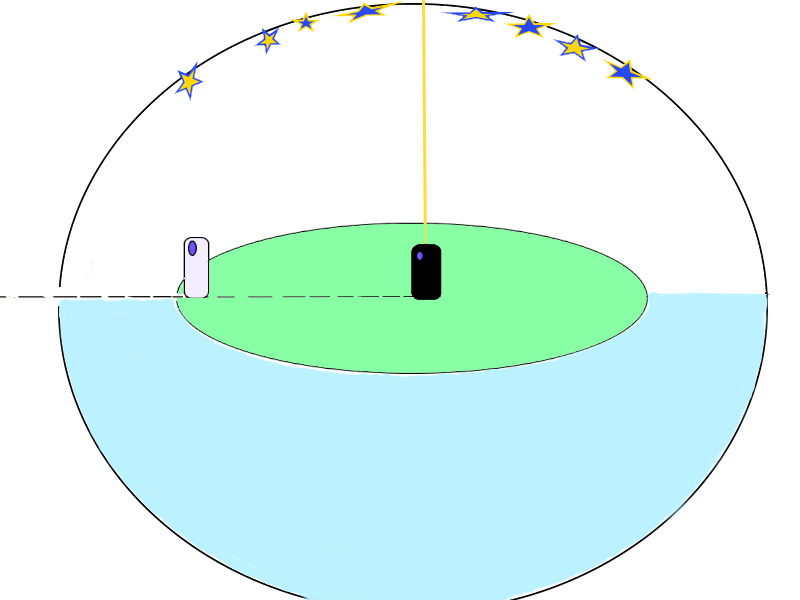 In this image we are looking at the world after it has been made round. The key feature is the dashed horizontal line = the Straight Road: a memory of the ancient shape of the flat mythical world that remains in our round world of history. If we stepped back in time the circle of the world would disappear and the dashed horizontal line that is memory would become the reality: in place of the Straight Road would be seen the Sea extending into the West of a flat world, through Númenor, and on all the way to Valinor.
The Straight Road is told of in 'The Fall of Númenor'. It is the sea-road that Elendil sails out of the ruin of Númenor, and the idea is that Elendil is the only one to sail the Straight Road in history because after this it is lost - if you sail west you will circumnavigate the world. But 'The Fall of Númenor' tells also of the Last Alliance: Elendil and Gil-galad march east to Mordor where Sauron has rebuilt his fortress, and there they both meet their doom, though the body of Sauron is also slain. Hence, in my drawing the Straight Road = the whole journey of Elendil out of myth, by sea and then land, all the way to Doom.
'The Fall of Númenor' also tells how, in the days of Elendil, the exiles of Númenor built high towers to look back into the lost realm of myth beyond the sea. So the Straight Road runs out of the western ocean, past a white tower built by the exiles, and on to the Dark Tower and Mount Doom in Mordor. This explains most of the drawing (I leave out of this account the vertical gold line).
My first claim is that 'The Fall of Númenor' arose out of Tolkien's Beowulf research. The Anglo-Saxon poem begins with the mythical king Scyld Scefing who sails out of the sea, and then steps forward in time to tell the tale of the hero Beowulf, who walks alone to meet his doom fighting a monster. In Tolkien's tale, Elendil travels the road that in the old poem is travelled by sea by the mythical king and by land by the hero Beowulf.
Behind this tale of Elendil is Tolkien's scholarship. He discerns in Beowulf a version of the same myth as found in the much later (Icelandic) myth of Ragnarök. In the later tale, the gods and their mortal allies fight - and lose - against the monsters. In the Anglo-Saxon tale, the gods have vanished, but the monsters remain; and so the mortal hero walks alone to fight the monsters. The key for Tolkien is provided early in Beowulf when the poet points to unnamed beings who dwell on the further shore of the Shoreless Sea and sent the mythical king to his people. From this Tolkien reads a Christian poet suggesting that once upon a time the gods were indeed our allies against the monsters, but that they vanished from our world a long time ago, leaving us alone with the monsters.
From this, The Silmarillion opens up before our eyes. Long, long ago in mythical days, Eärendil sailed into the West and the gods crossed the Sea and defeated Morgoth. Long, long ago, at the very beginning of history, the mythical king marched to Mordor to fight Sauron side-by-side with an immortal Elf. The tale of Beowulf is the next chapter in this tale of the progressive disenchantment of our world - now a mortal hero marches to Doom alone.
In a nutshell, the Straight Road is Tolkien's critical reading of the mythological frame of Beowulf, the image of ancient myth that the Anglo-Saxon poet used to construct the Old English poem. The Straight Road is what you use to tell a story that draws on the ancient myths when you live in a world that you know to be round and as such not like the world as imagined in the ancient myths. This idea of how to tell an ancient mythological tale in a round historical world - the idea of the Straight Road - was discovered by Tolkien in Beowulf.
My second claim is that having invented the Straight Road with the myth of Elendil in order to better understand Beowulf, Tolkien then used the Straight Road to imagine The Lord of the Rings. Being Tolkien, he did not simply replicate its use in the Anglo-Saxon poem but, rather, transformed its use by telling a fairy-story where the old poet had made an elegy.
This transformation of elegy into fairy-story is a simple matter of geometry and metaphysics. Geometrically, compare the traversing of the Straight Road. Beowulf = (i) ship voyage from out of the west to the shore of Middle-earth, (ii) march inland to Doom. Lord of the Rings = inland march to Mount Doom, and (this being a Hobbit story) back again, and (ii) final ship voyage into the west.
Metaphysically, in the Anglo-Saxon poem, Doom at the center = death. Now Mount Doom is where the Ring was forged, the source of un-death, and the doom that our Hobbit hero risks is not death so much as un-death - becoming a Ring-wraith. Now, in addition to the heroes marching to Doom at the center of things, undead monsters travel out from Doom and into the world, even to the doorstep of Bag-end.
The Straight Road is told of in 'The Fall of Númenor'. It is the sea-road that Elendil sails out of the ruin of Númenor, and the idea is that Elendil is the only one to sail the Straight Road in history because after this it is lost - if you sail west you will circumnavigate the world. But 'The Fall of Númenor' tells also of the Last Alliance: Elendil and Gil-galad march east to Mordor where Sauron has rebuilt his fortress, and there they both meet their doom, though the body of Sauron is also slain. Hence, in my drawing the Straight Road = the whole journey of Elendil out of myth, by sea and then land, all the way to Doom.
'The Fall of Númenor' also tells how, in the days of Elendil, the exiles of Númenor built high towers to look back into the lost realm of myth beyond the sea. So the Straight Road runs out of the western ocean, past a white tower built by the exiles, and on to the Dark Tower and Mount Doom in Mordor. This explains most of the drawing (I leave out of this account the vertical gold line).
My first claim is that 'The Fall of Númenor' arose out of Tolkien's Beowulf research. The Anglo-Saxon poem begins with the mythical king Scyld Scefing who sails out of the sea, and then steps forward in time to tell the tale of the hero Beowulf, who walks alone to meet his doom fighting a monster. In Tolkien's tale, Elendil travels the road that in the old poem is travelled by sea by the mythical king and by land by the hero Beowulf.
Behind this tale of Elendil is Tolkien's scholarship. He discerns in Beowulf a version of the same myth as found in the much later (Icelandic) myth of Ragnarök. In the later tale, the gods and their mortal allies fight - and lose - against the monsters. In the Anglo-Saxon tale, the gods have vanished, but the monsters remain; and so the mortal hero walks alone to fight the monsters. The key for Tolkien is provided early in Beowulf when the poet points to unnamed beings who dwell on the further shore of the Shoreless Sea and sent the mythical king to his people. From this Tolkien reads a Christian poet suggesting that once upon a time the gods were indeed our allies against the monsters, but that they vanished from our world a long time ago, leaving us alone with the monsters.
From this, The Silmarillion opens up before our eyes. Long, long ago in mythical days, Eärendil sailed into the West and the gods crossed the Sea and defeated Morgoth. Long, long ago, at the very beginning of history, the mythical king marched to Mordor to fight Sauron side-by-side with an immortal Elf. The tale of Beowulf is the next chapter in this tale of the progressive disenchantment of our world - now a mortal hero marches to Doom alone.
In a nutshell, the Straight Road is Tolkien's critical reading of the mythological frame of Beowulf, the image of ancient myth that the Anglo-Saxon poet used to construct the Old English poem. The Straight Road is what you use to tell a story that draws on the ancient myths when you live in a world that you know to be round and as such not like the world as imagined in the ancient myths. This idea of how to tell an ancient mythological tale in a round historical world - the idea of the Straight Road - was discovered by Tolkien in Beowulf.
My second claim is that having invented the Straight Road with the myth of Elendil in order to better understand Beowulf, Tolkien then used the Straight Road to imagine The Lord of the Rings. Being Tolkien, he did not simply replicate its use in the Anglo-Saxon poem but, rather, transformed its use by telling a fairy-story where the old poet had made an elegy.
This transformation of elegy into fairy-story is a simple matter of geometry and metaphysics. Geometrically, compare the traversing of the Straight Road. Beowulf = (i) ship voyage from out of the west to the shore of Middle-earth, (ii) march inland to Doom. Lord of the Rings = inland march to Mount Doom, and (this being a Hobbit story) back again, and (ii) final ship voyage into the west.
Metaphysically, in the Anglo-Saxon poem, Doom at the center = death. Now Mount Doom is where the Ring was forged, the source of un-death, and the doom that our Hobbit hero risks is not death so much as un-death - becoming a Ring-wraith. Now, in addition to the heroes marching to Doom at the center of things, undead monsters travel out from Doom and into the world, even to the doorstep of Bag-end.
Last edited by Chrysophylax Dives on Mon Nov 25, 2024 11:20 am, edited 1 time in total.
Eat earth. Dig deep. Drink water.
- Points: 792
Newborn of Imladris
Posts: 312
Joined: Sun May 17, 2020 10:25 am
Thanks @Chrysophylax Dives I have been reading up on this developing thesis, and it seems to me that the drawing elucidates the thesis and the thesis elucidates the drawing. Wonder whether you will agree with that, @Drifa ?
Remembering halfir by learning something new each day
- Points: 4 777
Tree
Posts: 3136
Joined: Sun May 17, 2020 7:54 pm
O Saranna, I love you!!!!

Dwarf, everyone, take a lesson from an Elvish Librarian!
Eat earth. Dig deep. Drink water.
- Points: 3 817

Mahal
Posts: 3173
Joined: Wed Aug 05, 2020 3:32 pm
I have never read Beowulf. So, I can not answer if
But you suggest that Elendil took the Straight Road to Middle-earth. Are those roads (waters) already open to them? They had voyaged there before, right? I am confused when you say he travelled the Straight Road to Mordor.
; the drawing elucidates the thesis, and the thesis elucidates the drawing
But you suggest that Elendil took the Straight Road to Middle-earth. Are those roads (waters) already open to them? They had voyaged there before, right? I am confused when you say he travelled the Straight Road to Mordor.
The world was fair in Durin's Day.
- Points: 4 777
Tree
Posts: 3136
Joined: Sun May 17, 2020 7:54 pm
There are two parts to the answer, the first on the sea-road concerns only Tolkien's story while the second on the land-road to Mordor only makes sense when considering also Beowulf.
1. Prior to the downfall of Númenor there is only a flat world and a straight road that runs from the western coast of Middle-earth to Númenor and on to Valinor. Before the downfall, the ships of Númenor indeed sail this flat sea-road into the east to Middle-earth. With the downfall the shape of the world changes and the Straight Road arises as a sort of memory of the mythical past that lingers in a round world. This is simply how it is told in 'The Fall of Númenor'.
But when you think about Elendil's ship (and of course all those that sailed with it out of the ruin) we have a singular journey because Elendil's starting-point is in myth; he sails out of myth and into the round world of history. Because he begins in myth his sea-road is the Straight Road. But this road as it were vanishes (to all but Elves) in his wake; no subsequent (mortal) ship can take this sea-road.
2. 'The Fall of Númenor' concludes with the 'legend' of the Last Alliance, when Elendil and Gil-galad march to Mordor. Hence 'The Fall of Númenor' recounts the journey of Elendil in two stages, the first by sea and the second by land. 'The Fall of Númenor' does not describe the inland march as a continuation of the Straight Road and I cannot justify doing so in Lore terms (i.e. within the world of Tolkien's stories), but only in terms of Tolkien's Beowulf studies.
Basically, the road over the sea out of the vanished West and inland to Doom joins the two mythical poles that Tolkien discerned in Beowulf - the vanished gods over the sea and the monsters of Doom at the center of things. Originally (so far as I can make out), 'The Fall of Númenor' was composed to make sense of the Anglo-Saxon poem.
Eat earth. Dig deep. Drink water.
- Points: 3 817
Mahal
Posts: 3173
Joined: Wed Aug 05, 2020 3:32 pm
Okay. So the ships of the Númenóreans that sailed first came to the Gulf of Lune before Elendil were travelling on the Straight Road, too?
The world was fair in Durin's Day.
- Points: 4 777
Tree
Posts: 3136
Joined: Sun May 17, 2020 7:54 pm
Technically, Tolkien introduces and defines the 'Straight Road' in FN as a memory. It is a memory of the flat world that endures in the round world. So the Númenórean ships before Elendil sailed on the flat sea of a flat world, but they did not sail the Straight Road - they sailed the reality, while the Straight Road is a memory of that flat world (from the mortal point of view; for the Elves it remains reality.)
The whole deal with these coastal towers that I bang on and on about is that they arise in history, in a round world, but provide a point of view to look on our world with 'straight sight' - which is a way of saying that these towers are about standing in history and seeing the ancient mythical world that is now memory.
In a nutshell, you climb a hill in our own time, enter the tower and climb its spriral staircase to arrive, at the top, at a view of the Straight Road: now you are seeing the world with the keen eyes of the Elves, you are looking at what to us is past and vanished and remains only as memory, and is for the Elves reality. (You are looking at the world almost as Frodo sees Glorfindel at the Ford of Bruinen.)
As I've said, in 1936 this was all for Tolkien a way of making sense of an Anglo-Saxon poem. All of the above can be read out of Beowulf (if you are Tolkien). From this point of view, when he starts The Lord of the Rings at the end of 1937, or rather, when in 1938 he decides that the new Hobbit story is set after Númenor - and so in a round world - all of this Straight Road and straight sight from the top of a tower comes into its own because it is an Anglo-Saxon blueprint of how to tell a story involving the ancient northern mythical imagination in a world that is known by storyteller and audience as round and not flat (the Anglo-Saxons knew the world was round, but thought that their pagan ancestors had believed it to be flat.) Ultimately, this is how we get the Eye of Sauron in the Dark Tower, which arises as a corruption and twisting of Tolkien's original image of the eye of Elendil looking into the west from atop a coastal tower (which original image spawns, ultimately, the Stone of Elendil in Elostirion).
Eat earth. Dig deep. Drink water.
- Points: 3 817
Mahal
Posts: 3173
Joined: Wed Aug 05, 2020 3:32 pm
So where did Bilbo, Frodo, Sam and Gimli go? Into a memory?
The world was fair in Durin's Day.
- Points: 4 777
Tree
Posts: 3136
Joined: Sun May 17, 2020 7:54 pm
Dear Dwarf,
I do appreciate your questions. I am tired and should go to bed. Your question might find a short answer in the morning. But here is a midnight ramble.
Dragon
By the way, I tend to overlook the claim of the Dwarves that Gimli crossed the Sea. That is amiss on my part.
You ask the most difficult question, akin to asking what Gandalf means about Frodo seeing Glorfindel as he is on the other side, and related to asking what it means that Sam hears and sees differently when he puts on the Ring. It is the right question to ask, but Tolkien himself has gone out of his way to make it impossible to give one answer.
Frodo was taken prisoner in Cirith Ungol in drafts composed in 1944. Sam did not rescue Frodo from Cirith Ungol until Tolkien returned to the story in 1947 - writing from this point continuously to the end. In this longest break from composition, in the immediate wake of the ending of World War II, Tolkien wrote a new version of 'The Fall of Númenor', and in this version the world was always round (it is even suggested that the idea that it was once flat is an invention of Sauron).
Already in 1944 Tolkien tells his son Christopher about Frodo's 'sea-funeral' at the end of the story. He has the scene that we know in mind. And it is because he has just this scene in mind that he writes the revised version of the Downfall of Númenor.
He writes this revised version not to replace the earlier flat-world myth said to be told by the Elves, but to craft the ambiguity that he is seeking for his final scene. He wants to ensure that your question is unanswerable!
So to attempt an answer. From an Elvish point of view, Bilbo, Frodo, and Gimli sail to Valinor on the Straight Road, which may be a memory to mortals but is reality to Elves. But from a mortal point of view later in history, to those in Gondor late in the 4th Age, the very idea that the world was once flat is a false myth, the Straight Road is merely a metaphor, and - I am sorry to have to inform you, my dear Dwarf, but Gimli, as also the two Hobbits, went west, which is a way of saying that they died.
But this is how Tolkien crafted your question on the other side of The Lord of the Rings. Your question is put in the terms of 1936 when all that was told was the myth of Elendil. And Elendil never returns over the sea; his tomb was in the center of Gondor, as you know. Before Tolkien arrives at the sophisticated craft of the sea-funeral of Lord of the Rings he reworks this myth of Elendil into the tale of the Rings of Power, which are themselves all about mixing the realms of ancient myth and round world history, so the idea of the Straight Road as memory has passed through Lórien and the vision of Elvish memory enduring as reality in the round world of history.
It is all about memory, but once the Rings are added to the Towers people are stepping in and out of memory merely by walking in Middle-earth, without the need for sailing over the sea.
I do appreciate your questions. I am tired and should go to bed. Your question might find a short answer in the morning. But here is a midnight ramble.
Dragon
By the way, I tend to overlook the claim of the Dwarves that Gimli crossed the Sea. That is amiss on my part.
You ask the most difficult question, akin to asking what Gandalf means about Frodo seeing Glorfindel as he is on the other side, and related to asking what it means that Sam hears and sees differently when he puts on the Ring. It is the right question to ask, but Tolkien himself has gone out of his way to make it impossible to give one answer.
Frodo was taken prisoner in Cirith Ungol in drafts composed in 1944. Sam did not rescue Frodo from Cirith Ungol until Tolkien returned to the story in 1947 - writing from this point continuously to the end. In this longest break from composition, in the immediate wake of the ending of World War II, Tolkien wrote a new version of 'The Fall of Númenor', and in this version the world was always round (it is even suggested that the idea that it was once flat is an invention of Sauron).
Already in 1944 Tolkien tells his son Christopher about Frodo's 'sea-funeral' at the end of the story. He has the scene that we know in mind. And it is because he has just this scene in mind that he writes the revised version of the Downfall of Númenor.
He writes this revised version not to replace the earlier flat-world myth said to be told by the Elves, but to craft the ambiguity that he is seeking for his final scene. He wants to ensure that your question is unanswerable!
So to attempt an answer. From an Elvish point of view, Bilbo, Frodo, and Gimli sail to Valinor on the Straight Road, which may be a memory to mortals but is reality to Elves. But from a mortal point of view later in history, to those in Gondor late in the 4th Age, the very idea that the world was once flat is a false myth, the Straight Road is merely a metaphor, and - I am sorry to have to inform you, my dear Dwarf, but Gimli, as also the two Hobbits, went west, which is a way of saying that they died.
But this is how Tolkien crafted your question on the other side of The Lord of the Rings. Your question is put in the terms of 1936 when all that was told was the myth of Elendil. And Elendil never returns over the sea; his tomb was in the center of Gondor, as you know. Before Tolkien arrives at the sophisticated craft of the sea-funeral of Lord of the Rings he reworks this myth of Elendil into the tale of the Rings of Power, which are themselves all about mixing the realms of ancient myth and round world history, so the idea of the Straight Road as memory has passed through Lórien and the vision of Elvish memory enduring as reality in the round world of history.
It is all about memory, but once the Rings are added to the Towers people are stepping in and out of memory merely by walking in Middle-earth, without the need for sailing over the sea.
Eat earth. Dig deep. Drink water.
- Points: 4 777
Tree
Posts: 3136
Joined: Sun May 17, 2020 7:54 pm
A morning answer is a postscript to the above. The two versions of the downfall of Númenor were intended (I conclude) to provide incompatible perspectives on the view into the west from the top of the tower = where Frodo's 'funeral-ship' ends up on the other side of the horizon: (a) Elvish and mythical, and (b) Gondorian and historical. This Elvish-mortal division, framed by the two stories of the end of Númenor and the Second Age in the Last Alliance, is echoed (I suggest) in the division of early 4th-Age Hobbit Libraries that I have carped on about in relation to Undertowers.
Through Merry, Brandy Hall has its traditions of etymological and botanical studies that situate Hobbit ways in relation especially to Rohan, with the two peoples sharing a northern origin from which they migrated. Great Smials has the Gondor connection and the collection of manuscripts related to the history of the Númenor kingdoms and traditions. So these Shire Libraries are connected with the mortal historical traditions of the second (always round-world) version of the downfall of Númenor.
Meanwhile, the Hobbits of Undertowers keep to themselves, tend their mushrooms, tell their stories, and on occasion climb the stairs of one of the three ancient Elvish towers on the hills above their town. From the tallest, they would look upon the western sea. And these are the Hobbits who pass on the tradition, received from Elanor, that Sam at his end gave to her the Red Book and then carried on to the havens and passed over the Sea. And some of the Fairbairns, as too one or two other Hobbits of Undertowers, when they look out on the view from Elostirion glimpse the Straight Road and imagine the peaks of Taniquetil far away in the uttermost west.
Last edited by Chrysophylax Dives on Mon Nov 25, 2024 9:28 am, edited 1 time in total.
Eat earth. Dig deep. Drink water.
- Points: 4 777
Tree
Posts: 3136
Joined: Sun May 17, 2020 7:54 pm
But all of these scenarious framed by Tolkien are but sophisticated workings out of the paradox that is written into the 1936 'Fall of Númenor'. Elves have their being in a realm that, once the world is made round, is not our world - or exists only as a sort of superimposition into it, an intrusion of memory, of ancient myth into history. Already in the 1936 material, your question points directly to the paradox at its heart.
Turning to The Lord of the Rings reveals Tolkien exploring the paradox. With the idea of the Rings of Power, mythical memory intrudes into history in two different ways: magically yet benignly and wonderfully with the Elvish realms of Elrond and Galadriel, magically and terrifyingly with the Ring-wraiths. These Elves and Ringwraiths, not to mention the Dark Tower and Mount Doom, are all mythical memories enduring in and intruding into early historical times. They arise as Tolkien works up and plays around with the idea of the Straight Road, of mythical memory enduring in a non-mythical world.
Turning to The Lord of the Rings reveals Tolkien exploring the paradox. With the idea of the Rings of Power, mythical memory intrudes into history in two different ways: magically yet benignly and wonderfully with the Elvish realms of Elrond and Galadriel, magically and terrifyingly with the Ring-wraiths. These Elves and Ringwraiths, not to mention the Dark Tower and Mount Doom, are all mythical memories enduring in and intruding into early historical times. They arise as Tolkien works up and plays around with the idea of the Straight Road, of mythical memory enduring in a non-mythical world.
Eat earth. Dig deep. Drink water.
- Points: 4 777
Tree
Posts: 3136
Joined: Sun May 17, 2020 7:54 pm
Hmmmm. All of this has been very useful to me - thank you Elvish Librarian and Dwarf.
Because I spent the summer deriving the Straight Road out of FN and Beowulf, that is where my head is still at, and subsequently the book proposal I wrote was focused on this side of things. But I see now that I need to think out clearly how the Rings of Power are imagined in relation to the Straight Road and in general focus more squarely on The Lord of the Rings. The posts above have pointed in this direction but I maybe need to draw the picture of the Straight Road in a round world anew, adding the Rings as well as the Towers, and maybe also placing Lórien on the map as a sort of semblance of Valinor (i.e. a memory of the ancient mythical past) enduring in the round world of history.
OK. This is the next step. Back in a while, hopefully with a new drawing.
Because I spent the summer deriving the Straight Road out of FN and Beowulf, that is where my head is still at, and subsequently the book proposal I wrote was focused on this side of things. But I see now that I need to think out clearly how the Rings of Power are imagined in relation to the Straight Road and in general focus more squarely on The Lord of the Rings. The posts above have pointed in this direction but I maybe need to draw the picture of the Straight Road in a round world anew, adding the Rings as well as the Towers, and maybe also placing Lórien on the map as a sort of semblance of Valinor (i.e. a memory of the ancient mythical past) enduring in the round world of history.
OK. This is the next step. Back in a while, hopefully with a new drawing.
Eat earth. Dig deep. Drink water.
- Points: 4 777
Tree
Posts: 3136
Joined: Sun May 17, 2020 7:54 pm
This question is still turning over in my mind. I think you give the answer in your question - they indeed sail into memory. But I cannot as yet formulate this clearly. I suspect that when I can give a clear answer I will have arrived at the end of my work. Meanwhile, this is just me thinking on the question.
If we step back in time into mythical days then the circle of the heavens and the Earth vanishes and the dashed horizontal line becomes the reality of the mythical world of The Silmarillion. Now it is physically possible to sail into the west, as does Eärendil. But even then, this voyage is not really for mortals. Eärendil is the exception.
The next mythical age of the world sees the Men of the West attempting to repeat the voyage of Eärendil in an attempt to conquer Valinor. This is the second recorded sailing of mortals into the uttermost West, and it concludes - as @Rivvy Elf has pointed out - with Ar-Pharazôn, the last king of Númenor, escaping death indeed, buried under fallen hills until the end of the world.
So even in the mythical ages of the world, when Valinor is a reality of the physical world, non-Elves are not supposed to sail into the West.
After the catastrophe, the ruin of Númenor, and the rounding of the world, the world is as it appears in the picture Fusion above.
The comparison of before and after suggests that the Straight Road is not simply a memory of the old mythical shape of the world, for the dashed horizontal line that is the Straight Road has a temporal dimension.
Only Elendil sails the Straight Road - out of myth. Once on land, however, he walks the Straight Road as it remains in history, as do all mortals after him. The inland portion of the Straight Road is simply the time of our lives, which inevitably ends when we arrive at our Doom. The natural way of life in Time is to travel the Straight Road from west to east.
So in history the Straight Road is about Time and Memory. From wherever we happen to be on this road, looking into the west is looking behind us into our past, while looking east is looking to our future, and its inevitable end. But while we can look in both directions, we can only travel forward into the east.
To travel west on the Straight Road is to travel back in Time. Such travel back in time is presented in various different ways.
1. The 1936 'Fall of Númenor' tells of ship burials in history, like that accorded to Scyld Scefing in Beowulf. The Elves explain how these heathen practices reveal the confusion of tradition - it is still recalled that beyond the Shoreless Sea is an immortal land, but it is forgotten that this realm is not for us, neither in life nor death. (What we should do instead is build coastal towers and be content merely to look into the West.)
2. The Ringwraiths walk the Straight Road out of the East. They have escaped the doom of mortals and become counterfeit Elves, mythical beings.
3. Bilbo, Frodo, Sam, and Gimli are all said to sail out of the East to Valinor. They repeat the voyage of Eärendil, only they sail the Straight Road because the world has since become round.
And if I could just make sense of how these three instances of east-west travel on the Straight Road are connected I would be able to give a clear and concise answer to the question!
Eat earth. Dig deep. Drink water.
- Points: 4 777
Tree
Posts: 3136
Joined: Sun May 17, 2020 7:54 pm
Basically, ascending the stairs of the tower (as opposed to descending) = travelling from east to west on the Straight Road (as opposed to west to east). Both = travel back in time, and as such on the face of it are impossible.
Please note, btw, the mechanical relationship of Straight Road and internal spiral staircase of the tower: To follow the journey of Elendil from the tower one begins at the top looking out to sea, but then descends the spiral staircase to make a half-turn to observe the inland journey. So, each generation that walks the Straight Road, as it passes the tower, entails a turn and descent down the staircase by one who observes from the tower.
Please note, btw, the mechanical relationship of Straight Road and internal spiral staircase of the tower: To follow the journey of Elendil from the tower one begins at the top looking out to sea, but then descends the spiral staircase to make a half-turn to observe the inland journey. So, each generation that walks the Straight Road, as it passes the tower, entails a turn and descent down the staircase by one who observes from the tower.
Eat earth. Dig deep. Drink water.
- Points: 4 777
Tree
Posts: 3136
Joined: Sun May 17, 2020 7:54 pm
One difficulty I face in this project is that it involves the interweaving of several distinct texts, each one of which is incredibly rich in detail, and it is easy to forget some detail that turns out to be crucial. It was before the Covid that I spent a couple of years on the early drafts of The Lord of the Rings. Then, 18 months ago, I stepped out of my Beowulf research and into these early drafts in order to compose A Hobbit's Guide to Stairs. I read these early drafts again (very) closely up to the end of the Barrow-downs, but not further. The next 'floor' of the Guide was always meant to be about Weathertop and the journey to Rivendell, but I have only just begun again on the relevant chapters of Return of the Shadow (the early drafts of LotR). And now I come upon this, which five or six years ago I not only registered but thought about a fair bit, but then completely forgot.
I need to think on this.
This is Christopher Tolkien's comments, but of course he is quite right. In these early drafts the Ring allows the silent communication between minds that is introduced into the published story only much later with the palantíri.In this chapter it is made plain that the commands of the Ring-wraiths are communicated wordlessly to the bearer of the Ring, and that they have great power over his will (RS, p. 199)
I need to think on this.
Eat earth. Dig deep. Drink water.
- Points: 3 817
Mahal
Posts: 3173
Joined: Wed Aug 05, 2020 3:32 pm
After King Elessar died in Fo.A.120, Legolas built a grey ship in Ithilien and sailed down the Anduin and onwards into the West, reportedly taking Gimli with him. Gimli was aged 262—old age for a dwarf.Eressëa and Valinor removed from the physically attainable Earth: the way west was open, but led nowhere but back again-for mortals. The Letters of J.R.R Tolkien, 154 To Naomi Mitchison
The Straight Road became the road to heaven. I think.

Legolas and Gimli depart by Turner Mohan
The world was fair in Durin's Day.
- Points: 4 777
Tree
Posts: 3136
Joined: Sun May 17, 2020 7:54 pm
I like that picture!
Drifa, you ask all the right questions and make all the right observations. But have not yet internalized my drawing! But I only just woke up. Sometime later this weekend I will return and reply to the - extremely relevant and to the point, but ultimately wrong - suggestion of the Straight Road as a road to heaven.
For now, though, heaven is up. One buys, or builds, a stairway to heaven. At most, a horizontal straight road into the west is a metaphor for a journey to heaven, a place that nobody in any of these stories knows about.
This is in fact where it all begins in Beowulf. Here is where we find the ship funeral, a reflection of actual heathen practices. A dead king is put on a ship and the ship is (not fired but rather) sent into the west. Tolkien reads the Anglo-Saxon poet as positing: (a) these heathen ancestors did not know about the fate of the soul after death (which is to ascend on the vertical outside the circle of the world) and so (b) that the Straight Road of ancient mythical memory leads to the realm of the mortal dead - a corruption and twisting of true traditions once known, which recognized that this road was an immortal road and not for the likes of us.
I need to wake up more. **Heads back to kettle**
Eat earth. Dig deep. Drink water.
- Points: 4 777
Tree
Posts: 3136
Joined: Sun May 17, 2020 7:54 pm

Last edited by Chrysophylax Dives on Sun Dec 01, 2024 1:40 pm, edited 1 time in total.
Eat earth. Dig deep. Drink water.
- Points: 792
Newborn of Imladris
Posts: 312
Joined: Sun May 17, 2020 10:25 am
By the teeth of Smaug! I sat down to play a game and read all this instead. Which is good for me as it cetainly challenges my old brain more than any game. (I am getting like Bilbo in Rivendell; hardly aware of where the kettle is!)
Greetings all - I feel privileged to be allowed to look at all this work going on, to see an idea developing and growing into a book. (300 copies for the Library of Undertowers, remember, CD) A shorter repsonse would be 'WOW! (but I am known for my wordiness.)
Please excuse me friends while I attempt a further paragraph of my book. See you here again, hopefully with tea! :)
Greetings all - I feel privileged to be allowed to look at all this work going on, to see an idea developing and growing into a book. (300 copies for the Library of Undertowers, remember, CD) A shorter repsonse would be 'WOW! (but I am known for my wordiness.)
Please excuse me friends while I attempt a further paragraph of my book. See you here again, hopefully with tea! :)
Remembering halfir by learning something new each day
- Points: 4 777
Tree
Posts: 3136
Joined: Sun May 17, 2020 7:54 pm
Saranna wrote: ↑Sat Nov 30, 2024 3:20 pm Greetings all - I feel privileged to be allowed to look at all this work going on, to see an idea developing and growing into a book. (300 copies for the Library of Undertowers, remember, CD) A shorter repsonse would be 'WOW! (but I am known for my wordiness.)
Eat earth. Dig deep. Drink water.
- Points: 3 817
Mahal
Posts: 3173
Joined: Wed Aug 05, 2020 3:32 pm
It was no longer attached to the physical earth. Where was it?
You double-posted. Greetings @Saranna!
You double-posted. Greetings @Saranna!
The world was fair in Durin's Day.
- Points: 792
Newborn of Imladris
Posts: 312
Joined: Sun May 17, 2020 10:25 am
Greetings, @Drifa Yes there was a doublepost, I have committed those myself in the past. Oh well.
I also like that picture and have an aching desire for it to be true that these two friends did not have to be parted. (The older I get the less able I am to read that last chapter without 'a number of pocket-handkerchiefs.' )
I wonder if the kind of 'where' that we are used to (just down the road and turn right and you'll see the supermarket) leads us to assume that every 'where ' is the same sort of thing. There must be 'wheres' that are another sort of thing. Where is that idea that I thought I had firmly in my head? Where are my parents now they are gone from this world? They are 'no longer attached to the physical world' but they are in my head. So where is where?
I also like that picture and have an aching desire for it to be true that these two friends did not have to be parted. (The older I get the less able I am to read that last chapter without 'a number of pocket-handkerchiefs.' )
I wonder if the kind of 'where' that we are used to (just down the road and turn right and you'll see the supermarket) leads us to assume that every 'where ' is the same sort of thing. There must be 'wheres' that are another sort of thing. Where is that idea that I thought I had firmly in my head? Where are my parents now they are gone from this world? They are 'no longer attached to the physical world' but they are in my head. So where is where?
Remembering halfir by learning something new each day
- Points: 4 777
Tree
Posts: 3136
Joined: Sun May 17, 2020 7:54 pm
@Saranna has it, but here are some ramblings.
See NoMe, XV, pp. 343-345. This is an old Tolkien (c. 1959) reflecting on your question. Here he suggests that Valinor is not destroyed but its spiritual nature is, so that it becomes an ordinary landmass in the round world (America). Aman or Valinor is then "the memory of the Elves and the Valar of the former land." You are welcome to study this and explain it some to me.
This is the old Tolkien reflecting on his lifetime of writing and attempting to bring it into coherence in the spirit of all the Loremasters of the old plaza and Tolkien Gateway and what have you; a respectable and popular endeavour, but ultimately theological, with the demand for a consistent subcreated 'secondary world' taken to its extreme. While I have always respected this approach, or at least learned to live with it seeing that it was the dominant mode of talking about Tolkien everywhere I ever went on the world wide web, it is not my way. My way is to study how the imagination of our author develops in time as he moves between studying the Anglo-Saxon story of Beowulf and writing his own stories of Hobbits.
Studying the old story, Tolkien saw that the Anglo-Saxon poet had 'fused' two models of the cosmos - a flat disc-world surrounded by the Shoreless Sea of northern mythology and the round cosmos of Ptolemaic astronomy. In this fusion, the poet takes the world as in reality round but situates the action within the world of northern myth.
Studying this old story, Tolkien makes sense of it by telling a story of his own, an Elvish story of how the flat-world became round. He is following a hint in Beowulf, but his telling a story of a step in Time from one shape of the world to another is his own innovation. From the perspective of his scholarship it is a useful innovation because it generates an effect akin to the double exposure of the negative in an old photograph, a superimposition of one image (the old flat world) on another image (the new round world).
And then he wrote a sequel to 'The Fall of Númenor' in which this superimposition of the old mythical world in the round world of history becomes much more substantial than is the afterimage of myth in history that is the 'legend' of the Last Alliance in 'The Fall of Númenor'. This is achieved by the imagination of the Rings of Power, which magically give substance to the mythical realm that should have vanished. Hence we have islands of Elvish myth in the Third Age where it is as if Númenor had never fallen and the world was still flat and so mythical. When the One Ring is destroyed these three islands of Elvish myth fade, as do the Elves, as does memory of the Straight Road over the Sea.
You can look back and attempt to project theological consistency, as does the old Tolkien and most Tolkien fans. But if you step forward in time, following the life of the man as he read, thought, and wrote you see him discovering how to write a time-travel story by other means. Rather than a machine to move backwards and forward in Time, as if it was merely a fourth dimension of Space, as H.G. Wells gave us, Tolkien works out how to tell a story of time travel in which the magic is made within the world of the story. This magic gives us the superimposition of two worlds.
But when the magic is itself vanished, the superimposition vanishes. We stand at the top of Elostirion of the colony of Undertowers in the 4th Age and all that we see in the West is the sea and an empty horizon. Our world is utterly disenchanted. Even the memory of Valinor is but a fairy-tale.
Eat earth. Dig deep. Drink water.
- Points: 4 777
Tree
Posts: 3136
Joined: Sun May 17, 2020 7:54 pm
This is just to the point. In 1895 H.G. Wells makes a story of time-travel by positing Time as but another dimension, analogous to Space. Then the French philosopher H. Bergson, around 1905 (and in the context of Einstein's theory of relativity) made his name as a philosopher by pointing out that Time is not analogous to Space (though we habitually talk as if it was). And for the next 30 or so years, people were seriously obsessed with the 'where' of past Time. This is precisely the wider context out of which Tolkien's 'method of superimposition' of two worlds emerges as his key reading of Beowulf.Saranna wrote: ↑Sun Dec 01, 2024 3:14 pm I wonder if the kind of 'where' that we are used to (just down the road and turn right and you'll see the supermarket) leads us to assume that every 'where ' is the same sort of thing. There must be 'wheres' that are another sort of thing. Where is that idea that I thought I had firmly in my head? Where are my parents now they are gone from this world? They are 'no longer attached to the physical world' but they are in my head. So where is where?
Go and catch a falling star,
Get with child a mandrake root,
Tell me where all past years are,
Or who cleft the devil's foot,
Teach me to hear mermaids singing,
Or to keep off envy's stinging,
And find
What wind
Serves to advance an honest mind.
Tell me where all past years are?
Eat earth. Dig deep. Drink water.
- Points: 4 777
Tree
Posts: 3136
Joined: Sun May 17, 2020 7:54 pm
The real thing, O mightly bearded Dward, @Drifa, is to stop thinking only in space and open your mind to that element of time that ultimately fascinated Tolkien. What he has conjured up is an idea of Valinor that transforms from reality to true myth to preposterous fairy-story.
Once we are in the 4th Age, Valinor remains as a memory in stories still (for a while) told, but even its mythical reality becomes dubious. Hence in Gondor they conclude that the world was always round, leaving no place for Valinor ever. Undertowers is intended as the one place in the whole of Middle-earth in the 4th Age where the memory of Valinor retains some credibility.
What Tolkien has achieved is a picture of memory over the long ages whereby what was once real is now deemed impossible. This is more than mere forgetting; it is a picture of disenchantment as a total eclipse, so that even memory is drained of its magic.
Once we are in the 4th Age, Valinor remains as a memory in stories still (for a while) told, but even its mythical reality becomes dubious. Hence in Gondor they conclude that the world was always round, leaving no place for Valinor ever. Undertowers is intended as the one place in the whole of Middle-earth in the 4th Age where the memory of Valinor retains some credibility.
What Tolkien has achieved is a picture of memory over the long ages whereby what was once real is now deemed impossible. This is more than mere forgetting; it is a picture of disenchantment as a total eclipse, so that even memory is drained of its magic.
Eat earth. Dig deep. Drink water.
- Points: 3 817
Mahal
Posts: 3173
Joined: Wed Aug 05, 2020 3:32 pm
Yeah, just a fairy-story.
The world was fair in Durin's Day.
- Points: 4 777
Tree
Posts: 3136
Joined: Sun May 17, 2020 7:54 pm
Robin Collingwood was a friend and colleague of Tolkien's at Pembroke College. He was an archeologist of Roman Britain and also a philosopher. He is one of the very few people I have ever read who can hold a candle to Tolkien. In other words, he is awesome. On the study of History he had much to say as a Philosopher. What he says seems to me to have a strange resonance with the issues involved in the question of the existence of Valinor at the end of the Third Age (or ever).
Collingwood says that History is not like Natural Science, which studies things in our world that exist. History studies the past, which no longer exists; it has vanished into non-existence. But some things in our world are evidence of this vanished past, and what the Historian does is use this evidence to re-enact past thought, that is, think again the thoughts that people once thought before. So while the past no longer exists, the thoughts in peoples' heads in the past have not irrevocably vanished, as have those who thought them; the people are dead and gone, but some of their thoughts can sometimes be re-thought by us today.
Collingwood says that History is not like Natural Science, which studies things in our world that exist. History studies the past, which no longer exists; it has vanished into non-existence. But some things in our world are evidence of this vanished past, and what the Historian does is use this evidence to re-enact past thought, that is, think again the thoughts that people once thought before. So while the past no longer exists, the thoughts in peoples' heads in the past have not irrevocably vanished, as have those who thought them; the people are dead and gone, but some of their thoughts can sometimes be re-thought by us today.
Eat earth. Dig deep. Drink water.
- Points: 792
Newborn of Imladris
Posts: 312
Joined: Sun May 17, 2020 10:25 am
'So while the past no longer exists, the thoughts in peoples' heads in the past have not irrevocably vanished, as have those who thought them; the people are dead and gone, but some of their thoughts can sometimes be re-thought by us today.'
Thanks @Chrysophylax Dives That is a rather comforting - er -thought. Hello, @Drifa I am purportedly writing Christmas Cards but somehow I can't resist this thread. Hope we will continue this yet further, friends.
Thanks @Chrysophylax Dives That is a rather comforting - er -thought. Hello, @Drifa I am purportedly writing Christmas Cards but somehow I can't resist this thread. Hope we will continue this yet further, friends.
Remembering halfir by learning something new each day
- Points: 4 777
Tree
Posts: 3136
Joined: Sun May 17, 2020 7:54 pm
How Collingwood thought of History seems similar to how Tolkien thought about Literary Criticism. In his writing on Beowulf, Tolkien aims to reconstruct the ideas - the intentions and design - of the dead Anglo-Saxon poet. He actually seems to believe that it is possible for the critic to think the ideas of an author more clearly than had the author. I think a palantír is an expression of this ideal, an enchanted instrument that would allow us (for example) to see the thought that is hidden behind Tolkien's writing.Saranna wrote: ↑Fri Dec 06, 2024 3:58 pm 'So while the past no longer exists, the thoughts in peoples' heads in the past have not irrevocably vanished, as have those who thought them; the people are dead and gone, but some of their thoughts can sometimes be re-thought by us today.'
Thanks @Chrysophylax Dives That is a rather comforting - er -thought. Hello, @Drifa I am purportedly writing Christmas Cards but somehow I can't resist this thread. Hope we will continue this yet further, friends.
What has long struck me about this idea of History and Literary Criticism is how close it seems to come to necromancy. With the palantír it is interesting how, in the story, reading the minds of the dead is almost suggested yet carefully avoided. Gandalf wishes to turn the Orthanc Stone over an ocean of Time and see the hand of Fëanor at work in Valinor in the days of the Two Trees - but not to actually see the mind of Fëanor. All the actual uses of the Stones in the story involve looking eye to eye with Sauron, who is not dead but is the Necromancer.
Collingwood's idea of History is not actually a call to necromancy, but it is not so easy to articulate the difference.
Eat earth. Dig deep. Drink water.
- Points: 792
Newborn of Imladris
Posts: 312
Joined: Sun May 17, 2020 10:25 am
Thanks @Chrysophylax Dives that means I had better read more Collingwood as I haven't retained the stuff I have already read. My reading pile beside the sofa gets steadily higher even though I am always reading. I wish I had set a lower Challenge aim on Good Reads this year, and think I shall have to cut it sharply next year. In the meantime I shall reflect on this notion of History, Literary Criticism and perhaps even fiction, as attempts to waken the dead.
Au revoir friends - it's chilly in my study!
Au revoir friends - it's chilly in my study!
Remembering halfir by learning something new each day
- Points: 4 777
Tree
Posts: 3136
Joined: Sun May 17, 2020 7:54 pm
@Saranna,
Our conversation has been in my mind these last few days, as I've turned onced again to 'Return of the Shadow'. Here is a practical case. The palantír would give us a view upon all of Tolkien's thought, even that which remained hidden to him, if we used it with sufficient art. We have not a palantír.
By now I know this volume as well as I do 'Fellowship of the Ring', Book I, and have mapped out the context of these drafts. In the first instance, the context is earlier stories of J.R.R. Tolkien, each of which then meaning something quite other than they do today, now that we see them only through the prism of the polished sequel. We need to see on its own terms what was 'The Hobbit' (1937), 'The Adventures of Tom Bombadil' (1934), and the unfinished 'The Lost Road' and Elvish myth of 'The Fall of Númenor' and the allegory of the tower in 'Beowulf: the Monsters and the Critics' (1936). Over long years, and as illustrated by various splurges of plaza Lore posts, I've studied each of these earlier stories, seeking what it was before the sequel.
Maybe a decade after first opening 'Return of the Shadow' I am ready to read its contents. Not that I have not tried before, and the Guide to Stairs was the most recent, a close reading of the Marish conversation on stairs, when the Elf-towers of the Tower Hills to the west of the Shire are described, shining in the light of the moon, by Bingo Bolger-Baggins.
One does have to step into Tolkien's thought, in some way to think it again to understand why he wrote just what he did. To rethink the thought of J.R.R. Tolkien without a Seeing Stone is possible, but takes long years of reading and reflection and reading some more. What I quite failed to consider in the days of the Guide to Stairs was that this Marish conversation was penned in the same phase of writing as a new 'Foreword' in which Gandalf suggests that, thanks to Gollum, Bilbo's ownership of the magic ring is known to the Necromancer, the Lord of the Rings in his Dark Tower.
The Ringwraiths are people who have passed through another magic ring and are now wraiths, slaves of the Necromancer, who has sent the Ringwraiths to get back his missing ring from Hobbits.
On the creeping closer of the second Black Rider, the Hobbits are saved by the chance laughter and song of a company of Wise-Elves. And after the night in the Woody End a chapter intended to carry on to the house in Buckland, JRRT paused, composed his new Foreword with its Dark Tower, and introduced the 3 Elf-towers as he resumed the walk to Buckland in a new (shortcut to mushrooms) chapter.
Now there is a frame of the new story: Western Towers just out of the frame of the new Shire map, and a journey from Bag-end to the new Dark Tower of the Necromancer in the South, a turn down the River after Rivendell and the mountains. The story is henceforth framed as beginning in Bag-end and considered from the point of view of the western Towers.
I did not see this frame two years ago. Only the western Elf-tower. I forgot that where is an Elf-tower there must be a Dark Tower.
Our conversation has been in my mind these last few days, as I've turned onced again to 'Return of the Shadow'. Here is a practical case. The palantír would give us a view upon all of Tolkien's thought, even that which remained hidden to him, if we used it with sufficient art. We have not a palantír.
By now I know this volume as well as I do 'Fellowship of the Ring', Book I, and have mapped out the context of these drafts. In the first instance, the context is earlier stories of J.R.R. Tolkien, each of which then meaning something quite other than they do today, now that we see them only through the prism of the polished sequel. We need to see on its own terms what was 'The Hobbit' (1937), 'The Adventures of Tom Bombadil' (1934), and the unfinished 'The Lost Road' and Elvish myth of 'The Fall of Númenor' and the allegory of the tower in 'Beowulf: the Monsters and the Critics' (1936). Over long years, and as illustrated by various splurges of plaza Lore posts, I've studied each of these earlier stories, seeking what it was before the sequel.
Maybe a decade after first opening 'Return of the Shadow' I am ready to read its contents. Not that I have not tried before, and the Guide to Stairs was the most recent, a close reading of the Marish conversation on stairs, when the Elf-towers of the Tower Hills to the west of the Shire are described, shining in the light of the moon, by Bingo Bolger-Baggins.
One does have to step into Tolkien's thought, in some way to think it again to understand why he wrote just what he did. To rethink the thought of J.R.R. Tolkien without a Seeing Stone is possible, but takes long years of reading and reflection and reading some more. What I quite failed to consider in the days of the Guide to Stairs was that this Marish conversation was penned in the same phase of writing as a new 'Foreword' in which Gandalf suggests that, thanks to Gollum, Bilbo's ownership of the magic ring is known to the Necromancer, the Lord of the Rings in his Dark Tower.
The Ringwraiths are people who have passed through another magic ring and are now wraiths, slaves of the Necromancer, who has sent the Ringwraiths to get back his missing ring from Hobbits.
On the creeping closer of the second Black Rider, the Hobbits are saved by the chance laughter and song of a company of Wise-Elves. And after the night in the Woody End a chapter intended to carry on to the house in Buckland, JRRT paused, composed his new Foreword with its Dark Tower, and introduced the 3 Elf-towers as he resumed the walk to Buckland in a new (shortcut to mushrooms) chapter.
Now there is a frame of the new story: Western Towers just out of the frame of the new Shire map, and a journey from Bag-end to the new Dark Tower of the Necromancer in the South, a turn down the River after Rivendell and the mountains. The story is henceforth framed as beginning in Bag-end and considered from the point of view of the western Towers.
I did not see this frame two years ago. Only the western Elf-tower. I forgot that where is an Elf-tower there must be a Dark Tower.
Last edited by Chrysophylax Dives on Mon Jan 13, 2025 8:21 pm, edited 12 times in total.
Eat earth. Dig deep. Drink water.
- Points: 792
Newborn of Imladris
Posts: 312
Joined: Sun May 17, 2020 10:25 am
@Chrysophylax Dives
Another set of excellent reasons why I should focus my reading more closely and not set wild, numerically-based targets. Thank you for setting my compass in a wholesome direction for 2025. I will ensure that I make room for re-reading, and indeed re-re-reading of Tolkien, which is what matters most to me, the centre of my reading and writing.
On a contemporary note, (i.e. Christmas 2024) I must quote Bilbo; 'this is the END. I am going. I am leaving NOW.'
Not forever though, just for family Christmas. A long drive rather than a trek to Rivendell, Christmas rather than Yule.
May the world grow saner in 2025.
Greetings@Drifa and @Aikári Salmarinian and all Plaza friends. See you next year.
Another set of excellent reasons why I should focus my reading more closely and not set wild, numerically-based targets. Thank you for setting my compass in a wholesome direction for 2025. I will ensure that I make room for re-reading, and indeed re-re-reading of Tolkien, which is what matters most to me, the centre of my reading and writing.
On a contemporary note, (i.e. Christmas 2024) I must quote Bilbo; 'this is the END. I am going. I am leaving NOW.'
Not forever though, just for family Christmas. A long drive rather than a trek to Rivendell, Christmas rather than Yule.
May the world grow saner in 2025.
Greetings@Drifa and @Aikári Salmarinian and all Plaza friends. See you next year.
Remembering halfir by learning something new each day

