Page 1 of 1

Speak Egg!

Posted: Wed May 08, 2024 5:35 am
by Chrysophylax Dives
OOC: This is a thread for @Priya, though of course all are welcome to comment. Priya, I am not going to attempt to organize all my mass of material but will drop in things as I find them, and give some comment. But I do begin where I think everyone ought.*

*By everyone ought I mean that if I was dictator of a nation I would abolish the current school curricula and impose compulsory but structured and graded reading of the works of J.R.R. Tolkien, commencing with The Hobbit. At a tender age, school children would also be introduced to 'The Arabian Nights', followed up a year or so later, with a passage of John Stuart Mill's System of Logic (1843) and A Christmas Carol by Charles Dickens (1843). Mayhaps I would wait another year or two before moving on to the full philological investigation, wherein the curious history of reception in England of 'The Arabian Nights' is traced, thereby to reveal to suddenly awakened adolescents how the quick wits and courage of Morgiana and the luck of Ali Baba come together in a Hobbit whose proper name is Bilbo Baggins.

Morgiana's Question

Soon after the robber and Baba Mustapha had separated, Morgiana had occasion to go out on some errand, and when she returned, she observed the mark which the robber had made on the door of Ali Baba’s house. She stopped to consider it. “What can this mark signify?”
Reference: ‘The History of Ali Baba, and of the Forty Robbers, Killed by One Slave.’ The Arabian Nights, Translated by Edward Forster, Vol. IV., London: William Miller, 4th edition, 1815 [1802], pp. 252-3. A story by Hanna Diyab, first given in Antoine Gallande (editor), Les Milles et Nuite, Vol. 14, 1715.

Nb. The original is French (not Arabic) and the English translations vary. When considering the history of reception it is well to attend to the year of translation. This is a translation read by the 'golden generation' who turned to 'The Arabian Nights' in their childhood in the days of the Napoleonic Wars, such as J.S. Mill and Charles Dickens.

Comment: obviously, I consider that this chalked mark has some bearing on the queer sign that the wizard puts on the door of Bag-end. After long pondering, however, my conclusion is that this chalked mark is more like the magic ring (of the original Hobbit). This conclusion reflects Covid years inquiry along three distinct paths of English reception.

(1) Philosophy: J.S. Mill reads the chalk mark as meaningless, and as such analogous to a proper name.
(2) Literature: Dickens reads the chalk mark as magical, and as such the door to a story.
(3) Henry Mayhew: a journalist who interviews the criminal classes reveals the reality of Patterer-marks.

Close inspection (eventually) reveals that Mill - and all the philosophers who commented on his definition of a proper name down through Betrand Russell to Ludwig Wittgenstein - were hopelessly confused because caught in a picture wrongly abstracted from the story. The philosophers only ever read Mill's quotation from the story - if they had only turned to the story they would have seen that Mill had read the story stupidly. This is a nice bonus because what Mill failed to see is that the two robbers who in turn chalk the door are - given the situation - doing something stupid. The robbers illustrate the wrong way to chalk a mark, and Mill taking them as a model for anything made a stupid analogy (and his philosophical heirs continue to this day to discuss the chalk mark in learned journals, quite unaware that they are now the ninth or such generation of stupid - a sight that in a Darwinian universe one just does not expect to see).

Historical research revealed that at just this time Henry Mayhew was publishing his famous volumes on the London poor - anthropological surveys of all the criminal and marginal types, which Dickens brought to literary life. Dickens' use of the chalk mark is solely magical, however: it becomes the ghostly face of Marley on the doorknocker that scares Scrooge at the start of his story (Ali Baba then appears in the first act, walking past a window of Scrooge's childhood school, and serving to unlock the other door of this story, opening up the heart of the miser).

Here are the Patterer-marks in Henry Mayhew's 'London Labour and the London Poor: Those that will work; Those that cannot work; and those that will not work' (pp. 218 & 247).

After Mayhew (1851) the respectable reading public knew about the secret heiroglyphic signs left by vagabonds, and we get books that purport to be serious, like Mayhew, but are more than half fantasy. Lurid and sensationalist accounts of how the gypsies carried Egyptian hierogphys from Asia and met and bonded with the criminal classes of Elizabethan England (that is, precisely the time of Shakespeare), with the fusion generating the monstrosity of criminal jargon - words and signs that may be spoken or drawn in public but with secret meanings. There is more than a hint of ancient English intercourse of outlaws, exiles, and evil spirits in the wastelands behind the imagined history of 'cant'.

Here are Mayhew's Patterer-marks (the same) packaged with a map on the frontispiece of the scurrilous Slang Dictionary (1859) of J.C. Hotten, 'A London Antiquary' (always a dubious bunch, in my experience). Hotten sensationalizes Mayhew and is already half-way to Harry Potter. Have a look also at the chapter 'Account of the Hieroglyphics used by Vagabonds'. Despite everything, the dictionary itself reveals jewels, and I suspect you will spot several that I had not noticed.

The first chapter of The Hobbit seems to me to play on this late-Victorian fantasy of a hidden underworld that extended even into the suburbs and the countryside - a land where an unknown hand might make a secret sign on your door, unnoticed by you and those who dwell within, but read by others in the trade. This fantasy itself obviously had roots in (a) actual criminal practice and (b) a generation enchanted by the tale of 'Ali Baba and the 40 Thieves' (seriously, that was the fandom of the age - they had no cinema, but they read the tales of 'The Arabian Nights' alone in their childhood and they loved those of Hanna Diyab and went to see performances at the theatre and the pantomime with family, and the imaginations of a generation were inhabited and haunted by Morgiana, as also the dream palaces of the story with the magic lamp).

Re: Speak Egg!

Posted: Thu May 09, 2024 2:53 am
by Chrysophylax Dives
A Note on the Two Doors

‘Ali Baba and the 40 Thieves’ is a tale of two doors, one hidden and one marked.

Hidden Door: Once upon a time in Persia, collecting firewood in the forest, Ali Baba overhears the magic formula that opens a hidden door in a rockface, behind which 40 thieves store their stolen plunder.*

Chalked Door: Discovering a burglary, one robber is sent from the forest to the town to track down the burglar - by good chance, the robber is led to the right house, and marks the door with chalk. Morgiana, the brave and clever slave girl, foils his plan by marking all the neighbors’ doors.**


The first chapter of The Hobbit establishes the plan for a story by reversing the order of appearance of these two doors and introducing a map (which marks a door in a more cunning way). One Tuesday morning a wizard looks long and hard at a hobbit and then marks his door with a queer sign.

Inside the hobbit-hole the following day, the wizard unfurls a map on which an Anglo-Saxon rune marks a hidden door into the mountain that leads to stolen treasure.

Reversing the order of the doors changes the story-meaning of the mark on the door. Where the two robbers of the original story are stupid and make stupid marks that lose them their heads, this is a mark made on a door by a wizard, and so by definition is the right kind of mark put on a door in the right kind of way.

* The spoken password is transformed in Tolkien's story into an elaborate calendrical magic and a key and a keyhole. But note how in drawing these two doors - hidden and marked - as one great gate, the western gateway to Moria, Tolkien reverts to the original spoken password magic of opening.

** The sequence is repeated with a second robber, but when the chief robber is led to the door he dispenses with a mark and looks long and hard at the house so to recognize it again. The chief then enacts the not-cunning-enough plan of hiding his men in empty jars of oil and smuggling them past Ali Baba’s door, only for Morgiana to dispatch them by pouring boiling oil into each of the jars. Cf. 'Barrels out of Bond'.

Re: Speak Egg!

Posted: Thu May 09, 2024 3:50 am
by Priya
Hello Chrysophylax Dives


Of course, I’m more than willing to discuss your line of research. It’s of great interest to me - and I mean that!

The tale of ‘Ali Baba’ shows up in Andrew Lang’s The Blue Fairy Book as The Forty Thieves - with the door/chalk theme included. Perhaps Tolkien retained such a memory from early childhood, and later built upon it?

He does mention per Tolkien On Fairy-stories - pg. 227, Flieger & Anderson, 2014

“Far back a folk-tale or fairy-story can be guessed; in The Arabian Nights it appears tricked out with literary raiment; it is diffused in Europe by means of of translations and adaptations; it is abridged and re-told, dwindling back into ‘mere’ fairy-story: the tale of The Fairy Paribanou in the Blue Fairy Book.” (Tolkien’s underlined emphasis)

So he seems to be aware/understand how the spread of Arabian fairy tales occurred across Europe to eventually make their way to England with various translations along the way.

Do you have any hard/soft evidence that Tolkien knew of, or was acquainted with:

John Stuart Mill's System of Logic (1843),

The History of Ali Baba, and of the Forty Robbers, Killed by One Slave.’ The Arabian Nights, Translated by Edward Forster, Vol. IV., London: William Miller, 4th edition, 1815 [1802], pp. 252-3. A story by Hanna Diyab, first given in Antoine Gallande (editor), Les Milles et Nuite, Vol. 14, 1715.,

or

‪J.C. Hotten’s Slang Dictionary, 1859 ???‬

Re: Speak Egg!

Posted: Thu May 09, 2024 4:13 am
by Chrysophylax Dives
This post moved from Priya's troll thread.

On 'burglar' and 'thief' in The Hobbit

One key in my reading of the story is the theory that, after writing the first sentence Tolkien thought about that sentence for a few years and that when he sat down to write the first chapter he knew pretty well the story all the way to the stealing of the cup from under the nose of the sleeping Smaug - the early drafts indicate that after this Tolkien had to work out the rest of the story.

So I take it that the burglar/thief distinction is part of the plan, with 'thief' the Old English word that will apply when Bilbo has crossed the wild, and 'burglar' the modern word pronounced on this side of the wild, where be comfortable Hobbit holes and contracts.
Þaér on innan gíong -- There went inside
niða náthwylc ond néah geféng -- a man, I know not which, and he groped near
haéðnum horde· hond gewríþenne -- the heathen hoard, his hands wrapped round
since fáhne hé þæt syððan beget -- an ornamented bauble, he got that afterwards;
þéah ðe hé slaépende besyred hæfde -- though he who sleeping had been tricked
þéofes cræfte· -- by thief's cunning;
(Beowulf lines 2214-2219)
From 'Beowulf': þéof náthwylces (line 2223) - nameless thief; the part that Bilbo is to play on the other side of the wild.

The Hobbit is named 'thief' by the dragon, who should know better than anyone. Utterance of 'thief' by Gollum is misleading. This is only in the revised riddle-game, penned as Tolkien was composing the tale of Sam and Frodo and Gollum walking into Mordor. Sauron is now the nameless thief and the revision implants the spirit of the One Ring into the riddle-game. But the original riddle game is completely different.

Actually, the revision spoils any chance of people getting the plot of the story. The original riddle game is Bilbo passing his apprenticeship in burglary. The Hobbit has picked up some lost property in a goblin tunnel and now encounters its owner. However, neither potential-burglar nor potential crime-victim are aware that the guest has the property of the host in his pocket. The riddle game with the final riddle - What have I got in my pocket? - sets up a sort of Schrodiger's cat situation, whereby Gollum's guess determines whether Bilbo is or is not a burglar.

If Gollum guesses what is in the Hobbit's pocket he guesses rightly, in effect, that on the person of the guest is the property of Gollum, framing the Hobbit as a burglar - so regaining his own property and gaining a free lunch (for winning the riddle game).

Because Gollum failes to guess what is in the pocket of Bilbo Baggins, the magic ring becomes the property of Bilbo Baggins. For in the original the magic ring is one of the two stakes in the competition. Therefore Bilbo Baggins walks out of the goblin tunnels with his new magic ring in his pocket - he is not a burglar!

This - obviously - is how one passes an apprenticeship and becomes a master burglar: one of those ultimate crimes, because it is not actually a crime.

But one can only pity Gollum, who is left alone in the dark after giving away his birthday present, and did not even taste the Hobbit. :cry:

Re: Speak Egg!

Posted: Thu May 09, 2024 4:45 am
by Chrysophylax Dives
Priya wrote: Thu May 09, 2024 3:50 am Hello Chrysophylax Dives

The tale of ‘Ali Baba’ shows up in Andrew Lang’s The Blue Fairy Book as The Forty Thieves - with the door/chalk theme included. Perhaps Tolkien retained such a memory from early childhood, and later built upon it?

Do you have any hard/soft evidence that Tolkien knew of, or was acquainted with:

John Stuart Mill's System of Logic (1843),

The History of Ali Baba, and of the Forty Robbers, Killed by One Slave.’ The Arabian Nights, Translated by Edward Forster, Vol. IV., London: William Miller, 4th edition, 1815 [1802], pp. 252-3. A story by Hanna Diyab, first given in Antoine Gallande (editor), Les Milles et Nuite, Vol. 14, 1715.,

or

‪J.C. Hotten’s Slang Dictionary, 1859 ???‬
Hi Priya,
On evidence and method, I think that I work differently to you. Certainly in this particular case. To begin with, I see what I am doing here as unearthing a forgotten chapter in the history of English Literature, which my study of The Hobbit has alerted me to - but I'm concerned with the whole episode, not just The Hobbit.

So that particular edition of The Arabian Nights has no bearing on the editions Tolkien read - I hunted it down because I wanted to see the kind of translation read in childhood by the likes of Dickens and Mill.

Hotten's Slang Dictionary may well have been noticed by Tolkien because it is just the kind of thing that he would be interested in. Whether he did look at it or not I have no idea. I place importance on Hotten because he illustrates the way that the late-Victorians embraced a fantasy of a hidden underworld that seems clearly to have been inspired in part by the tale of Ali Baba.

Mill's Logic is a different kettle of fish. I know of no evidence Tolkien looked at it and I have never bothered to look for such. We are talking here of the Professor's professional concerns. Mill's account of a proper name was challenged around 1918 by Betrand Russell, and the argument over the meaning and reference of a proper name became vital in the new developments in linguistics of which Tolkien was bound up (the linguist Tolkien was engaging with was Otto Jespersen). One could say that in the Interwar period within English universities Mill's account of the chalk mark was as well know as was the story of Ali Baba in England beyond the universities.

I should note one further aspect of the story in The Arabian Nights which I wonder about, but in this case do feel constrained by lack of evidence. A main part of Tolkien's 1936 criticism of the critics of 'Beowulf' is that they were unable to tell the difference between folk tradition and an authored story - to Tolkien's mind, 'Beowulf' betrays all the marks of design and the notion that this was some ancient oral tradition betrayed failure to read the story. 'Ali Baba and the 40 Thieves' is analogous. It is now clear that it was told by Hanna Diyab, a Maronite from Aleppo who was in Paris, who also told the tale of Aladdin and the Lamp and also the Paribou tale referenced in OFS. But this has only become consensus recently, with the dicovery of Diyab's autobiography in a library in the Vatican. In Tolkien's day the learned folklore journals were full of essays discovering this or that original source of the story and basically reading it as a folklore tradition. I believe that Tolkien spotted the design in the tale and so inferred an author. My only reason for believing that, though, is that (imo) The Hobbit evidences a systematic investigation of Diyab's story by turning it inside out and upside down so as to shake out the magic. I think that Tolkien recognized another master storyteller, just as he did with 'Beowulf'.

Re: Speak Egg!

Posted: Fri May 10, 2024 1:51 am
by Priya
Hello Chrysophylax Dives
On evidence and method, I think that I work differently to you. Certainly in this particular case.
That doesn’t matter! We can still converge on the same conclusion, even if we begin at polar ends. It is quite possible to meet at the equator - but there also lies the possibility that we both head off into space, and never agree!

On ‘evidence’ - I was trying to establish where you were on this. No criticism intended (yet) - just curiosity. Because I first want to hear the whole story. And from what I can gather, there’s more you have to offer.
A main part of Tolkien's 1936 criticism of the critics of 'Beowulf' is that they were unable to tell the difference between folk tradition and an authored story - to Tolkien's mind, 'Beowulf' betrays all the marks of design and the notion that this was some ancient oral tradition betrayed failure to read the story. 'Ali Baba and the 40 Thieves' is analogous.
I do agree with this. From what I can discern - both Ali-Baba and the Forty Thieves and Aladdin have the common theme of ‘forty’ running in them. Probably a strong sign that these were both the works of a ‘common’ story-teller.

With Aladdin (again from Andrew Lang’s Blue Fairy Book - with my underlined emphasis):

“Aladdin’s mother not to be surprised at not having seen him before, as he had been forty years out of the country.”

“… your son must first send me forty basins of gold brimful of jewels, carried by forty black slaves …”

“Aladdin begged for forty days in which to find her, promising, if he failed, to return and suffer death at the Sultan’s pleasure.”

One other request I have is - can you comment on: chalk signs as used by Patterers often signifying the ‘house to be burgled’, as opposed to Gandalf’s sign and the one on Ali-Baba’s door as marking the ‘house of a burglar’.

Re: Speak Egg!

Posted: Fri May 10, 2024 8:56 am
by Chrysophylax Dives
Priya wrote: Fri May 10, 2024 1:51 am One other request I have is - can you comment on: chalk signs as used by Patterers often signifying the ‘house to be burgled’, as opposed to Gandalf’s sign and the one on Ali-Baba’s door as marking the ‘house of a burglar’.
If this is another request, what were the previous ones? Please bear in mind that I have not looked at this material for over two years and am not at present on top of it. So I've just been splurging stuff from my old notes. Looking over this material, while I see that I never got to the end of things, I do feel confident about relating The Hobbit to then contemporary academic debates about proper names. It took me a while to get what the philosophical/linguistic issues were - they are actually simple, but because very abstract quite hard to grasp clearly. But when one is clear on the key ideas - proper names, distinguishing marks, and definite descriptions, then I suggest that it is not possible to read the story without seeing how Tolkien is playing with these ideas.

This is especially so in the first chapter. Consider the philosophical debate: Mill says 'Gandalf' is a meaningless mark; Russell says 'Gandalf' is really a disguised description. Tolkien begins with the wizard confusing things further:
I am Gandalf, and Gandalf means me!
And then has Bilbo illustrate Russell's thesis by relating the proper name to several definite descriptions, which each 'mean' Gandalf.
"Gandalf, Gandalf! Good gracious me! Not the wandering wizard that gave Old Took a pair of magic diamond studs that fastened themselves and never came undone till ordered? Not the fellow who used to tell such wonderful tales at parties, about dragons and goblins and giants and the rescue of princesses and the unexpected luck of widows' sons? Not the man that used to make such particularly excellent fireworks!"
The next day in the hole we switch to Mill's thesis that a proper name is a meaningless yet distinguishing mark.
  • Dwalin: blue beard, golden belt, dark-­green hood.

    Balin: white beard, scarlet hood

    Fili & Kili: both with blue hoods, silver belts, yellow beards; and a bag of tools and a spade.
The proper names of Dwalin and Balin might be dispensed with, at least outside when they are wearing their hoods. You might refer to them as, respectively, 'Blue Beard' and 'White Beard' and I would know which Dwarf you were talking about. But Fili and Kili appear identical - and so here the proper name becomes a distinguishing mark in just the kind of way that Mill proposes.

And there is more... (the wizard's word play with 'Good morning' and 'Beg your pardon', btw, is lifted out of Otto Jespersen's account of linguistic formulas; reference supplied on request.) But you had a specific question:
can you comment on: chalk signs as used by Patterers often signifying the ‘house to be burgled’, as opposed to Gandalf’s sign and the one on Ali-Baba’s door as marking the ‘house of a burglar’.
Right, don't think I am being picky for the sake of it, but when dealing with such subtle themes every single word must be correct. The philosophers who comment on Mill on the Ali Baba story invariably mess up their definite descriptions, writing, say, of 'the chalk mark on Ali Baba's house' - an ambiguous description, because the house begins as Cassim's house and changes hands. This to my mind illustrates how a storyteller defeated the philosophers. But I mention here as a start to considering the correctness of 'house of a burglar' in the two stories.

1. Ali Baba. Thomas Shedden in The Elements of Logic declares the chalk mark a Patterer-like mark that means 'the house where the cobbler had sewn together the four quarters of a man'. If you think on this, it is as stupid a suggestion as any made by Mill. Patterer marks that included such elaborate descriptions would require 100s if not 1000s of symbols, and require years of training to learn. Such a system is going to employ a dozen or so symbols. So if the thief were to employ a hieroglyphic symbol it is going to be one of the regular ones, of which the thief's mark seems the obvious, that is, a mark that means 'Thief' and if placed on the door of a house means 'Thief here'.

2. Bilbo Baggins. Does not live in a house but a hole. And while it is the wizard who puts the mark on the door, the Dwarves are intended to (and do) read the queer sign as put by the Hobbit on his own door. This mark means 'Burglar for hire' - and Tolkien has now opened a black hole of the mind as we try and wrap our heads around whether this queer sign could be the same sign as that in the Ali Baba story; that is, does a burglar selling his services employ the same sign as do those who accuse the burglar of burgling them? It is far from obvious... And really, of course, the very idea of a burglar putting up a sign saying 'I am a burglar' is preposterous, not to say absurd. But this is the humour of The Hobbit, and the way that Tolkien makes such enormous fun out of the abstract academic debates.

Finally, in my experience one should never allow oneself to get too lost following any one of the three key texts that I deem instrumental to the imagination of the story as a whole: Ali Baba story, Mill on the chalk mark, and Beowulf. In this case, it pays to hold clear in mind that from the start - from the second sentence - the author's plan was to use the wizard to out the Hobbit as a burglar, send him over the wild with the Dwarves (stepping in and out of some other holes and tight places) so that he could step down the secret passageway and play the part of the þéof náthwylces (line 2223), the nameless thief who steals a cup from the dragon.

In the formulation, þéof náthwylces, the notion of someone whose name is not known is as vital as that of the thief. From the perspective of a reader of Beowulf, the man we know as Ali Baba is to the 40 Thieves a þéof náthwylces - when one of them chalks a mark on the door he has the same kind of idea in mind as does the dragon when he asks the Hobbit for his name.

The queer sign that the wizard puts on the door is not an actual Patterer mark. The very idea of a 'burglar for hire' mark borders on the absurd. We are reading a fairy-story, managed by the wizard, and the wizard's queer sign is the first step in the magic that outs Bilbo's latent burglar qualities and makes of Bilbo Baggins a credible nameless thief in his intended conversation with a dragon. But this queer sign is only the first step. The real magic occurs in a nasty, wet hole in the ground, in a game of riddles - or it did once, in the first edition.

Re: Speak Egg!

Posted: Fri May 10, 2024 9:35 am
by Chrysophylax Dives
The thing about this project is that I made a step for the first time into story, so to speak. By thinking so hard on the Ali Baba story I kind of got my head round it, more or less. But what helped me get my head round it is The Hobbit, which also helped me get my head round Mill's howlers. And as a result, I felt my way to a sense of how The Hobbit was made by turning the Ali Baba story inside out whilst correcting Mill at the same time.

Here is one illustration. What should the thieves do once the cobbler has led them to the correct house? One can debate - as did the philosophers - whether the chalk mark was meaningless or a cypher, but the fact that Morgiana spots the chalk marks of both robbers suggests that marking was a bad idea, whatever the nature of the mark. The Chief robber, who looks long and hard and marks distinguishing features of the house in his memory gives a better solution, and the correct one for a rural bandit who does not know how to use marks. But in this story one should always ask: 'What would Morgiana do?'

When you think on it, the two robbers should have used their chalk to make a map as they followed the cobbler, then marked the house on the map – then their mark would have been secret and safe.

And this of course is what Tolkien teaches us in the first chapter when the wizard unfurls a map on which a door is marked - a mark on paper, not on the door itself: possibly a more intelligent way to mark a door?

And this map in The Hobbit points also to a delicate spot in the Ali Baba story. How could Cassim find the hidden door to the cave of the 40 Thieves? This is never explained and rather brushed under the carpet, and the reason for this is surely that Hana Diyab could not have Ali Baba draw a map for his brother because the presence of the map would have spoiled the magic of the chalking of the stupid thieves. The magic - by which I mean our enchantment as readers - works only because we do not quite see how stupid the marking is.

Re: Speak Egg!

Posted: Fri May 10, 2024 9:55 am
by Chrysophylax Dives
And finally, the demonstration, were one needed, that Peter Jackson utterly and absolutely fails to understand any of the magic of The Hobbit.

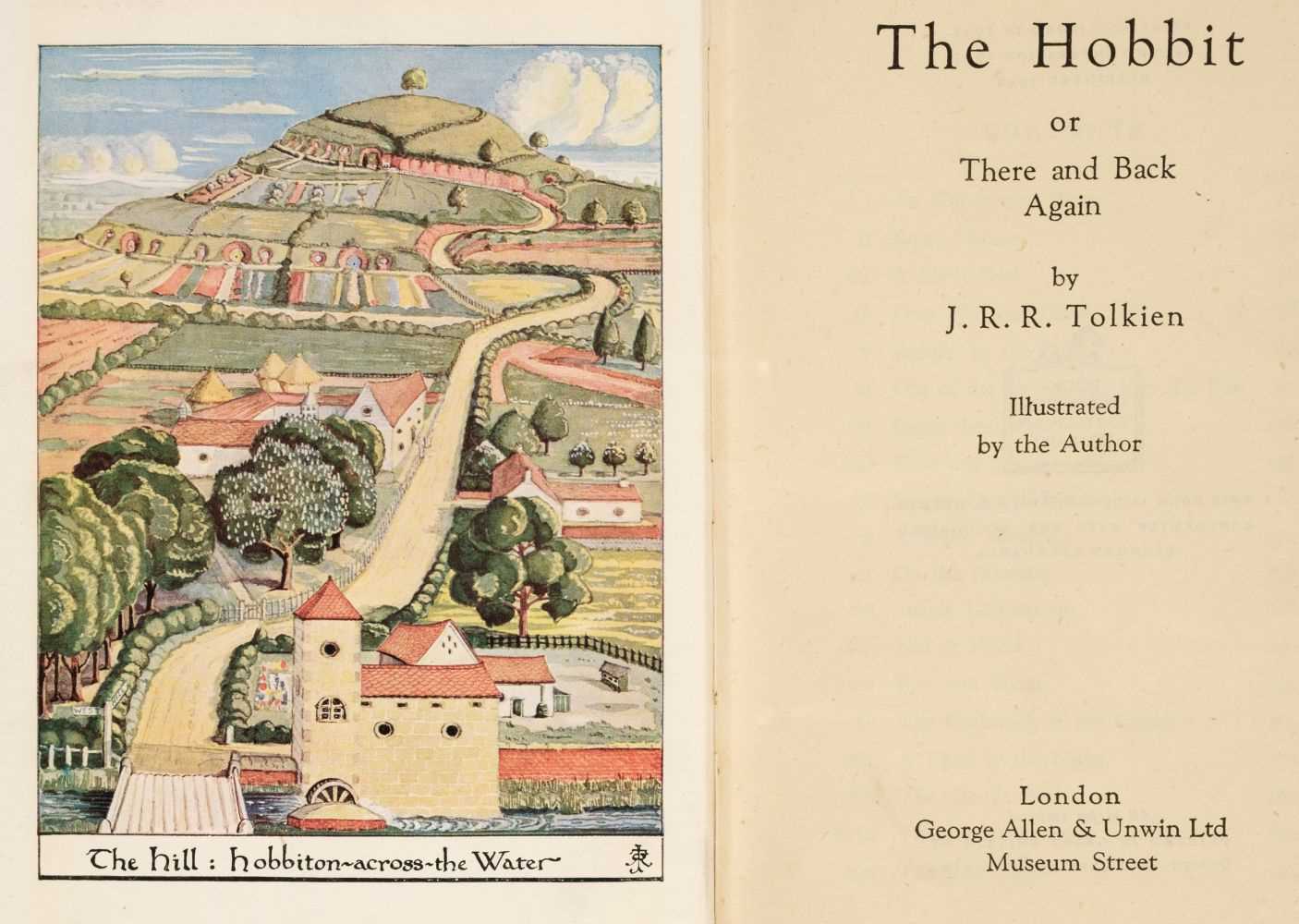
Thorin says that he would never have found Bag-end were it not for the mark on the door! Peter Jackson (unwittingly) frames the queer sign as a chalk mark in the Ali Baba story, distinguishing this Hobbit's hole from other Hobbit holes. Now look at the illustration of Bag-end in the book.

Image

If anywhere needs no added distinguishing mark it is Bag-end, which is already distinguished by being (as the name suggests) the hole at the end of the road that winds up the Hill. And if that is not enough to keep a stupid Dwarf from getting lost, Bag-end is the only Hobbit-hole with a green front door. Really, the idea that this singular hole with its distinctive front door requires an additional distinguishing mark is, well, moronic. Those three movies missed all the magic of The Hobbit.

Re: Speak Egg!

Posted: Sun May 12, 2024 3:39 am
by Priya
Hello Chrysophylax Dives
If this is another request, what were the previous ones?
Er - this is a continuous conversation is it not? A prior request, if you look back at my previous post, was for you to give me a reply on certain references that you’d cited, per:
Do you have any hard/soft evidence that Tolkien knew of, or was acquainted with …
Anyway, such a quibble is a distraction of minor consequence.


The reason why I asked:
can you comment on: chalk signs as used by Patterers often signifying the ‘house to be burgled’, as opposed to Gandalf’s sign and the one on Ali-Baba’s door as marking the ‘house of a burglar’.
is because, per The Hobbit tale, in a way, none of these seem truly a 100% match. Which İs a comment/observation I was kind of expecting from you.

I know you stated:
The very idea of a 'burglar for hire' mark borders on the absurd.
But The Hobbit is a ‘fairy-story’. Much or most of it is viewable as absurd!


Per the text we are told by a dwarf:

“… a mark on this door - the usual one in the trade, or used to be. Burglar wants a good job, plenty of Excitement and reasonable Reward, …”.

So this is a case, I am led to believe, where typically in the period of yore depicted, the home-owner advertised his services. This then, is unlike the Victorian Patterer or the Ali Baba situations.

It’s more akin to a home-owner putting up a sign on his property offering painting services (which by the way I see in a house across the road from me - a drawn paint brush and a phone no. next to it). Or as another example a display showing a picture of a glass of lemonade with a dollar sign next to it and an arrow - all of which signify ‘come in for a glass of home-made lemonade for a buck’. Etc., etc.

Additionally, I must note that in the Ali Baba tale and similarly with the professional Patterer, those both posting the sign and able to read it - were nefarious types. That’s unlike The Hobbit, because I don’t classify Gandalf or Thorin’s Company as such. They are just knowledgeable about the ‘trade’ (and mark), unlike Bilbo who’s ignorant because he’s never had any connection/dealings in the business.

So we have a little divergence beginning to appear. I think these distinctions are of importance, and should be ruminated upon.

Re: Speak Egg!

Posted: Sun May 12, 2024 6:34 am
by Chrysophylax Dives
Hi Priya, I thought I had adressed those questions - but it may have got lost in the two threads.

Gandalf and the Dwarves are nefarious types from the point of view of respectable Hobbit society.

The correspondences are never one-to-one because Tolkien has turned the Ali Baba story inside-out, and then some.

'Ali Baba' is a tale of two doors, the first hidden, opening on to treasure by magic formula, the other marked with chalk.

'The Hobbit' reverses the order of doors, so we begin with the marked door. On the hidden door, Tolkien substitutes the magic of Durin's Day and the keyhole for 'Open Sesame'. On the marked door, Tolkien replaces a stupid thief with a wizard - and for this reason alone the mark on the door must be different: instead of a stupid mark that fails this story opens with a wizard's mark that works.

But Tolkien has done more than reverse the order of the doors, he has introduced a third element - a magic ring won in a game of riddles in a doorless hole. Basically, my provisional hypothesis is that here is where Tolkien revises Mill: the magic ring is introduced as an illustration of a 'meaningless mark' (as Mill has it) that distinguishes an individual - that is, a proper name.

So, in light of the mess that Mill and the philosophers have made of the Ali Baba story, Tolkien works out his own version. Now the mark on the door is made by a wizard and is a common name, meaning 'burglar', and the 'meaningless mark' that distinguishes an individual (and is for Mill a picture of a proper name) is introduced between the two doors, and won as his own by the Hobbit in a doorless hole.

The point is not that sign A in The Hobbit is really sign X in the Ali Baba story or mark Y in Mayhew's account of Patterer signs. We are not looking at 'literary influence'. What we are dealing with is Tolkien's theory of the nature of names, what they are, how they work, how they are to be pictured.

Re: Speak Egg!

Posted: Sun May 12, 2024 9:24 am
by Chrysophylax Dives
Priya,
It may help if I translate the Ali Baba argument among the philosophers into more familiar language.
‘Fair lady!’ said Frodo again after a while. ‘Tell me, if my asking does not seem foolish, who is Tom Bombadil?’
‘He is,’ said Goldberry, staying her swift movements and smiling.
"Who are you, Master?" he asked.
"Eh, what?” said Tom sitting up, his eyes glinting in the gloom. “Don’t you know my name yet?"
Tolkien is playing with the ambiguous nature of a proper name.

Both Tom and Goldberry adhere to Mill's position, over that of Shedden and Russell. The question 'Who?' is a request for a reference, a pointing out of that one; it requests no information as to the nature of that one, merely an identification. Hence, your proper name is the only answer to the question who are you.

But as Tolkien says in that famous letter, in ordinary life we laxly confuse the 'who' and the 'what' - and Frodo is really asking, that is he means to ask, what Tom Bombadil is.

The difference between the 'who' and the 'what' is the difference between the chalk mark as a distinguishing mark (like a proper name that means nothing) and a description of some qualities of that person (like a common name that means 'burglar').

I'm just trying to say that what can appear as a mountain made of a mole-hill can nevertheless illuminate some of Tolkien's word-craft in his stories.

Re: Speak Egg!

Posted: Mon May 13, 2024 5:31 am
by Priya
Hello Chrysophylax Dives

One thing we can be pretty sure of is that most authors put exceptional thought and effort into constructing the first paragraph, if not first chapter, of a story. We know Tolkien thought (probably deeply) about The Hobbit long before he put pen to paper - and we also know that he dropped working on the tale after completion of the first chapter for quite a while too.

Because Tolkien was an Oxford Don - there is no doubt in my mind that he slipped academic material in. The overarching idea of a quest to kill a dragon and recover treasure was definitely the primary driving force, incipient before he began that first famous sentence. And indeed we can see that in the second sentence:

“Not a nasty, dirty, wet hole, filled with the ends of worms …”.

Because it was here that Tolkien punningly and with great subtlety intimated to the careful reader that indeed this is where the end of the great worm Smaug would begin - just not quite yet - at least not until the arrival of Gandalf and the dwarves would the plan take shape in Bilbo’s hole in the ground.

It’s curious that Tolkien appeared to minimize a Beowulf source being a major source in the theft of the cup (Letter #25). Frankly, I don’t believe him. As I don’t believe his denial in the same letter:

“ I do not remember anything about the name and inception of the hero.”

It is possible that Tolkien wove into the tale a ‘comment’ or an ‘argument’ about the correct way to interpret Ali Baba and the significance of names with an added Beowulfian touch - as you are interpreting it. But right now, I’m trying to get on that track - but just finding it difficult. And that’s possibly down to me - and not your fault!

There’s possibly something genuinely there - but I need to mull on it a bit more. What would be really helpful is a collation of academic quote evidence from the Professor on this subject. It might aid clarity if you point out to which motive/sentence in The Hobbit it is applicable to.

Were you intending to publish a thesis/article on the matter?

Re: Speak Egg!

Posted: Mon May 13, 2024 6:10 am
by Chrysophylax Dives
Priya wrote: Mon May 13, 2024 5:31 am Because Tolkien was an Oxford Don - there is no doubt in my mind that he slipped academic material in. The overarching idea of a quest to kill a dragon and recover treasure was definitely the primary driving force, incipient before he began that first famous sentence. And indeed we can see that in the second sentence:

“Not a nasty, dirty, wet hole, filled with the ends of worms …”.

Because it was here that Tolkien punningly and with great subtlety intimated to the careful reader that indeed this is where the end of the great worm Smaug would begin - just not quite yet - at least not until the arrival of Gandalf and the dwarves would the plan take shape in Bilbo’s hole in the ground.
Right. But note also how this sentence foreshadows also Gollum's nasty, wet (and doorless) hole. Next time I have some moments I will dig up some of my meditations on the first paragraph and the second - how the first sentence was rounded out and continued. I think we glimpse some quite profound workings of Tolkien's mind, which is shown to work by comparison. We begin with one Hobbit in his hole in the ground, and the first step is a comparison of this hole with other holes. The next step is to take the Hobbit out of his hole and put him in some of these other holes, thereby to discover the hidden qualities inside him - the what of this Hobbit. (I spent a lot of time on this!)

I am not planning on doing anything with this material for the foreseable future because all my time is going into my Seeing Stones project. But I am very happy to discuss these ideas here with you and other plaza members.

I understand that the entrance is a very abstract and seemingly inconsequential idea about names. It took me a very long time to get my head around the idea. Once I had, however, I saw that it is very simple - it is almost the simplicity that causes the problem in understanding. I think the real problem is that we find it very hard to think about something as everyday and ordinary as a bit of language - we use language, but do not know how to begin to think about it. Well, here we have some pictures of a name...

Ultimately, all of this Hobbit inquiry arose out of my long-term quest to get to grips with its sequel. Once I got my head around the fact that the riddle game that we all know was superimposed I began the effort to read the story as it was read between 1937 and 1952, when the second edition ruined the keystone of the whole edifice. This was my path into alienation from Tolkien fans, because I found it utterly impossible to communicate to Tolkien fans that there was a buried Hobbit story, a story that was different because the riddle game was different. But once you take this on board, then it becomes clear that the magic ring of the original story was also different. So to understand how the sequel was imagined it is necessary to hold clear what the magic ring actually was before it was transmuted into the One Ring.

Here is where my old research intersects with yours, but I am not sure what you will make of where I come from. Just to say, having read recently your December post where your quotes show beings in the world that are not of the world, I don't doubt your basic reading of Bombadil and Goldberry (though perhaps I'd ultimately not go for 'angels' as the most useful word here). So I don't think what I am about to say undermines your Bombadil theses.

My own conclusion from careful study of 'Return of the Shadow' is that before Tolkien sat down to write 'A Long-expected Party' at the close of 1937, at which point he vanished Bilbo Baggins a second time but did not arrive at an heir, he already had fairly clear in mind the following idea of a sequel: a party of Hobbits would cross the Shire and enter the realm of Tom Bombadil, adventuring in a sequel of Tom's adventures in the 1934 poem, where he escapes Willowman, banishes a Barrow-wight from his bedroom, and marries Goldberry. Tolkien's basic idea was to retell The Hobbit story, but now with around 3/4 of the action set before Rivendell (basically the realm of Bombadil plus Bree plus something - which turned out to be Weathertop), and then some battle on the other side of the Misty Mountains and the end - a tale about the same size as the original.

Of course, everything changed as he started writing. What happened was that the 'unpremeditated' encounter with Black Riders, followed by the meeting with Elves in the woods of the Shire, became the basis of a completely different story about the One Ring, which was seen for the first time by Tolkien only around late autumn 1938, when the narrative reached Weathertop.

But as the whole story was imagined from the ground up after Weathertop, that bit set down in the realm of Bombadil remained pretty much as was. So what we read today is pretty much what Tolkien penned before he was writing the story we know as LotR.

In a nutshell, I read the Bombadil adventures in the sequel as the true sequel to the original Hobbit story. In practice, this means that my reading of The Hobbit in terms of names dovetails with my reading of the curious dialogue about names in the house of Tom Bombadil. I believe that Gollum (as originally conceived, not what he became) is the answer to the riddle 'Who are you, alone, yourself, and nameless?'