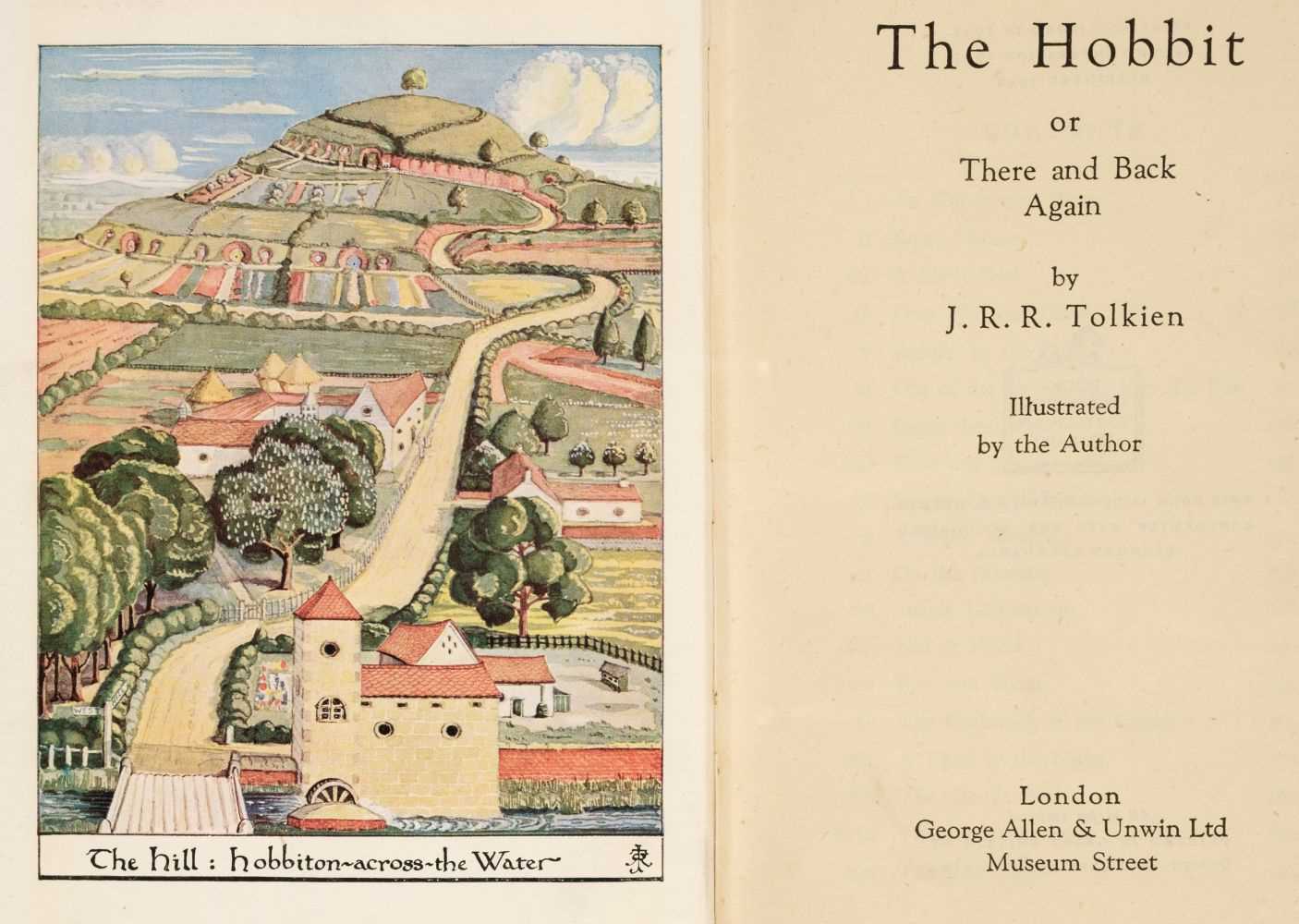


*By everyone ought I mean that if I was dictator of a nation I would abolish the current school curricula and impose compulsory but structured and graded reading of the works of J.R.R. Tolkien, commencing with The Hobbit. At a tender age, school children would also be introduced to 'The Arabian Nights', followed up a year or so later, with a passage of John Stuart Mill's System of Logic (1843) and A Christmas Carol by Charles Dickens (1843). Mayhaps I would wait another year or two before moving on to the full philological investigation, wherein the curious history of reception in England of 'The Arabian Nights' is traced, thereby to reveal to suddenly awakened adolescents how the quick wits and courage of Morgiana and the luck of Ali Baba come together in a Hobbit whose proper name is Bilbo Baggins.
Morgiana's Question
Reference: ‘The History of Ali Baba, and of the Forty Robbers, Killed by One Slave.’ The Arabian Nights, Translated by Edward Forster, Vol. IV., London: William Miller, 4th edition, 1815 [1802], pp. 252-3. A story by Hanna Diyab, first given in Antoine Gallande (editor), Les Milles et Nuite, Vol. 14, 1715.Soon after the robber and Baba Mustapha had separated, Morgiana had occasion to go out on some errand, and when she returned, she observed the mark which the robber had made on the door of Ali Baba’s house. She stopped to consider it. “What can this mark signify?”
Nb. The original is French (not Arabic) and the English translations vary. When considering the history of reception it is well to attend to the year of translation. This is a translation read by the 'golden generation' who turned to 'The Arabian Nights' in their childhood in the days of the Napoleonic Wars, such as J.S. Mill and Charles Dickens.
Comment: obviously, I consider that this chalked mark has some bearing on the queer sign that the wizard puts on the door of Bag-end. After long pondering, however, my conclusion is that this chalked mark is more like the magic ring (of the original Hobbit). This conclusion reflects Covid years inquiry along three distinct paths of English reception.
(1) Philosophy: J.S. Mill reads the chalk mark as meaningless, and as such analogous to a proper name.
(2) Literature: Dickens reads the chalk mark as magical, and as such the door to a story.
(3) Henry Mayhew: a journalist who interviews the criminal classes reveals the reality of Patterer-marks.
Close inspection (eventually) reveals that Mill - and all the philosophers who commented on his definition of a proper name down through Betrand Russell to Ludwig Wittgenstein - were hopelessly confused because caught in a picture wrongly abstracted from the story. The philosophers only ever read Mill's quotation from the story - if they had only turned to the story they would have seen that Mill had read the story stupidly. This is a nice bonus because what Mill failed to see is that the two robbers who in turn chalk the door are - given the situation - doing something stupid. The robbers illustrate the wrong way to chalk a mark, and Mill taking them as a model for anything made a stupid analogy (and his philosophical heirs continue to this day to discuss the chalk mark in learned journals, quite unaware that they are now the ninth or such generation of stupid - a sight that in a Darwinian universe one just does not expect to see).
Historical research revealed that at just this time Henry Mayhew was publishing his famous volumes on the London poor - anthropological surveys of all the criminal and marginal types, which Dickens brought to literary life. Dickens' use of the chalk mark is solely magical, however: it becomes the ghostly face of Marley on the doorknocker that scares Scrooge at the start of his story (Ali Baba then appears in the first act, walking past a window of Scrooge's childhood school, and serving to unlock the other door of this story, opening up the heart of the miser).
Here are the Patterer-marks in Henry Mayhew's 'London Labour and the London Poor: Those that will work; Those that cannot work; and those that will not work' (pp. 218 & 247).
After Mayhew (1851) the respectable reading public knew about the secret heiroglyphic signs left by vagabonds, and we get books that purport to be serious, like Mayhew, but are more than half fantasy. Lurid and sensationalist accounts of how the gypsies carried Egyptian hierogphys from Asia and met and bonded with the criminal classes of Elizabethan England (that is, precisely the time of Shakespeare), with the fusion generating the monstrosity of criminal jargon - words and signs that may be spoken or drawn in public but with secret meanings. There is more than a hint of ancient English intercourse of outlaws, exiles, and evil spirits in the wastelands behind the imagined history of 'cant'.
Here are Mayhew's Patterer-marks (the same) packaged with a map on the frontispiece of the scurrilous Slang Dictionary (1859) of J.C. Hotten, 'A London Antiquary' (always a dubious bunch, in my experience). Hotten sensationalizes Mayhew and is already half-way to Harry Potter. Have a look also at the chapter 'Account of the Hieroglyphics used by Vagabonds'. Despite everything, the dictionary itself reveals jewels, and I suspect you will spot several that I had not noticed.
The first chapter of The Hobbit seems to me to play on this late-Victorian fantasy of a hidden underworld that extended even into the suburbs and the countryside - a land where an unknown hand might make a secret sign on your door, unnoticed by you and those who dwell within, but read by others in the trade. This fantasy itself obviously had roots in (a) actual criminal practice and (b) a generation enchanted by the tale of 'Ali Baba and the 40 Thieves' (seriously, that was the fandom of the age - they had no cinema, but they read the tales of 'The Arabian Nights' alone in their childhood and they loved those of Hanna Diyab and went to see performances at the theatre and the pantomime with family, and the imaginations of a generation were inhabited and haunted by Morgiana, as also the dream palaces of the story with the magic lamp).