A Hobbit's Guide to Stairs

"As for myself," said Eomer, "I have little knowledge of these deep matters; but I need it not."
Tree
Points: 4 777 
Posts: 3136
Joined: Sun May 17, 2020 7:54 pm
Saranna wrote: Tue Aug 22, 2023 3:24 pm Back to the subject of stairs, did the cellars of hobbit homes have stairs down to them as well as cellar doors, or were they merely the smaller rooms at the back with no windows? Did Sam have to go down into a dark cellar as we know it today, to bid farewell to the beer barrel?
Of Hobbit houses, I assume the cellars are dug down and reached by stairs. On the holes, Sam, and the barrel, may I refer you to Wednesday 2, which sets out the fundamental principle of Hobbit architecture from the second paragraph of The Hobbit?
The door opened on to a tube-shaped hall like a tunnel… The tunnel wound on and on, going fairly but not quite straight into the side of the hill… No going upstairs for the hobbit: bedrooms, bathrooms, cellars, pantries (lots of these), wardrobes (he had whole rooms devoted to clothes), kitchens, dining-rooms,
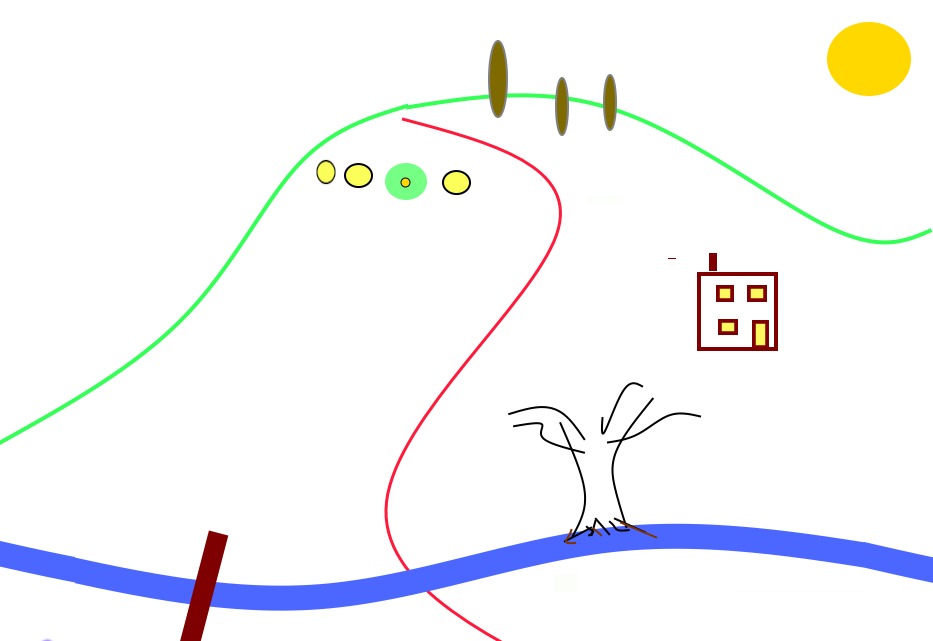
The starting point of The Guide to Stairs is this principle, which is not well-known because not respected in any of the PJ movies (which show connecting doors between the rooms in place of the corridor). When mapped out against the curve of the Hill, it is observed that the result is a hole in which a cellar is reached from a door on the same corridor - and so same horizontal level - as a living room; and yet, because the cellar-door is on the Hill side it opens onto a room that is deeper underground than the living room on the View side.

To my mind, this is the great overlooked marvel of Hobbit-hole dwelling, which when combined with the fact that 'The Hill' draws buildings (with stairs) at the bottom of the Hill, provides the background of the consideration of stairs just witnessed as the Hobbits first walk to the house of Farmer Maggot. That, and the House up, down, and under hill that was already in the back of his mind as a strange opposite of 'The Hill', and to which I will turn in a moment (after selecting an appropriate tune on the jukebox).
Eat earth. Dig deep. Drink water.

Tree
Points: 4 777 
Posts: 3136
Joined: Sun May 17, 2020 7:54 pm
Wednesday 14: Out through the Window

What is the story of Bingo Bolger-Baggins? Basically, he stepped out of Bilbo's second vanishing as the star character of a story of a Hobbit with friends who would adventure around the House of Tom Bombadil - a plan for a sequel apparently in Tolkien's mind before he penned the long-expected party and second disappearance of Bilbo Baggins in the week before Christmas 1937. So while the Maggot farmhouse built on the drained flatlands of the Marish is a first point of pause and reflection on the 'geography' to be drawn out of the illustration of 'The Hill', we should keep in mind that the author who is taking Bingo and Odo and Frodo Took to the other side of the Shire in the early months of 1938 has already clear in mind a House on the other side of the Hedge: up, down, under Hill. Those adventures were composed that autumn – rapidly, with only a handful of (significant) additions and almost no other revision subsequently, which really sets the Bombadil realm apart from the rest of the early story from Bag-end to Rivendell, which was worked over again and again (all sorts of sub-stories and characters appear and then vanish, leaving tiny residues in the final text).

This House entered by the Hobbits of the new story replays, albeit much earlier in the adventure, the House of Beorn in The Hobbit. When it comes to these magical Houses, whatever side of the Misty Mountains you be, the sensible response to nightly noises is obviously to hide one's head under the blankets.

Let us be clear on the editorial policy of the Guide to Stairs: Our writers are not permitted to consider opening the door of the original House at night nor looking upstairs in the House of the sequel at any time. Is it not enough to know that you may dream secure for tonight within these walls? After all, you will have to leave them soon enough. Do not be absurd, and maybe tomorrow it will rain.

But though it is forbidden to consider the stairs in the sequel, it is permitted to ascend the stairs of the original 1934 story, in which Bombadil begins a bachelor. Thanks to a marvel of dedicated labor by halfir on the old plaza, now restored in a locked archive on the new plaza, 'Peeling the Onion' allows us to do this with ease, while also pointing us to the late suggestion of J.R.R. Tolkien that his early poems of Tom Bombadil were actually told by the Hobbits of the Marish (a suggestion that halfir did not think much of). In any case, on halfir's now canonical thread, arguably the greatest monument of Old Lore, the Guide to Stairs ventures one - and only one – external contribution.

Of this early poem, 'The Adventures of Tom Bombadil', halfir rightly called attention to the power of Tom Bombadil's voice, which all other protagonists obey. But upstairs in the House of Tom Bombadil the barrow wight does not seem to do exactly as told. Abbreviated from pp. 15-16 of the halfir archive, pdf version of 'Peeling the Onion':
Dark came under Hill. Tom, he lit a candle upstairs creaking went, turned the door-handle
‘Hoo! Tom Bombadil, I am waiting for you just here behind the door! I came up before you.'
‘Go out! Shut the door, and don’t slam it after! Take away gleaming eyes, take your hollow laughter!'
Out fled barrow wight through the window flying, through yard, over wall, up the hills a crying

This is the Guide's sole notice of this particular staircase. The great lesson learned of old about Tom Bombadil and Goldberry is that sometimes it is better to go the long way round. While the House of Bombadil will be mentioned in some subsequent posts, house rules require that henceforth it is viewed only from the outside.
Eat earth. Dig deep. Drink water.

Newborn of Imladris
Points: 792 
Posts: 312
Joined: Sun May 17, 2020 10:25 am
@Chrysophylax Dives

'may I refer you to Wednesday 2'

- sorry to have earned myself this dreaded phrase. I suspect my brain is no less affected by being 75 years old than is the rest of me. How would it be if I printed out this thread so I can read it more carefully from the begining? But say if you would prefer me not to.

On the positive side it would encourage me to climb my stairs, which is good for me, and assemble the printout on my desk where all the necessary volumes are at hand. If I got a better grip it might deter me from this annoying tendency to flippancy when in fact I find the whole thing really interesting.
Remembering halfir by learning something new each day

New Soul
Points: 257 
Posts: 174
Joined: Mon Jul 31, 2023 1:21 pm
Having read, all but briefly, parts of this fun thread, I'm not certain if this has been covered; I'm wondering how stairs would reckon in hobbit mythology and metaphor.
In our own culture, stairs are often seen as something used to attain. I think of Led Zepplin's "Stairway to Heaven," in which a lady is attempting to attain rest, (as her eyes look to the west), and complete satisfaction, (as she wants to be sure, because you sometimes words have two meanings). In Chinese culture I believe stairs are often seen as a metaphor for attaining wisdom, and as an approach to the heavenly realms. Again, in ancient Greece, there is the concept of the gods dwelling atop Mount Olympus.
I wonder, in Middle Earth in general, and in hobbitish culture specifically, whether steps and stairs would hold the same meaning. After all their equivalent of our concept of heaven is not "above us," but rather, "across the sea."
While the Undying Lands lie west, and not "above" we still have the Elves love of the stars and thereby, the "heavens." Opposing the beauty and fairness of the heavens, there are the evils of Morgoth's Lair which we read of as being caverns beneath the Earth, and the dungeons of Sauron's Barad Dur.
I wonder if, for the various people's of Middle-Earth, the metaphor and mythology of stairs might vary greatly. I can rather imagine the elves holding stairs as a symbol of attaining nearness to the starlight that they so adore. Like-wise, the race of men have always been both closely connected and at odds with the elves, desiring to grasp the immortality of the Undying Lands. Perhaps for elves, there is a representation of fulfillment and becoming all that they should be, while for men, stairs the the contest for unachievable immortality. Hence we see great men building great towers and monuments hoping them to last forever.
Then we have the dwarves. Would stairs have any meaning for them, or is there only meaning found in gems and creating? Stairs for them lead deeper to more delving; the hope of a greater treasure. If downwards, then for dwarves, stairs might lead upwards - to men and elves for whom histprically, or mythologically, they have little love and less trust. Perhaps for dwarves, stairs hold a double meaning; one of attaining, (of wealth, of beauty, of conquest), and one of trouble, and even war dependent of the direction of the stairs.
Finally, our good hobbits. In terms of mythology - well, they don't seem to have a lot, except for a few of the more Tookish, who hold some understanding of Elvish lore. So I think we can assume next to know mythological reading, yet we have that passage at the start of this thread with the stairs of the white Tower here we have an un-explained imagery. Our dear hobbit protagonist, as is pointed out by @Chrysophylax Dives never actually ascends those stairs. Perhaps for Hobbits, who would rarely use stairs, and obviously (from the description of Bag-End, "no going up and down stairs for this hobbit"), avoid them altogether. Perhaps then, we can assume a certain mystery around the metaphor of stairs and steps in hobbitish culture, that they represent the unkown, and perhaps the toil required to achieve it.
Periantar:
I am a multi facited hobbit, for I am a gardener;
a leader, hobbit second regiment of the HDS;
and fireworks meister of TISAPA.

Tree
Points: 4 777 
Posts: 3136
Joined: Sun May 17, 2020 7:54 pm
Periantar wrote: Wed Aug 30, 2023 12:03 am I wonder, in Middle Earth in general, and in hobbitish culture specifically, whether steps and stairs would hold the same meaning. After all their equivalent of our concept of heaven is not "above us," but rather, "across the sea."
The general plan for this Guide is to follow the stairs of the story through the drafts of LotR. At present, we are only at the mid-point of the very first stage, and Tolkien seems to be using Hobbits and stairs to better place Hobbits in relation to Dwarves (stairs in hole) and Elves (stairs in tower). We have a long way to go, and the business only gets serious when the tallest of the western Elf-towers (seen by Bingo) is moved to dream while various inland towers built by the Men of the West enter the picture.

But as befits the one who unlocked the unlockable lock, I think you capture the very heart of the matter in the above quotation. The next few Wednesdays are dedicated to 'the other side of the Hill', culminating in the barrow, and then we arrive at Bree - where architectural considerations return to the fore. But then we arrive at Weathertop...

Only on Weathertop did Tolkien for the first time understand the magic of the ring. The conception of the Ring appeared with the confrontation between Bingo (Ring on finger) and the Black Riders (who have "passed through" other magic rings). Christopher Tolkien in his editorial commentary employs a valuable metaphor in commenting on this new conception of the Ring, which as he says, appears out of the blue and all at once at this moment: he says that it is a bridge between two realms. Though supplied by the son, not the sub-creator, I think this metaphor gives the hidden frame for the meaning of stairs in the story.

As set out in reference to Gollum on an earlier Wednesday: The One Ring has nothing to do with stairs. By contrast, the Elf-tower has everything to do with stairs, which take one up to a height from where one can look on a view. On completion of his story (and only then) Tolkien decided that this view of Valinor was seen through Elendil's Stone, thus invoking on the margin of this story the moral of Numenor: it is granted mortals to see immortality, but to reach out and touch and try to take is to invite calamity. The Ring is a bridge because it invites and allows mortals to reach out and touch that which they glimpse and desire, and so the (metaphorical) antidote to the Ring is to climb the stairs - a return to looking without attempting to take for one's self.

That for you, my young Hobbit riddle-solver, is the hidden thesis of The Guide to Stairs. However, in spinning it out in the plaza i have run into this thread, where conversation with @Silky Gooseness has opened my eyes to the fact that this thesis is only one half of the picture! This is to put the new Hobbit story into its true relationship with the final Silmarillion story, first penned in early 1936, 'The Fall of Numenor'. But behind this relationship stands the earlier Silmarillion stories, extending back another 20 years, in which an Elvish perspective on stairs is discovered! In this Elvish perspective, so far as I can gather, everything appears as from the other side of the shoreless sea, as if from the point of view of Galadriel, and stairs are something to descend and a symbol of escape. At least that is what i understand so far - i am hoping that sooner or later the Goose will say something else because these Elvish matters are a bit beyond me...
Eat earth. Dig deep. Drink water.

Tree
Points: 4 777 
Posts: 3136
Joined: Sun May 17, 2020 7:54 pm
Periantar wrote: Wed Aug 30, 2023 12:03 am I think of Led Zepplin's "Stairway to Heaven," in which a lady is attempting to attain rest, (as her eyes look to the west), and complete satisfaction, (as she wants to be sure, because you know sometimes words have two meanings). In Chinese culture I believe stairs are often seen as a metaphor for attaining wisdom, and as an approach to the heavenly realms. Again, in ancient Greece, there is the concept of the gods dwelling atop Mount Olympus.
I wonder, in Middle Earth in general, and in hobbitish culture specifically, whether steps and stairs would hold the same meaning. After all their equivalent of our concept of heaven is not "above us," but rather, "across the sea."
Yeah! :headbang: The direction to follow here is Tolkien's study of Beowulf, an Anglo-Saxon poem set in the world of the ancient imagination of the pagan ancestors before they crossed the sea to the British Isles. Tolkien reads the Anglo-Saxon poet as imagining the ancient world of the hero Beowulf as one in which heaven above was once known, but forgotten so long ago that the forgetting has been forgotten, while the meaning of that beyond the western ocean is also forgotten, but people still remember that there is something that they have forgotten. The poet of course telling this story in a newly Christian society, in which everyone is quite clear now on the heavens above but have almost completely forgotten any memory of the gods beyond the shoreless sea - a conception now doomed because everyone knows also that beneath the heavens is a round world and so the other side of a flat shoreless sea is no longer a credible 'geography'.

Tolkien tells his stories in a world in which (after the initial Music) the heavens above are very real but not at all in the picture, while the beyond over the sea is in the picture. But the Three Ages of Middle-earth culminate in the end of even a residual (Palantir-tower) 'horizontal' vision of immortality over the sea. The possibility of enchantment through mutual vision and communication with the Elves has now vanished forever, its end captured in the image of the fairy-ship that departs our shores taking the Stone of Elendil into the West, along with the Three Rings of the Elves under the sky.

Today, alas, stairs are only metaphorical. And also a nuisance, as is known by Hobbits and anyone on wheels.
Eat earth. Dig deep. Drink water.

Tree
Points: 4 777 
Posts: 3136
Joined: Sun May 17, 2020 7:54 pm
Wednesday 15: Annoying Hobbits

To read today this very early Hobbit stair-conversation between Bingo, Odo, and Frodo is almost impossible. We think we are in the world of The Lord of the Rings but are actually in the ghost sequel to The Hobbit, and while recognizable elements - like the Marish and the Elf-towers - appear in the background, they do not yet mean the half of what they mean today. That our stair-conversation was removed from the narrative to reappear in the Prologue speaks to a decade-long process in which the world of the story that we know was put together.

In these early drafts of The Lord of the Rings the safe reference is The Hobbit, but from the beginning Tolkien has in mind something deeper and darker - though his initial conception of this is a barrow-wight awaiting Bingo on the other side of the Hill. At the same time, he is stepping out of the imagination of one singular Hobbit, who adventures only in middle-age, but is very little and hides his head under the blankets at the nightly noises outside the door of Beorn.

The Hobbit is told by a wonderful narrator, who knows just when to use a blanket and what to pull out of a pocket. The misconception that the Red Book – a narrative by Hobbits – arose from Tolkien's self-criticism of the perfect narratorial style of The Hobbit confuses the original with the sequel, in which the heirs to Bilbo Baggins step into their adventure as Hobbit tweens - alarmingly close to what Tolkien in the real world knew as 'undergraduates.'

When you step out of the new Hobbit story that grew over the next decade and back into early 1938, the 'Marish stair-conversation' appears as satire, an Oxford Professor laughing at the conversation of educated yet clueless young folk, who fly in the air in abstractions while blissfully unaware of the pertinent facts on the ground. The joke may be opened up in relation to the untold story of Bag-end.

Bilbo and Frodo were exceptional as bachelors (Prologue), and we may wonder that Bungo Baggins and Belladona Took burrowed Bag-end but left in it but the one son, Bilbo. In the end, it takes Sam and Rosie Cotton to populate this Hobbit-hole as it was clearly designed to be used:
And also you have Rose, and Elanor; and Frodo-lad will come, and Rosie-lass, and Merry, and Goldilocks, and Pippin; and perhaps more that I cannot see. (LotR, VI, ix)
The reality of regular Hobbit life establishes what upstairs rooms in a house, as well as the spare rooms on the same level in this hole, will actually be used for. The imagination of some Hobbit-snack whilst doing an Elvish-view from upstairs, and its exposure as a fantasy by Odo Took with his clever talk of handkerchiefs is - basically, fundamentally, and intentionally - annoying. Anyone who has tried to fix a pipe under the sink whilst some child explains something clever about plumbing that they once watched on YouTube may appreciate the situation drawn.

The scene is funny, but the gulf is too wide. Not even the art of Tolkien can make students anything but annoying to everyone else. Wisely, he stepped onward, eventually arriving at the Red Book: a story told by Hobbits, which allowed all the prejudices and different points of view that we have seen him play with so far to be absorbed as internal, in-world prejudices and points of view, while stairs as stairs were vanished as a subject of conversation.
Last edited by Chrysophylax Dives on Wed Aug 30, 2023 5:00 am, edited 4 times in total.
Eat earth. Dig deep. Drink water.

Tree
Points: 4 777 
Posts: 3136
Joined: Sun May 17, 2020 7:54 pm
Saranna wrote: Wed Aug 23, 2023 1:56 pm @Chrysophylax Dives

'may I refer you to Wednesday 2'

- sorry to have earned myself this dreaded phrase. I suspect my brain is no less affected by being 75 years old than is the rest of me. How would it be if I printed out this thread so I can read it more carefully from the begining? But say if you would prefer me not to.
Dear Saranna, the whole point of the numbered Wednesdays is to allow use of this dreaded phrase, and i was duly grateful for the opportunity that you afforded (not the first, nor the last) :mwahaha:

I've been pondering organization. I was thinking of the Bombadil realm as a second 'chapter' - or better, 'stair' or 'flight' - but came down on making the first (let's say) 'flight' a perspective on both sides of The Hill, so from Bag-end to the barrow-wight. When I get to Bree I have in mind collecting all the posts and putting the 30 or so Wednesdays as one long post on my blog. The decision to do both sides of the Hill means that such collection is still some way off, though.

PS. I've started organizing these posts to go on a single blog page, and am seeing the places where i got the order wrong or went on a loop because i'd forgotten something that should have beem said before. one thing this teaches me is admiration for how halfir organized 'Peeling the Onion'.

PPS. Saranna, I have worked and slaved and now have a working version of the Guide all in one file - here. This is still a basic, there are no doubt many typos and i need to sort out the formatting a bit. But here you are!
Eat earth. Dig deep. Drink water.

Arien
Arien
Points: 2 417 
Posts: 1982
Joined: Thu May 07, 2020 8:56 pm
Your use of the word “Flight” immediately makes me think of “Flight to the Ford”, and I wonder how much worse an experience that would’ve been had the entire chase been up a flight of stairs.

It also makes me think of the other famous stairs in LotR: the ones that the Hobbits and Gollum climb on their way to Cirith Ungol. It’s interesting to me because passing through Cirith Ungol very much evokes passing through the valley of the shadow of death - and this is echoed in Frodo’s call to Elbereth - le nallon si d’nguruthos! A tiro nin, Fanuilos! and yet instead of DESCENDING to this Valley, Frodo and Sam, in fact, climb up to it.

Climbing up is also harder than descending stairs; you expend energy but gain potential, so the journey to the valley is a struggle and not a rush down “the wider path” as a descent to hell itself. The passage is something Frodo and Sam choose to face, and struggle even on the road towards it.
cave anserem

Tree
Points: 4 777 
Posts: 3136
Joined: Sun May 17, 2020 7:54 pm
Silky Gooseness wrote: Sat Sep 02, 2023 5:26 pm It’s interesting to me because passing through Cirith Ungol very much evokes passing through the valley of the shadow of death - and this is echoed in Frodo’s call to Elbereth - le nallon si d’nguruthos! A tiro nin, Fanuilos! and yet instead of DESCENDING to this Valley, Frodo and Sam, in fact, climb up to it.
I assume that the descending/ascending inversion that you point to here is related to the up/down dichotomy of escape/gaining a view, which you have previously pointed out. As with Luthien's hair, i am way behind you. In general, I've begun to see that i've failed to properly read this part of the story. Here is where we step from Numenor - where i have been focused - back to the First Age, and the Hobbit narrative becomes more mythical, with textual echoes of the Silmarillion stories, most of which I miss.

But for what it is worth, this seems to make intuitive sense. We focus on the horizontal - not only of a Hobbit-hole's corridor but also the view from the Elf-tower through the horizon to Valinor, and tend to overlook the vertical. Tolkien's Middle-earth is a world that makes no explicit reference to Christianity: above is the sky, not the heavens, and the keen-eye of Elvish-vision that discerns the 'other realm' looks not up but out - over the sea, or from one tower to another here on Middle-earth. Now, the ideal here is a mutual 'horizontal' meeting of vision, as achived in a Seeing Stone or as witnessed in the scene around the Mirror of Galadriel, which is all about Elf and mortal seeing one another (with Galadriel tempted no less than Frodo, but no ring changing hands and no fall!).

The Guide to Stairs is a protest against an exclusively horizontal focus. In a manner of speaking, you could say that it began with my ruminations on a comment by Verlyn Flieger on the famous allegory of a tower that Tolkien told about Beowulf in 1936:
It is particularly important to Tolkien’s allegory, and perhaps to an understanding of how he reads Beowulf, that the view from the tower leads the eye outward, not upward. The vision carries no promise of hope of salvation. (SL, 1983, p. 19)
This seems quite correct. But seems also to overlook the significance of the staircase that must be climbed in order to look outward. This is not a Hobbit reading of the allegory! And so, the Guide began as an exploration of the stairs of Middle-earth from a Hobbit point of view, but always with the difficult ascent of the stairs in view - never, before Rapunzel in the Elf-tower, did it occur to me to think about descent of the staircase.

But now that you mention it, or at least now that I am thinking about the dance and the tree and the cat and the Silmaril, given that on the horizontal what is foundational for Tolkien is a mutual meeting of vision, it intuitively makes sense that on the vertical we have something related - maybe, not quite the same?

Hope that makes some sense. For myself, I completely fail to see how it might explain the ascent into the valley, but i write all this in the hope that you might explain some of it to me!
Eat earth. Dig deep. Drink water.

Arien
Arien
Points: 2 417 
Posts: 1982
Joined: Thu May 07, 2020 8:56 pm
I’m not sure I’m explaining anything at all, but I’m certainly enjoying “thinking aloud” about it with you!

What you say about the horizontal vs vertical makes sense, and I certainly hadn’t thought before about Heaven, in Tolkien’s vision, not being up - vertical - but rather directionally west on the horizontal plane. As such, it makes sense that Frodo’s cry is “to thee I call from the shadow of death”. The Valley is no longer mentioned, as implicitly somewhere deep, which must be descended into. So just as Heaven is no longer Up, so Death and Hell are no longer Down (and Purgatory, in the form of Mandos’ Halls, are also on the same plane).

However, if we don’t have valleys, we still have mountains: the iconic Tanequetil, also called Oiolossë: or *everlasting whiteness*, almost the same as *Fanuilos*, which is what Frodo calls Varda in his prayer: Everwhite. Therefore, it might be said that Frodo is summoning aid from the heavens, even if he’s not himself in the Valley.
cave anserem

Tree
Points: 4 777 
Posts: 3136
Joined: Sun May 17, 2020 7:54 pm
Tis so difficult to know what to say these days.
Last edited by Chrysophylax Dives on Sun Jan 14, 2024 3:40 pm, edited 2 times in total.
Eat earth. Dig deep. Drink water.

Tree
Points: 4 777 
Posts: 3136
Joined: Sun May 17, 2020 7:54 pm
Metaphysics or trust? Who can say.
Last edited by Chrysophylax Dives on Sun Jan 14, 2024 3:41 pm, edited 3 times in total.
Eat earth. Dig deep. Drink water.

Tree
Points: 4 777 
Posts: 3136
Joined: Sun May 17, 2020 7:54 pm
It all comes out in a footnote. I suppose. Another account of the world made round.
Last edited by Chrysophylax Dives on Sun Jan 14, 2024 3:42 pm, edited 3 times in total.
Eat earth. Dig deep. Drink water.

Arien
Arien
Points: 2 417 
Posts: 1982
Joined: Thu May 07, 2020 8:56 pm
I’d love a map, yes! And thanks for the tip - I don’t have that book, but I’ll keep an eye out for it. I think you’ve realised why I liken the Cirith Ungol bit to the journey to death/hell (not the same thing, I guess - perhaps Cirith Ungol is the journey to Death, and Mount Doom is more Hell? The fiery pit of Doom certainly gives off that vibe) and it’s basically solely down to Frodo’s cry for help in the Cleft. But you’re right I shouldn’t ignore the obvious Journey to Mount Doom, which is also a mountain: but the journey the Hobbits take there is to the heart of the mountain (but not the jewel of that name), rather than to the top of the mountain. Rather than looking up and out, as to heaven, they’re going inwards. And the earth, Arda itself, being Morgoth’s Ring, they’re confronting the Devil himself?

This is all wild conjecture as usual, but I do have fun drawing parallels even if only for our own amusement.
cave anserem

Tree
Points: 4 777 
Posts: 3136
Joined: Sun May 17, 2020 7:54 pm
How many edits can a page take? The Guide to Stairs has to stop!
Last edited by Chrysophylax Dives on Sun Jan 14, 2024 3:42 pm, edited 2 times in total.
Eat earth. Dig deep. Drink water.

Tree
Points: 4 777 
Posts: 3136
Joined: Sun May 17, 2020 7:54 pm
One made the air cold cut like a knife
And at the same time you put him together again
Cut the tongue deep scarred for life
And with the same breath you put him together again
Cut his hands off left and right
And then you burned him Vulcan put him together again
Jack Point mad jealous spite
This house moves we put him together again
Last edited by Chrysophylax Dives on Fri Jan 05, 2024 11:59 pm, edited 1 time in total.
Eat earth. Dig deep. Drink water.

Newborn of Imladris
Points: 792 
Posts: 312
Joined: Sun May 17, 2020 10:25 am
It's excellent@Chrysophylax Dives that you're developing the posts into a coherent paper, at the moment the link doesn't open for me but I'm willing to wait for that. It's all leading to something very interesting. Yes, the Onion was a massive achievement. Looking forward to more stairs to climb, hopefully not to trip up on!
Remembering halfir by learning something new each day

Arien
Arien
Points: 2 417 
Posts: 1982
Joined: Thu May 07, 2020 8:56 pm
Do we need to include the stuff from Book of Lost Tales - I recall vaguely there being doors of day and night? I’ll have a think. I’m not very good at “placing” whereabouts in my mind, which is why maps as a visual aid are helpful.

By the jewel, I mean the Arkenstone, also called The Heart Of The Mountain.

Glad you’re enjoying Saranna, please do share your thoughts too!
cave anserem

Tree
Points: 4 777 
Posts: 3136
Joined: Sun May 17, 2020 7:54 pm
God has gone wrong again
He's taken my money and run
I lost control of him I turned the switch and none of the lights came on
God has gone wrong again
He's taken my money and run
I lost control of him I turned the switch and none of the lights came on
Last edited by Chrysophylax Dives on Fri Jan 05, 2024 11:59 pm, edited 1 time in total.
Eat earth. Dig deep. Drink water.

Tree
Points: 4 777 
Posts: 3136
Joined: Sun May 17, 2020 7:54 pm
Wednesday 16: Barrow
Raising himself on one arm he looked, and saw now in the pale light that they were in a kind of passage which behind them turned a corner. Round the corner a long arm was groping, walking on its fingers towards Sam... (LotR, I, viii)
A Hobbit-hole at the top of a Hill looks for all the world like a barrow. In fact, this stairless hole is Bag-end in a mirror, the hole awaiting on the other side of the Hill. Hence, some Hobbits have worried that their hole is quite the wrong kind of hole, being in fact a barrow, where the dead are housed.

Hobbits do not fear! Here are 3 simple tests to establish if your hole is really a barrow:

1. Shape of Windows and Door: No sign of round windows and door on the abode of a Barrow-wight.

2. Roof decoration: Bag-end has a tree above it, while barrows have standing stones.

3. Corners: The passage in a barrow is not a corridor going nearly straight into the side of the Hill; it has a corner.
Eat earth. Dig deep. Drink water.

Newborn of Imladris
Points: 792 
Posts: 312
Joined: Sun May 17, 2020 10:25 am
@Chrysophylax Dives

it should work; please try again, and let me know.

The perennial cry of the IT user - it should work. I have tried again and still get an ERROR 404 screen. Ulp!
Remembering halfir by learning something new each day

Tree
Points: 4 777 
Posts: 3136
Joined: Sun May 17, 2020 7:54 pm
@Saranna : i'm looking into it. in the meanwhile, just to make sure the link is right: https://yemachine.com/posts/the-guide-to-stairs/
Eat earth. Dig deep. Drink water.

Mahal
Mahal
Points: 3 817 
Posts: 3173
Joined: Wed Aug 05, 2020 3:32 pm
Chrysophylax Dives wrote: Tue Sep 05, 2023 9:36 pm 1. Shape of Windows and Door: No sign of round windows and door on the abode of a Barrow-wight.
A low door-like opening appeared at the end of the chamber beyond Frodo's feet; and there was Tom's head (hat, feather, and all) framed against the light of the sun rising red behind him.
How do we know that it was not a round door? It was door-like. It could have been any shape. Have you ever heard of Round barrows? The UK has some interesting ones.
Chrysophylax Dives wrote: Tue Sep 05, 2023 9:36 pm 2. Roof decoration: Bag-end has a tree above it, while barrows have standing stones.
The late afternoon was bright and peaceful. The flowers glowed red and golden: snap-dragons and sun-flowers, and nasturtiums trailing all over the turf walls and peeping in at the round windows.
Tom went back in again, and there was a sound of much thumping and stamping. When he came out he was bearing in his arms a great load of treasure: things of gold, silver, copper, and bronze; many beads and chains and jewelled ornaments. He climbed the green barrow and laid them all on top in the sunshine.
There could have been a standing stone above Bag-end and a tree above the barrows. It was not unheard of to see a tree near a tomb or a stone on a hill. Both had turf on them.
Chrysophylax Dives wrote: Tue Sep 05, 2023 9:36 pm 3. Corners: The passage in a barrow is not a corridor going nearly straight into the side of the Hill; it has a corner.
The best rooms were all on the left-hand side (going in), for these were the only ones to have windows, deep-set round windows looking over his garden and meadows beyond, sloping down to the river.
In my brain, when you enter a room, you can turn either left or right at the corner of the door and the wall unless the wall starts at the door jams, which would make it a hall and not a room. So there are corners in a hobbit hole, I think.
Raising himself on one arm he looked, and saw now in the pale light that they were in a kind of passage which behind them turned a corner. Round the corner a long arm was groping, walking on its fingers towards Sam, who was lying nearest, and towards the hilt of the sword that lay upon him.
How do we know what was around the corner in the barrow? It may have been a tunnel or a room. Passage and corridor are basically the same.

Personally, I think the barrows and hobbit holes had many similarities. Men made the barrows, as we all know as Tyrn Gorthad. They were called burial chambers, and one would think they were not dark and loathsome at that time while the kingdom lasted. Also on the flip side, there were more primitive hobbit holes.
Actually in the Shire in Bilbo's days it was, as a rule, only the richest and the poorest Hobbits that maintained the old custom. The poorest went on living in burrows of the most primitive kind, mere holes indeed, with only one window or none; while the well-to-do still constructed more luxurious versions of the simple diggings of old.
The world was fair in Durin's Day.

Tree
Points: 4 777 
Posts: 3136
Joined: Sun May 17, 2020 7:54 pm
Oooooh! Excellent stuff. Thank you very much @Drifa! I will wake up, drink coffee, digest and ponder...

In general, before I work through each of your points, two things.

1. Composition of this last section of this first floor has been a bit patchy because of all the work on Adamanta's story, and the reorganization of the previous sections. So i have not put as much time into the last posts as I should have.

2. The frame of this Floor is given by the image of 'both sides of the Hill' posted above (and again below). This frame derives from two observations:
i. The original Hill and hole of Bilbo Baggins, as illustrated in 'The Hill', is inspired by the speculation of the Oxford Professor of Celtic, John Rhys, that Britain's aboriginal population lived in holes hidden in small hillocks or mounds - most of which (but not Skara Brae) have since been classified as barrows. For more on this, see here.
ii. All the evidence of the early drafts points to the fact that the magic ring did not become the One Ring until the encounter on Weathertop, and what we are reading in the realm of Tom Bombadil is a Hobbit adventure 'on the other side of the Hill' conceived as the first substantial chunk of a sequel to The Hobbit.

My considered conclusion on all this, then, is that the idea for the first 8 months or so of composition of the new Hobbit story is captured by the image below, the intention being to take another Hobbit out of the same hole in the ground but have him come to himself in a hole on the other side of the Hill that reveals the dark foundation on which our idea of snuggly Hobbits arises - this Hobbit has come home! This is why corners are so important - they are part of what keeps the nightmare at bay. Ultimately, though far more like a Hobbit-hole than any Hobbit would care to admit, the corners are the give away: this is not a Hobbit-hole, it is a haunted barrow!

Image
Eat earth. Dig deep. Drink water.

Tree
Points: 4 777 
Posts: 3136
Joined: Sun May 17, 2020 7:54 pm
Drifa wrote: Sat Sep 09, 2023 12:05 am
Chrysophylax Dives wrote: Tue Sep 05, 2023 9:36 pm 1. Shape of Windows and Door: No sign of round windows and door on the abode of a Barrow-wight.
A low door-like opening appeared at the end of the chamber beyond Frodo's feet; and there was Tom's head (hat, feather, and all) framed against the light of the sun rising red behind him.
How do we know that it was not a round door? It was door-like. It could have been any shape. Have you ever heard of Round barrows? The UK has some interesting ones.
Drifa! You of all people should know better about how to use words. I do not know if the door-like entrance was round or square. All I know from the text is that it is 'door-like'. Hence it is correct to say that there is no sign of round door or windows.
Drifa wrote: Sat Sep 09, 2023 12:05 am
Chrysophylax Dives wrote: Tue Sep 05, 2023 9:36 pm 2. Roof decoration: Bag-end has a tree above it, while barrows have standing stones.
The late afternoon was bright and peaceful. The flowers glowed red and golden: snap-dragons and sun-flowers, and nasturtiums trailing all over the turf walls and peeping in at the round windows.
Tom went back in again, and there was a sound of much thumping and stamping. When he came out he was bearing in his arms a great load of treasure: things of gold, silver, copper, and bronze; many beads and chains and jewelled ornaments. He climbed the green barrow and laid them all on top in the sunshine.
There could have been a standing stone above Bag-end and a tree above the barrows. It was not unheard of to see a tree near a tomb or a stone on a hill. Both had turf on them.
Right. Which is why Bag-end and the barrow are as one hole seen in a mirror of time. Who knows what was stood on Bag-end Hill in later days, who knows what was on the Hill of the barrow before the stone was stood? (Actually, the barrow is on the Downs, and the Downs do not have many trees - though i suppose once upon a time when the Old Forest stretched to Fangorn...)

You begin to see, maybe, why i am having problems framing this. Because it is a solution, of sorts, to the House of Tom Bombadil and the revelation on stairs of this Floor. Bag-end and the barrow are (almost) the same hole seen from either side of the Hill = seen from different perspectives in time. But Tom Bombadil in this first draft declares himself an 'aborigine' who was here before the first Tree - and so presumably was his house.

So while the ages of the world change, and comfortable Hobbit-holes in the Hill become haunted barrows under a standing stone, and walking from one side of the Hill to the other is like taking a journey into an ancient past, that ancient is still relative. However far back you go there was always Bombadil, always the House of Bombadil, and so always stairs.

Stairs are aboriginal in this story.
Drifa wrote: Sat Sep 09, 2023 12:05 am
Chrysophylax Dives wrote: Tue Sep 05, 2023 9:36 pm 3. Corners: The passage in a barrow is not a corridor going nearly straight into the side of the Hill; it has a corner.
The best rooms were all on the left-hand side (going in), for these were the only ones to have windows, deep-set round windows looking over his garden and meadows beyond, sloping down to the river.
In my brain, when you enter a room, you can turn either left or right at the corner of the door and the wall unless the wall starts at the door jams, which would make it a hall and not a room. So there are corners in a hobbit hole, I think.
I suggest you untangle your bearded Dwarvish brain with a Hobbit comb! The issue is not whether one turns into a room from off of the corridor. The issue is wheter the corridor is straight, or if it has a corner. Hobbits get spooked sometimes by thoughts of what is in the rooms off of the corridor. But put them in a corridor with a corner and they are terrified.
Drifa wrote: Sat Sep 09, 2023 12:05 am How do we know what was around the corner in the barrow? It may have been a tunnel or a room. Passage and corridor are basically the same.
Right. And that ambiguity, that possibility that the corridor is not even a real corridor but a room with a corner that pretends to be a corridor is at the heart of the terrifying experience of coming to yourself in a barrow - at least if you are a Hobbit.

The thing about a corner is that you do not know what is around it - it could be anything!

Drifa wrote: Sat Sep 09, 2023 12:05 am Personally, I think the barrows and hobbit holes had many similarities. Men made the barrows, as we all know as Tyrn Gorthad. They were called burial chambers, and one would think they were not dark and loathsome at that time while the kingdom lasted. Also on the flip side, there were more primitive hobbit holes.
Actually in the Shire in Bilbo's days it was, as a rule, only the richest and the poorest Hobbits that maintained the old custom. The poorest went on living in burrows of the most primitive kind, mere holes indeed, with only one window or none; while the well-to-do still constructed more luxurious versions of the simple diggings of old.
Well, I am glad that you think so because you are correct and it demonstrates the good Dwarvish sense that i have learned to expect from you. As in my reply above, I refer you to this account from some years back - which turns rather to Gollum than the barrow.

But while the burial chambers of the Downs were not haunted back in the day, and so not loathsome, death is always dark. The burial mounds of Rohan are not haunted but are still not exactly joyful, comfortable mounds of the kind we associate with Hobbits.

Speaking of Rohan - your invocation of primitive burrows makes me suspect that this part of the account of building in the Prologue (which i don't think is in these early 1938 drafts) must have been crafted after and in relation to Theoden on his people's memories of Hobbit hole-dwellers up in the old homeland in the North.

And now, unless you object, i will add a 2nd credit under your name on the OP. Because even more curious than the pre-history of Hobbit building and burrowing as supplied by Theoden (and perhaps pondered by Meriadoc in later years?) is the simple word play that I had never noticed before but must now integrate into the Guide.

A wight Barrows but a Hobbit burrows
Eat earth. Dig deep. Drink water.

Tree
Points: 4 777 
Posts: 3136
Joined: Sun May 17, 2020 7:54 pm
Drifa wrote: Sat Sep 09, 2023 12:05 am Have you ever heard of Round barrows? The UK has some interesting ones.
Yes. Have you heard of Long barrows? The UK also has some interesting ones, and they are older than the round barrows.

To a dweller in a long barrow, a round barrow would be strange, and vice versa. But it would seem that a Hobbit hole draws both kinds of ancient British barrow together: from the outside it looks round but inside it is a long passage.
Eat earth. Dig deep. Drink water.

Mahal
Mahal
Points: 3 817 
Posts: 3173
Joined: Wed Aug 05, 2020 3:32 pm
I think a Wight Borrows, but a Hobbit Barrows dirt from his Burrow. :grin:
The world was fair in Durin's Day.

Tree
Points: 4 777 
Posts: 3136
Joined: Sun May 17, 2020 7:54 pm
Drifa wrote: Sat Sep 09, 2023 10:30 pm I think a Wight Borrows, but a Hobbit Barrows dirt from his Burrow. :grin:
Yay. :grin: That is to the point. Hobbit-holes are burrowed by Hobbits. But wights, like some dragons, occupy tombs burrowed by others.
Eat earth. Dig deep. Drink water.

Tree
Points: 4 777 
Posts: 3136
Joined: Sun May 17, 2020 7:54 pm
Tuesday Cliffhanger: Stair End


And so concludes this first series of The Guide to Stairs

To take the final steps to reach the first floor of the Hobbit tower, please navigate the polished staircase.
Image

----------------------------------------------
On paper, I've stepped out of this thread and back to my blog because all the discussion here, while incredibly helpful, distracted from the steps of the staircase. By now, I doubt anyone here could possibly follow the series of actual steps from ground to first floor. So it seems pointless to do here the big reveal at the end of the first staircase - if you can be bothered, go read on my blog, after which i would be as grateful as ever for comments here.

Actually, the real issue is this: the only content in my head when i began the Guide was to analyze the Marish conversation and all the stuff before was just procrastination. But by dedicating so much concentration to this single conversation, composed around January 1938, I woke up in the middle of it to what the author was really doing. Hitherto, I'd been distracted by the Elf-tower, which appears on the margins of the story right here. And this Elf-tower will become an anchor over the next decade of composition. But right here and now, with this ridiculous Hobbit conversation about stairs, I suddenly glimpsed how terrible is this author. The conversation is put together with such craft and such love, and is indeed an exploration of Hobbit points of view and an insight into the making of the Shire and all that. But all of it is being worked up by an author who intends to take these Hobbits under the Hedge, through Tree and Water and aboriginal House, and into a Barrow. At the center of all this conversation is already the image of poor Bingo coming to himself in a dark hole with no stairs but rather a passage with a corner.

Now I have to rework the entire staircase, from first step to last, in the knowledge that from leaving Bag-end to arrival in Bree the basic idea is to establish stairs as a hidden (aboriginal) key to Hobbit enchantment and corridors with corners as the true nightmare. So that is what I've set out to do on my blog - and it will take a while to get right.

When it is done I'll take a breather, and then commence Floor 2, a staircase that winds around the conical Hill of Doom named Weathertop. If people are up for it I'd be more than happy to post here as with this floor, but i'll talk to the admins first.

Finally - an apology to the old admins. I had meant to check with you before posting the Guide on the plaza and did post a query in the right place. But when @Drifa replied in a friendly fashion I saw the Tribute rank and assumed I had admin blessing.
Eat earth. Dig deep. Drink water.

Tree
Points: 4 777 
Posts: 3136
Joined: Sun May 17, 2020 7:54 pm
Thursday Summary: First Staircase


All that is gold does not glitter,
Not all those who wander are lost.


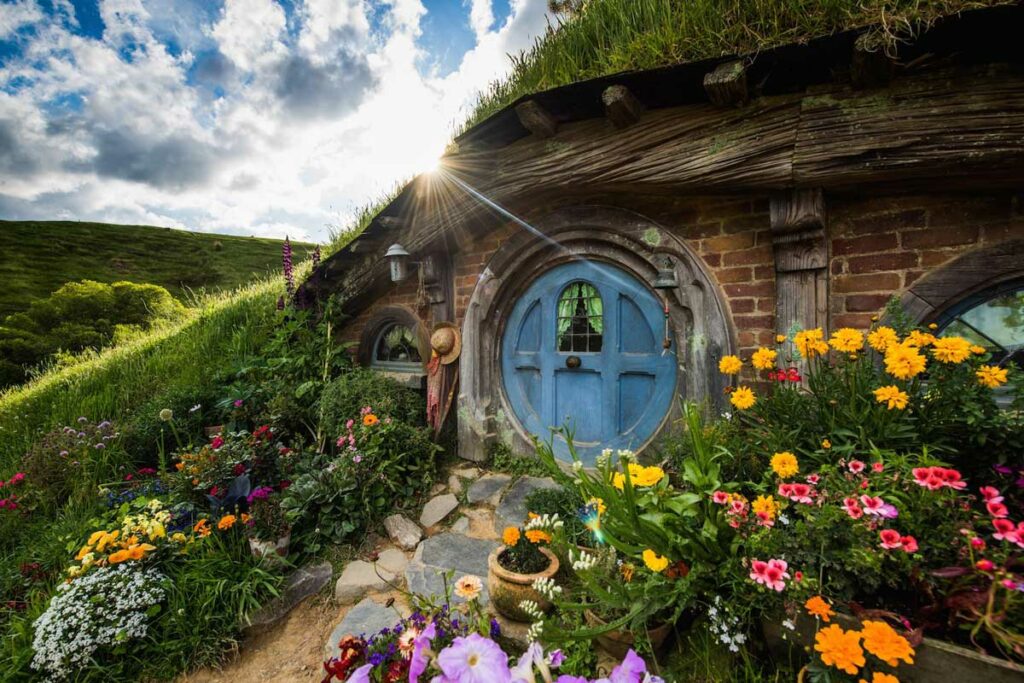
Around a decade or so into the new media age of the Internet, images of New Zealand Hobbit-holes began to be shared online. Once ubiquitous, even today they remain an image of choice for those who identify as Hobbits.

Image
These holes are fake Hobbit-holes.

From the outside they look right, but inside they are absent the long passage or corridor, going nearly but not quite straight into the side of the Hill. Instead, we find doors opening from one room to another!

Those who cannot see a Hobbit-burrow for what it is fall into a hole in the house of Tom Bombadil because they never notice the significance of the Barrow waiting for the Hobbits up on the Downs.

Fake New Zealand Hobbit-holes are not haunted Barrows, for they have no corners. But they are an intermediate step, and in practice it is found that those who begin in a fake burrow soon enough find themselves in a true barrow, though they remain as unaware of their surroundings as before.

If you are a Hobbit dwelling in a fake hole, it is not too late to get out!

But remember Bingo Bolger-Baggins in the Barrow - true Hobbits don't leave their friends in the wrong kind of hole.
Eat earth. Dig deep. Drink water.

Tree
Points: 4 777 
Posts: 3136
Joined: Sun May 17, 2020 7:54 pm
Well, that is the end of that. The end of all tricks. Now we have to wait for the Critical Notice. Hopefully early in the New Year.
Last edited by Chrysophylax Dives on Sun Jan 14, 2024 3:44 pm, edited 2 times in total.
Eat earth. Dig deep. Drink water.

Arien
Arien
Points: 2 417 
Posts: 1982
Joined: Thu May 07, 2020 8:56 pm
I am sorry to say I haven’t managed to read the commentary yet :lol: I haven’t found it anywhere! Am I searching in the wrong spots?
cave anserem

Newborn of Imladris
Points: 792 
Posts: 312
Joined: Sun May 17, 2020 10:25 am
@Chrysophylax Dives Thank you I have now accessed 'A hobbit's guide to stairs.' Sorry for long absences, I am still hard at work on my novel and have had family visiting. Wet weather has returned so I should have more time with my computer as I can't do the gardening! I will read up the guide asap. :smile:
Remembering halfir by learning something new each day

Tree
Points: 4 777 
Posts: 3136
Joined: Sun May 17, 2020 7:54 pm
@Saranna you warm the cockels of my heart. I do miss the English rain. Here we have a few more weeks before the rain comes. So now it is all brown and scorched and the snakes are still out and about. Within a few weeks after the rains begin it turns green and flowers sping up everywhere. My life is lived in winter but endured in summer.
Eat earth. Dig deep. Drink water.

Tree
Points: 4 777 
Posts: 3136
Joined: Sun May 17, 2020 7:54 pm
Silky Gooseness wrote: Mon Sep 18, 2023 7:02 pm I am sorry to say I haven’t managed to read the commentary yet :lol: I haven’t found it anywhere! Am I searching in the wrong spots?
I probably sent it to my blood-drinking ghost account instead of the plaza Admin email that i had thought i used. i'll check my email spots and see if i spot a lurking gollum.

as i step out of this floor of the Guide, i did want to say to you two things, Goose.
1. i am actually sorry i did not check in with you before starting the Guide on Lore - i confused Drifa's tribute rank for admin status. also perhaps i should have checked before moving it out of Lore? i did mean to check with the Amins on all of this but i so enjoyed talking with you that i forgot about your admin hat.
2. i don't know if you have looked at the online guide, but so much of it is yours i feel embarrassed. the blurb that begins with Luthien is only one instance. also, the whole cover story of Adamanta and Albus, while Adamanta Chubb steps out of Drifa's master riddle of some while back, the vision of the Folly on the Hill came to me as i read your folklore OP. And much more. In fact, talking with you was much better than writing it, which is part of why i put a halt on writing it. i don't feel a footnote thanking you is sufficient, but don't know what to propose. if you have a wish let me know.

Perhaps the Cirith Ungol proposal was a bit premature? One does not just walk into Mordor with Sam, one also has Gollum as a guide.
Eat earth. Dig deep. Drink water.

Arien
Arien
Points: 2 417 
Posts: 1982
Joined: Thu May 07, 2020 8:56 pm
Chrys, do not worry at all! I am delighted you forgot my admin hat: it is only of use when I am actually called upon to do some admin tasks. Re-filing your thread seems sensible to me. Also, I’m delighted to be referenced as a footnote in your online guide! You’re putting the work in of collation and the discussion has been a great deal of fun, so thank you for facilitating it.
cave anserem

Tree
Points: 4 777 
Posts: 3136
Joined: Sun May 17, 2020 7:54 pm
There was a footnote. Then it vanished.
Last edited by Chrysophylax Dives on Sat Jan 06, 2024 12:02 am, edited 1 time in total.
Eat earth. Dig deep. Drink water.

Tree
Points: 4 777 
Posts: 3136
Joined: Sun May 17, 2020 7:54 pm
By the way, not that anyone asked, the 'blinding flash' on the broken staircase is an illustration from the excellent Kidnapped (1886) by Robert Louis Stevenson (of Treasure Island fame). Note the name of the illustrator as signed: W. Hole. Surely a Hobbit?
Eat earth. Dig deep. Drink water.

Newborn of Imladris
Points: 792 
Posts: 312
Joined: Sun May 17, 2020 10:25 am
@Chrysophylax Dives I wish I could share some of our rain with you! I have been a bit unwell the last 5-6 days so have still not read the document I was clamouring for. I hope to get to it shortly. I have however realised how significant the point is that hobbits don't go in for stairs. It makes me grasp more clearly how terrifying the whole climb up the Straight Stair and the Winding Stair must have been. Previously when Sam crossed the rope bridge over Celebrant his main impression seems to be one of being at a great height: 'Sam shuffled along, clutching hard, and looking down into the pale eddying water as if it was a chasm in the mountains.' How much more horrifying must the sense of increasing height ahead/depth behind have been on those stairs to the one place they had to get to, but but wished not to? (No matter how often I read that, climb, I still Feel giddy myself!)
Remembering halfir by learning something new each day

Arien
Arien
Points: 2 417 
Posts: 1982
Joined: Thu May 07, 2020 8:56 pm
I have finally managed to look through “the road goes ever on”, sharing courtesy of Chrysophylax, who suggested we look a bit more deeply at the linguistics. The essay suggests it’s in iambs, although it felt a bit more lilting to me -

A Elbereth Gilthoniel
^ - ^ ^ ^ -^ ^

^ for unstressed - for stressed

rather than

^ - ^ - ^ - ^ -

all of which is to say, it feels more lilting, than a march

But the note in the essay also gives some guidance on stressors, which are usually on the first syllable of the word (following Old English naming conventions i guess?) At any rate, it feels less a marching chant than lullaby.

Lots of parallels drawn in the words as well: the choices are clearly very deliberate. The translation uses phrases such as “on high”… “from afar”… “sundering sea” - great distance is evoked, and no sign of how to cross it: except via this hymn. Elbereth hears this hymn. Song crosses great distances, as we already know: how do Sam and Frodo find each other in the tower of Cirith Ungol? Via song. A hymn, in fact.

So what bridges a far distance: prayer?
cave anserem

Tree
Points: 4 777 
Posts: 3136
Joined: Sun May 17, 2020 7:54 pm
i'm just going through marking a few things in the text.

1. penna - slants down
i was wondering if this slanting down relates to the Morgal Vale slanting up?

2. Fanuilos - a word to analyze when discussing the gender of the Ainur, but also if pondering how Hobbit eggs pop into the world of the Silmarillion. If i follow the early HoMe drafts correctly, the notion of the veil that is visible that covers the spirit of the Valar was not quite the same before LotR. (I may be wrong on that). Fanuilos is an ultimate egg diagram! (i mean i would love to be able to do an egg diagram to illuminate the meaning of the word, but would not know how to begin).

3. A tiro - look towards (watch over) [this is Sam's invocation]
this was what really hit me. here we have an intimation of Tirion in Valinor as the ultimate opposite of the Dark Tower in Mordor. And we discover that behind this story that appears to all about the Evil Eye that wishes to see your thoughts and enslave you, appears to be a model of its opposite.
6. The stem TIR, 'to look at towards), watch, watch over', occurs in Q. palantír and in Tirion, 'great watch-tower'.
In other words, we discern here the symmetrical model that actually structures LotR but is hidden because the 'white tower' is always a mysterious token - Gondor in the story, the Elf-tower of Frodo's dream on the margin of the story, which are - i don't know the correct word, maybe - representatives (?) of the white tower that never appears anywhere in the story. Our author knows exactly what he was doing (though i don't think he did before his story arrived at Lorien - it was through Galadriel that he worked it all out).

4. The account of what Gildor and his Elves likely saw in the Elf-tower seems contrived, as in, why is he telling us this? I think Tolkien was trying to point people to the precise image of Elbereth 'standing on the mountain' and - only then - addressed as Fanuilos. My instinct is that this image is to be contrasted with the Eye in the Dark Tower to reveal the proper relationship between two eggs (mutual vision of insides without possessiveness) - as circled with Frodo and Galadriel - as the model out of which is drawn the twisted relationship between two eggs that the One Ring is all about.
Last edited by Chrysophylax Dives on Wed Sep 27, 2023 7:07 am, edited 1 time in total.
Eat earth. Dig deep. Drink water.

Tree
Points: 4 777 
Posts: 3136
Joined: Sun May 17, 2020 7:54 pm
Silky Gooseness wrote: Tue Sep 26, 2023 7:15 pm Song crosses great distances, as we already know: how do Sam and Frodo find each other in the tower of Cirith Ungol? Via song. A hymn, in fact.
So what bridges a far distance: prayer?
If (as i think we should) we call 'prayer' that which crosses the great distance from the tower of Cirith Ungol to Varda on the mountain, then i think the next step might be to clarify the nature of this distance - because when it hits the sundering sea it is not quite the same. I think we need to introduce also the notion of time as well as distance.

Here is the framework that i have worked out:

The Second Age ends when the world is made round as Númenor falls, the cosmos is bent into a globe and so the Straight Road to Valinor is lost.

So the Third Age = the age of the round world, as our own; we are in History, a world that has left behind the reality of Myth.

But it turns out that a residual elvish enchantment remains, bound up in a strange communication by vision, which can still pass over the sundering sea (Elendil's Stone) and, with the Seven Seeing Stones, utilize this enchanted elvish vision within Middle-earth.

And with the Rings of Power it is discovered that the Elves can create pockets of First Age reality, as Galadriel does. So Hobbits in the round world of the Third Age can still step into full-blown Elvish enchantment.

I give enormous importance to the footnote in Appendix A that tells us about the Seeing Stone in the western Elf-tower, most of all in the detail that this Stone of Elendil was removed and taken back over the sea in the fairy-ship that takes Frodo et al.

The story of the War of the Ring seems to be (or to have become) a vision of the ending of an age of residual enchantment intermediary between the First Age, when the Elves are here in our Great Lands and the disenchanted historical world from which the Elves have all faded.

So just underlining time as well as space as key elements here, and suggesting that this prayer is like a lightening flash that momentarily reveals the whole world all around (from one mountain to the other).
Eat earth. Dig deep. Drink water.

Tree
Points: 4 777 
Posts: 3136
Joined: Sun May 17, 2020 7:54 pm
From Cave notes:

List of occasions in which Elbereth is mentioned.

Shire: Gildor Inglorion - the Elves sing a hymn, but (crucial, i think) Gildor says to Frodo:
But my heart forbodes that, ere all is ended, you, Frodo son of Drogo, will know more of these fell things than Gildor Inglorion. May Elbereth protect you!’
On Weathertop

At the Ford

Then Rivendell - Hall of Fire ('The Road Goes Ever On' is a bit weird here. Ostensibly, this is the song that is being commented on. But actually it seems Tolkien wants to circle Gildor Inglorion and that song - which i think is not about far-seeing and watching over at all!)

Then Legolas cries the name of Elbereth on the Great River, when a Nazgul first flies overhead - a moment of sudden dread.

Next is Sam's 'invocation' - in the fight with Shelob.

'Elbereth' is then the password used by Sam and Frodo in the hidden (ladder-reached) high chamber of the tower.

The Watchers (I think this is crucial): Sam uses Galadriel's phial and cries to Elbereth, Frodo says something else in Elvish (i cannot understand it)

And then at the Grey Havens - the first song of Gildor Inglorion repeats as the last Elves take the last ship with two Hobbits.
Eat earth. Dig deep. Drink water.

Tree
Points: 4 777 
Posts: 3136
Joined: Sun May 17, 2020 7:54 pm
in terms of egg-meetings, that of Frodo and Gollum is peculiarly intreresting (i had not thought about it much before). there is a strange mutual vision between them, in which the Ring corrupts everything and yet the two still see each other for who and what they are.

This really a digression, but i am looking at a forthcoming book 'Pity and the One Ring' by Tom Hillman, which is very useful in considering the relationships between the 3 Hobbits. The book prompted me to look at Gollum's entrance:
Down the face of a precipice, sheer and almost smooth it seemed in the pale moonlight, a small black shape was moving with its thin limbs splayed out. Maybe its soft clinging hands and toes were finding crevices and holds that no hobbit could ever have seen or used, but it looked as if it was just creeping down on sticky pads, like some large prowling thing of insectkind. And it was coming down head first, as if it was smelling its way. Now and again it lifted its head slowly, turning it right back on its long skinny neck, and the hobbits caught a glimpse of two small pale gleaming lights, its eyes that blinked at the moon for a moment and then were quickly lidded again.
Do you think this is a sort of twisted inversion of Lúthien's descent? (Not sure quite what i mean by that question.)
Eat earth. Dig deep. Drink water.

Arien
Arien
Points: 2 417 
Posts: 1982
Joined: Thu May 07, 2020 8:56 pm
Re Gollum and Lúthien descending:

1) Both make their descent without stairs: both, because there are no stairs. Gollum is in a place of cliffs without stairs - the only aid is the Elven rope, which he shuns and fears, and which in any case Sam has taken with him. Luthien is in a tower as a prisoner, and the ladder has been deliberately taken away.

2) They both use their bodies: Luthien uses Elvish craft, which Gollum utterly rejects. Luthien has Elven rope as Sam did: crafted from her own hair; i.e. made from her body, but she refines it and creates the rope (subcreation)? In contrast, Gollum’s descent uses the skill of his body in climbing, which is described in deliberately beastly terms, like a large and prowling insect.

3. Both seek a treasure taken from them. Gollum seeks the Ring. Luthien seeks Beren, and what they both call require for the fulfilment of their dream: the Silmaril.
cave anserem

Tree
Points: 4 777 
Posts: 3136
Joined: Sun May 17, 2020 7:54 pm
Silky Gooseness wrote: Tue Sep 26, 2023 7:15 pm So what bridges a far distance: prayer?
Was reading Tolkien's late lecture on Sir Gawain and the Green Knight and found the following (original emphasis):
How does Gawain find the castle? In answer to prayer. He has been journeying since All Hallows. It is now Christmas Eve, and he is lost in a wild country of tangled forest; but his chief concern is that he should not miss Mass on Christmas morning. He was

troubled lest a truant at that time he should prove
from the service of the sweet Lord, who on the selfsame night
of a maid became man our mourning to conquer,
And therefore sighing he said: 'I beseech then, O Lord
and Mary who is the mildest mother most dear,
for some harbour where with honour I might hear the Mass
and thy Matins tomorrow. This meekly I ask,
and thereto promptly I pray with Pater and Ave and Creed.'


It is when he has so prayed, and made an act of contrition, and blessed himself thrice with the sign of the cross, that he suddenly catches sight through the trees of the beautiful white castle, and rides on to a courteous welcome, and the answer to his prayer.
What especially strikes me about this passage is that Tolkien in Lorien gives a similar kind of story but in terms of wish - when Sam and Frodo declare a wish to see Elf-magic (Sam) and to see the Lady again (Frodo) and Galadriel immediately appears. And it is the same theme also of the prayer/wish delivering more than the speaker had thought to be asking for. Sam sees the Shire being destroyed and wishes he had not and Frodo 'sees' Galadriel's inner heart. In the Gawain story, the castle is indeed a place where Gawain can celebrate Christmas, but it is also the home of the Green Knight and his Lady, and so the site of Gawain's three days of temptation.

So how to distinguish between prayer and wish?

Incidentally, I find the notion of Christ as conquering mourning deeply significant given that a spirit of mourning is the keynote of the whole of Beowulf, which I am sure Tolkien sees as cast in the image of the Old Testament, with the coming of the good king at the very beginning the only hint of a miracle - and this indeed captures the historical 'age' in which Beowulf is supposed to be set: the miracle of the past is already half-forgotten, and there is no hope of another.

Also, comparing the monsters of Beowulf and Gawain is interesting. Tolkien insists that Beowulf is the origin of the story of the Christian knight. But the monsters are now different. The Green Knight makes deals - you cut off my head, and then in a year I have a go at yours, I go hunting and you stay here and we give each other all we have won at the end of the day. The monsters of Beowulf would never make a deal. One sees here, I think, how Gollum was never in origin a real northern monster (like goblins or dragon) because the essence of his interaction with Bilbo is a deal.
Last edited by Chrysophylax Dives on Fri Nov 24, 2023 9:08 am, edited 2 times in total.
Eat earth. Dig deep. Drink water.

Tree
Points: 4 777 
Posts: 3136
Joined: Sun May 17, 2020 7:54 pm
Seeing as the Guide is back at the top of the pile for a time, thought I might remind everyone that we are waiting for the Critical Notice.
Last edited by Chrysophylax Dives on Sun Jan 14, 2024 3:45 pm, edited 1 time in total.
Eat earth. Dig deep. Drink water.

Tree
Points: 4 777 
Posts: 3136
Joined: Sun May 17, 2020 7:54 pm
The Case of the Vanishing Footnote.
Last edited by Chrysophylax Dives on Sat Jan 06, 2024 12:03 am, edited 1 time in total.
Eat earth. Dig deep. Drink water.

Tree
Points: 4 777 
Posts: 3136
Joined: Sun May 17, 2020 7:54 pm
Nothing happened on the case of the vanishing footnote (yet).
Last edited by Chrysophylax Dives on Sat Jan 06, 2024 12:03 am, edited 1 time in total.
Eat earth. Dig deep. Drink water.

Locked